In celebration of Sonia’s birthday today, this documented timeline of newspaper references comes to a fitting conclusion. The first installment of Sonia H. Greene in the Press focused primarily on the “Greene years”, covering her participation in amateur journalism, her marriage to—and later divorce from—H.P. Lovecraft, and the period leading into her later years after Lovecraft. That installment has recently been updated with two newly located advertisements from 1924 in which Lovecraft and Sonia offered her piano for sale.
This second segment begins with Sonia’s return to amateur journalism and continues through the years in which she emerged publicly as the former Mrs. Lovecraft. Included here is the complete transcript of the 1948 memoir, Howard Phillips Lovecraft as His Wife Remembers Him.
While this two-part timeline brings together the presently known newspaper references of Sonia, the record remains open and will be updated as additional clippings come to light.
I again wish to thank Bobby Derie for generously sharing several of the clippings included throughout this documented record of Sonia in the Press.
Table of Contents:
- June 1948
- August 1948
- September 1948
- October 1948
- May 1949
- July 1949
- October 1949
- December 1949
- January 1950
- November 1952
- January 1955
- June 1955
- December 1955
- May 1958
- June 1959
- July 1959
- September 1959
- November 1959
- March 1962
- August 1962
- September 1962
- July 1963
- Date Unknown
June 1948
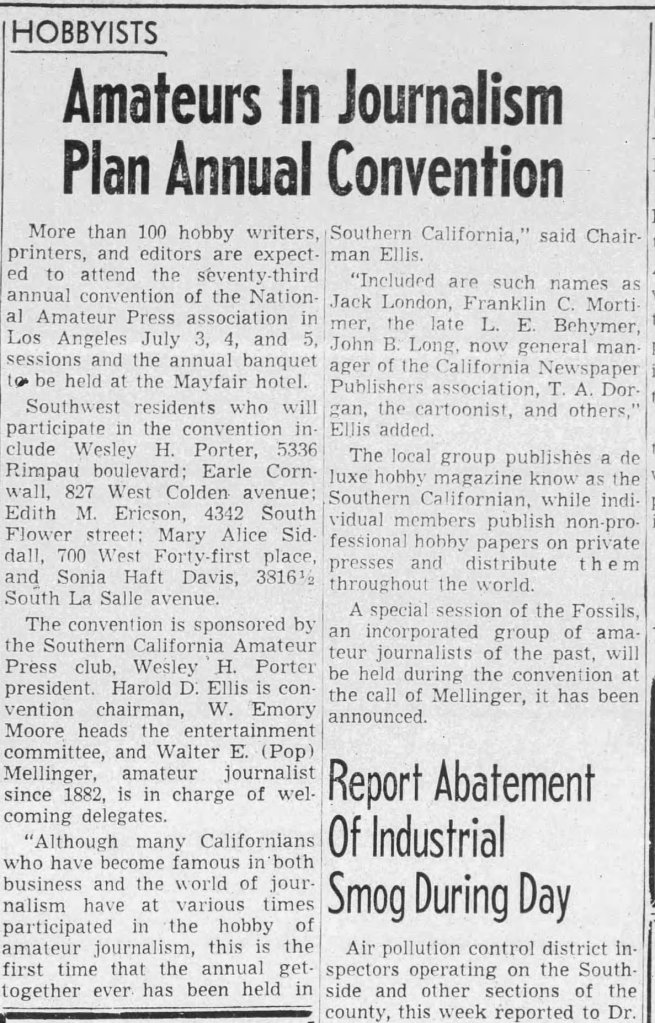
Amateurs In Journalism Plan Annual Convention
HOBBYISTS
Amateurs In [sic] Journalism Plan Annual Convention
More than 100 hobby writers, printers, and editors are expected to attend the seventy-third annual convention of the National Amateur Press association [sic] in Los Angeles July 3, 4, and 5, sessions and the annual banquet to be held at the Mayfair hotel.
Southwest residents who will participate in the convention include Wesley H. Porter, 5336 Rimpau boulevard; Earle Cornwall, 827 West Colden avenue; [sic] Edith M. Ericson, 4342 South Flower street; Mary Alice Siddall, 700 West Forty-first place, and Sonia Haft Davis, 3816½ South La Salle avenue. [sic]
The convention is sponsored by the Southern California Amateur Press club, Wesley H. Porter president. Harold D. Ellis is convention chairman, W. Emory Moore heads the entertainment committee, and Walter E. (Pop) Mellinger, amateur journalist since 1882, is in charge of welcoming delegates.
“Although many Californians who have become famous in both business and the world of journalism have at various times participated in the hobby of amateur journalism, this is the first time that the annual get-together ever has been held in Southern California,” said Chairman Ellis.
“Included are such names as Jack London, Franklin C. Mortimer, the late L. E. Behymer, John B. Long, now general manager of the California Newspaper Publishers association, T. A. Dorgan, the cartoonist, and others,” Ellis added.
The local group publishes a deluxe hobby magazine know [sic] as the Southern Californian, while individual members publish non-professional hobby papers on private presses and distribute them throughout the world.
A special session of the Fossils, an incorporated group of amateur journalists of the past, will be held during the convention at the call of Mellinger, it has been announced.
August 1948
Next Sunday’s Book Page
NEXT SUNDAY . . .
Howard Phillips Lovecraft
AS HIS WIFE REMEMBERS HIM
BY SONIA H. DAVIS
In her intimate story written especially for the Providence Sunday Journal, Sonia H. Davis—Mrs. Lovecraft from 1924 to 1929—sheds considerable light on a personality about which there has been much mystery and speculation.
Here, for the first time, is the fascinating story of Howard Phillips Lovecraft, Providence eccentric, semi-recluse and horror story writer until his death in 1937, whose posthumous fame has become international, and whose collection of weird tales now brings high prices in the rare book markets.
Next Sunday’s Book Page
THE PROVIDENCE SUNDAY JOURNAL
Howard Phillips Lovecraft as His Wife Remembers Him
Bookman’s Galley
IN THE accompanying article the woman who was once Howard Lovecraft’s wife emerges from silence, even from considerable mystery as to her whereabouts, and for the first time speaks out. In the field of Lovecraftiana, it is an article of the very first importance. Nevertheless it is not designed to stand quite self-sufficiently, and so I want to make Bookman’s Galley today a brief Foreword.
Lovecraft was born here in Providence 58 years ago this August 20 just past. He died here in March, 1937. Boy and man he was an over-mothered, over-protected, somewhat neurotic, shy and brilliant eccentric. His weird tales of the supernatural brought him little notice in his lifetime, but in recent years Lovecraft’s fame has become international.
This has been due to three developments. First, of course, the publication of Lovecraft’s stories in two huge collections by August Derleth’s Arkham House: “The Outsider” and “Beyond the Wall of Sleep.” Second, a simultaneous spurt of writing about Lovecraft, himself a strange and fascinating personality. And third, a general increase of reader interest in the weird, or horror, story.
Paper-book selections of his work, reprints of stories in many anthologies, residual publication of Lovecraft material, promise of his “Letters” yet to come from Arkham House: these have filled out the posthumous reputation. Collectors have paid between $50 and $100 for a copy of “The Outsider”—that highest priced being, as Anglophilic H. P. L. would delight to know, in England.
For general Lovecraft biography, any unfamiliar reader may refer to Derleth’s little book, “H. P. L.: A Memoir,” published by Ben Abramson, and to my article, “His Own Most Fantastic Creation,” published in the Lovecraft addenda-volume called “Marginalia” (Arkham House). At the John Hay Library, Brown University, is a constantly extended H. P. L. collection.
Now, as to Sonia Davis’ [sic] personal memoir. It is precisely that. It is her version. Perhaps—I do not know—it will not prove unassailable in every point. Certainly it corrects much that has been written about Lovecraft. It further and consistently enriches what we already know of his personality. It offers new material on his family and financial affairs. Above all it tells the story of his marriage of which until now little has been known beyond the astonishing fact that so diffident a person did marry.
Long ago I said in print that if the one-time Mrs. Lovecraft could be discovered and persuaded to tell her story it would be of inestimable value. Now at last this has happened. And we have here, I think, not only the expected valuable addition to Lovecraft biography but a story which is in itself unexpectedly moving.
W. T. S.
Her Memoirs of the Providence Writer of Horror Stories Now First Published
Woman Who Knew Him Best Tells of Their Strange Marriage and Difficult Years
By SONIA H. DAVIS
(the former Mrs. H.P. Lovecraft)
Howard Phillips Lovecraft and I met in 1921 and we were married at New York in March 1924. What follows here may to all intents and purposes be called the true story of his private life. It differs somewhat from that given by most of his biographers.
For instance, I have recently read the late W. Paul Cook’s “In Memoriam: Howard Phillips Lovecraft.” As far as it goes it is a very interesting and worthy eulogy of a truly great person. But it contains—as do other accounts—several misconceptions about Howard’s life, and especially of events in the years 1921–1932 of which no one but myself knows.
Of various early incidents in his life, not generally repeated to others, Howard himself told me. Of other incidents I speak from my own experience while still his wife; some of these arc of a very personal nature.
First Meeting
I first met Howard Lovecraft at a Boston convention of the Amateur Journalists. I admired his personality but, frankly, at first not his person.
As he was always trying to find recruits for Amateur Journalism, he offered to send me samples of work—his own and others’—which appeared in the different amateur journals; non-paying little papers and magazines, privately printed and circulated. From then on we kept quite a steady correspondence, and I felt highly flattered when he told me in some of his letters that mine indicated a freshness not born of immaturity but rather a “re-freshingness” because of the originality and courage of my convictions when I disagreed with him.
I disagreed often; not just to be disagreeable: if possible I wanted to remove some of Howard’s intensely fixed ideas.
During many months of correspondence H.P. mentioned the names of several writer-friends, many of whom he knew through letters only. One of these whom he particularly lauded was Samuel Loveman of Cleveland, Ohio. “Samuelus,” Howard called him—he was always romanizing [sic] names of his friends. Howard had a great regard for Loveman and used him in the story called “Randolph Carter.”
Other Friends
When one of my business trips took me to Cleveland for the first time, I indeed found Samuel Loveman to be all the things H.P. had said about him. And at the end of my day’s work there, Loveman surprised me by calling together, at a moment’s notice almost, a meeting of all the available Cleveland amateur journalists.
At the very end of a very pleasant evening we all signed our names to a Cleveland postcard and sent it to Howard, and when I wrote him later I deplored the fact he too could not have been with us. I said his presence would have made my happiness complete for that evening. His reply, though bountifully mixed with reservations, was quite warm and appreciative—coming from him.
New York Visit
So now I had two correspondents: Lovecraft and Loveman. I decided to invite them both to New York, to meet at last, and to spend Christmas and New Years. I turned my Parkside Avenue apartment over to them. A neighbor gave me sleeping space in hers. And evenings the two men would meet me and we would go to dinner and see a play, or sometimes have a conclave of “amateur” friends—James F. Morton Jr. (who had introduced me to Lovecraft), Frank Belknap Long, Rheinhardt [sic] Kleiner and others.
Never having done such a thing before I was somewhat amazed at myself—inviting two men at my expense to be my guests. I had one excellent reason having to do with Howard’s race prejudices of which I shall speak later on.
I remember one evening we went to a fashionable Italian restaurant. It was the first time Howard had ever been in an Italian restaurant, (he was then in his early thirties), the first he had ever eaten Minestrone [sic] of spaghetti with meat and tomato sauce and Parmesan [sic] cheese. He balked at wine. He said he never had tasted any alcohol and didn’t wish to begin now.
Soon Loveman returned to Cleveland, but Howard stayed on.
My neighbor who was so kindly making room for me had a beautiful Persian cat. When Howard saw that cat he made love to it. He seemed to have a language that it understood and it immediately curled up in his lap and purred.
Half in earnest, half joking, I said “What a lot of perfectly good affection to waste on a mere cat—when a woman might highly appreciate it!”
He said, “How can any woman love a face like mine?”
“A mother can,” I replied, “and some who are not mothers would not have to try very hard.” We all laughed and Howard went on stroking the cat.
Howard’s voice was clear and resonant when he read. It became thin and high-pitched in conversation, somewhat falsetto. His singing voice, though not strong, was very sweet. He would sing none of the modern songs—only the more favored old ones.
Howard’s mother had hoped her child would be a girl, and as a baby he looked like a beautiful little girl. A photograph shows him with a mass of flaxen curls which he wore until he was about six. When at last he protested, his mother took him to the barber’s where she cried bitterly as he was shorn. (These curls were kept; Howard once showed them to me.)
Once when we were looking at an early photograph of him, he exclaimed, “And look at me now!”
His very plain face he attributed, he said, to two reasons. At 15 or 16 he fell and broke his nose when he and another boy were racing their bicycles. The other reason, he said wrily, [sic] was that nightly he would look up at the stars through his telescope. Actually, he resembled his mother very much. Though less pronounced in the womenfolk, the entire Phillips family had the prognathous jaw and the extremely short upper lip. Howard was fond of making caricatures of himself as he would appear when he became old.
Well—to return to Howard with the Persian cat—I felt that if he could be made to feel more confident of his genius as a writer and to forget his “awful looks,” as he put it, he would become less diffident and more happy. So whenever an opportunity presented itself I would not avoid giving him compliments.
When Howard, still in New York, went out with “the boys” for several evenings I realized how poignantly I missed him. I suggested that instead of his going home to Providence, we bring “Providence” to Parkside Avenue. Each of us wrote an urgent invitation to the aunts with whom he lived, Mrs. Lillian Clark and Mrs. Annie Gamwell, and Mrs. Gamwell came for a few weeks.
Return to Providence
After their return to Providence I was not ashamed to write him how very much I missed him. His appreciation of this led us both to more serious ground.
I knew Howard was not in a position to marry. Of his Grandfather Phillips’ estate there was only about $20,000 left, and that was supposed to last the rest of the lives of his two aunts and himself. Had he been less proud to write for money he need not have starved himself. He would say “I write to please myself only; and if a few of my friends enjoy my effusions I feel well repaid.”
He spent much of his time revising the atrocious work of others, for which he was paid a pittance. He would wear himself out over some of the stupid trash he was asked to revise, some of it for authors who later became well known and prosperous.
Meanwhile his letters indicated his desire to leave Providence and settle in New York. Each of us meditated the possibilities of a life together. Some of our friends suspected. I admitted to friends that I cared very much for Howard and that if he would have me I would gladly be his wife. But nothing definite was decided.
I came to America when I was nine years old, a White Russian of the old Czarist regime. In 1899, when I was 16, I married a fellow-countryman who had adopted the name of a Boston friend, Greene. My husband died in 1916. By him I have one daughter who was for several years Paris correspondent for various American newspapers. After my divorce from Howard Lovecraft I married Nathaniel A. Davis, a former professor at the University of California at Berkeley, and we were very happy during the 10 years before his death. At the time of my meeting Howard Lovecraft I held an executive position with a fashionable women’s wear establishment on Fifth Avenue. My salary was close to $10,000 a year.
More Meetings
On my business trips to Boston I would stop off at Providence and the aunts and Howard would dine with me at the Biltmore. They all enjoyed these occasions, but they thought me extravagant. The aunts would not join me in Boston but they condescended to trust Howard alone with me there. I would attend to business during the daytime, while Howard explored museums, graveyards, old houses and whatnot. At least once on each visit we would have our dinner at a Greek restaurant which H. P. favored for its tiled walls depicting scenes from Greek classics. He loved to talk to me of ancient Greece and Rome while I, in turn, considered it a great privilege after a hard day’s work to listen to him. Later he would show me the historical places in Boston and we would walk the old, narrow streets.
Once we visited Magnolia, Mass. As we walked along the esplanade there one evening we heard a peculiar snorting, grunting noise, loud in the distance. The moon made a path on the water. Emergent tops of piles in the water were connected with rope, like a huge spider web.
“Oh, Howard,” I said, “here you have the setting for a really strange and mysterious story.”
“Go ahead, and write it,” he said.
“Oh, no, I couldn’t do it justice.”
“Try it. Tell me what the scene pictures to your imagination.”
After we parted for the night I sat up and wrote the general outline which he later revised and edited. His enthusiasm next day was so genuine that I surprised and shocked him right then and there by kissing him.
He was so flustered that he blushed and then he turned pale. When I chaffed him about it he said he had not been kissed since he was a very small child. (I know he had loved his mother and he loved his aunts in a positive way, but he was not demonstrative in his affections.) He said he would probably never be kissed again. But I fooled him.
Decision to Marry
It was after that vacation in Magnolia that our more intimate correspondence began which led to our marriage. H. P. wrote me of everything he did, everywhere he went; sometimes filling 30, 40, even 50 pages with his fine writing. There were two years of almost daily correspondence. Then he decided to break away from Providence.
Early in March 1924, Howard came to New York. I had asked him to tell his aunts he was going to marry me, but he said he preferred to surprise them. In the matter of details—securing the license, buying the ring, etc.—he seemed to be jovial. He said one would think he was being married for the ‘nth time, he went about it in such a methodical way.
The man at the marriage bureau thought I was the younger. I was 7 years Howard’s senior, and he said nothing could please him better: that Sarah Helen Whitman was older than Poe, and that Poe might have met with better fortune had he married her.
I thought a civil marriage would be sufficient, but Howard insisted that we be married by a Christian minister and that the marriage take place in St. Paul’s Church—“where Washington and Lord Howe and many other great men had worshipped!” In this, as later in so many other things, I let him have his way. In nearly everything he was the “victor” and I the “vanquished.” I would gainsay him nothing if I thought it would eradicate his complexes.
Houdini Manuscript
The night before our marriage Howard absent-mindedly left in the Providence station the Houdini manuscript—that is, an article which he had ghost-written for the famed magician. It was not, as someone has said, “a public stenographer” who copied the hand-written notes which H. P. still had. I alone was able to read those crossed out notes.
I read them slowly to him while he pounded at a typewriter borrowed from the hotel in Philadelphia where we were spending our first day and night. So we spent them, and when the manuscript was finished we were too tired and exhausted for honeymooning or anything else. But I wouldn’t let Howard down, and the manuscript reached the publisher in time.
The only money Howard ever spent on me which he had earned was what he had received for that article. When I insisted only half the amount be used for a wedding-ring, he insisted the future Mrs. Howard Phillips Lovecraft must have the finest, with diamonds all around it, even if it took all the proceeds of that first well-paid story.
I called him a dear, generous spendthrift. He said there would be more where that came from—which, alas, did not materialize except in stipends when he sold a story (not too often) to Weird Tales magazine.
When we were married he was gaunt and hungry-looking, too much so even for my taste. I used to cook a well-balanced meal every evening, make a substantial breakfast (he loved cheese souffle for breakfast!), and I’d leave a few (almost Dagwoodian) sandwiches, cake and fruit for his lunch.
Sometimes he would meet me after my day’s work; we would dine out and go to a theater. He had no conception of time. Even in bitter wintry weather I often had to wait in some lobby or at some street corner from three-quarters of an hour to an hour and a half. He was always late for an appointment, whether it was with me or anyone else.
H. P. L. and Mummies
Here I must record an extraordinary story about this master of weird stories. Howard was allergic to the spices of the mummified corpses at the Metropolitan Museum. Near them, his hands and wrists became swollen. Sometime after we had left the Museum the swelling went down and we thought no more of it. But about a week later we returned to see and study as much as we could of Tut-ahn-ka-men’s tomb, and again Howard’s wrists and hands began to swell. I urged him to consult a doctor, but Howard laughed it off and refused. He never wanted to have a doctor, no matter how ill he was.
But, anyway, during our life at Parkside Avenue he became quite stout, and he looked and felt marvelous. He really became a more interesting human being. I think he half-starved himself before he knew me, and probably starved once more after we separated permanently.
I criticized his ten-year-old overcoat and insisted on buying him a new coat, suit, hat, gloves, and even a billfold; (I didn’t like the tiny, old-fashioned pocketbook he would unsnap to take out change). Looking at himself in the mirror he protested: “But, my dear, this is entirely too stylish for ‘Grandpa Theobald,’ it doesn’t look like me. I look like some fashionable fop!” And I really think he was glad when the new suit and coat were later stolen; he had the old ones to resume.
And Money
Before our marriage I tried to contribute to his ease and comfort by sending him the stamps for his voluminous correspondence, and by gifts of money at birthday and holiday times. If at any time he lacked money I did not know it, and while he was my husband I saw to it that he was supplied out of my earnings. His aunts, out of his own share of the Phillips estate, were supposed to send him $15 a week; but while I provided for him they sent only $5 and that not always regularly.
I told Howard they need not send him anything if they found it difficult, that some day he would earn more than I. In jest I used to say “You’ll pay it all back with interest, I’m sure.” And we’d both laugh about it. Often he would spend much of the money on books, for me or for some of his friends; and he sometimes gave them money. Two of the amateur brotherhood wrote him the letters of gentle grafters and he would go without things himself in order to aid them. No one knew of this save myself and his beneficiaries.
I effaced my own interests and deferred to him upon all matters and domestic problems regardless of what they were. Even to the spending of money I not only consulted him but tried to make him feel that he was the head of the house.
In Brooklyn Alone
I soon found it necessary to accept an exceedingly well-paid job out of town. I wanted Howard to make his home with me there, but he said he would hate to live in a midwestern city, he would prefer to remain in New York where at least he had some friends. I suggested he have one of them come to live with him in our apartment, but his aunts thought it wiser for me to store and sell my furniture and find a studio room large enough for Howard to have the old (and several dilapidated) pieces he had brought from Providence. It was then the Clinton Street, Brooklyn, address was decided upon.
I could be in New York only a few days at a time, every three or four weeks. I gave him money each time I came to town and I sent him weekly checks.
Racial Prejudice
He admired the quaintness of that part of Brooklyn, and at first he seemed to love his Clinton Street setup. But the crowds in the subway, streets and parks he hated, and he suffered through that hate. He referred chiefly to Semitic peoples: “beady-eyed, rat-faced Asiatics,” he called them. In general, all foreigners were “mongrels.”
Long before we were married, Howard wrote me in a letter praising Samuel Loveman that the only “discrepancy” he could find in Loveman was that he was a Jew. I replied in amazement at such discrimination and reminded him—as I did constantly—that I, too, come of Hebrew people. It was his prejudice against minorities, especially Jews, which prompted me to that simultaneous invitation of Howard and Loveman to New York of which I have spoken.
Later H. P. assured me he was quite “cured.” But unfortunately, (and here I must speak of something I never intended to have publicly known), whenever we found ourselves in the racially-mixed crowds which characterize New York, Howard would become livid with rage. He seemed almost to lose his mind. And if the truth must be known, it was this attitude toward minorities and his desire to escape them that eventually prompted him back to Providence.
Soon after our marriage he told me that whenever we had company he would appreciate it if “Aryans” were in the majority. As a matter of fact, I think he hated humanity in the abstract. He once said: “It is more important to know what to hate than it is to know what to love.” And he believed it was better to be dead than alive, best of all not to be born. It was good, he thought, to be in that state of oblivion before birth.
“Henry Ryecroft”
A better understanding of Lovecraft may be gained in reading Gissing’s “Private Papers of Henry Ryecroft,” a book Howard gave me early in the life of our romance. Throughout it elucidates much of Howard’s own personality, his attitude toward the masses and toward life in general. Non-religious and anti-democratic, Howard’s code was to let his fellowmen alone and mind his own business. As for me, whenever I protested I was one of the “alien hordes,” he would say: “You are now Mrs. H. P. Lovecraft of 598 Angell Street, Providence, Rhode Island.”
Mr. Cook quotes the line: “I … still refrained from going home to my people lest I seem to crawl back ignobly in defeat.” This is only part of the truth. He wanted more than anything else to go back to Providence but he also wanted me to come along. This I could not do because there was no situation in Providence fitting my abilities and needs. And since he was reluctant to return without me, he remained at Clinton Street, whence the foregoing cry.
I believe he loved me as much as it was possible for a temperament like his to love. He’d never mention the word, “love.” He would say, “My dear, you don’t know how much I appreciate you.” I tried to understand him and was grateful for any crumbs from his lips that fell my way.
Our family nicknames of “Socrates” and “Xantippe” were originated by me. I saw in Howard a Socratic wisdom and genius. I had hoped in time to humanize him further, to lift him out of his abysmal depths of loneliness and psychic complexes by a true, wedded love. I am afraid my optimism and excessive self-assurance misled us both. (His love of the weird and mysterious, I believe, was born of sheer loneliness.)
I had hoped, in other words, that my embrace would make of him not only a great genius but also a lover and husband. While the genius developed and broke through the chrysalis, the lover and husband receded into the background until they were apparitions that finally vanished.
It has been said—quoting letters of Howard’s—that our separation was mainly caused by his lack of money. That is not true. The real reasons my own story makes evident. Marvelous person though he was, it was probably to “save face” that Howard, having to give a reason, offered one that might be more easily believed.
When Howard felt he could no longer tolerate Brooklyn, it was I suggested he return to Providence. He’d say “If I could. . . live in Providence, the blessed city where I was born and reared, I am sure, there I could be happy.” I agreed. I said “I’d love nothing better than to live in Providence if I could do my work there.”
Providence Again
Well, he returned, and I followed him much later. Again: it is not true that his aunts “dispatched a truck which brought Howard back to Providence lock, stock and barrel.” I made a special trip from out of town to help him pack his things, to see to it all was well before he left, and to pay—his railroad fare and all—out of my own funds.
Eventually we held a conference with the aunts. I suggested I take a large house in Providence, hire a maid, pay the expenses, and we all live together; our family to use one side of the house, I to use the other for a business venture of my own. The aunts gently but firmly informed me that neither they nor Howard could afford to have Howard’s wife work for a living in Providence. That was that. I knew then where we all stood.
To be not too far from Providence where I could spend some weekends, I took a new and less well paying [sic] job in New York. (The time was now 1927.) But there was a Chicago job too good to refuse, and I knew I could have Howard meet me in New York every few weeks on my buying trips. I hated Chicago, though, and after six months—it Christmas—I decided to try Providence for a short vacation while waiting for something to happen, I didn’t know what.
Visits and Letters
I spent several weeks there. But I soon needed money, so I returned to New York, rented an apartment, retrieved from storage what was left of my furniture and set up housekeeping by myself. I opened a small millinery shop in the neighborhood.
Our marital life for the next few months was spent on reams of paper in rivers of ink. That spring I invited Howard to visit me and he gladly accepted, as a visitor only. To me, even his nearness was better than nothing. The visit lasted throughout the summer but I saw him only during the early morning hours when he would return from jaunts with Morton, Loveman, Long, Kleiner, some or all of them. Then he visited Vrest Orton at Yonkers and returned to Providence in the early fall.
Then we lived in letters again.
Howard was perfectly willing and even satisfied to live this way, but not I. I began urging divorce. He tried every method he could devise to persuade me how much he appreciated me: divorce would cause him great unhappiness; a gentleman does not divorce his wife unless he has cause, and he had none.
I told him I had done everything I could think of to make our marriage a success, but that no marriage could be such in letter-writing only.
Howard said he knew of a very happy couple whose marriage was kept intact by letters; the wife living with her parents, and the husband because of his illness living elsewhere.
I replied that neither of us was really sick and I did not wish to be a “long-distance” wife. I told him it was all impossible, that he ought to divorce me and find and marry a young woman of his own background and culture, live in Providence and try to live a happy, normal life.
“No, my dear,” he would say, “if you leave me I shall never marry again. You do not realize how much I appreciate you.”
“But your way of demonstrating,” I would reply, “is so unheard of!”
Divorce
The divorce came in 1929. On a friendly but impersonal basis we occasionally corresponded.
In 1932 I went to Europe. I was almost tempted to invite him along, but I knew he would not accept. However, I wrote him from England, Germany and France, sent him books and pictures of every conceivable thing I thought might interest him. And I sent him a travelogue which he revised for me.
Final Meeting
After my return to the United States I was quite ill. On recuperating, I went to Farmington, Conn. I was so enchanted by the 18th century beauty of it that I wrote Howard at once to join me there, which he did. We explored the town and also Weathersfield. [sic]
I believe I still loved Howard very much, more than I cared to admit even to myself. Although in my travels I had met many eligible men and some offering proposals of marriage, for eight years I met none who did not seem inadequate in intellect compared to Howard. When we parted for the night I said, “Howard, won’t you kiss me goodnight?” He said “No, it is better not to.”
The next day we explored Hartford, and when we parted that night I no longer asked for a kiss. I had learned my lesson well.
I never saw Howard again.
H. P. L’s Death
Off and on we still corresponded, after I moved to California. Here I soon met and married Dr. Davis. It was here, too, I met Mr. Wheeler Dryden who told me of Howard Lovecraft’s death.
I do not believe it an exaggeration to say that Howard had the mind, taste and personality of a much greater artist and genius than that with which he was accredited in his lifetime. He will be I am quite sure a legendary, mysterious figure. The irony is that he died before the rewards and celebrity of his labors occurred. I like to believe that time mellowed him, that he found other men of all sorts to be normal, kindly folk. And even though I am not his widow, I mourn in sorrow and reverence his untimely passing.
(Copyright, 1948.
The Providence Journal Co.)
Writer of the Uncanny
Editor:
I read the Sonia H. Davis article on H. P. Lovecraft on the book page of the Aug. 22 Sunday Journal. I thank Mrs. Davis for giving us her impressions of one of the finest writers Providence has ever produced. My husband and I knew Lovecraft so well that we often visit his grave at Swan Point Cemetery in memory of a very dear friend and a gentleman of the “old school.”
Often, we typed Lovecraft’s manuscripts, finding it a joy to assist this prolific writer of the weird and uncanny. Lovecraft lived in a world of his own making, a sort of “dream world” where night became day. Most of his writings were accomplished at night. Providence was Lovecraft’s first, last and only real love in my opinion. He derived his inspiration from Providence’s little-known alleys, back streets and ancient burying grounds. We knew Lovecraft I really believe, better than anyone else (outside of his two aunts), and no finer gentleman ever lived. I feel safe in saying, than this man who just could not reconcile himself to married life, perhaps because his writing meant his entire life to him.
MRS. MURIEL E. EDDY.
Providence.
September 1948
Bookman’s Galley
I HAVE a note from the Chicago writer Vincent Starrett on Sonia H. Davis’ [sic] “fine article,” “Howard Phillips Lovecraft As His Wife Remembers Him,” which was published here on Aug. 22. Mr. Starrett says “I can much pleased—it is a notable news beat in a way, and I congratulate you.”
. . . Albert E. Lownes of Providence writes “The story was a corker. I don’t recall its equal since Sara Helen Whitman decided to “tell all” about Poe—and Sarah Whitman was tied down by Victorian reserve.” . . . And the eminent Poe scholar Thomas Ollive Mabbott is thankful for “that very important article. I do not think her statements controversial; her story fits in with the general picture. And the one thing disputed that is at all important—just how he left New York—she is more likely to be right about than anyone else. As to his statement that the principle trouble was his lack of money—her interpretation is I think correct. He must have felt embarrassed at his position, men whose wives finance them do, and he probably was too polite ever to tell her that he felt this deeply.”
Oddly enough, the very first people to write me were associates in these group where H. P. Lovecraft first made his literary contacts, including Sonia H. Greene who became his wife. Mrs. Nita Gerner Smith of Point Pleasant, N.J., and Michael Phelan of Plainfield, Conn. Mr. Phelan wants me to say something about amateur journalism. He writes: “There are, in fact, three major amateur press associations in the U.S. today: the National, the United, and the American Amateur Press Association. All are non-profit and organized for the greater personal enjoyment and amateur journalism. The members vary widely in age, in financial standing, in ability . . . Chief means of operation is for writers to send their stuff to those who print and/or publish. Once a journal is published, the printers send them to an elected mailer who monthly mails a bundle of all submitted journals to each member.”1
In more critical veins there are comments from Bill Powers and Elliot Paul. . . . Bill Powers is a composing room friend of mine who really puts this page together in its zinc and lead state. Said he: “She’s a fine-looking woman. And here where it says she asked him to kiss her goodnight, and he wouldn’t—why, the s.o.b. I wish I’d been standing right behind him!” . . . Let me say parenthetically that Mr. Paul reports (from Cranston, where he is living at present) that he is now completing the autobiographical volume which will follow his recently published “The Ghost Town on the Yellowstone,” and that “it is made up of my recollections of the Louisville of 1909 and 1910.” But he was modestly enough writing me primarily about the Lovecraft piece. He says: “I want to thank you for the service rendered to life and letters in publishing Mrs. Lovecraft’s piece about her late husband. His work was not of the kind I enjoy very much because it always seemed strained and artificial, Nature contains enough horror and any attempt to drag it in from outside the boundaries is sure to fail. Lovecraft’s prose reminded me of a cart overloaded with bananas but his personality as revealed by his wife, thanks to you, has grown in significance. The author out-horrors his own lugubrious creations. Wasn’t he a bit like Harry Lehr but ingrown instead of an exhibitionist?”
I’ve received some personal reminiscences about Lovecraft which I shall print next Sunday. But today let me wind up with excerpts from a long letter from Lovecraft’s editor and publisher, August Derleth:
“On the whole,” he says, Mrs. Davis’ [sic] memoir “would appear to be innocuous enough, but I am afraid that in various places the impression it gives is distorted and not in accordance with facts. I am most disagreeably impressed by Mrs. Davis’ [sic] writing that ‘Howard would become livid with rage. He seemed almost to lose his mind.’” (That is, upon confronting foreign-born Americans en masse in New York.) “Now,” Derleth continues, “it is the considered opinion of all others who have known HPL that, though he resented the infiltration of foreign elements into old areas of the cities he loved, and the often consequent despoiling of those places particularly of their antiquities and charm, he was not in fact guilty of any actual anti-Semitism. As for his being ever in a state of ‘livid rage’ that, I feel, is a gross exaggeration of the worst kind; his letters testify that whatever he did, he was a gentleman. . . .
“It is therefore absolutely incredible either that HPL ever was ‘livid with rage,’ that he ‘seemed almost to lose his mind,’ or that he ever said to anyone the statement Mrs. Davis attributes to him: ‘It is more important to know what to hate than it is to know what to love.’ I can positively refute these statements by drawing upon the Lovecraft letters to show in his own written words thoughts and concepts directly contrary to any such idea. Lovecraft was absolutely incapable of hate. . . .
“We have evidence to show in the Lovecraft letters that he was often in the habit of making disparaging remarks about Jews, Orientals, Portuguese, etc., etc., but these remarks cannot be construed as racial prejudice in the vicious sense in which it exists today. Furthermore, these views were tempered and vanished in his later letters; during his last 20 years he is seldom found to make any such remarks. . . .
“Mrs. Davis writes of how much money she gave HPL. The impression she makes is that she contributed very largely to his support, and that Howard earned nothing, and that his aunts sent him nothing. His aunts unfortunately are dead, and cannot answer for themselves. BUT—Howard had no less than 22 stories, several reprints, and anthology representations published in the period of his marriage, 1924–1929. Mrs. Davis mentions only one rewrite story. At the same time, he revised (for others) voluminously. . . . AND ALSO—there are in our possession the Lovecraft letters to his aunts, in which he thanks them for things they have done for him; these do not quite jibe with the statement that he was sent only $5.
“We had hoped to keep out of the ‘Selected Letters’ some of the references to HPL’s married life; but publication of Mrs. Davis’ [sic] article now makes it necessary for us to refute some of the aspects of what is otherwise an interesting document.
“Despite these differences, I think it is good that Mrs. Davis’ [sic] article saw the light of day. . . . It carries with it, too, the feeling that HPL did not know Mrs. Davis was a Jewess until she told him. But one of the things about HPL’s married life that distressed him from the beginning was the way in which his wife often talked in longer conversations on the telephone in Jewish, so that he never know what she talked about, whether of him, their life together, or what, and the incidence of these long talks often persuaded him that he was the subject of the conversation.”
The letters Mr. Derleth refers to are, of course, still published and he has not quoted from them in his own letter; in other words, my excerpts have dropped only further explication of Derleth’s main points; and that I’ve had to do because of that old devil space.
W. T. S.
October 1948
Bookman’s Galley2
FOR the time being, let us wind up discussion of Howard Phillips Lovecraft: for the dangers of turning even interesting subjects stale by over-production are very real dangers. Today I turn the column over to Sonia H. Davis, the one-time Mrs. Lovecraft, whose reminiscences of H.P.L., published here last Aug. 22, have inspired so much pro and con correspondence.
—W. T. S.
Through the columns of the Providence Journal, I would like to think the many letter writers for their kindly and interesting remarks regarding my article on H. P. Lovecraft.
As to Mr. Derleth’s cutting and insolent remarks, it were best to ignore them. But lest some of his remarks be given credence (of course even a “gentleman” is privileged to call a “lady” a liar even when she tells the truth.) I must insist that everything in that article is as stated: on this I take my solemn oath. For the sake of the kindlier critics, let me say that, to the best of my knowledge, Mr. Derleth never even met Lovecraft. So he could not have known H. P. L. as I did.
Since I do not wish to involve any one else, I shall not mention the name of the best witness I have—one of his own friends and correspondents—that upon many occasions Lovecraft would become livid with rage; (even when not in my company) when anything was said or when meeting and seeing people he didn’t like, especially foreigners.
Mr. Derleth’s own admission, quote: “It is the considered opinion of all others who have known H.P.L. that though he resent the infiltration of foreign elements into old areas of the cities he loved and the often consequent despoiling of those places particularly of their antiquities and charm he was not in fact guilty of any actual anti-Semitism” etc. does testify that he was more than unfriendly toward most foreigners except the English, i.e., the British born.
I reiterate again on my solemn oath, that when he became “livid with rage” at the foreign elements in the streets of New York, I would try to calm his outburst by saying “You don’t have to love them, but hating them so outrageously can’t do any good.” It was then that he said, “It is more important to know what to hate than it is to know what to love.” He many times said even worse things which I dare not state lest I be deluged with Mr. Derleth’s abuse.
Again I quote Mr. Derleth: “We have evidence to show in the Lovecraft letters that he was often in the habit of making disparaging remarks about Jews, Orientals, Portuguese, etc., but these remarks cannot be construed as racial prejudice in the vicious sense in which it exists today. Furthermore, these views were tempered and vanished in his later letters.” What else is this but hate! I had hoped that time and my absence would mellow his temper, but it did exist 20 years ago.
Another quotation of Mr. Derleth’s: “Mrs. Davis writes of how much money she gave H.P.L. The impression she makes that she contributed largely to his support and that Howard earned nothing and that his aunts sent him nothing.” Mr. Derleth should re-read the article. Perhaps he failed to notice that I said he did work for many clients, revising their work, but was paid very little; and that his aunts sent him $15 a week when he lived in Clinton St. This is $15 a week was hardly enough for him to live on. His studio room was ten dollars a week—that made about $45 a month. The balance of $22 dollars or so a month was not enough for food and incidentals, that is why I would send him some each week, and give him still more while I visited Clinton St. for the few days each time I came on buying trips, from out of town.
When we lived in Parkside Avenue he became quite stout. He still showed some avoirdupois in Clinton Street, until he used much of the money for books, sightseeing and what not. His photography after returning to Providence indicates that he was starving himself. If he had earned as much on those 22 stories Mr. Derleth says H.P. sold, most of them written after he returned to Providence, why did H.P. die of starvation as some one [sic] has said?
He left Brooklyn, I think, late in 1925 or ’26. I was still his wife then. On my trips to N.Y. while he was in Providence, I paid for his trips to N.Y.C. and sent him gifts to Providence and extra money besides what he was supposed to have earned from those many stories.
It was in 1928 when he visited me that he was again beginning to look better, but when he finally returned to Prov. and I saw him again in 1932 for the last time, I noticed how very thin he was. What could have happened?
As to H.P. not knowing that I was a Jewess until I told him, that was very natural. I saw no need to broadcast it to the universe. I thought that many of my friends, in fact all of them knew it; I never tried to hide the fact—may have told him of it at the Brooklyn convention 1921. Certainly I told him very soon after we met, especially when he remarked that it was too bad that Samuel Loveman was a Jew.
During the less than three years of our correspondence I reminded him of this. When he decided to ask me to be Mrs. Lovecraft I reminded him once more. And in his last letter to me before we were married, I reminded him once more and gave him a chance to retract the offer of marriage if he wished. But evidently he didn’t wish to retract, since he came post haste to N.Y. to marry me, which he did that very day.
Here, in the following, I am sure it is Mr. Derleth who exaggerates. “One of the things in H.P.’s married life that disturbed him from the beginning was the way in which his wife often talked in longer conversations on the telephone in Jewish, so that he never knew what she talked about, whether of him, their life together or what, and the incidence of these long talks often persuaded him that he was the subject of the conversation.” This is only partly true. Such a conversation was held exactly once, with my mother, and it was not a “longer” conversation nor was it of a disparaging character concerning H.P. I never disparaged him, as my article will attest.
To sum up, such claims as that no gentleman ever gets angry, etc., are completely ridiculous; nor is it impressive to “refute” statements of mine by merely saying they can’t be so, and no more impressive either to say there is evidence but not to produce it.
SONIA H. DAVIS.
May 1949
Child Delinquency to be Speech Topic
Mrs. Sonia H. Davis will be guest speaker before the Mental Hygiene Group at a meeting at 4 p.m. in the Christian Fellowship Church, 3125 W Adams Blvd.
Mental Hygiene Committee of Outdoor Life and Health Holds Civic Program
The Mental Hygiene Committee of the Outdoor Life and Health association met at the Congregational Fellowship Center, 3125 West Adams blvd. [sic] recently with Dr. Leonard Stovall presiding.
Mrs. Sonia H. Davis addressed the group on the topic of “Causes and Prevention of Juvenile Delinquency.” She also read several Mother’s Day poems composed by her late husband, Dr. Nathaniel A. Davis.
Three vocal selections were rendered by Miss Rose Haft, who accompanied herself at the piano. Her musical numbers included “All The Things You Are,” “I Love Thee Dear,” and “The Stars and Stripes For Me.” The meetings of the Mental Hygiene Committee are free to the public and are held on the second Sunday of each month at the Congregational Fellowship Center.3
July 1949
Benefit Recital For Sanatorium Slated Tomorrow
Recital for the benefit of the Duarte tuberculosis sanatorium will be held at 8 p.m. Friday, July 29, at Patriotic hall, [sic] it has been announced by Mrs. Sonia H. Davis, program chairman of the Outdoor Life and Health association, which is sponsoring the concert.
Artists scheduled to appear include Duci de Kerekjarto, violinist; Theodore Saidenberg, pianist; Mildred Emerson, dramatic soprano of opera fame; “Amilda,” interpretive dancer; Carrie Brent’s Las Bailladoras; Mildred McClellan’s interpretive exhibition ballet dancers; Mrs. Billie’s Covan’s song and dance artists; Prince Madoupe of Nigeria; Georgia Anne Laster, Atwater Kent award winner, and others.
October 1949
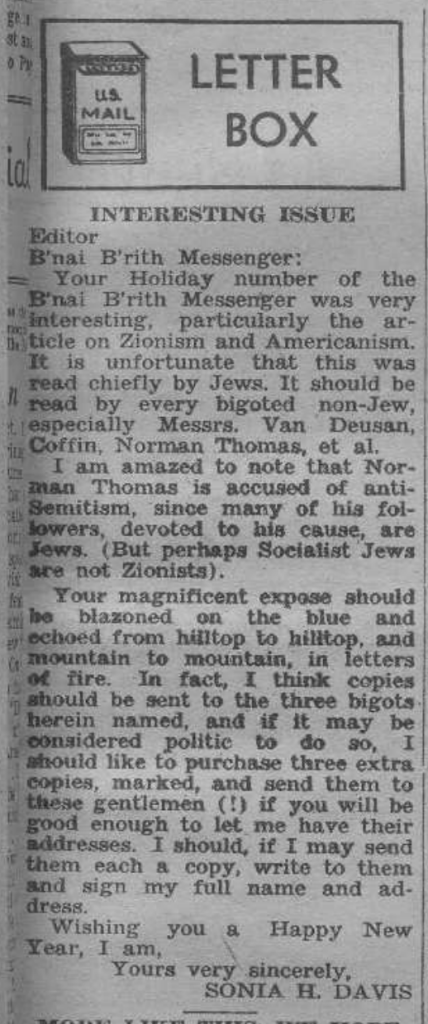
Interesting Issue
Editor
B’nai B’rith Messenger:
Your Holiday number of the B’nai B’rith Messenger was very interesting, particularly the article on Zionism and Americanism. It is unfortunate that this was read chiefly by Jews. It should be read by every bigoted non-Jew, especially Messrs. Van Deusan, Coffin, Norman Thomas, et al.
I am amazed to note that Norman Thomas is accused of anti-Semitism, since many of his followers, devoted to his cause, are Jews. (But perhaps Socialist Jews are not Zionists).
Your magnificent expose should be blazoned on the blue and echoed from hilltop to hilltop, and mountain to mountain, in letters of fire. In fact, I think copies should be sent to the three bigots herein named, and if it may be considered politic to do so, I should like to purchase three extra copies, marked, and send them to these gentlemen (!) if you will be good enough to let me have their addresses. I should, if I may send them each a copy, write to them and sign my full name and address.
Wishing you a Happy New Year, I am,
Yours very sincerely,
SONIA H. DAVIS
December 1949
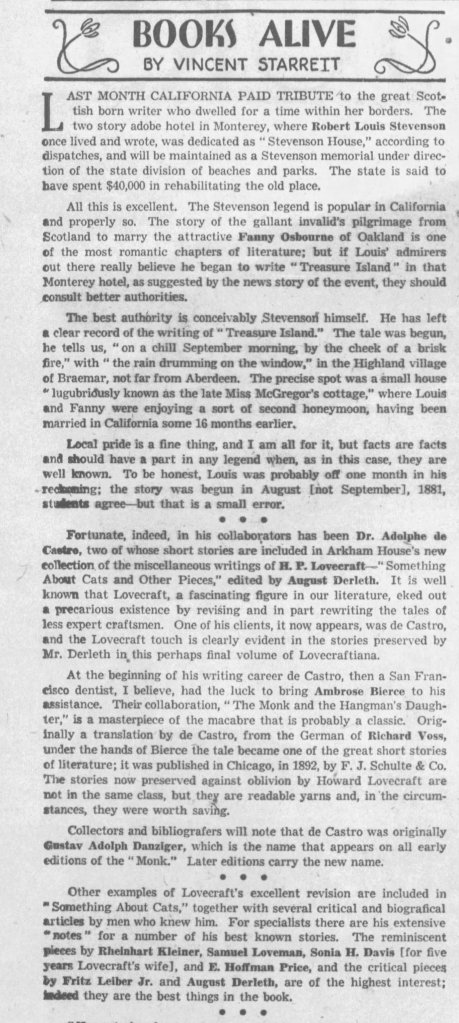
Books Alive by Vincent Starreit [sic]
LAST MONTH CALIFORNIA PAID TRIBUTE to the great Scottish born writer who dwelled for a time within her borders. The two story adobe hotel in Monterey, where Robert Louis Stevenson once lived and wrote, was dedicated as “Stevenson House,” according to dispatches, and will be maintained as a Stevenson memorial under direction of the state division of beaches and parks. The state is said to have spent $40,000 in rehabilitating the old place.
All this is excellent. The Stevenson legend is popular in California and properly so. The story of the gallant invalid’s pilgrimage from Scotland to marry the attractive Fanny Osbourne of Oakland is one of the most romantic chapters of literature; but if Louis’ admirers out there really believe he began to write “Treasure Island” in that Monterey hotel, as suggested by the news story of the event, they should consult better authorities.
The best authority is conceivably Stevenson himself. He has left a clear record of the writing of “Treasure Island.” The tale was begun, he tells us, “on a chill September morning, by the cheek of a brisk fire,” with “the rain drumming on the window,” in the Highland village of Braemar, not far from Aberdeen. The precise spot was a small house “lugubriously known as the late Miss McGregor’s cottage,” where Louis and Fanny were enjoying a sort of second honeymoon, having been married in California some 16 months earlier.
Local pride is a fine thing, and I am all for it, but facts are facts and should have a part in any legend when, as in this case, they are well known. To be honest, Louis was probably off one month in his reckoning; the story was begun in August [not September], 1881, students agree—but that is a small error.
•••
Fortunate, indeed, in his collaborators has been Dr. Adolphe de Castro, two of whose short stories are included in Arkham House’s new collection of the miscellaneous writings of H. P. Lovecraft—“Something About Cats and Other Pieces,” edited by August Derleth. It is well known that Lovecraft, a fascinating figure in our literature, eked out a precarious existence by revising and in part rewriting the tales of less expert craftsmen. One of his clients, it now appears, was de Castro, and the Lovecraft touch is clearly evident in the stories preserved by Mr. Derleth in this perhaps final volume of Lovecraftiana.
At the beginning of his writing career de Castro, then a San Francisco dentist, I believe, had the luck to bring Ambrose Bierce to his assistance. Their collaboration, “The Monk and the Hangman’s Daughter,” is a masterpiece of the macabre that is probably a classic. Originally a translation by de Castro, from the German of Richard Voss, under the hands of Bierce the tale became one of the great short stories of literature; it was published in Chicago, in 1892, by F. J. Schulte & Co. The stories now preserved against oblivion by Howard Lovecraft are not in the same class, but they are readable yarns and, in the circumstances, they were worth saving.
Collectors and bibliografers [sic] will note that de Castro was originally Gustav Adolph Danziger, which is the name that appears on all early editions of the “Monk.” Later editions carry the new name.
•••
Other examples of Lovecraft’s excellent revision are included in “Something About Cats,” together with several critical and biografical [sic] articles by men who knew him. For specialists there are his extensive “notes” for a number of his best known stories. The reminiscent pieces by Rheinhart Kleiner, Samuel Loveman, Sonia H. Davis [for five years Lovecraft’s wife], and E. Hoffmann Price, and the critical pieces by Fritz Leiber Jr. and August Derleth, are of the highest interest; indeed they are the best things in the book.
January 1950
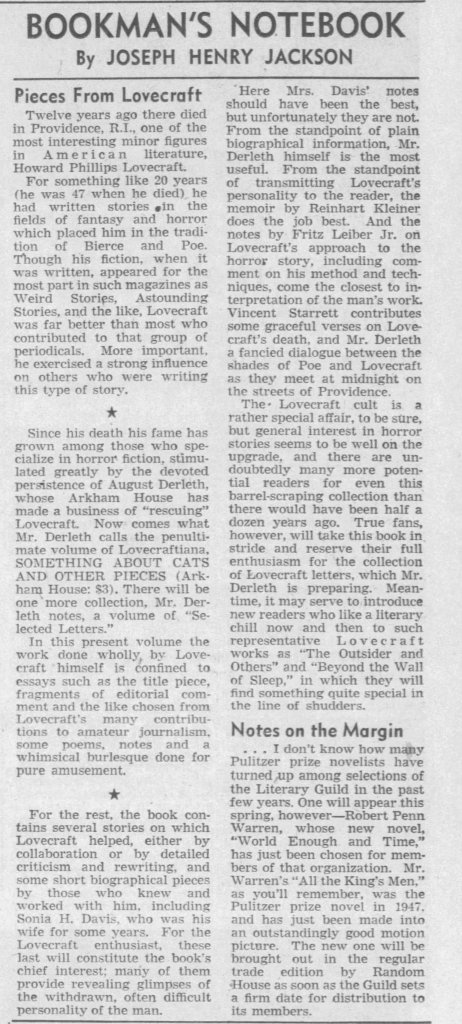
Bookman’s Notebook
Twelve years ago there died in Providence, R.I., one of the most interesting minor figures in American literature, Howard Phillips Lovecraft.
For something like 20 years (he was 47 when he died), he had written stories in the fields of fantasy and horror which placed him in the tradition of Bierce and Poe. Through his fiction, when it was written, appeared for the most part in such magazines as Weird Stories, Astounding Stories, and the like, Lovecraft was far better than most who contributed to that group of periodicals. More important, he exercised a strong influence on others who were writing this type of story.
★
Since his death his fame has grown among those who specialize in horror fiction, stimulated greatly by the devoted persistence of August Derleth, whose Arkham House has made a business of “rescuing” Lovecraft. Now comes what Mr. Derleth calls the penultimate volume of Lovecraftiana, SOMETHING ABOUT CATS AND OTHER PIECES (Arkham House: $3). There will be one more collection, Mr. Derleth notes, a volume of “Selected Letters.”
In this present volume the work done wholly by Lovecraft himself is confined to essays such as the title piece, fragments of editorial comment and the like chosen from Lovecraft’s many contributions to amateur journalism, some poems, notes and a whimsical burlesque done for pure amusement.
★
For the rest, the book contains several stories on which Lovecraft helped, either by collaboration or by detailed criticism and rewriting, and some short biographical pieces by those who knew and worked with him, including Sonia H. Davis, who was his wife for some years. For the Lovecraft enthusiast, these last will constitute the book’s chief interest; many of them provide revealing glimpses of the withdrawn, often difficult personality of the man.
Here Mrs. Davis’ [sic] notes should have been the best, but unfortunately they are not. From the standpoint of plain biographical information, Mr. Derleth himself is the most useful. From the standpoint of transmitting Lovecraft’s personality to the reader, the memoir by Reinhart [sic] Kleiner does the job best. And the notes by Fritz Leiber Jr. on Lovecraft’s approach to the horror story, including comment on his method and techniques, come the closest to interpretation of the man’s work. Vincent Starrett contributes some graceful verses on Lovecraft’s death, and Mr. Derleth a fancied dialogue between the shades of Poe and Lovecraft as they meet at midnight on the streets of Providence.
The Lovecraft cult is a rather special affair, to be sure, but general interest in horror stories seems to be well on the upgrade, and there are undoubtedly many more potential readers for even this barrel-scraping collection than there would have been half a dozen years ago. True fans, however, will take this book in stride and reserve their full enthusiasm for the collection of Lovecraft letters, which Mr. Derleth is preparing. Meantime, it may serve to introduce new readers who like a literary chill now and then to such representative Lovecraft works as “The Outsider and Others” and “Beyond the Wall of Sleep,” in which they will find something quite special in the line of shudders.
November 1952
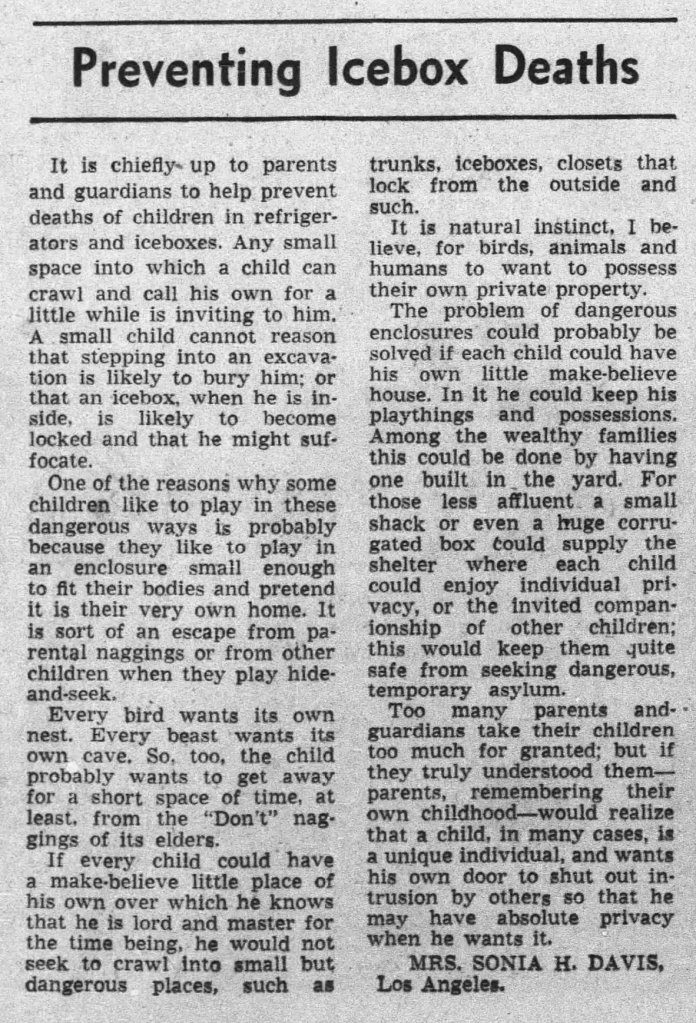
Preventing Icebox Deaths
It is chiefly up to parents and guardians to help prevent deaths of children in refrigerators and iceboxes. Any small space into which a child can crawl and call his own for a little while is inviting to him. A small child cannot reason that stepping into an excavation is likely to bury him; or that an icebox, when he is inside, is likely to become locked and that he might suffocate.
One of the reasons why some children like to play in these dangerous ways is probably because they like to play in an enclosure small enough to fit their bodies and pretend it is their very own home. It is sort of an escape from parental naggings or from other children when they play hide-and-seek.
Every bird wants its own nest. Every beast wants its own cave. So, too, the child probably wants to get away for a short space of time, at least, from the “Don’t” naggings of its elders.
If every child could have a make-believe little place of his own over which he knows that he is lord and master for the time being, he would not seek to crawl into small but dangerous places, such as trunks, iceboxes, closets that lock from the outside and such.
It is natural instinct, I believe, for birds, animals and humans to want to possess their own private property.
The problem of dangerous enclosures could probably be solved if each child could have his own little make-believe house. In it he could keep his playthings and possessions. Among the wealthy families this could be done by having one built in the yard. For those less affluent a small shack or even a huge corrugated box could supply the shelter where each child could enjoy individual privacy, or the invited companionship of other children; this would keep them quite safe from seeking dangerous, temporary asylum.
Too many parents and guardians take their children too much for granted; but if they truly understood them—parents, remembering their own childhood—would realize that a child, in many cases, is a unique individual, and wants his own door to shut out intrusion by others so that he may have absolute privacy when he wants it.
MRS. SONIA H. DAVIS,
Los Angeles.
January 1955
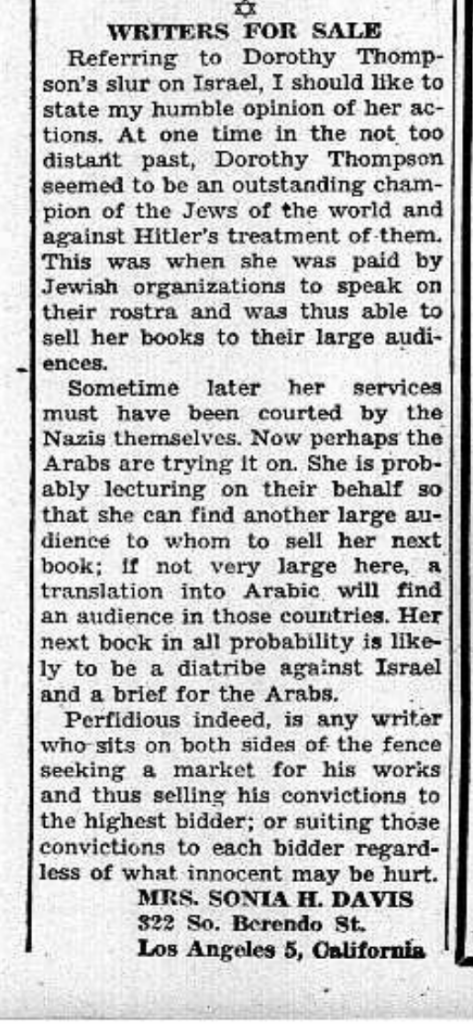
Writers for Sale
Referring to Dorothy Thompson’s slur on Israel, I should like to state my humble opinion of her actions. At one time in the not too distant past, Dorothy Thompson seemed to be an outstanding champion of the Jews of the world and against Hitler’s treatment of them. This was when she was paid by Jewish organizations to speak on their rostra and was thus able to sell her books to their large audiences.
Sometime later her services must have been courted by the Nazis themselves. Now perhaps the Arabs are trying it on. She is probably lecturing on their behalf so that she can find another large audience to whom to sell her next book; if not very large here, a translation into Arabic will find an audience in those countries. Her next book in all probability is likely to be a diatribe against Israel and a brief for the Arabs.
Perfidious indeed, is any writer who sits on both sides of the fence seeking a market for his works and thus selling his convictions to the highest bidder; or suiting those convictions to each bidder regardless of what innocent may be hurt.
MRS. SONIA H. DAVIS
322 So. Berendo St.
Los Angeles 5, California
June 1955
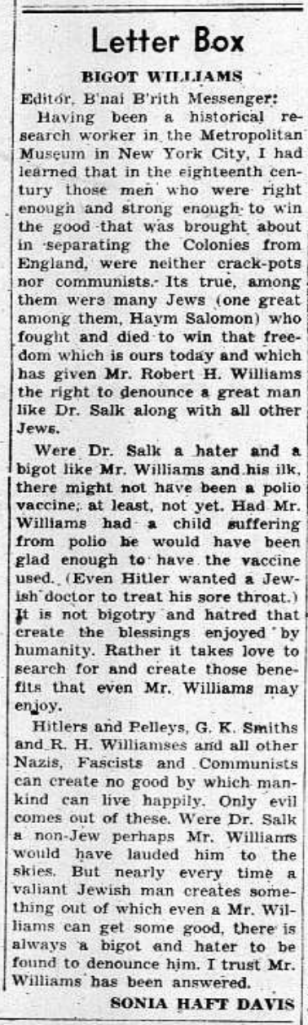
Bigot Williams
Editor, B’nai B’rith Messenger:
Having been a historical research worker in the Metropolitan Museum in New York City, I had learned that in the eighteenth century those men who were right enough and strong enough to win the good that was brought about in separating the Colonies from England, were neither crack-pots nor communists. Its [sic] true, among them were many Jews (one great among them, Haym Salomon) who fought and died to win that freedom which is ours today and which has given Mr. Robert H. Williams the right to denounce a great man like Dr. Salk along with all other Jews.
Were Dr. Salk a hater and a bigot like Mr. Williams and his ilk, there might not have been a polio vaccine, at least, not yet. Had Mr. Williams had a child suffering from polio he would have been glad enough to have the vaccine used. (Even Hitler wanted a Jewish doctor to treat his sore throat.)
It is not bigotry and hatred that create the blessings enjoyed by humanity. Rather it takes love to search for and create those benefits that even Mr. Williams may enjoy.
Hitlers and Pelleys, G. K. Smiths and R. H. Williamses and all other Nazis, Fascists and Communists can create no good by which mankind can live happily. Only evil comes out of these. Were Dr. Salk a non-Jew perhaps Mr. Williams would have lauded him to the skies. But nearly every time a valiant Jewish man creates something out of which even a Mr. Williams can get some good, there is always a bigot and hater to be found to denounce him. I trust Mr. Williams has been answered.
SONIA HAFT DAVIS
December 1955
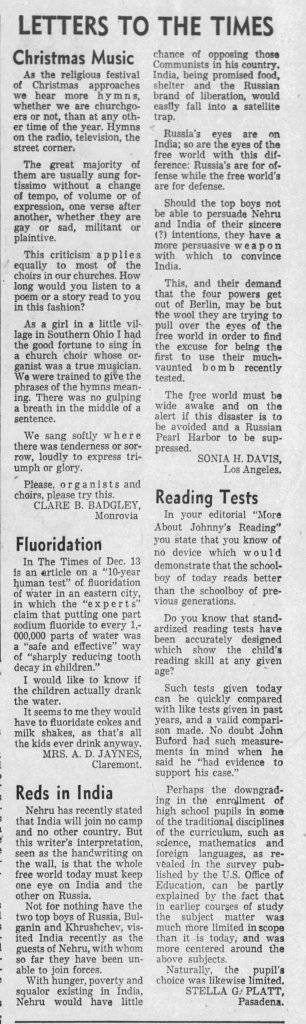
Reds in India
Nehru has recently stated that India will join no camp and no other country. But this writer’s interpretation, seen as the handwriting on the wall, is that the whole free world today must keep one eye on India and the other on Russia.
Not for nothing have the two top boys of Russia, Bulganin and Khrushchev, visited India recently as the guests of Nehru, with whom so far they have been unable to join forces.
With hunger, poverty and squalor existing in India, Nehru would have little chance of opposing those Communists in his country. India, being promised food, shelter and the Russian brand of liberation, would easily fall into a satellite trap.
Russia’s eyes are on India; so are the eyes of the free world with this difference: Russia’s are for offense while the free world’s are for defense.
Should the top boys not be able to persuade Nehru and India of their sincere (?) intentions, they have a more persuasive weapon with which to convince India.
This, and their demand that the four powers get out of Berlin, may be but the wool they are trying to pull over the eyes of the free world in order to find the excuse for being the first to use their much-vaunted bomb recently tested.
The free world must be wide awake and on the alert if this disaster is to be avoided and a Russian Pearl Harbor to be suppressed.
SONIA H. DAVIS,
Los Angeles.
May 1958
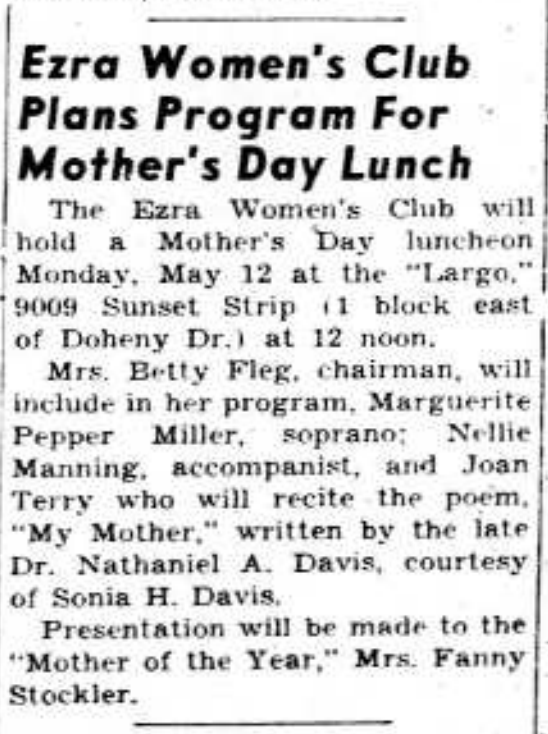
Ezra Women’s Club Plans Program For Mother’s Day Lunch
The Ezra Women’s Club will hold a Mother’s Day luncheon Monday, May 12 at the “Largo,” 9009 Sunset Strip (1 block east of Doheny Dr.) at 12 noon.
Mrs. Betty Fleg, chairman, will include in her program Marguerite Pepper Miller, soprano; Nellie Manning, accompanist, and Joan Terry who will recite the poem, “My Mother,” written by the late Dr. Nathaniel A. Davis, courtesy of Sonia H. Davis.
Presentation will be made to the “Mother of the Year,” Mrs. Fanny Stockler.
June 1959
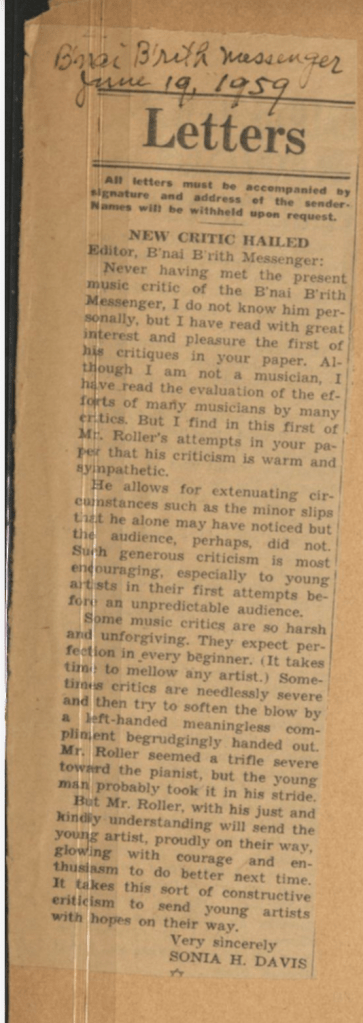
New Critic Hailed
Editor, B’nai B’rith Messenger:
Never having met the present music critic of the B’nai B’rith Messenger, I do not know him personally, but I have read with great interest and pleasure the first of his critiques in your paper. Although I am not a musician, I have read the evaluation of the efforts of many musicians by many critics. But I find in this first of Mr. Roller’s attempts in your paper that his criticism is warm and sympathetic.
He allows for extenuating circumstances such as the minor slips that he alone may have noticed but the audience, perhaps, did not. Such generous criticism is most encouraging, especially to young artists in their first attempts before an unpredictable audience.
Some music critics are so harsh and unforgiving. They expect perfection in every beginner. (It takes time to mellow any artist.) Sometimes critics are needlessly severe and then try to soften the blow by a left-handed meaningless compliment begrudgingly handed out. Mr. Roller seemed a trifle severe toward the pianist, but the young man probably took it in his stride.
But Mr. Roller, with his just and kindly understanding will send the young artist, proudly on their way, glowing with courage and enthusiasm to do better next time. It takes this sort of constructive criticism to send young artists with hopes on their way.
Very sincerely
SONIA H. DAVIS
July 1959
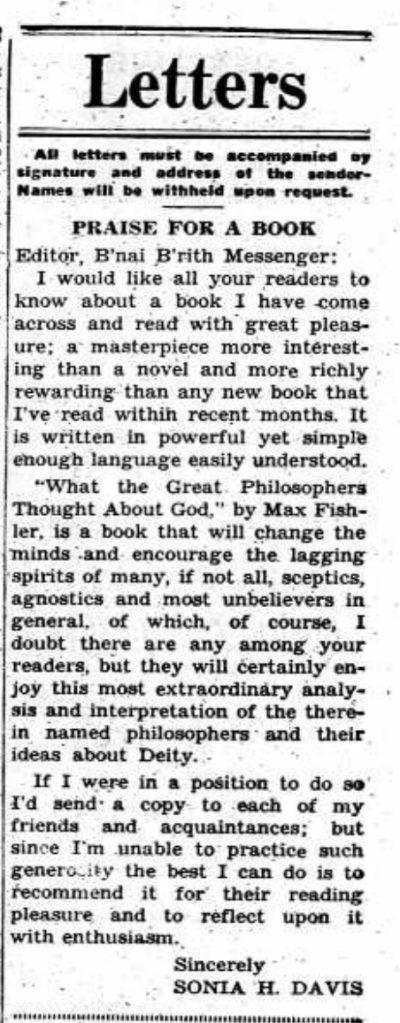
Praise for a Book
Editor, B’nai B’rith Messenger:
I would like all your readers to know about a book I have come across and read with great pleasure; a masterpiece more interesting than a novel and more richly rewarding than any new book that I’ve read within recent months. It is written in powerful yet simple enough language easily understood.
“What the Great Philosophers Thought About God,” by Max Fishler, is a book that will change the minds and encourage the lagging spirits of many, if not all, skeptics, agnostics and most unbelievers in general, of which, of course, I doubt there are any among your readers, but they will certainly enjoy this most extraordinary analysis and interpretation of the therein named philosophers and their ideas about Deity.
If I were in a position to do so I’d send a copy to each of my friends and acquaintances; but since I’m unable to practice such generosity the best I can do is to recommend it for their reading pleasure and to reflect upon it with enthusiasm.
Sincerely,
SONIA H. DAVIS
September 1959
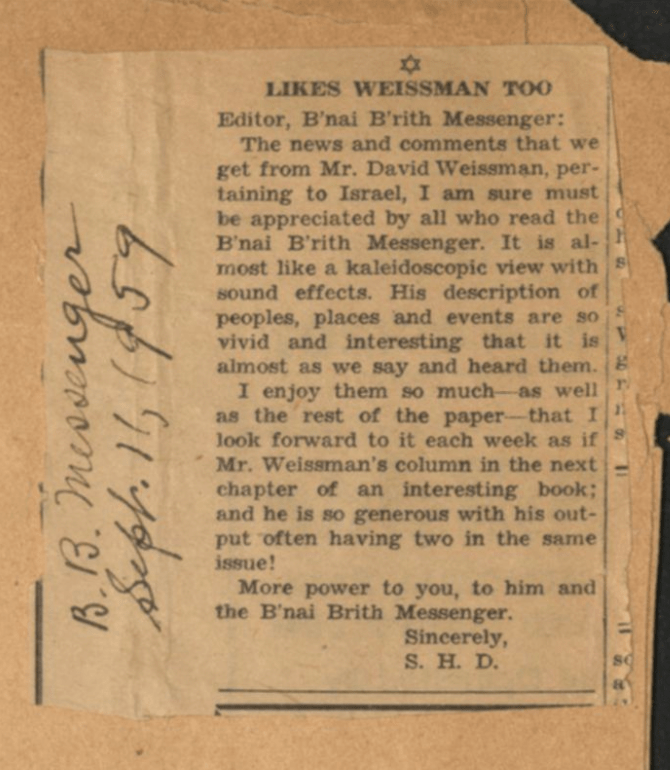
Likes Weissman Too
Editor, B’nai B’rith Messenger:
The news and comments that we get from Mr. David Weissman, pertaining to Israel, I am sure must be appreciated by all who read the B’nai B’rith Messenger. It is almost like a kaleidoscopic view with sound effects. His description of peoples, places and events are so vivid and interesting that it is almost as we say [sic] and heard them.
I enjoy them so much—as well as the rest of the paper—that I look forward to it each week as if Mr. Weissman’s column in the next chapter of an interesting book; and he is so generous with his output often having two in the same issue!
More power to you, to him and the B’nai Brith Messenger.
Sincerely,
S. H. D.
November 1959
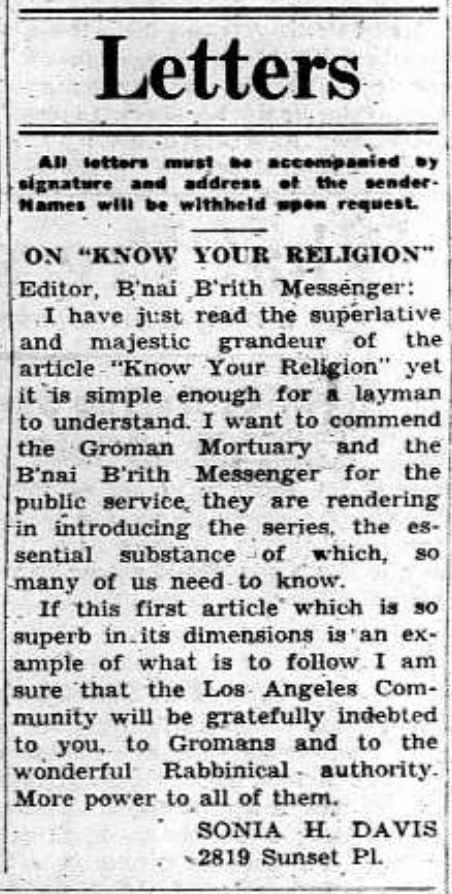
On “Know Your Religion”
Editor, B’nai B’rith Messenger:
I have just read the superlative and majestic grandeur of the article “Know Your Religion” yet it is simple enough for a layman to understand. I want to commend the Groman Mortuary and the B’nai B’rith Messenger for the public service they are rendering in introducing the series, the essential substance of which, so many of us need to know.
If this first article which is so superb in its dimensions is an example of what is to follow I am sure that the Los Angeles Community will be gratefully indebted to you, to Gromans and to the wonderful Rabbinical authority. More power to all of them.
SONIA H. DAVIS
2819 Sunset Pl.
March 1962
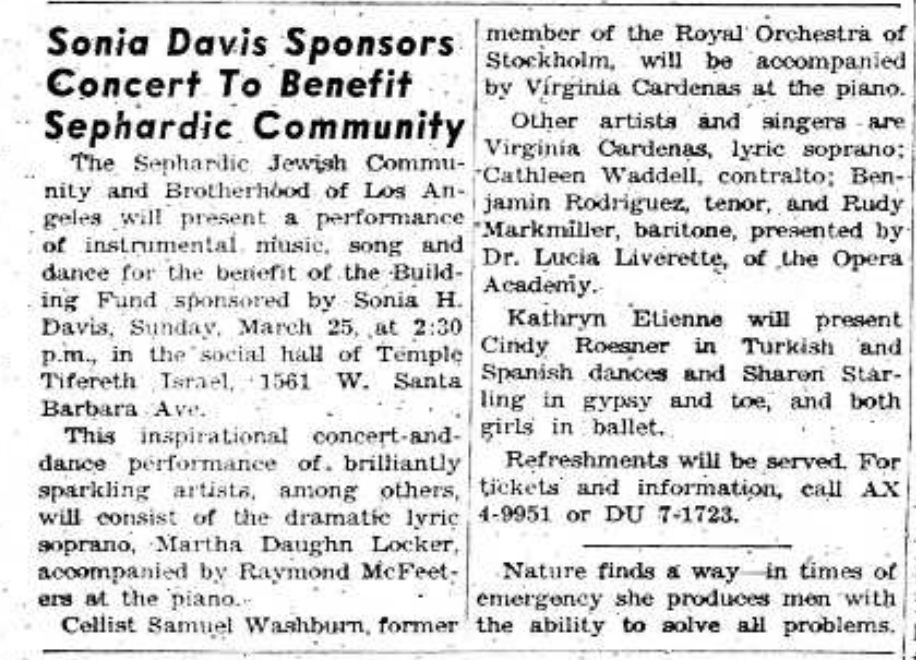
Sonia Davis Sponsors Concert to Benefit Sephardic Community
The Sephardic Jewish Community and Brotherhood of Los Angeles will present a performance of instrumental music, song and dance for the benefit of the Building Fund sponsored by Sonia H. Davis, Sunday, March 25, at 2:30 p.m., in the social hall of Temple Tifereth Israel, 1561 W. Santa Barbara Ave.
This inspirational concert-and-dance performance of brilliantly sparkling artists, among others, will consist of the dramatic lyric soprano, Martha Daughn Locker, accompanied by Raymond McPeters at the piano.
Cellist Samuel Washburn, former member of the Royal Orchestra of Stockholm, will be accompanied by Virginia Cardenas at the piano.
Other artists and singers are Virginia Cardenas, lyric soprano; Cathleen Waddell, contralto; Benjamin Rodriguez, tenor; and Rudy Markmiller, baritone, presented by Dr. Lucia Liverette, of the Opera Academy.
Kathryn Etienne will present Cindy Roessner in Turkish and Spanish dances and Sharon Starling in gypsy and toe, and both girls in ballet.
Refreshments will be served. For tickets and information, call AX 4-9951 or DU 7-1723.
Martha Locker
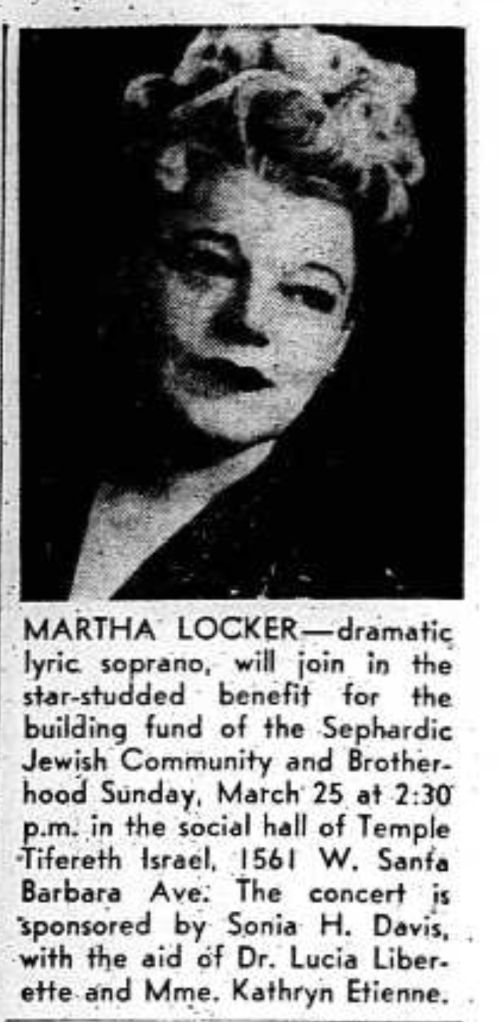
MARTHA LOCKER—dramatic lyric soprano, will join in the star-studded benefit for the building fund of the Sephardic Jewish Community and Brotherhood Sunday, March 25 at 2:30 p.m. in the social hall of Temple Tifereth Israel, 1561 W. Santa Barbara Ave. The concert is sponsored by Sonia H. Davis, with the aid of Dr. Lucia Liberette and Mme. Kathryn Etienne.
August 1962
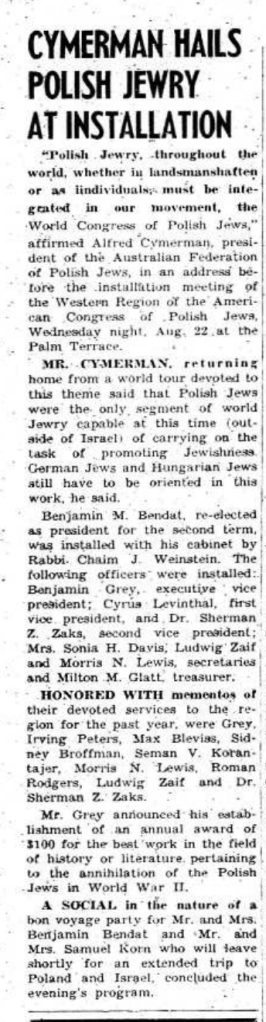
Cymerman Hails Polish Jewry at Installation
“Polish Jewry throughout the world, whether in landsmannschaften or as individuals, must be integrated in our movement, the World Congress of Polish Jews,” affirmed Alfred Cymerman, president of the Australian Federation of Polish Jews, in an address before the installation meeting of the Western Region of the American Congress of Polish Jews, Wednesday night, Aug. 22, at the Palm Terrace.
Mr. Cymerman, returning home from a world tour devoted to this theme, said that Polish Jews were the only segment of world Jewry capable at this time (outside of Israel) of carrying on the task of promoting Jewishness. German Jews and Hungarian Jews still have to be oriented in this work, he said.
Benjamin M. Bendat, re-elected as president for the second term, was installed with his cabinet by Rabbi Chaim J. Weinstein. The following officers were installed: Benjamin Grey, executive vice president; Cyrus Levinthal, first vice president; and Dr. Sherman Z. Zaks, second vice president; Mrs. Sonia H. Davis, Ludwig Zaif and Morris N. Lewis, secretariesand Milton M. Glatt, treasurer.
Honored with mementos of their devoted services to the region for the past year were Grey, Irving Peters, Max Bleviss, Sidney Broffman, Seman V. Korantajer, Morris N. Lewis, Roman Rodgers, Ludwig Zaif and Dr. Sherman Z. Zaks.
Mr. Grey announced his establishment of an annual award of $100 for the best work in the field of history or literature pertaining to the annihilation of the Polish Jews in World War II.
A social in the nature of a bon voyage party for Mr. and Mrs. Benjamin Bendat and Mr. and Mrs. Samuel Korn who will leave shortly for an extended trip to Poland and Israel, concluded the evening’s program.
September 1962
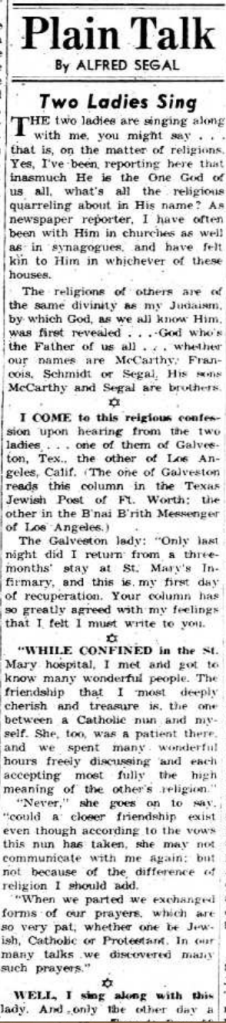
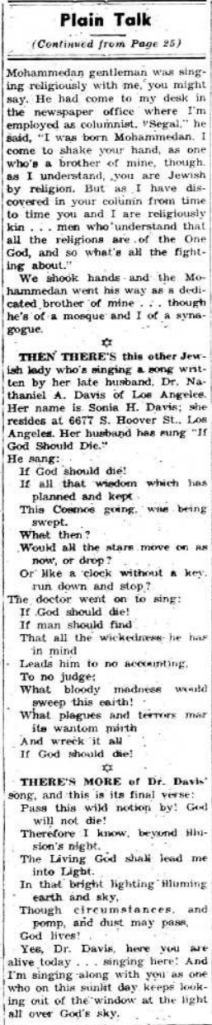
Plain Talk
Two Ladies Sing
The two ladies are singing along with me, you might say . . . that is, on the matter of religions. Yes, I’ve been reporting here that inasmuch He is the One God of us all, what’s all the religions quarreling about in His name? As newspaper reporter, I have often been with Him in churches as well as in synagogues, and have felt kin to Him in whichever of these houses.
The religions of others are of the same divinity as my Judaism, by which God, as we all know Him, was first revealed . . . God who’s the Father of us all . . . whether our names are McCarthy, Francois, Schmidt or Segal; His sons McCarthy and Segal are brothers.
I come to this religious confession upon hearing from the two ladies . . . one of them of Galveston, Tex., the other of Los Angeles, Calif. (The one of Galveston reads this column in the Texas Jewish Post of Ft. Worth; the other in the B’nai B’rith Messenger of Los Angeles.)
The Galveston lady: “Only last night did I return from a three-months’ stay at St. Mary’s Infirmary, and this is my first day of recuperation. Your column has so greatly agreed with my feelings that I felt I must write to you.
“While confined in the St. Mary hospital, I met and got to know many wonderful people. The friendship that I most deeply cherish and treasure is the one between a Catholic nun and myself. She, too, was a patient there and we spent many wonderful hours freely discussing and each accepting most fully the high meaning of the other’s religion.
“Never,” she goes on to say, “could a closer friendship exist even though according to the vows this nun has taken, she may not communicate with me again; but not because of the difference of religion I should add.
“When we parted we exchanged forms of our prayers, which are so very pat, whether one be Jewish, Catholic or Protestant. In our many talks we discovered many such prayers.”
Well, I sing along with this lady. And only the other day a Mohammedan gentleman was singing religiously with me, you might say. He had come to my desk in the newspaper office where I’m employed as columnist. “Segal,” he said, “I was born Mohammedan. I come to shake your hand, as one who’s a brother of mine, though, as I understand, you are Jewish by religion. But as I have discovered in your column from time to time you and I are religiously kin . . . men who understand that all the religions are of the One God, and so what’s all the fighting about.”
We shook hands and the Mohammedan went his way as a dedicated brother of mine . . . though he’s of a mosque and I of a synagogue.
Then there’s this other Jewish lady who’s singing a song written by her late husband, Dr. Nathaniel A. Davis of Los Angeles. Her name is Sonia H. Davis; she resides at 6677 S. Hoover St., Los Angeles. Her husband has sung “If God Should Die.”
He sang:
If God should die!
If all that wisdom which has planned and kept
This cosmos going, was being swept.
What then?
Would all the stars move on as now, or drop?
Or like a clock without a key, run down and stop?
The doctor went on to sing:
If God should die!
If man should find
That all the wickedness he has in mind
Leads him to no accounting;
To no judge;
What bloody madness would sweep this earth!
What plagues and terrors must its wanton mirth
And wreck it all
If God should die!
There’s more of Dr. Davis’ [sic] song, and this is its final verse:
Pass this wild notion by; God will not die!
Therefore I know, beyond illusion’s night,
The Living God shall lead me into Light,
In that bright lighting illumining earth and sky.
Though circumstances, and pomp, and dust may pass,
God lives!
Yes, Dr. Davis, here you are alive today . . . singing here! And I’m singing along with you as one who on this sunlit day keeps looking out of the window at the light all over God’s sky.
July 1963
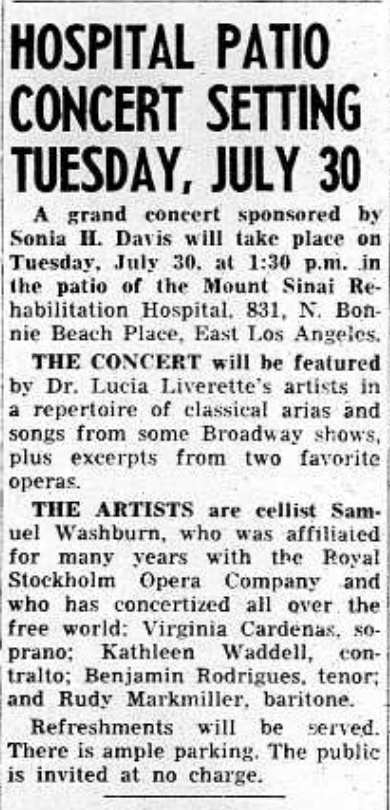
Hospital Patio Concert Setting Tuesday, July 30
A grand concert sponsored by Sonia H. Davis will take place on Tuesday, July 30, at 1:30 p.m. in the patio of the Mount Sinai Rehabilitation Hospital, 831 N. Bonnie Beach Place, East Los Angeles.
The concert will be featured by Dr. Lucia Liverette’s artists in a repertoire of classical arias and songs from some Broadway shows, plus excerpts from two favorite operas.
The artists are cellist Samuel Washburn, who was affiliated for many years with the Royal Stockholm Opera Company and who has concertized all over the free world; Virginia Cardenas, soprano; Kathleen Waddell, contralto; Benjamin Rodrigues, tenor; and Rudy Markmiller, baritone.
Refreshments will be served. There is ample parking. The public is invited at no charge.
Date Unknown
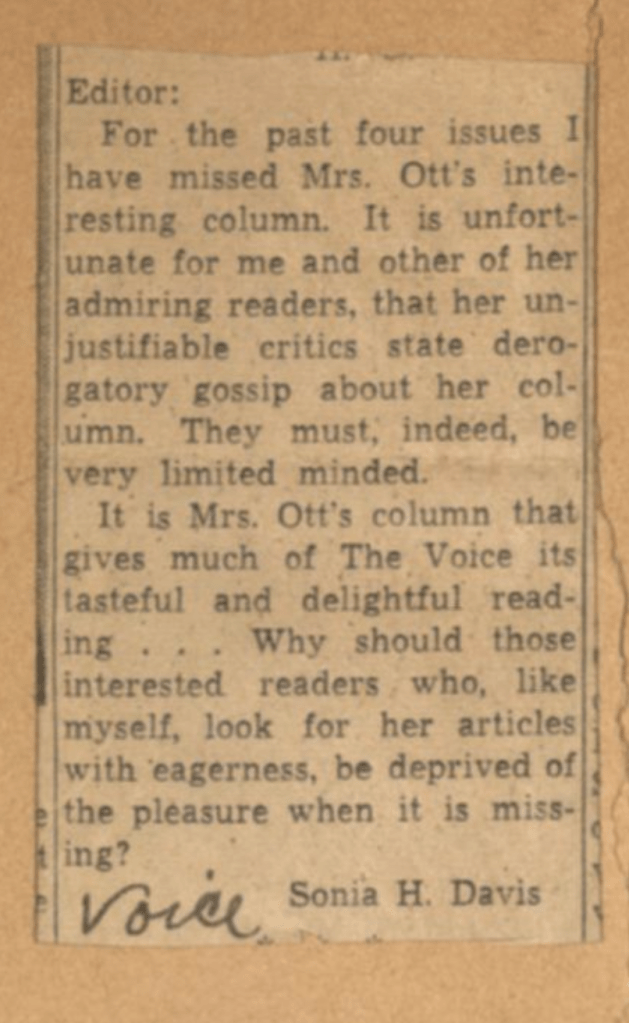
Editor:
For the past four issues I have missed Mrs. Ott’s interesting column. It is unfortunate for me and other of her admiring readers, that her unjustifiable critics state derogatory gossip about her column. They must, indeed, be very limited minded.
It is Mrs. Ott’s column that gives much of The Voice its tasteful and delightful reading . . . Why should those interested readers who, like myself, look for her articles with eagerness, be deprived of the pleasure when it is missing?
Sonia H. Davis
- “Although it has been a very long time since I have made a contribution to the “BUNDLE”, I would certainly be delinquent—regardless of my illness—if I did not make one at this time. Very few pages are now to be found in the “Bundle” but every time I receive one it is so welcome!” Sonia H. Davis, “A Grateful Letter From Sonia”, Correspondence, 1938–1971, Box 1, Folder 2, John Hay Library, Providence R.I. ↩︎
- Due to the illegibility of the left columns, I relied on Sonia’s enclosed reply to Winfield Townley Scott (September 24, 1948) to verify the transcription. See, Davis, Sonia H. to Scott, Winfield Townley. ↩︎
- See “Child Delinquency (An Essay)”. ↩︎
 soniahdavis.com