
You have my version, as my dear late mother told it to me…
Sonia to Christine D. Hathaway, March 6, 1968.
I’ve made it no secret that I’ve been working on a timeline for Two Hearts That Beat as One, and with such a task at hand, I was able to delve more deeply in the finer details of Sonia’s life. While constructing the timeline, I focused on materials that I would not have otherwise incorporated in the autobiography. I wanted to build a timeline that was both exhaustive and concrete. It certainly wasn’t easy, but what came out of it was meaningful and provided a newfound appreciation for the life and legacy of Sonia H. Davis.
My original reason for creating the timeline was because of my over compulsiveness as a storyteller. The events described in her autobiographical writings lacked dates and were far from being organized, making each placement of accounts difficult or sometimes impossible to arrange them where they inherently belong. The perfect example would be The Private Life of H.P. Lovecraft, in which the memories are jumbled up and it’s hard at times to differentiate when the moments precisely occurred.
Hence why the last month and a half was devoted specifically to what I called the “HPL Years”, because it was just that, I was working solely on the years between Lovecraft and Sonia. Much of my work involved annotating, which, because of my sourcing other materials to verify the narrative, I was then obliged to rearrange certain recollections to fit in their rightful order. Yet, there still remained scenes where they were irrevocably out of place, and could no longer be moved elsewhere. Thus, the timeline was created. It was also because of this adamant attention to the finer details that brought another marriage to the forefront.
The “HPL Years” is , in reality, a smaller detail taken out of a larger picture.
This is a part of Sonia’s life that has been under the microscope for far too long, and there are other “years” to this life that have been denied that same microscopic attention. Granted, it all comes down to interest and target audience. However, it was in this “timeline” state of mind that I learned more intimately about Sonia’s mother, Racille, aka Rachel Moseson—specifically about her marriage to Solomon Moseson. Although Sonia divulged generous accounts of the marriage, I discovered additional tidbits about the rocky relationship and it was through the lens of newspaper clippings. Before the great advancement of the internet, the newspaper was the printed form of social media, in which its subscribers were given the liberty to publicize their lives to the critical masses. In the case of Solomon and Racille, it’s no different. The clippings provided in this post not only verify the statements made by Sonia, but they also reveal Racille’s loss in which Sonia did not disclose in her autobiographical writings.
Before marrying Solomon Moseson in New York, however, Racille Haft was married to Simyon Shafirkin in Ichnya, Ukraine. It was through Joseph Haft, Racille’s middle brother, that Simyon and Racille met. Despite the disapproval of Moisieh Haft, Racille’s father, Simyon and Racille married around 1881/1882, and on March 16, 1883, Sonia was born. Days after her birth, the young Shafirkin family fled Ichnya at the news of a possible pogrom threatening to sweep through their village, settling permanently at the home of Racille’s parents in Konotop, Ukraine. In 1884, due to the compulsory enlistment throughout the nation, Simyon was obligated to serve in the military upon turning twenty-one. His departure was a sad one for his family—especially for Racille.
Right from the very beginning we are informed of the odds set against Simyon and Racille, but rarely of the treasured memories they shared which made their marriage a beautiful one. Their marriage was from one danger to another and one heartbreak from another. When Racille later relayed everything to Sonia it is quite possible certain particulars were likely forgotten, bunched together, or seemed insignificant to share. Also, because of the length of time which had elapsed from when Racille shared these recollections with Sonia and when Sonia finally wrote it all down, who knows how much more Sonia had forgotten as well.
In 1888, Simyon returned from his service and would sadly leave Racille and Sonia once more. This time, he thought he would seek his livelihood outside of Ukraine and call for Racille and Sonia to wherever he was to find it. Sonia had these words to say about her father, and how accurately they describe him:
Being young and idealistic, he believed that he could find his destiny instead of it,findng [sic] him.
Autobiographical Writings, Box 9, Folder 3.
What neither Simyon nor Racille had expected was for her father to force a divorce upon them, breaking their family apart for good. It is easy to fall into the rabbit-hole of “what ifs” at this crossroad of their story. What if Simyon had chosen his family over seeking work outside of Ukraine? What if Simyon and Racille had stayed together? What if Sonia had her father’s love as she grew up? Their lives would have been drastically different from what we now know it, and I would not be here talking about Sonia and her loved ones.
After the divorce, Racille and Sonia migrated to Liverpool, England, around 1889, and while living there, Racille went with friends to the United States around 1890. Sonia remained behind with her uncles, Harris and Joseph Haft, in Liverpool and attended school. Being wholly different from Ukraine and even from Liverpool, America had a completely liberating way of living. Racille was free here to live without persecution, free to be who she wanted to be, and free to seek the highest education. She decided America was the perfect place to raise Sonia, and with high hopes she set her mind to raise the funds to bring her to the States. It was during this time that Solomon Moseson met Racille, now Rachel.
To this day N.Y.C. is full of marriage bureaus and marriage consultants; and they make it their business to find marriagable [sic] girls and young widows. That’s how Mr. Sol Moseson found my mother.
Sonia to Sidney Moseson and his wife, Florence, August 19, 1964.
This slightly conflicts with what is said in the autobiographical writings, in which Sonia revealed Rachel was not interested in seeking a relationship when she arrived in America. It is unclear if Rachel had joined this supposed marriage bureau, or her name was in a roster of single women. Regardless, Solomon was interested in Rachel. Being fully aware of the persuasion of money, he managed to prey on Rachel’s wish to bring Sonia to America. He courted Rachel with material things rather with genuine affection, promising her a good life.
Around 1891, Rachel married Solomon Moseson and moved to Elmira with him. It is this time when Solomon begins to reveal his true character. Who was formally a generous man, was now suddenly frugal in providing for his loved ones. He was slow to fulfill his promise to Rachel, not only in providing her a good life but in bringing Sonia to America. Yet, after enough persistence, Solomon gave in, and Sonia arrived on June 4, 1892. On September 9, 1892, Rachel gave birth to Anna Moseson, the first child from her new marriage.
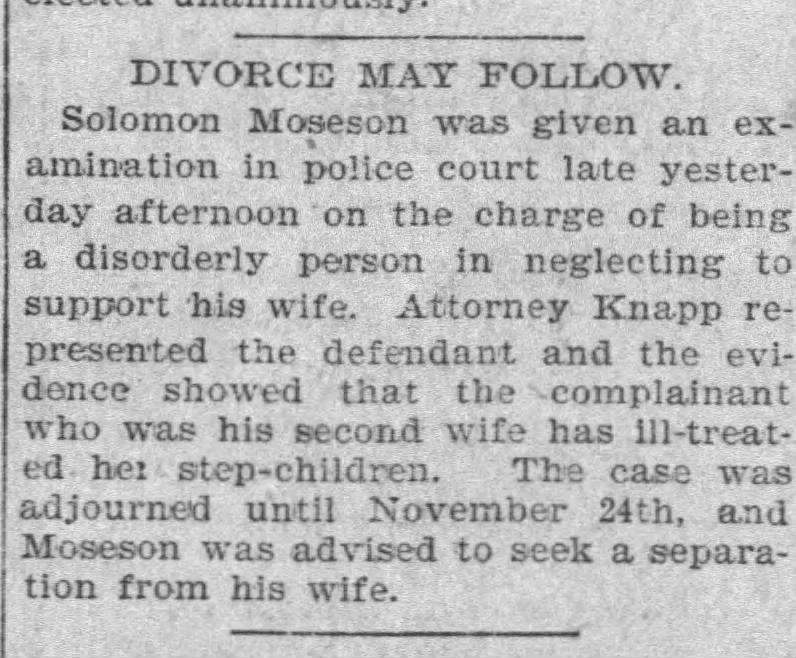
On November 1896, however, their marital troubles begin to make headlines.
Source: Newspaper.com
Sadly, it does not come as a surprise when a stepchild may deal with small injustices from a stepparent. It is easy to assume this was the case with Solomon and Sonia, although it just wasn’t so. Sonia not only described the abuse she went through while living under his roof, but she also recounted the abuse he brought upon his own children from his first wife and from Rachel. In 1896/1897, Sonia was forced to move out and live with a family friend because Solomon’s harassment became too much for her to bear.
Thanks to the love and support of this friend, Sonia was given the opportunity to follow her dream in becoming a milliner. She was able to apprentice under Mary Bathsheba Hagadorn, a woman who either ran her own millinery shop or oversaw a shop in Elmira. Inevitably, Sonia finished her apprenticeship and with the assistance of the family friend, Sonia was able to travel to the city to seek work within her trade. In the midst of this, on January 18, 1897, Rachel gave birth to another baby, Sidney Moseson. Sonia loved her half-siblings, and had helped her mother to care for them while she had lived in Elmira.
Sonia, now living on her own, met Samuel Greene on December 24, 1898, marrying him on December 24, 1899. Samuel was a man whose cruel behavior resembled Solomon’s own. In September 1900, one month before Sonia would give birth to her first child, Rachel with her two children, Anna and Sidney Moseson, left Solomon.
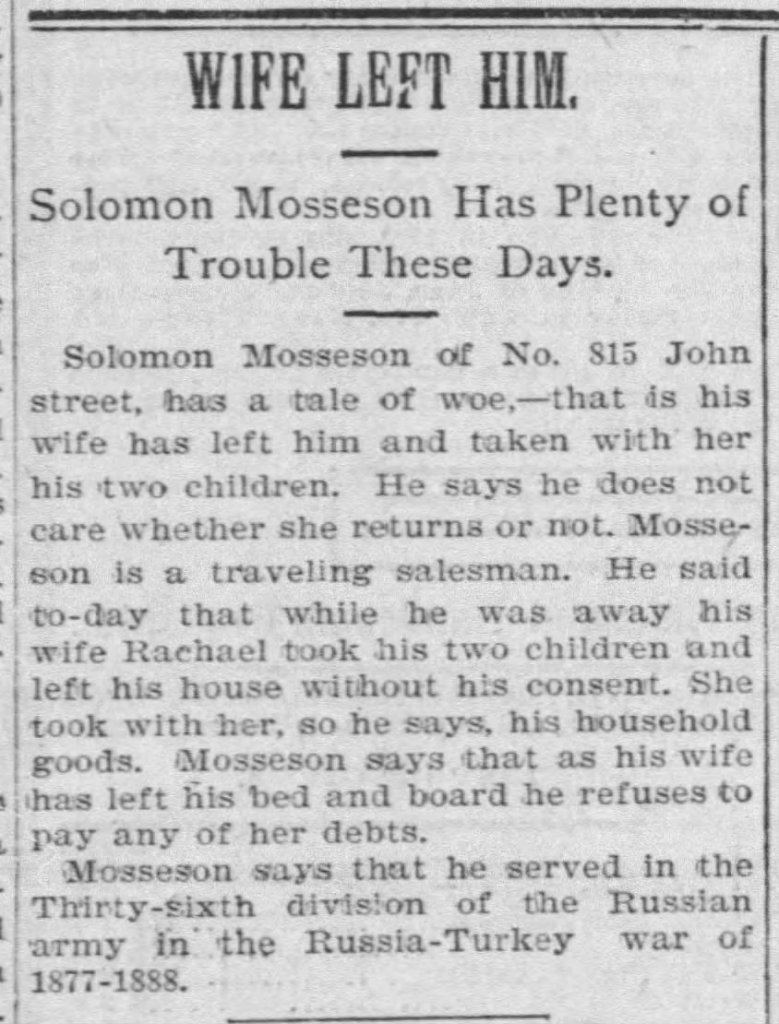
What is most interesting about these two clippings is that in the first, Solomon was advised to seek a separation from Rachel and failed to do so. And yet, in the second clipping, he openly admitted his lack of care whether she returned to him or not. It’s unclear what his true intention for continuing the marriage was, for evidently, he cared very little about Rachel. Perhaps it was simply his want of control over her, seeing her a possession rather than his wife. Regardless of his reasoning, their troubles would stretch for another 11 years, and it would not be until 1911 when enough would be enough for Rachel.
In the span of those 11 years, though, Sonia had gone through a great deal herself. After losing her first child in January 1901, she gave birth to another baby, Florence Carol Greene, on March 19, 1902. Sonia’s marriage was turbulent—being emotionally and physically abused. In 1906, Sonia and Florence left Samuel, moving first to her mother in law’s home, then to Baltimore. There, they remained for two years, and in 1908, upon Sonia’s request, Rachel came for Florence, and she took her to Elmira. Sonia returned to New York thereafter and divorced Samuel.
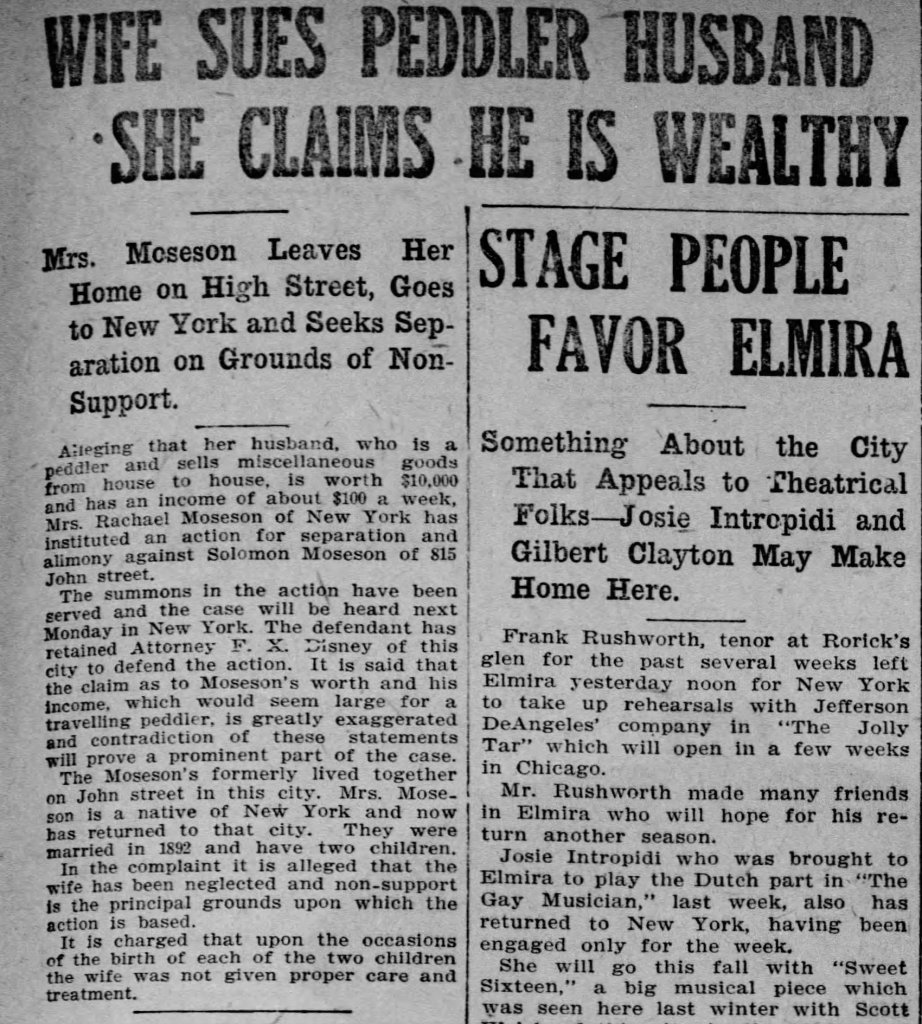
In the autobiographical writings, Sonia described going back to Elmira to get Florence and it’s at this time that Rachel also leaves with Sonia to come to New York. She had the intention of leaving him for good. The following newspaper clipping aligns with this truth. However, in the autobiographical writings, Rachel returns to Solomon while the clipping gives the vague impression of her never returning to him.
Source: Newspaper.com
From August 1911 through March 1912, Rachel would go up against Solomon in court for separation and alimony.

Source: Newspaper.com

Source: Newspaper.com
Justice is a funny thing, especially in this case. Naturally, the judge would have ruled in favor of Rachel—she had six witnesses while Solomon had only himself, and yet, Rachel lost because of a single mistake on her part. New York had maintained a strict rule over divorce, in which adultery was the only grounds for a divorce, that is until 1966 and later in 2010 when the no-fault law was passed. Abandonment, or desertion, was also taken into consideration. When Rachel began the case against Solomon, she was no longer living with him, giving the judge cause to rule against her. This one mistake costed her greatly, and it’s easy to imagine her sense of defeat, especially when the evidence was on her side. Surprisingly, given the nature of the case, Sonia did not disclose any of the court matter in her autobiographical writings, and it’s unclear if it was because she chose not to, or it slipped her mind.
Martin H. Kopp, the son of Anna (Moseson) Kopp, would later described his recollections of Rachel and even of Solomon, putting it simply:
Apparently, Grandpa was an overpowering, dominating Orthodox man, and here was Grandma, the product of a very cultured, urbane family environment.
“Memories of Sonia H. Greene Davis”, Lovecraft Annual, p. 28.
Surely, there’s still more to be learned about the marriage of Solomon and Rachel Moseson. Yet, with these newspaper clippings, we get a little more insight and a little more verification on what Sonia wrote in her autobiographical writings. There is something to be said about Rachel staying in a marriage for nearly twenty years. It either speaks volumes of her perseverance or it is quite possible there were moments of hope for the relationship to continue. But like most things, unless we were there, we’ll never truly know.
 The Papers of Sonia H. Davis
3 responses to “Rachel Moseson — A Marriage Through the Lens of Newspaper Clippings.”
[…] her essays from personal experience or research, revealed Sonia’s childhood friend, elaborated on the rocky relationship of Solomon and Racille (Rachel) Moseson, unpacked Sonia’s contribution to amateur journalism (Part I) (Part II), and lastly spotlighted […]
LikeLike
I did not realize newspapers from the past were so focused on people’s personal lives. I naively assumed they mostly covered important big issues and events.
I guess the urge for gossip has always been with us. Having these snippets of legal news does give us unique insight over time into their lives.
It must be exhausting to comb through years of newspapers to find these snippets of information since it is (I assume) not available in a way that you can just search for certain words or names the way we can now with Google.
LikeLiked by 1 person
I had no idea either that newspapers printed personal information like that, but it makes senses. It’s like us watching the news or scrolling through social media.
I hate to disappoint but actually, there’s a newspaper website where you can search for someone’s name, and it’ll pull up any mention of the name. That’s how I was able to find these clippings.
LikeLike