
While the autobiography is undergoing the final stages of corrections, I have been transcribing the essays of Sonia. The topics range from adolescent delinquency to Jewish ideals. Love, however, is a prominent topic among her theses. The thing is, I often wonder: are the essays personal or researched? How much of what Sonia is writing arises from personal experience or how much of it is researched? Sonia genuinely enjoyed researching new things, such as her time as a historical researcher during the Great Depression.
I was given a sheet of paper with subjects named, for which I was to search out all I could regarding “Roger Williams Speaks Out for Liberty Before the New England Divines.” I must have read at least 20 books on the life of R.W [sic]. I found it most interesting and enchanting. The Banker, Mr. P, told me it did not pay much, but enough to keep the wolf from the door. I accepted the job with alacrity and loved it.
Autobiographical Writings, Box 9, Folder 8.
If there is anything I’m certain of is, Sonia spoke from experience regarding a husband’s philandry. The essay that particularly confirmed this fact (and inspired this post) was Love, Marriage and the Philanderer. The majority of the article focuses on the true significance of love, and what truly makes a marriage work. She references the marriages of the Brownings, Dr. Samuel Johnson, Napoleon Bonaparte, and others, to further strengthen her points. And yet, when she begins to elaborate on the philanderer, Sonia’s tone shifts toward resentment. There’s a conviction in the words. What was a collected and composed essay paragraphs prior, the concluding paragraphs regarding philandry betrays her wounds in the matter.
Mental philanderers usually go about telling other women that their wives do not understand them. The truth of the matter is, that the wives understand them only too well, and would probably quite cheerfully divorce such husbands and let them go merrily to the devil in their own philandering ways were it not either for the sake of the children, or other compelling considerations, such as the damage they would do to their homes, their lives and the loss of their social prestige. Were it not for the children more than for any thing [sic] else, many such wives would feel they are well rid of such husbands.
Love, Marriage and the Philanderer.
It is no secret Samuel Greene, Sonia’s first husband, was a vile man. He was a notorious philanderer. In her autobiographical writings and even in her letters, Sonia wrote openly about the abuse she endured while being married to him. It was so bad that she believed her dying would liberate her completely from him. Fortunately, certain circumstances allowed her to leave him without having to die. While she wasn’t someone to dwell on the past, she divulged much of her past to her half-brother, Sidney, his wife, Florence, and to his daughter, Leonore.
I hired a maid who was very good to the baby girl born in Marh [sic]. I soon lost the maid. S G [sic] would pester the life out of her until she was obliged to tell me why she was leaving. Then he became enamored of my medical nurse when the little girl was born. By little and little I was gaining in my trade, both experience and money. I simply closed my eyes to his philanderings [sic].
Sonia to her half-brother, Sidney and his family, August 25, 1964.
Even though Sonia closed her eyes to his philanderings, she did not remain a victim in the marriage for the sake of her daughter, Florence. Instead, she strove for higher positions within her trade so she could provide for the both of them. Ultimately, she succeeded, but in the end, we will never truly grasp the amount of trauma this ordeal likely had on both Sonia and Florence, even if they lives were for the better after Samuel left them alone.
The physical chemistry alone, under the influence of which so many men and women marry, is not enough. Soon they are bored with one another, since there is nothing else of interest to hold them together.
Love, Marriage and the Philanderer.
Let be known that Sonia was not a well-sexed woman. She was not a woman who bribed for sexual favors, she was not seeking and marrying men for the pursuit of sex. In fact, she was far from that reality, and was rather reserved about sex. Proof of this fact was her marriage to H.P. Lovecraft, a man who was equally close-mouthed about the act. For Sonia, intelligence trumped over physical attraction, but it was a bonus if the man was both smart and handsome. Every relationship that led to her marriages was first ignited by intellect. These men first seduced her mind, then very lastly, her body.
It is unbecoming a gentleman to broadcast such nonsense—in fact, a gentleman doesn’t—he incidentally loses the very admiration and respect of those whose approbation he most desires. Such a man is a mental philanderer. A refined and cultured man usually possesses sufficient poise and self-control not to be wish-thinking out loud for freedom from the chains that bind him in marriage. Supposing his wife went about saying the same thing to men! A circuitous invitation for men to make love to her?
Love, Marriage and the Philanderer.
Sonia did not put special emphasis on sex, but she agreed it holds a unique place within a marriage. Sex is not, however, everything that should encompass a relationship or the only reason for marriage. She goes into great detail about this in her essay, The Influence of Sex in Love, Marriage and Happiness, which I covered in the post: What Love Meant to the Lovecrafts. In Hermaphrodite or Deviate, Which? Sonia gives away her frustrations on the excessive talk of sex.
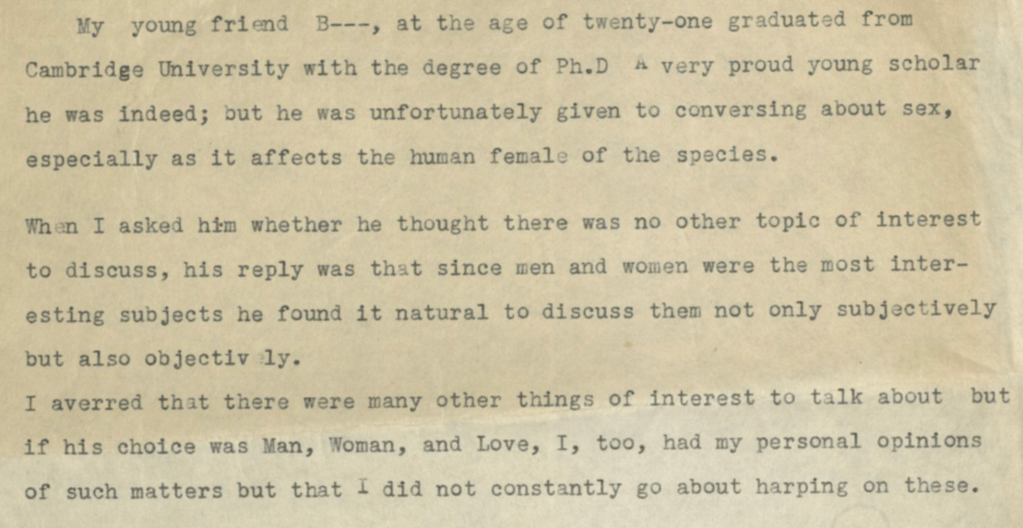
In another thesis, in which personal experience abounds, is The Love of Youth and Old Age. Although Sonia doesn’t reveal the educator’s name, this following passage closely resembles the actions of Nathaniel Davis.
One interesting case in point is that of an educator, artist and poet, who, at the age of seventy-eight, after many years of wedded bliss, was still sufficiently alert to remember his wife’s birthday and their wedding anniversary; and every year upon each occasion throughout his lifetime he would compose an original love-poem and place it beside her dinner-plate as a mark of his loving remembrance. With an exquisite tenderness upon one occasion, he assured her that when she was a baby her mother could not have loved her more than he did. Withought [sic] being uxorious, he was sufficiently demonstrative in his love for her and for his tenderness toward her, to have loved her, not only as he might have loved his own child, but he loved her as his trusted friend, his beloved mistress and his adored wife. Few men seem to be capable of this greatest of all arts—a tender, devoted, romantic love for one woman.
The Love of Youth and Old Age.
He never forgot our wedding anniversary nor my birthday. On such occasions I always found a poem beside my plate.
Autobiographical Writings, Box 9, Folder 8.
Nathaniel was nearly 79 years old when he passed away. Sonia elaborated in several accounts that he was very much alert to have a discussion with his friends, a Mr. Jackson and Mr. Wheeler Dryden, while in the gurney prior to his death.
That Thursday night Mr. Jackson and Mr. Dryden accompanied us to the hospital; they stayed until one o’clock in the morning. Then a very tired and sleepy intern was awakened to see NAD’s [sic] wound. When our two friends left, they said: “NAD [sic], get well quickly; we have much to talk about. We’ll see you as soon as you get out of the hospital. [sic] We all knew, including NAD [sic], that this was the last time any of us would see him in the flesh.
Autobiographical Writings, Box 9, Folder 8.
Side Note:
While transcribing the first page of Mothers and Daughters, I thought the writing sounded rather familiar. I decided to compare the page with the first page of The Psychic Phenomenon of Love, and much to my surprise, they were a match! The top image is from The Psychic Phenomenon of Love, and the bottom image is from Mothers and Daughters.


One would think that Sonia would’ve been very knowledgeable in the ways of motherhood to give a speech about it. Sadly, she had to research the matter. It’s well known by now that Sonia had a rocky relationship with Florence. Some assume the reason for the fallout was because Florence wanted to marry Sonia’s half-brother, Sidney. I beg to differ, and the problem was quite simple: Florence had a temper. Several accounts surrounding Florence portray her of having a temper, and being the daughter of Samuel Greene, it’s no surprise that Sonia and Florence argued much as the latter grew older.
According to Sonia, regarding the essay, the President of Hadassah, a Jewish group, asked Sonia to speak about mothers and daughters.
Once I was asked by the Hadassah President whether I could give them a talk on “Mothers and Daughters” I said if they didn’t mind my reading an essay on the subject, I’d be happy to accomodate [sic] them. I did a lot of research in the library and then added my comments. They gave me the date of the dinner* to which NAD [sic] was also invited. (*At the Ambassador Hotel).
“Part of Biography”, Autobiographical Writings, Box 9, File 1.
It is unclear how many pages the essay is—I only have page one and twelve in my digital possession, and page twelve is cut off in midsentence. Given by what is available, Sonia focuses primarily on love and the power of it. As mentioned above, the first page is identical to the first page of The Psychic Phenomenon of Love. Certain passages of Mothers and Daughters reads very similar as well to the other “love” essays that Sonia had penned. I can’t say for sure how much of herself was included in Mothers and Daughters; although having studied what I have, it is still quite possible she included a part of herself that might have done things differently with Florence. Perhaps, the essay is a form of criticism to herself and feedback to others. Unfortunately, we can only speculate until the missing pages someday (hopefully) emerge.
In short, the reality is a little bit of Sonia can surely be found in her own essays. Whether certain topics expose her experiences completely or not, what she had to say was and is worth a perusal. She was sharp and intelligent, and she felt deeply about things. If not to persuade, her only hope was to shine a light, to provide insight on a subject that could interest others.
I will conclude these remarks; anxious that I be not thought to make a mountain from a molehill, but that my words be understood to constitute what they really do…a little document of genuine human feeling, proffered for whatever slight good might be extracted from it.
Boy Scouts.
In Memoriam
While outlining this post, I received word that Randal Alain Everts and his wife were in a vehicular homicide in April. Sadly, she passed away in the accident, while Randal was hospitalized. I understand the tension that arises at the mention of R. Alain Everts, and regardless of what has occurred in the past, please set it aside and keep his family in your thoughts and prayers. Mr. Everts has been a major supporter of my efforts in my research of Sonia’s life, and is therefore a dear friend of mine.
 The Papers of Sonia H. Davis
3 responses to “The Essays of Sonia: Personal or Researched?”
[…] literature that Sonia read and enjoyed, analyzed the possibility if Sonia wrote her essays from personal experience or research, revealed Sonia’s childhood friend, elaborated on the rocky relationship of Solomon and Racille […]
LikeLike
Have you come across any correspondence that gives us a clue about Florence’s perspective? Or any exchanges from relatives that may have stayed in touch with both Sonia and Florence ? Familial estrangement is so personal and often embarrassing so they may not have written it down but this essay makes me wonder.
LikeLiked by 1 person
Sadly I haven’t, but I do elaborate on Florence in this month’s post: https://soniahdavis.com/2024/10/15/florence-carol-greene/
LikeLike