
Happy Valentine’s Day!
On an overly marketed day, “Love” loses its luster and depth. Love suddenly becomes an action or a product on a day such as today. Sonia, however, was not a woman easily wooed by words or gifts.
“Where most young women expected flattery, she disdained it.”
Two Hearts That Beat as One manuscript, p. 55.
“Compliments did not interest her. She had the unique desire to be wanted for what might have been just herself, and not for merely a pretty face or being a meal ticket to a ‘gigolo’.”
Two Hearts That Beat as One manuscript, p. 81-82.
Sonia certainly endured relationships devoid of love, and with the addition of her “stunning” appearance, her views on love were ultimately shaped by the aforementioned. Her first marriage to Samuel Greene was turbulent, and although she does not fully elaborate on the physical abuse in her autobiographical writings, it is insinuated he was violent towards her. Upon first meeting Sonia, Samuel was suave, but initially she did not take the bait.
“Have you ever heard that trite saying ‘Love at first sight’?” he asked.
She waited a moment, then added, “Yes, I’m sorry to admit that I’ve heard it nearly every time I meet a young man for the first time, and I’ve been hearing it frequently for the past few months. It does not flatter me one bit. I refuse to be swept off my feet.”
Two Hearts That Beat as One manuscript, p. 54.
Unfortunately, Sonia inevitably married Samuel and suffered throughout that marriage. Although he taught her an array of interesting subjects, he also taught her, by his cruel actions, what she did not want in a man. She was prepared for such a man and was able to avoid it going forward in her life. It wasn’t until she met Howard Phillips Lovecraft that she finally found someone who shared in thought the same views on love. Granted, he is perhaps the last person anyone would consider having any expertise on love, but in one of his letters to Sonia, which she would later include in the essay, The Psychic Phenomenon of Love, portrays the notion of which Sonia held in high regard. Even though Lovecraft did not practice what he preached, it would be Nathaniel A. Davis who would inevitably fulfill the role of the “man of my dreams” that Sonia had initially assumed was Lovecraft.
It is uncertain how the topic of love emerged between Lovecraft and Sonia in their correspondence. Regrettably, Sonia admitted to having burned over 400 letters from Lovecraft, and for that reason, we will never entirely know the conversations they held over the years. However, we have much to be grateful for Sonia having preserved these following excerpts from Lovecraft. The Psychic Phenomenon of Love and The Influence of Sex in Love, Marriage and Happiness are nearly identical in what they’re trying to convey. The only variance between the two are the passages by Lovecraft in The Psychic Phenomenon of Love, and even so, what he expounds is in line with what Sonia relates in her much longer thesis, The Influence of Sex in Love, Marriage and Happiness.
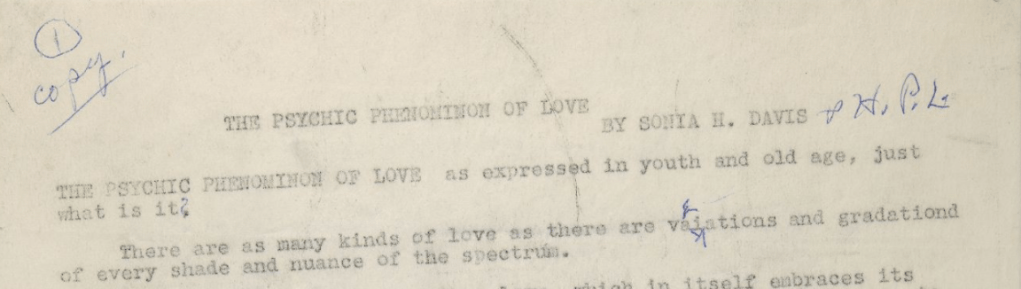
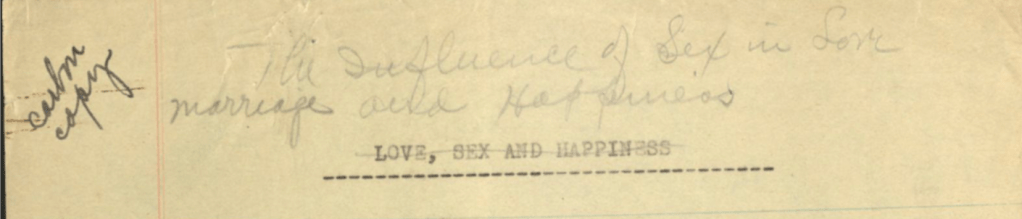
First and foremost, there are two copies of The Psychic Phenomenon of Love. They are both available in the Brown Digital Repository. The two copies begin in the same way, and yet one ends slightly different from the other. In the first version, a carbon copy, starts with a letter by Lovecraft referring to Sonia. It’s a typed letter that was transcribed and published in the Selected Letters; the essay follows immediately right after, and it reaches its conclusion with the sad reality of one who lives a life seeking only “free love”. However, she concludes on a somewhat hopeful note:
“We hear more of unhappiness in love and marriage than we do of happiness—except in novels and plays where both are plentiful; because unhappiness cries out loud its misery into the universe; it exhales its sad and bitter fumes upon the circumambient air disturbing the passerby as he approaches, but true happiness, ever serene, rests in the shady nooks of happy memories.”
Sonia H. Davis, The Psychic Phenomenon of Love, p. 5.
In the second version, a photocopy, starts immediately with the essay. It does not have the typed letter as the other copy. It continues just the same as the other, however, after that somewhat hopeful conclusion in the other, Sonia continues for two additional pages. Rather than focusing on the tragedy and consequences of seeking “free love”, she delves in the sacredness of marriage and parenting. She drives the point that even though many may be married and have children, it does not mean they understand the true blessing and beauty of each role. She concludes the essay with the overall goodness of those who appreciate their marriage and children, and how the unhappy envy its very sight, even if they don’t admit it to themselves.
“They have found what they wanted and they worship it among themselves, while the unhappy seekers are usually the snivellers who go about telling the world that their wives or the husbands, as the case may be, ‘do not understand them.’ And the unmarried hunters vent their perpetual hypochondriac plaints upon the universe in general. They always seem capable of producing perfectly good alibis for their riotous lives, but in the secrecy of their souls they envy the happily married, who are proud Fathers and Mothers to their children, as well as friends to each other, and good citizens + neighbors to their community in general. This can be accomplished only where the love impulse is a sacred one, and not one of biological necessity only.”
Sonia H. Davis, The Psychic Phenomenon of Love, p. 7.
On the back of this essay, Sonia wrote a small note, which means a great deal.

In The Psychic Phenomenon of Love, Sonia starts off the thesis with the very different types of love. There is the love for a mother, father, friends, arts, sciences, and so on. Each of these loves, although they each have a basis for existing, there’s an even deeper need in the human soul which goes beyond the physical.
“The great inner need in most of mankind is to love and be loved; that is—love entirely free from the sex-urge or sex-expression.”
Sonia H. Davis, The Psychic Phenomenon of Love, p. 1.
This statement alone is the very heart of The Psychic Phenomenon of Love and The Influence of Sex in Love, Marriage and Happiness. It’s this main point that reveals how identical these essays are, and with Lovecraft’s excerpts in The Psychic Phenomenon of Love, we are made aware of how similar in thought Lovecraft and Sonia were about love.
“Very often ostentatious passion belonging to the exquisteness [sic] of a few early years, is erroniously [sic] regarded as love and is essentialy [sic] incompatible with maturity.”
H.P. Lovecraft, The Psychic Phenomenon of Love, p. 2.
“The tragic mistake is in fancying that normal marriage can rest for any appreciable length of time on the erotic phenomenon of youth and novety [sic] so popularly termed “sex-appeal”. Now what about this erotic magnetism that hastens two incompatible persons into marriage, blinds them to each other’s true natures for a while, and then leaves them stranded on the rocks of boredom, misunderstanding and uncongeniality! And what is its relation to those finer marriages which actually do remain permanent, contented and inspiring? I am afraid we can never know until we rid ourselves of the illusion that sex and love are one; an illusion that the lighter writings and pseudo-science of the moment tend to bolster up.”
Sonia H. Davis, The Influence of Sex in Love, Marriage and Happiness, p. 15.
In each essay both Lovecraft and Sonia ventured to prove the profoundness of love. Unfortunately, love gets muddled or grouped as one with other types of casual affection. Lovecraft and Sonia strongly believed that love goes beyond the physical. To them, true love was not some flighty emotion exacted in passionate exertion— it went deeper than the flesh. True love is a mutual appreciation for another and their shared memories; an innocent love that does not focus on physical appeal, but rather on personality and intellectual attractiveness. This kind of love, in their opinion, can only be achieved by the length of years.
“There is a universal difference between the romances of youth and of maturity. By forty or perhaps fifty a wholesome replacement process begins to operate, and love attains calm, cool depths based on tender association beside which the erotic infatuation of youth takes on a certain shade of cheapness and degradation. Mature tranquillized love produces an idyllic fidelity which is a testimonial to its sincerity, purity and intensity.”
H.P. Lovecraft, The Psychic Phenomenon of Love, p. 3.
“If a man of delicately evolved sensibilities marry upon a basis of mental and spiritual equality, providing there be love and sufficient sympathetic and harmonious relationship between him and his choice, in the fields of the physical, the aesthetic and the cultural, he will find no need, as the years advance, to seek all over again his inspiration and ideal in some silly, bovine, flippant bobby-soxer. His ideals will have taken root where he first planted them, growing, flowering and richly expanding with the advance of the years, of which he enjoys the richest fruits.”
Sonia H. Davis, The Influence of Sex in Love, Marriage and Happiness, p. 8.
Like in The Psychic Phenomenon of Love, The Influence of Sex in Love, Marriage and Happiness talks about admiring physical attractiveness, and once again, Lovecraft and Sonia mirror one another’s opinion on the matter.
“Mature men and women might regard youthful beauty as an exquisite statue or carving, to be admired but not necessarily desired, while more mature or elderly persons would be regarded simply like themselves, interesting or otherwise, to be liked and admired or conversely—according to their personalities and sociability.”
H.P. Lovecraft, The Psychic Phenomenon of Love, p. 3.
“A man whose love is founded on such rare ideals would not exchange one gray hair of her belov’ed [sic] head for a veritable Venus. To him a youthful woman is simply to be admired in her proper place but not necessarily desired by him.”
Sonia H. Davis, The Influence of Sex in Love, Marriage and Happiness, p. 9.
The Influence of Sex in Love, Marriage and Happiness is Sonia’s argument to those whose only focus, whether in action or conversation, is sex. In contrast to The Psychic Phenomenon of Love, Sonia begins this massive essay with the exorbitant price for the sole pursuit of sex and “of its preposterous elusiveness”. She criticizes those who dwell incessantly on the topic, and how in reality, these people are actually poor in thought. If stripped of the element of sex, these persons lack the capability to socialize with others on an intellectual level. From this stance on the matter, Sonia weaves her real point which is also the same point in The Psychic Phenomenon of Love: a matured love is love in its truest form.
However, Sonia admits that even the elderly can fall victim to the sway of “free love” or the pursuit for a young lover. This concept is briefly touched on in The Psychic Phenomenon of Love while in The Influence of Sex in Love, Marriage and Happiness Sonia elaborates further.
“Then again, there is a species of man who, regardless of his advanced age, like Endimion [sic], although not asleep, flatters himself into believing that he is eternally young, and finds that he cannot be happy or even decently content unless he has at various times, some young woman near the age of twenty. Because of this self-deluded belief in his perennial youth, he often becomes susceptible to the questionably intoxicating glamour of the beautiful but mediocre scatter-brain.”
Sonia H. Davis, The Influence of Sex in Love, Marriage and Happiness, p. 10.
“Were our erstwhile Endimion [sic] to analyse himself, he would find that at his age, the period of emotional intoxication is past and he ought not to fancy that youthful beauty can forever be a stimulous [sic] to his jaded appetites. Time is time, and in settled middle age he ought to see that the only permanent foundation for a home is genuine companionship based on similarity of tastes and interests and the possession of a sufficient fund of shared information and enthusiasm to furnish a lifetime of congenial conversation independent of transient physical attractions and the lure of novelty and adventure. When a man does not wish to found a home on permanent companionship and mental congeniality, he will never be content with one home, long. True love for one’s companion easily engenders true love for one’s home, and such love has its innumerable roots and tendrils which, with the years become increasingly difficult to disentangle or destroy. Such love does not cheapen or debase itself by seeking changes in objects of affection; it is so deeply ingrained and becomes so inextrcably [sic] a part of its original objective that all the hopes and dreams and achievements of the lover become fully identified with the Belov’ed [sic].”
Sonia H. Davis, The Influence of Sex in Love, Marriage and Happiness, p. 11.
To Sonia, this is the most tragic: when an elderly person continues his or her conquest for “free love” rather than having appreciated the rewarding love of growing old with a spouse. In her eyes, such a person has no anchor and therefore will never be content if he or she is always seeking the false glimmer of adolescent love.
“He knows no true home to welcome him, no true love, no wife, no child, and in his old age he usually becomes a pitiable and despicable derelict of life; for life returns to him what he gave to it.”
Sonia H. Davis, The Psychic Phenomenon of Love, p. 4.
While The Psychic Phenomenon of Love focuses on love and its true form, The Influence of Sex in Love, Marriage and Happiness also focuses on the proper place of sex in love, and the consequences if it’s put in the place of love or other vital issues.
“I am not wholly unaware of the relative importance of sex in its rightful place in the life, welfare and happiness of the human species and therefore in society and civilization, and that its place is by no means insignificant, nor so unimportant as many of our puritanic censors would persuade us to believe; yet, that importance and its various phases need usurp no major part of our concern regarding its disposition.”
Sonia H. Davis, The Influence of Sex in Love, Marriage and Happiness, p. 3.
Although it is evident that Lovecraft and Sonia held the same views on love, the question that remains is at what point did Sonia finally realized its full significance in her own life? In her autobiography, Sonia relayed an epiphany which might have sparked these essays. Toward the last days of Nathaniel’s life, their interactions were becoming extremely emotional. In one exchange, Nathaniel told Sonia that he would always be with her, that only his body would be leaving her. To this she responded:
She would tell him that she could not imagine the real Nathaniel without a body.
“I want to hold you in my arms,” she would say. “I want to look at your beautiful head and eyes. I want to feel your kisses. I want to feel your arms around me. I want to see you at your typewriter, steal up behind you and kiss you, and you’d grab my hand, kiss it, and tell me how much you love me. I used to think that only the youth knew how to love, but youth will have to become old in body and young in mind and spirit to know how to love truly. I wish we had met when we were young.”
Two Hearts That Beat as One manuscript, p. 171.
Sonia had once assumed that only the young knew how to love, but much like her two essays, she came to understand and experience that true love could only become genuine once it has matured. Although neither of the essays have a clear date as to when she wrote them, it is safe to assume they were both written late in her life and about the same time, which is precisely why they are very similar to one another.
In some respects, Lovecraft and Sonia were a perfect match when it came to the theory of love. Regardless of their marital outcome, this is what love meant to the Lovecrafts. There remains so much more to be said about each essay, both in comparison and in contrast. However, the conclusion is The Psychic Phenomenon of Love and The Influence of Sex in Love, Marriage and Happiness deserve to be read and presented together, because where one lacks, the other provides.
 The Papers of Sonia H. Davis