Despite the radio silence on my part and this website, scholarship on Sonia has not wavered. In this special post, I wanted to highlight an article recently published in The Fossil, and newly discovered newspaper clippings, all of which adds another layer to the portrait of Sonia. Additionally, I’ll conclude the post with an update on An Ardent Recruit.
The Horror at Martin’s Beach
One evening while walking along this esplanade—the full moon reflecting its light in the water, a peculiar and unusual noise heard at a distance as of a loud snorting and grunting, the shimmering light forming a moon-path on the water, the round tops of the submerged piles in the water exposed a rope connecting them like a huge spider’s web—gave the vivid imagination full play for an interesting, weird tale.
Two Hearts That Beat as One, Sonia H. Davis, p. 99.
The object was some fifty feet in length, of roughly cylindrical shape, and about ten feet in diameter. It was unmistakably a gilled fish in its major affiliations; but with certain curious modifications, such as rudimentary forelegs and six-toed feet in place of pectorial fins, which prompted the widest speculation. Its extraordinary mouth, its thick and scaly hide, and its single, deep-set eye were wonders scarcely less remarkable than its colossal dimensions…
“The Invisible Monster”, Sonia H. Greene, H.P. Lovecraft, Something About Cats and Other Pieces, 1949, pp. 19–20.
The invisible monster in “The Horror at Martin’s Beach” has rarely been dissected in terms of scholarship. Even Sonia, when describing the night which inspired the story, failed to reveal what animal had caused the loud snorting and grunting sounds. “Sonia Greene and the Cape Ann Sea Serpent” by David Goudsward is the answer to the mystery. Despite the short length, the article fantastically compares and contrasts the Invisible Monster to the Cape Ann Sea Serpent. Not wishing to give too much away though, I believe the story needed this kind of analysis for some time, and with David’s knowledge in cryptozoology, the article brings a fresh perspective to “The Horror at Martin’s Beach”.
The newspaper was to Sonia, and to others of her time, what social media is to us. The newspaper was not only a platform for breaking news and/or information about current events, but it was also a space where the locals could announce or advertise to others. It was through newspaper clippings that we were able to learn what really happened between Racille and Solomon Moseson. [Rachel Moseson]. It’s the same way we’re getting to know Sonia as well, beyond the confines of her marriage to H.P. Lovecraft. There are periods in Sonia’s life that are still unaccounted for, much of which she remained silent about in her autobiographical writings.
The following clippings shed insight on Sonia in 1930 after her divorce from Lovecraft, and in 1935, when she was then living in California. A huge thank you to Bobby Derie for finding the clippings and sharing them with me.
Transcript:
“HAND PAINTED CARDS for all occasions. Sonia Greene, 368 E. 17th St. Flatbush 5632.” Brooklyn Eagle, Brooklyn, New York, Fri, Apr 25, 1930, page 29. [Newspaper.com]
Transcript:
Noisy, Needless ‘Extras’
“From time to time the streets of the Ditmas Park section are aroused late at night or just before midday on Sundays with “Extras” hawked by newsmen that are neither important nor interesting enough to warrant such nerve-wracking alarm at a time when the neighborhood is entitled to peace and quiet.
At 11 o’clock Sunday morning newsmen for another paper were shouting the “Extra” that I had already read both in the Times and the Brooklyn Eagle at a much earlier hour.
Cannot some measure be taken to check this needless attack by newsmen upon peaceful, quiet neighborhoods? Besides alarming the neighborhood needlessly it is an imposition that obtains money under false pretenses. I trust it can be curbed in the future.” Sonia H. Greene, Brooklyn Eagle, Brooklyn, New York, Wed, Jun 25, 1930, page 18. [Newspaper.com]
Transcript:
“MILLINERY—Hats of the highest grade imported, velour soleil, velvet or French felt, made to fit your head; copied after original models; also your own hats cleaned, blocked and remodeled equal to new at very reasonable prices, Sonia Greene, 809 Ocean ave., near Cortelyou rd. Flatbush 5632, Apt. 1-D” The Brooklyn Citizen, Brooklyn, New York, Sat, Oct 11, 1930, page 9. [Newspaper.com]
“The current events class of the Redondo Union Evening high school is to hear a talk on “National Progress” by Mrs. Sonia H. Greene, of the Utopian’s speakers bureau, in the library, tonight at 7 o’clock.
Everyone is cordially invited to attend this class, which is instructed by Miss Alma Squires. Many speakers have enlightened the students on current economical problems during the past semester. Mrs. Greene is one of the outstanding speakers of the Utopian society and consequently is expected to bring a message of vital importance to everyone.” The Daily Breeze, Torrance, California, Thu, Apr 25, 1935, page 2. [Newspaper.com]
An Ardent Recruit
With Two Hearts That Beat as One now being in the wild, the natural course was to begin the next book, An Ardent Recruit. An Ardent Recruit focuses on Sonia’s contributions to amateur journalism. Seven months into the writing process, I wish I was further along in the manuscript than where I’m at currently. However, the journey has been interesting, especially as materials emerge along the way, bringing more depth to the overall progress. The following image is the table of contents for the book, and while some of the chapter titles may be subjected to change, the order in which the information will be presented will remain the same.
I’m wrapping up Chapter 1.2, taking on additional reading to supply extra particulars to the chapter. I would like to clarify, though, An Ardent Recruit will not give an in-depth history on amateur journalism. I’m providing a bare-bones summary to give context. By understanding some key historical moments of amateur journalism, we can then understand the struggles of what Sonia dealt with as a participant in publishing her journal and later as president.
An Ardent Recruit is still very much in its infancy stage, but once the bulk of the historical context is written, the rest of the writing should be relatively easy. I will certainly post an update on the next milestone.
Although 2025 is halfway over, considerable progress has been made for Sonia this year. As much as I try to give Sonia some renown of her own outside of her association with Lovecraft, it’s through that very relationship which has kept her from falling into complete obscurity. As long as there’s interest in Lovecraft, so will there be for Sonia.
She was, first and foremost, a milliner. When the slow seasons between the high demand came around, Sonia had side jobs. The side jobs were either still within her trade, i.e., creating hats for neighbors and friends, or seasonal positions elsewhere. The Wall Street Crash of 1929, however, was the prelude to the Great Depression, and this was a season in which Sonia had not calculated into her financial security:
After I returned from Europe in 1932 where I went both for a business as well as a vacation trip, I found, upon my return to N.Y., that many of my heretofore successfully financial patrons had at last been caught up by the Wall St. debacle of 1929 + 30s and many of them were no longer able to pay the prices of my exclusive merchandise that they had enjoyed heretofore. While visiting many places of interest in Germany, England, + France I did not neglect the buying of millinery models to take back home with me; thinking that both French merchandise and copies of my models would more than pay for the expensive trip, but I calculated without the climate of the times. Many fashionable women among my clientele were no longer able to pay the prices they once did. Many of them owed me money and could not pay, and I did not feel that I wanted to sue them, since many of them were my friends.
Sonia H. Davis, Autobiographical Writings, Box 9, Folder 7, John Hay Library, Providence, RI.
In a country when needs would suddenly outweigh the wants, Sonia took a hit in her millinery. With no work, her funds were certainly dwindling, and she described a meeting with her banker that ultimately changed her trajectory:
My own misfortune did not pass me by until 1933, when I returned from Paris.
My banker, having noticed the depletion of my account, after having liquidated all my debts, called me into his office and asked me what I intended to do. Facetiously, I replied, “Not what several of the tycoons did when they lost their entire fortunes in Wall St. or elsewhere. I love life in all its phases. He asked what education did I have. I told him I had taken a cultural course at Columbia, but have no degree.
Did I know anything about early American history. “A little” I replied.
“How would you like to do some historical research, for a Diorama that is being planned by the members of the Metropolitan Museum?” he asked.
“I wouldn’t know how to go about it.” I said.
“I am one of the supporters of the Metropolitan Museum of History, and we are engaging artists and researchers for Early Colonial History.” You will get all the help you need from the Librarian of the children’s department which is in a separate building in Brooklyn.”
“I can try,” I said. “Very well” and he gave me a card with his name and occupation, and I went to Brooklyn’s Museum of Natural History, where I was engaged.
Sonia H. Davis, Autobiographical Writings, Box 9, Folder 8, John Hay Library, Providence, RI.
The dioramas were planned for the Brooklyn Children’s Museum, and according to the museum’s guide to the “Photograph Collection”, one folder contains photographs of dioramas that were created through the WPA. (1.2.4: Dioramas, 1906 – 1936, p. 7) The Works Progress Administration was a program created by Franklin Roosevelt on May 6, 1935, to help provide work during the Great Depression. (History) The exact month and day of when Sonia was hired as a historical researcher is unknown, but it was certainly in 1933.
Her scribbled notes as a historical researcher are included in the “Sonia H. and Nathaniel A. Davis papers” over at Brown University Library, but the notes themselves are not organized together in one specific folder. The first three pages, including the envelope, are in “Prose – M – R, Box 1, Folder 29”, while the last three pages are in “Autobiographical Writings, Box 9, Folder 1.” Nowhere else has her research papers been presented in their entirety—not even in her autobiography—until now:
Transcript:
The Roger Williams Historical Group
A plea for its completion according to the original plan.
In any series of historic groups chosen on the principles implied in the B’klyn [sic] Children’s Museum’s list, it is difficult to see how proper completeness can be attained without the inclusion of the model entitled
“Roger Williams speaks out for liberty before the New England Divines”
as provided for in the original plan.
It seems clear from the given list that the intention is to present certain typical, crucial moments and events in the formation of the American nation and attitude as they are today, and that the chief standard of selection is (apart from pictorial or dramatic vividness) the importance of these moments or events as decisive factors in the historic stream.
Thus there are groups representing the Indian background, the coming of the European, the victory of English civilization, the fixation of African Slavery, the vindication of a free press, the revolution, the establishment of the constitution, the enthronement of a democratic ideal under Jefferson, and so on down the years of the age of mechanical invention and wholesale immigration. Each of these groups depicts whatever active event seems most decisive or symbolic in connection with the national characteristic to be illustrated.
Now it would be difficult to name a national principle more basically, distinctively, importantly and influentially American than that of the separation of church and state. In its purest form it is an original product of American Soil, and one aspect or another of it has been dominant in the whole process of colonization and social and governmental development. More than anything else it is the distinguishing mark of this continent’s peculiar culture; and it has, in addition, reached back to the Old World to form a (monumental??), human attitude whose value is increasingly (illegible/missing word) every fresh historic development.
Above all other institutions which the sojourn of Europeans on American soil has produced, this assertion of the individual’s freedom of thought and opinion stands out as a salient landmark in the history of the United States and of world civilization alike. It is, then, unthinkable that some illustration of it should not be included within the present series of groups.
Now it is clear that any effective illustration of this all-important principle must come from the life of Roger Williams, whose precedence in proclaiming it in its entirety, and with all its implications, is plain and unchallenged. There is no ambiguity whatever about Williams’s place in history as a major pioneer in human thought and institutions, as the presence of his figure on the great international monument of the Reformation at Geneva, and of his bust in the American Hall of Fame, amply attests. The only real question concerns the particular episode in his career to be shown.
But even this question would be very easy to decide, for what scene could possibly be more directly, visibly and dramatically related to Roger Williams’s championship of the libertarian ideal than that of his open confrontation of the procedure at Newtown in October 1635? Here he dispelled all doubt of his position, openly defied the ruling powers of the Puritan Theocracy and publicly outlined his conception of the separate functions of church and state with a full realization of the consequences. This—unmistakably and conspicuously—was the Rubicon whose crossing led ultimately to the establishment of soul-liberty as a cornerstone of American governmental policy and a prime ideal of advanced humanity as a whole.
In the planning of the original museum list by Dr. Fox, this line of reasoning was very obviously followed; and it is hard to see how its cogency can be successfully challenged. Of all the long list of proposed groups, this one would seem to be the least capable of omission, substitution or variation. What then is the cause of the proposed departure from the original design?
The change, we are told, results from the reluctance of artists to model the substantial number of figures needed to represent the history-making scene at Newtown. It is alleged that something simpler in composition, and therefore easier of mechanical execution, would be a preferable choice. But has it been shown that these objections are valid enough to warrant the abandonment of anything as vital and pivotal as Roger Williams’s great dramatic moment as a subject for exhibition in a pageant of American historic essentials?
The list of titles prepared by Dr. Fox is a deeply and sensitively intelligent one—one obviously prompted by a profound understanding of history and a keen perception of its vital moments. Nothing on it ought to be changed without the maturest reflection; least of all this crucial item which concerns not only an unique and paramount principle in American and worldwide thought, but one of the great colonizing geniuses who established the nation and helped to give it its solid foundation of material and spiritual life.
The writer therefore asks, with all due humbleness that the scene of Roger Williams’s great ordeal be not excised from the museum’s programme unless the really gravest objections be found to stand in the way of its inclusion.
It represents something supreme and not to be replaced, and deserves from researchers, artists and planners alike a willing, indomitable, constructive zeal reflecting something of the vision and stamina of its great subject.
S.H.G.
John Fiske “The Dutch + Quaker Colonies in America”
Isaac Sharpless “History of Quaker Government”
Johns Hopkins University Studies of “Pennsylvania History”
Vol. 10, pp. 381 – 464 “Quakers in Pennsylvania
J.F. Sachse “German Protists of Provincial Pennsylvania.”
J.F. Sachse “The Fatherland” 1450 to 1700
John T. Faris “Old Churches + Meeting Houses” Lib. Bklyn Ch. Mus.
American Architecture (A.R. 727 – 12) 3” flr. Pratt Lib.
+Early Domestic Architecture of Pennsylvania by Eleanor Raymond 3 flr. Pratt
American Architecture (724.9 – E. 15) 3 flr. Pratt.
Phila. Academy of Fine Arts (A.R. 708.1 – L857) 3” flr. ”
Phila. Historic Houses, Colonial Homes 917.48, E. 16 “ ”
*Mitting “Furniture of the Pilgrim Century” 3 flr. Pratt
Suggestion for (possible) living-room or “saal” in home of Pastorius
Two-armed bench standing against wall.
Single board seat and single board back.
Either two-board table with heavy, unfinished legs or table of trestle-board and frame.
Reference for the former
(Pl. 2) (Plate 5 + 7) (Plate 51)
“Early Domestic Architecture of Pennsylvania” E. Raymond+
Ref. for latter “Furniture of the Pilgrim” Mitting* pages 214, 343, 438
Suggested desk, page 116.
Beams exposed in ceiling (suggestion)
Floor probably sand-covered, or rugs woven by the Indians.
The excerpt from Whittier on former page might suggest a more elaborate household; if used for model, probably the “kitchen from Müller House, Millbach, Lebanon County, Pa. German 1752.” Card appended.
But if Penn called on Pastorius while he was still a bachelor, his home probably was furnished in more primitive taste.
Of his life of ‘domestic felicity’ is portrayed, then it will be required that his wife—and at least the first child—(a boy) be included, on a little bed or in a cradle; and Van Wyck clock on stone hearth. Fire.
If Penn visits Pastorius while he is a bachelor it would probably be in the house he built that was “30 ft. long + 15 ft. wide with oil-papered windows” probably gambrel-roofed+, (+ or primitive Gothic) made of the rough logs of wood, from the trees hewed down on the spot where it stood. These logs were probably exposed inside the house as well as outside.
Over the door reads the legend “Procul Este Prophani.”
See “Old Churches + Meeting Houses” by John T. Faris opposite page 176. (Library, Bklyn Children’s Museum)
“The Log College of Reverend William Tennent near Hartsville”
“Old Churches and Meeting Houses in + Around Philadelphia”
The Germans are very fond of garden-seats; and nearly all their homes have benches, stools or chairs, and tables—either directly—outside the door or removed, some feet, from it, in the centre of the garden where there is a shelter or rest.
Might not Penn have been received outside the door, if he called on him in summer? Perhaps seated at either side of table with tankards of beer?
Pastorius was seven years younger than Penn.
For design of house see “The Log College of Rev. William Tennent near Hartsville”, in “Old Churches and Meeting – Places” by John T. Faris opposite page 176. Lib. Bklyn Chld. Mus.
The Germans are very fond of garden seats. Two might be shown in front of the house on either side of the entrance.
Pastorius is seven years younger than Penn and Anna is 7 years younger than Pastorius.
The floor was probably made of huge, broad beams hewn from the same timber as the logs from which the rest of the cottage was built.
It may have been covered daily with clean sand, a utilitarian custom of that day; but it is also not unreasonable to believe that may have been adorned with rugs supplied by the friendly Indians who owed much to Pastorius’ knowledge of medicine.
Sonia was not silent about her experience as a historical researcher, and she described her impressions of the work itself and working with the Curator-in-Chief, Miss Anna Billings Gallup:
I was given a sheet of paper with subjects named, for which I was to search out all I could regarding “Roger Williams Speaks Out for Liberty Before the New England Divines.” I must have read at least 20 books on the life of R.W. I found it most interesting and enchanting. The Banker, Mr. P, told me it did not pay much, but enough to keep the wolf from the door. I accepted the job with alacrity and loved it. When I read all I could find on the subject, beside the reading matter, I drew a chart to illustrate the scene.
The Trial took place in “Newtown.” Well, I was obliged to find where “Newtown” was, once upon a time. It was on the ground where Harvard University stands. The courtroom was a wooden building with a sand floor. It had two diamond-paned windows in the eastern wall, if I remember. Between the windows, fastened to the wall was the Union Jack.”
For a lecturn [sic], before which the Judges sat, I sketched a line, in back of which were their chairs. From there I drew nine lines Thus:
on each I had placed the name of the Judge in the order in which they sat. The presiding Judge behind the table.
I had to find the page in a certain volume describing the age, and gown of each, etc. When all was finished, the Curator, Miss Gallup, said “You have too many figures.” Why don’t you have R.W. run away through the woods? That would be enough. I couldn’t change her mind. I pleaded with her. I said “This was his big moment; standing before the Divines and before his accuser, Thomas Hooker.
But she had it her way.
My second subject was intensely interesting “Francis Daniel Pastorius” meets William Penn in Germantown, Pa.”
This time the ‘personae dramatis were properly dressed and the scenery was correct except the Skulkill [sic] River was left out. The third subject was “Patrick Henry” in “Give Me Liberty or Give Me Death.
Sonia H. Davis, Autobiographical Writings, Box 9, Folder 8, John Hay Library, Providence, RI.
Sonia was adamant about her group’s research on Roger Williams, and her written plea from her research notes verifies her disagreement with Gallup in the autobiographical account. In the midst of this opportunity, Sonia felt the need to reconnect with H.P. Lovecraft. It is thus we have these excerpts from her memoir:
Upon my return to the U.S.A. I became quite ill. Upon recuperating I took a trip to beautiful Farmington, Conn. I was so enchanted with this beautiful Colonial built city that I wrote to Howard at once to join me there which he did. We explored not only the rare city of Farmington whose architecture, at that time even the newest, such as the Library and the new Bank and Chamber of Commerce, was of the early eighteenth century, but we went to Weathersfield, [sic] that ancient shrine where we paid our homage to the Church where George Washington worshipped, and to Thomas Hooker’s grave and other graves and places of historic character and interest.
[…]
Where was I? Oh, yes, back from Europe and once more in New England with Howard at my side exploring the grounds and places of cities more than three hundred years old. Yes, I believe I must have still loved Howard very much, more than I cared to admit even to myself.
[…]
When Howard and I parted for the night I said “Howard, won’t you kiss me goodnight?” His reply was “No, it is better not to.” The next morning we met again and explored Hartford.
At that time I was doing some historical research work for the Brooklyn Children’s Museum. Among the several pieces I was delegated to do was was [sic]one called “Roger Williams Speaks out for Liberty before the New England Divines.” Much of the research was done in the Fifth Ave. and Forty-Second St. Librarry [sic] in N.Y.C. But when I told HP what I had been doing along this line and would like more data he graciously led me to the Hartford Library and at once got busy inquiring for original books and hawling [sic]down tomes for me from the shelves. The sculptors at the Brooklyn Museum were then to make the figurines and the other scenery depicting the history included in my research. In parting for the night, I no longer asked for the kiss. I’d learned my lesson well. I did several pieces of research for the Museum, which is a branch of the Metropolitan; among others was one of great interest yet hardly heard of in the public High Schools, namely: “Francis Daniel Pastorius meets William Penn in Germantown, Pa. But since at that time historical research was not properly remunerative work, I returned to my own.
Sonia H. Davis, The Private Life of Howard Phillips Lovecraft, unedited manuscript, John Hay Library, Providence, RI.
As much of a blessing this job might’ve been for Sonia, especially at time when there was little work to be had, the pay wasn’t enough for long term means.
On my free time I was still seeking a millinery Buyership, found one at a much better figure than that as a historical researcher worker, and accepted it.
Both Miss Gallup and the Librarian expressed their sincere regrets at my leaving. I accepted my new job in August, in Newberg, N.Y. in 1933, worked there until one day before Christmas.
Sonia H. Davis, Autobiographical Writings, Box 9, Folder 8, John Hay Library, Providence, RI.
What followed after that Christmas of 1933 would be Sonia’s decision to visit California, leaving for that trip on January 6, 1934. (FamilySearch) While visiting, she decided to remain in California and after settling and remarrying, her life in New York would remain a distant memory. What was past, however, would inevitably become her present again. After Nathaniel Davis’s death, Sonia was financially struggling. Coincidence or not, Sonia penned the following letter to Anna Gallup during the time she began her reminiscences of Lovecraft. In fact, she wrote this very letter while visiting New York on the same day she was responding to August Derleth’s threats about not publishing her memoir The Private Life of H.P. Lovecraft.
Transcript:
Sept. 13, 1947
My Dear Miss Gallup: —
First of all I wish to apologize for using this paper, but there is none other available at this moment.
You will be utterly surprised when you will see the signature of the writer.
Fourteen years ago I did some historical research work in the Brooklyn Children’s Museum at the time you were the curator.
You gave me a list of captions that I researched. I left the museum because once more a good buyership in my own line was open to me.
However, I was able to finish the “Roger Williams speaks out for Liberty before the New England Divines”
“Patrick Henry”, and Francis Daniel Pastorius meets William Penn.
You were very kind to praise these pieces, and you asked me which I liked best. I told you I loved historical research and was glad to be privileged to work for you.
I loved all the pieces I wrote but my favorite character was Roger Williams.
I said I hoped you would find it feasible to have the scenes made as I had written them.
You read it, told me it was fine, but instead of concentrating on the court scene when he was tried before the N.E. Divines, that it would entail less work to show him as he was fleeing from his enemies.
I pleaded with you to give his memory the full meed of credit that he deserved, that the trail scene depicted the “Big Moment” in his life and was the most interesting part of his life and history. I wonder whether you recall it!
However, I came back to N.Y. after 14 years, for a visit, a very short one, only two weeks.
I had wondered whether these scenes were ever made. What was my delight and surprise upon visiting the museum two days ago to find the three scenes there, even if you did order the one of R.W. with the least number of figures.
I just love the Pastorius + Penn, it is utterly splendid.
And the Patrick Henry is almost faultless! (The pulpit was up high in the actual church, but the artist made it on a level with the floor. But all in all they are splendid.
I spent a pleasant half-hour with Miss Sheppen and asked her for photograph reproductions, but she had none.
However, she promised to try to get them. Now here is where I wish to ask you for a very great favor, would you be good enough to state on paper, i.e. in a letter to me that I was the researcher? It would probably mean a life time job for me in the cinema field, a field most difficult to enter.
If you will be good enough to make your statement on this sheet and also return the rest of this letter I would appreciate it abundantly. (This would be my credential.) I would consider it a great favor indeed.
With every good wish for your health and prosperity, and many thanks in anticipation of your favor, I am
Very Sincerely Yours
Sonia (Greene) Davis.
P.S. You will see by the added surname that I was married. My dear late husband passed away two years ago. And please write me about yourself!
Mrs. Sonia (Greene) Davis, according to her own statement was one of the research workers on a series of historical groups in American History. I cannot recall the circumstances but I believe Mrs. Davis is correct because she recalls in detail the composition of the groups much better than I can do. I sincerely hope this statement will help her because I know she had to do good work in order for us to make the groups.
I was Curator-in-Chief of The Brooklyn Children’s Museum at the time the groups were made and we had consultants who helped us with the details of accuracy.
Very truly yours,
(Miss) Anna Billings Gallup
Sonia direly needed a job, and she was lining up whatever opportunity she could that would bring the necessary funds. Not only was she corresponding with Derleth during the trip, but they met also with her hopes of selling her memoir for as much as she could.
Meanwhile, did I tell you Sonia Lovecraft Davis turned up with some laughable idea of cashing in on HPL’s “fame” and the desire to publish a “frank” book, entitled THE PRIVATE LIFE OF H. P. LOVECRAFT, and quoting generously from his letters. She read me part of the ms. in New York, and in it she has HPL posing as a Jew-baiter (she is Jewish), she says she completely supported HPL for the years 1924 to 1932, and so on, all bare-faced lies. I startled her considerably when I told her we had a detailed account of their life together in HPL’s letters to Mrs. Clark. I also forbade her to use any quotations from HPL’s letters without approval from us, acting for the estate. I told her by all means to write her book and I would read it, but it was pathetically funny; she thought she could get rich on the book. She said it would sell easily a million copies! Can you beat it! I tried to point out that a biographical book on HPL by myself, out two years, had not yet sold 1000 copies, and that book combined two well-known literary names. She thought she should have $500 advance on her book as a gift, and royalties besides! I burst into impolite laughter, I fear.
August Derleth to R.H. Barlow, October 23, 1947, Wisconsin Historical Society.
Returning to the main thread, however, Sonia’s letter to Anna Gallup perfectly correlates with what has been written in her autobiographical writings. It’s unclear what aspect of cinema Sonia was trying to break into, but if I had to speculate, it likely had to do with set designing since her job as a historical researcher was a foundation for the creation of the dioramas. What’s sad about the letter is Anna’s reply. Given the scale of the project, it’s easy to understand why Anna might’ve forgotten Sonia. The Brooklyn Children’s Museum, however, remembered Sonia and her work, for they had her research papers in their archives for some time prior to sending them back to her.
Anna was still kind of enough to respond to Sonia:
Transcript:
Dear Mrs. Davis:
Please forgive this long delay in answering your letter. I went to Boston—and did not order my mail forwarded because I knew I would be moving about. All the accumulation during my absence just had to wait and I am sorry your letter was among the others. I do hope you will get the position you are seeking.
I have been retired ten years and I am sorry I cannot remember you or your work. There were so many—but I feel pretty sure you are correct in all you say.
I went to live with my brother who had a beautiful home. He had just lost his wife and I went right in there and took charge of everything. He had two excellent Swedish maids and a good farmer. We lived in the country, had a car and a very pleasant life. I really expected to stay with him always. He was younger than I but had an exceptional flair for making the land produce bountifully and was quoted in many papers all over the land. In the Middle West and East he did much catering and had a book started for which the New York Editors were pushing him. My sister too, in Waterbury, Conn. (we lived in North Stonington Conn.) was a widow and we planned trips together. We did take some but in 1945 both dropped off very suddenly within a few months of each other. I was heartbroken and came here to Mystic to live. I didn’t wish to stay in a log house in the country and I didn’t know how to drive a car. I came to Mystic because I know some people here and I thought a small town would be fine. Now I have my own apartment and I like it very much though my brother and sister were two people too choice to lose. I have two nieces and a nephew and four grand nieces and nephews. I was much recuperated by coming to Mystic and now am all right. I very much want to go to California and shall do it when I find the right companions. There are people out there whom I know. I have been once.
Now I do hope you will have excellent success with your undertaking.
Yours very truly,
Anna Billings Gallup
Anna Billings Gallup was born on November 9, 1872, in Ledyard, Connecticut. Her parents were Christopher Milton Gallup and Hannah Eliza Lamb. (FamilySearch) Christopher was a farmer while her mother took care of the household. (FamilySearch) Anna was the middle child, with an older sister and a younger brother. Her sister, Harriet Tooker Gallup, was born on March 29, 1869. Harriet married Darragh de Lancey on October 30, 1897, having three daughters and a son. (FamilySearch) Although, that bit of information conflicts with what Anna wrote about having two nieces and a nephew. Anna’s brother, Christopher Milton Gallup III, was born on February 10, 1876. He married as well, marrying Christine Richmond Ewing on October 28, 1899, and it appears the couple didn’t have children. (FamilySearch)
Anna remained single but pursued a career as curator. In the 1905 New York Census for the Brooklyn, Kings borough, she was rooming with Florence Kilburn and was already listed as a curator for the Brooklyn Children’s Museum. (FamilySearch) Then in the 1910 census, she moved in with her mother, Hannah Gallup, residing in Brooklyn, Kings. (FamilySearch) As her letter reveals, Harriet passed away May 16, 1945, while her brother, Christopher, passed away on December 27, 1945. Yale University published an obituary for Christopher (FamilySearch):
Transcript:
CHRISTOPHER MILTON GALLUP
PH B 1897
Born February 10, 1876, in Ledyard, Conn
Died December 27, 1945, in Westerly, RI
Father, Christopher Milton Gallup, a farmer in Ledyard, son of Christopher Milton and Anna Stanton (Billings) Gallup of Ledyard Mother, Hannah Eliza (Lamb) Gallup, daughter of Samuel Stillman and Eliza (Gallup) Lamb of Groton, Conn Yale relatives include Nathan Gallup (B A 1823) (great -uncle), Herbert S Griggs, ’82, C Milton Griggs, ’83, and Everett G Griggs, ’90 S (cousins), Darragh de Lancey (B F A 1925) (brother-in-law), Darragh de Lancey, Jr (LL B 1932) (nephew)
Norwich (Conn) Free Academy
Enlisted as seaman Second Division Naval Battalion, Connecticut National Guard, April, 1897, served aboard receiving ship Minnesota, Boston harbor, discharged August 6, 1898, on staff City Engineer (in charge of pavements), Hartford, Conn, 1898–1903, free lance writer and editor Somerset Independent, Skowhegan, Maine, 1903–05, editor Maine Farmer, Augusta, 1905–10, underwriter Travelers Insurance Company, Hartford, 1913 until retirement 1928, resided in North Stonington, Conn, 1928–45, experimented with new biochemical methods of agriculture especially suited to Connecticut, promoted radio weather service for farmers, secretary New London County Farm Bureau, representative from Connecticut on forestry committee of New England Council, member board and president Connecticut Forest and Park Association 1940–45, president West Hartford Chamber of Commerce 1922 and on advisory council Proportional Representation League, West Hartford, acting secretary Norwich Chamber of Commerce 1931–33 and vice-president, chairman board of assessors North Stonington 1941–45, in World War I chairman West Hartford Savings Committee and in World War II vice-chairman Selective Service Board 20B, organized, and president Gallup Family Association for several years, trustee Denison Family Association, on forty-five year Class reunion committee, member First Church of Christ Scientist, Boston.
Married (1) October 28, 1899, in Hartford, Christine Richmond, daughter of the Honorable Henry C Ewing and Rachael Whittier (Root) Ewing No children Mrs Gallup died June 17, 1937 Married (2) February 28, 1940, in Norwich, Ruth Kinney Gaines, daughter of Charles Newcomb and Julia Huntington (Hutchinson) Kinney
Death due to coronary occlusion Buried in Gallup Cemetery, Ledyard Survived by wife and a sister, Anna Billings Gallup (B S Massachusetts Inst Technology 1901) of Mystic, Conn.
At the age of 83, Anna Billings Gallup passed away on October 21, 1956.
Ultimately, Sonia neither got the cinema job nor her hundreds of dollars for her memoir of H.P. Lovecraft. Instead, she studied to become a nurse:
With Ann’s And [sic] Sid’s frequent help I got along. I went to a nursing school and was so glad when I could write to Sid and Ann that I thanked God I could now make my own living as a nurse. I worked until I was seventy two years old.
Sonia to Sidney, Florence, and Leonore Moseson, August 25, 1964, Autobiographical Writings, Box 9, File 1, John Hay Library, Providence, RI.
Even after everything came and passed, Sonia certainly loved her job as a historical researcher because she loved learning. We can now see how much work she incorporated into the simple position, and because of it, we also get to learn about Anna Gallup and her role as curator. Moreover, this opportunity gave Sonia another chance to spend with Lovecraft, which sadly would be the last. Sonia’s time as a historical researcher was both the closing of one chapter of her life and the promise of a new chapter.
Very little has been said, or written, about Florence Carol Greene. Even her own mother, Sonia H. Davis, had imparted minuscule crumbs of information about her. In Sonia’s autobiographical writings, Florence is only specifically mentioned during the turbulent years of Sonia’s marriage to Samuel Greene, and she’s majorly referred to as the “little girl”, “baby”, or “child”. Of the twenty-two times that Florence is mentioned by Sonia, only nine times does Sonia use her actual name. In Sonia’s letters to her family, which also contain autobiographical matter, Florence is mentioned again only in passing as “child” or “baby girl”.
However, this is only one side of the coin, figuratively speaking. In two essays regarding children’s behavior and manners, Sonia gave further insight:
Transcript:
HOW I OVERCAME CHILD’S FEAR OF THE BOOGIE MAN
A detailed description how a diffficulty [sic] was met and dissipated, might be helpful to some mothers in vanquishing a young child’s bedtime fear.
At three and a half years of age my little girl suffered from fright caused by the maid, who, in seeking to get away from her quickly after putting her to bed, told her that if she didn’t go to sleep at once, the Boogie Man would get her.
On the maid’s night out, I put the child to bed and as soon as I was about to leave the room and put out the light she started to whimper, and then to cry. Upon asking the reason, she told me she was afraid of the Boogi [sic] Man; that Mary said the Boogie Man would get her if she didn’t go to sleep right away.
I realized at once what the child was suffering and forthwith tried to conquor [sic] the fear.
“What does the Boogie Man do, darling?” I asked her.
“When Mary puts out the light he knocks on the bed. I’m afraid of the dark.”
While the light was still on, I rapped on the bed with my knuckles.
“Is this the noise he makes?” “Yes.” Then I shaped her hand into a fist and had her knock on the bed.
“See, darling?” This is no Boogie Man. Its your own hand making the noise when you knock.” Then I took her in my arms and put out the light, holding her tightly to convey assurance, I knocked on the bed again. At this she clung to me very hard. Turning on the light, I requested her to put it out.
“See, dear? It was you who put out the light. Now give me your hand.” Here I brought her hand into contact with the bed.
“See? It was your hand knocking on the bed that made the noise.
There is no Boogie Man.”
“Now get into bed like a brave little girl and knock on the bed.”
This was done, while I spoke to her softly and reassuringly, and I put on the light once more. “Now I’m going to put out the light again and you knock on the bed. While she did this I kept on talking to her caressingly, constantly impressing upon ger mind that there is no Boogie Man and that there was nothing whatsoever to fear in the whole house; that everything and everybody was safe, and that Mary was only fooling.
I followed this practice several evenings for nearly a week, reassuring her each time of the true facts. I found that she both understood and appreciated the fraud that was practiced on her by Mary. Gradually she outgrew all childich [sic] fears and became a self-confident and self-reliant young woman. I need hardly state that the maid was dismissed.
Transcript:
EXAMPLE CREATES BEST OF MANNERS IN CHILDREN
The excessive effort brought to bear upon a child in order to develop politeness is often wasted, and the ostensible intention is often resented by the youngster, especially when it is coerced, shamed or bribed into being forcibly polite. This attribute the child must acquire from habitual observation of his family elders in his own home.
Unless he sees and hears the best only, in and from his parents and home environment he usually acts like the street urchin. Parents, or other members of the family, cannot be constantly quarreling, arguing, acting or speaking sarcastically without producing decidedly malevolent effects upon the children.
My little girl of three years of age came to me one afternoon and asked me to give her a piece of bread and butter. When I think of it now, I realize that this is what I should have done; but instead, I sent her to the maid in the kitchen, telling her to ask Mary for it. She soon returned, munching the morsel. “Did you say ‘Thank you’ to Mary? I asked her. Silently and not looking at me, she continued munching.
After waiting a few seconds I repeated my question. Still not looking up at me, she slowly shook her head in the negative. “What?” I asked with pretended indignation, “Didn’t you say “Thank you” to Mary?” Pouting a while, she then answered “Don’t have to say “Thank you” to Mary.”
“Why not, dear?”
“‘Cause Mary don’t know how to say “You’re welcome”, any how.”
This was said almost protestingly; Mary had lately landed and could speak no English.
If one must have a maid or a nurse, it is best to acquire one who speaks English unless another language is to be part of the child’s education. Then it is desirable that the governess or tutor be a purist in the language the child is to learn.
The last point is particularly to be observed. A European gentlewoman who speaks several Mediterranean languages, is constantly horrified in this country by the bad accent and ungrammatical French of nurses who are engaged by American mothers.
Many mothers seem to think that as long as her child speaks a desirable secondary language, that the mantle of distinction descends upon it.
A Young American, who, for three years, had studied French in one of our mid-western universities, told me, upon his return, that he was unable to understand the language when he visited France, that he remained their two years to acquire the correct pronunciation and accent.
Another great source of information about Florence was Sonia’s letter to the Special Collections Librarian, Christine D. Hathaway. Sonia openly shared anecdotes about Florence, from her cutest moment to her ultimate rebellion. The following is only an extract from the several-page letter.
When “Carol Weld” whose real name is “Florence Carol Greene,” was a child of about ten, I was engaged to an extremely handsome young Italian of excellent family, education and breeding, but I, being of Jewish heritage, and he, of Catholic, our mothers, his and mine objected to our marriage. We were both obliged to renounce the thought and action.
I’ve always sought a man of education, culture, and inquiring mind, good family and other virtues. I was 24—he was 22. I studied the Italian language and learned to read, write and speak a little. He often ate at my mother’s table and I, at his mother’s who liked and admired me very much, but she did not quite guess whether her son and I intended to marry. When both mothers found out there were the usual objections on both sides. Neither of us would do the usual—elope. We at last gave up the thought.
One day Florence met him on the street; he grabbed her up, folded her to himself and ‘boo-hood’ like a hurt animal. When she came home and told me what happened, I felt sorry for both of them. She asked me, aren’t you going to marry F.B?
I said “No, his mother and grama have great objections.” I’m getting over my part, but evidently, he is still badly hurt.
The child was very young but had sense enough to say—for she was very fond of him—Well! if he’ll wait for me I’ll marry him!” As she grew up I obtained a good music-teacher for her, but she wouldn’t practice. Her lower teeth were crooked, but she missed many sessions with her orthdontist [sic].
In both cases I scolded and we became more and more apart. I wanted her to go to college, but she didn’t want a local college. She had a girl-friend who urged her to join her at a girls’ college in Rochchester [sic]N.Y. where they were taught games and rode horses. I told her we had Columbia U, here in N.Y. and I can’t afford to pay for her pleasures. We quarrelled again over that girl. At last she left me and I hadn’t heard from her in years. She learned stenography + typewriting and made her own living.
I looked for Florence everywhere. I heard she went to Chicago. I took a job so I might find her, but I didn’t.
I had a friend who worked in the Hall of Records in N.Y.C. I asked her whether she could obtain some important information for me so I told her I was looking for my daughter; giving her the name and age. She found the name in the Hall of Records. She went to Paris where she became a newspaper writer for the Hearst newspaper, lived there for seven years. On the Boat, going there, she met a young American newspaper-man and they married; but it seems that her temper was unable to hold on to the man, so they were divorced in Paris, but she stayed on. He came back to America, married and now has a newspaper of his own, and interests in a moving picture project.
My daughter still carries his name. She no longer writes, but has formed a Woman’s Club of some sort, and lives in Florida. I’ve obtained her address and have written to her several times. The first two letters were returned to me unopened and unanswered. But I wrote several others, which she accepted but has not answered. She is now 67 years old, never married again. That’s all there is.
Sonia H. Davis to Christine D. Hathaway, October, 8, 1968, Autobiographical Writings (Box 9, Folder 1).
It is only through this letter and the personal essays that we get a real glimpse into Sonia’s relationship with Florence. It would seem their mother-daughter relationship had once been solid, but as years progressed and with that inner rage (or sheer stubbornness) of youth within Florence, their relationship began to come apart. While no one openly claimed it, except by Sonia, Florence seemed to have a temper.
Yet, how much of her temper was a result of years of unresolved trauma? As a child, Florence had not only lived under the roof of Samuel Greene, but had also been sent to live with her grandmother, Racille, aka Rachel Moseson, while Sonia tried to separate from Samuel. We can only imagine what she had witnessed living under the roof of two abusive men: first with her father, Samuel, and later with her grandfather, Solomon Moseson. The former abused her mother, and the latter, her grandmother.
Eventually, Sonia collected Florence and they lived together once again. In spite of the turbulence between Sonia and Florence through the latter’s adolescent years, Sonia wrote and dedicated a poem to her daughter in the first volume of her journal, The Rainbow:
Sonia H. Greene, “Ode to Florence”, The Rainbow, Vol. 1. No. 1, 1921, p. 3.
Transcript:
ODE TO FLORENCE
When the sun sinks in the west, dear,
Birds and babes have gone to rest, dear,
Then I know I love you best, dear
Baby mine.
When the stars break in the blue, dear,
Then with love my heart beats true, dear,
Then I sadly think of you, dear
Baby mine.
When the moon is brightly beaming,
On the night her radiance streaming,
Then, dear heart, of you I’m dreaming,
Baby mine.
When Aurora greets the morn, dear,
When sweet zephyrs cool are born, dear,
I feel lonely and forlorn, dear
Heart, for you.
There’s no denying the unspoken heartache of Sonia’s words. The poem was printed in October 1921, but one can only wonder just how long Sonia had been constructing these poetic lines to help ease the strain between her relationship with Florence. 1921 was a pivotal year for Sonia, from joining amateur journalism in January, to meeting H.P. Lovecraft in July, then publishing her own amateur journal in October. Lovecraft certainly harbored some impressions about Florence:
At dinner—about one-thirty—were Loveman, Theobald, Long, Mme. Greene, and the latter’s flapper offspring, yclept Florence—a pert, spoiled, and ultra-independent infant rather more hard-boiled of visage than her benignant mater.
H.P. Lovecraft to Maurice W. Moe, Lord of a Visible World, May 18, 1922, p. 115.
But one thing Mme. Greeneva says quite desolates me—she avers that her fair & frivolous offspring is not to be captivated by the charms of any highbrow, not even the otherwise irresistible Bolingbroke!
H.P. Lovecraft to Rheinhart Kleiner, Letters to Rheinhart Kleiner and Others, p. 187.
Whether intentional or not, once Sonia’s relationship with Lovecraft deepened, Florence had dropped out of the picture. It’s unclear when Florence moved out of her mother’s house, but once Lovecraft moved in with Sonia in March 1924, she was gone. Thereafter, Florence went by her middle name, Carol. On September 3, 1927, Carol Greene had returned to New York from Havre, France. (FamilySearch) It’s hard to say how long her stay was at Havre, but this trip would only be the beginning of her extensive travels to Europe. Only ten days after her return, on September 13, 1927, Carol married John Weld. (FamilySearch)
So, what really happened? What caused the ultimate division between Sonia and Florence? The truth is no one really knows. There’s only Sonia’s truth and speculation.
In 1983, the one and only publication that has ever fully focused on Florence was Lovecraft’s Daughter by R. Alain Everts. “Lovecraft’s Daughter” comprises of three, extremely thin, stapled pamphlets. Legally, Florence was Lovecraft’s stepdaughter when he married Sonia. However, it was an empty title, a role that Lovecraft never truly stepped into, nor one that Florence fully accepted. The journal, in my opinion, does well to inform the reader of who Florence really was, and her achievements in life. While it’s the most anyone has done for her, it still isn’t enough, but that’s no fault of the publication given that Florence worked hard to distance herself from her past and live privately.
I have only the first and second volume in my possession since these were the only two that emerged for sale on eBay.
Transcript:
LOVECRAFT’S DAUGHTER
When Carol Weld died, the newspaper reported the following facts about her long life:
MRS. CAROL WELD, COVERED ABDICATION
Carol Weld, former foreign news correspondent, who claimed to be the first American to report the Prince of Wales-Wallis Simpson romance years before the Prince’s abdication as King Edward VIII, died Saturday in Cedars of Lebanon Hospital.
Mrs. Weld, 70, reported from Paris to The Chicago Tribune on the abdication. She was the only American reporter who met the Prince’s train at a small village railroad station as some 200 other newsmen, misled by offical-released [sic] rumors, waited miles away at Chaumont.
During her career, Mrs. Weld wrote for The New York American and The New York Herald-Tribune, the Paris staff of The Chicago Tribune, Universal and International News Services, United Press International and The London Sunday Express.
She came to Miami as southeastern director of advertising and publicity for RKO Radio Pictures, setting campaigns for RKO, Samuel Goldwyn and Walt Disney Productions.
Services will be at 10 a.m. Thursday in Miami Memorial Park. Reid-Lowe Funeral Home is handling arrangements.
Not only is the notice pitifully brief and lacking in factual information, but the information that was there is for the most part toally [sic] inaccurate. The inaccuracies were not, however, the fault of the newspaper or the author of the obituary, but were carefully perpetrated by the subject of the notice—Carol Weld. For Carol Weld had a secret that she protected and hid for over 50 years.
No mention is made above the parentage ofCarol [sic] Weld, who was in fact the daughter—albeit the step-daughter—of Howard Phillips Lovecraft. She was born Florence Carol Greene in New York City on 19 March 1902, of Samuel Greene and Sonia Haft Shafirkin. Her mother, Sonia Shafirkin, was barely 20 years old, and had been married for four years to her despotic and drunken husband, who was a salesman. Some years after the birth of their only child, Greene killed himself, leaving Sonia destitute—she and her daughter went to live with Sonia’s mother, who had married a second time and had children not much older than Florence.
By 1919, when Sonia first became acquainted with the Amateur Press movement and with James Ferdinand Morton, junior, her 17 year old daughter was living with her in New York City, and was beginning to show signs of rebellion against her mother’s stern rule as puberty overtook the young woman. When Sonia met Lovecraft in 1921 and began her earnest courtship of him in 1922, Florenne [sic] was there—the 19 year old “flapper” as HPL referred to her also began to have problems of a more serious nature with her mother. Sonia recalled to me various dinners at her apartment with both Lovecraft and Samuel Loveman present, where she and Florence would host them for an evening of food and conversation. On some occasions, Sonia and Florence would disagree so strongly that they would fight in front of their guests. By the time of Sonia’s marriage to Lovecraft in March of 1924, Florence had left her mother’s apartment and her mother’s life for good—it is likely even that she left the day she turned 21 on 19 March 1923.
What was the cause of this terrible breach that was never ever healed or repaired, even after 50 years? The facts lay in the marriage of her mother to Lovecraft, and the adamant denial of permission for Florence to marry the man she loved. Some years earlier, I believe Sonia mentioned to me that Florence was about 18, she had fallen in love with a nice man with background credentials of impeccable quality—they should have been, for the man was Sonia’s half-brother, by her mother’s second marriage. Florence was practically raised with her half-brother Sydney, [sic] and it was fairly easy for her to fall in love with him. However, Sonia was furious, not only with the prospect of her own daughter marrying at a young age as did Sonia with the resultant disasters, but the fact of her daughter marrying a near full brother made Sonia so livid that she absolutely forbade the match. This argument was a topic for several years, but by the time Sydney turned 21 in middle 1919, Florence was still obeying her mother’s wishes.
Further more, [sic] as Sonia reported to me, such a marriage is not allowed under the Orthodox Jewish faith which both Sonia and her daughter were at this time. Florence though told her mother that she would elope, and Sonia told her that she would have the marriage annulled if Florence did elope before she was 21. These demands of her mother were very bitter for Florence, who was genuinely in love with her half-uncle Sydney—but the final straw was Sonia’s own marriage to Howard P. Lovecraft in early 1924. This convinced Florence that she must separate from her mother, and she did—never again did she ever communicate with Sonia. When I wrote on Sonia’s behalf in 1967 to Carol Weld (as she then styled herself), the letter was returned to me, opened, with a handwritten message that the envelope had been opened by mistake. I will never forget Sonia’s expression when I showed her this envelope, and she replied sadly that the handwriting was Florence’s.
From this period onward, Florence dropped her first name, and went under the name of Carol Greene, until she met a 22 year old newspaper man named John Weld and they wer e [sic] married in New York City in October of 1927. They separated by mutual agreement (they never had children) in Paris in 1932 and in 1933, John Weld obtained a divorce on the grounds of incompatability [sic] in Los Angeles. Carol Weld however stayed in Europe, never remarried, and never discuss her relationship with her mother, not even with John Weld. He told me that “Carol was in no wise a flighty of rebellious girl” when they met in 1927, but that her relationship with her mother seemed to be a closet that Carol preferred to leave closed.
From then on, Carol Weld made her name as a writer and reporter—she was indeed the first American reporter to cover the romance between Mrs. Simpson and the Prince of Wales, and during the War, she covered many stories, organised a Red Cross Ambulance Fund in Los Angeles (where ironically her mother was then living) and had her photo appear in the May, 1945 issue of The New York Times—a clipping that Sonia proudly showed me in 1967. An attempt to contact her daughter at this time went unanswered.
But Sonia followed the career of her daughter from afar and seemed to have some idea of what she had done during the years. For about the last 30 years of her life, Carol Weld worked for RKO in Miami—and significantly enough, her half-brother Sydney was living there when Carol moved there, although he had married and raised a family. Surely this was the reason that Carol Weld moved to Florida—for over 30 years they lived only blocks apart. But, Carol never would contact her own mother or have anything to do with her, even after nearly a half-century. And when she died, nothing at all about her parents, and nearly nothing factual appeared in the obituary.
She was 77 years old when she died on 1 April 1979—even though The New York Times gave her age as 65. For a brief while, she had been nearly a daughter to Lovecraft, and from 1924 until her marriage to John Weld, she was his step-daughter.
Transcript:
LOVECRAFT’S DAUGHTER – II
In the first part of my essay on the daughter of Sonia Greene Lovecraft, and the step-daughter of Howard Phillips Lovecraft, I discussed some of the efforts at subterfuge by Carol Weld, actually Florence Carol (Greene) Weld (1902 – 1979) to hide her parentage and to avoid any reference to her origins. Erroneously, I stated that her date of death was 1 April 1979 which would have, under the circumstances, been a very fitting date for her to have died on—April Fool’s Day— as Carol was so set on fooling everyone about her background.
Her death certificate indicates that she in fact died on 31 March 1979, less than a fortnight after her birthday, her 77 th [sic] birthday, not her 71 st [sic] birthday. March if you recall was the very month that Sonia and HPL were married in, and that was the month that HPL died in. At the time of her death, Carol trimmed 6 years from her date of birth, and after spending one week in the hsopital, [sic] she declined to provide any information for their records, although she must have known that this bout with her serious emphysema might prove fatal. After her demise, it was her lawyer who provided the information on her death certificate, and Carol’s parentage was apparently not known to her personal lawyer.
Her lawyer also indicated to me that she did not know of any surviving kin to Carol, totally unaware that Carol’s half-brother Sydney was living in Miami.
Carol’s lawyer could only give me one name of a friend of Carol—her literary agent. The lawyer did however send me two snapshots of Carol Weld, which I have reprinted. Shortly before her death, Carol did donate her papers to the University of Wyoming, where they considered her to be “Miss” Carol Weld, and conspicuously there is no biographical information about her life in the Carol Weld Collection in the Archive of Contemporary History. In the Collection however are a number of books autographed to Carol Weld, from Evan Allen Bartlett (LOVE MURDERS OF HARRY F. POWERS), Edna Lee Booker (NEWS IS MY JOB), George Seldes (CAN THESE THINGS BE!), and many paperbacks from Paris during the 1930’s and many items from the Overseas Press Club that Carol had been a member of for so many years.
There are also several booklets in the Collection written by Carol Weld, amazingly enough along the exact same topics that Carol’s mother had written about. SECRETS OF BEING WELL-DRESSED was published by Carol in 1937, and quite a few of her unpublished manuscripts also repose in the Carol Weld Collection: DEADLINE, 114 pages, THE ‘DUMB’ CELEBRITIES, 233 pages, about animals in the news, a topic that Carol was fascinated with her entire life, THE FRENCH CAFE, 279 pages, MARIGOLD, OR THE PINK ELEPHANT, 181 pages, THE WANDERERS, 31 pages, WINGS OF MERCY, co-authored with Kenneth Higgins, 36 pages, and WOMAN’S PLACE IS IN THE HOME, 27 pages. The sole published hardcover book that appeared in Carol’s life was ANIMALS ARE LIKE THAT! (New York, McBride and Co., 1939) that she wrote with the famous hunter Frank Buck.
Evidence in the Weld Collection indicates that Carol was very well known in the American Expatriate Colony that lived in Paris during the 1920’s and 1930’s. Lastly, there are 6 uncatalogued and unindexed scrapbooks of her writings and articles—these round out the last few items of Carol’s long life and career. And, nary a clew [sic] to her true origins, nor any hint of her parents or her most famous step-father.
This is the first source, and perhaps the only source, in which we get this theory of Florence being in love with her uncle, Sidney Moseson—Sonia’s half-brother. I can’t neither accept nor deny this notion to be true, only because Sonia never claimed it to be the reason why they had their fallout. However, Sonia had been interviewed by Everts, and she had spent enough time with him that just maybe this theory was a hard truth she revealed in confidence. There’s also the likelihood of a slight confusion since Sidney had fallen in love and married a young woman named Florence Stone on March 25, 1923. (FamilySearch) Could Everts have easily confused one Florence for another? Probably or probably not. One thing is true: Carol had moved down to Miami, which was not far from Sidney and his family. However, this doesn’t mean she was in love with him but could easily mean she valued him as her closest family. They were practically raised together.
Another interesting anecdote is the argument between Sonia and Florence while Lovecraft and Samuel Loveman were visiting. The only time this incident could’ve occurred with both Samuel Loveman and H.P. Lovecraft around was in April 1922. Sonia had initially invited Loveman to visit New York, and when he did, but did not find it enticing enough to stay, she invited Lovecraft to keep him company. Sonia had turned over her place to them, while she stayed over at her neighbor’s home. This could mean that Florence had also joined Sonia in staying with their neighbor or somewhere else at a friend’s house, or Florence had already moved out, but was still visiting Sonia. Sadly, we’ll never knew what drove these two women to disagree with one another to the point of argument in front of others.
After marrying, John and Carol Weld moved to Paris. In a set of three letters to R. Alain Everts, John Weld gives insight to his relationship with Carol:
Transcript:
Dear Mr. Kirsch:
You might be able to locate Carol Weld through the Overseas Press Club, 54 West 40th st., New York I8, N.Y. I believe she was a founding member and I would presume she still belongs to the organization.
I never did know Carol’s mother, though I believe she lived in Brooklyn while Carol and I were living in Manhattan. There seemed to have been some estrangement between them. I’m afraid I do not have any photograph of Carol, mainly because, when we separated in Paris, in 1932 I left all of my possessions with her. I have not seen her since.
We were married in New York in October, 1927, as I recall, though the exact date I do not remember. My birthdate is February 24, 1905, and you may find some biographical material in Who’s Who in the West. Carol and I had no children. Our separation was by mutual agreement and I was granted a divorce on the grounds of incompatibility in Los Angeles in 1933. So far as I know Carol has not remarried, but then I would not have known of it if she had probably.
It interests me that you are writing the biography of Carol’s mother. Was (is) she someone of note?
Transcript:
Dear Mr. Kirsch:
It seems that we are working up quite a correspondence about Carol Greene Weld. We met in 1927 when we were working as reporters on Hearst’s New York American. I never did understand Carol’s relationship with her mother, and indeed we never discussed it; it seemed to be a closet she preferred to leave closed. Carol in no wise was a flighty or rebellious girl and certainly in my opinion she was not promiscuous, certainly not in a sexual sense.
You say that Mrs. Davis “was one of the first to support the Amateur Press movement”. What was that? I’ve never heard of it.
Good luck with your manuscript.
Transcript:
Dear Mr. Kirsch:
Do drop in when you’re down this way. Better call me though before you come.
Knowing Carol’s attitude toward her mother, I am not surprised that she refuses to cooperate with you. No, I do not have any photographs of Carol—as I told you, when I left Paris in 1932 I left all of my personal effects with her. However, my sister may have a snapshot or so. I’ll ask her.
Carol does appear to have remained in Europe until 1936, after which she went back and forth from the U.S. to Europe throughout 1936 and into 1937. (FamilySearch, 1936, 1937) Perhaps their failed marriage was a result of incompatibility, but Sonia believed it was her bad attitude that ruined the marriage. As mentioned before, it’s quite possible Carol had a temper, and when you have snippets such as the following newspaper clipping, it’s easy to see her strong will and force at play.
The Miami News, January 13, 1959, p. 21. Source: newspapers.com
Transcript:
(Photo Caption: “The trial is through, but not Miss Carol Weld. Gives arresting officer Bob Kirby a few pointers.”)
The Lady Fights Well
This is Justice?
Justice, justice, cried Carol Weld, lifting her hands and her adverbs to the heavens. Guilty, said the judge, wiping a weary brow.
But she fought the good fight in Miami Beach’s traffic court today, did Miss Weld, a writer—oh, a prolific writer indeed, and one of vast, if futile, resource.
She weighed in with a firm “Not Guilty!” and waving a sheaf of verbiage, clenching a martyred jaw. And she departed waving an indignant finger, banners tattered but flying.
The Cause?
Cause of all this commotion, which left even Judge A.H. Saperstein somewhat awed? Of what heinous misdeed was she accused? Well, this policeman, Bob Kirby, had the temerity to say she went through a stop light…
And Miss Weld felt the light was yellow—on this firm foundation she based her cause, and she spoke of violation of civil rights and she touched on deprivation of livelihood and she waxed eloquently on matters of learned law.
“But…” said the judge. “Listen…” said the judge. “I submit…” said the judge.
Judge Gives Up
The judge then leaned back with the wisdom of resignation and some 25 minutes later managed a lecture on traffic safety, fined her the usual $10 but, in obvious admiration, knocked off the $4 court costs.
Miss Weld departed with her writing, a sheaf of it, a detailed explanation of Florida traffic law which had taken her hours to prepare, enough copy—in another medium—to provide two weeks groceries on the open market.
For Officer Kirby, a sneer.
For an idealistic questioner, a stern wise-up:
“No, it wasn’t just the principle. It was the money.”
Throughout the years, Sonia never gave up searching for Carol. In the summer or fall of 1926, Sonia got a job in Chicago. While she claimed the job paid better, Sonia also believed getting the job would help her find Carol, since she thought her daughter was living there at the time. Sadly, Sonia was not aware of the whole truth regarding that bit of information: Carol was working for the Chicago Tribune, but in Paris—not in Chicago. Apparently, though, Sonia’s nephew, Martin K. Kopp mentioned something about a possible meeting in San Francisco between the two women:
I also heard that Sonia located Florence, who, as I remember it, was living in the San Francisco area. This was after World War II. They finally met. It was a disaster, and Sonia returned to the Los Angeles area, and never discussed the matter again.
Sonia never mentioned or wrote about meeting Florence in San Francisco after World War II. She did, however, elaborate on a job she got in San Francisco where she stayed there from 1935 to 1936. Perhaps Sonia mixed the years, or she actually made a second trek to San Francisco to meet Florence.
The truth of the matter is we will never know.
The Courier-Journal, March 17, 1940, p. 22. Source: newspapers.com
Transcript:
Carol Weld, Writer, Is Avisiting
By Dot Tellitall
There is a lass in our town and she’s had wondrous fun… She’s avisiting with Jane Dixon Wells, and she has had the kind of experiences that make our mouth water. Her name is Carol Weld, and she is on leave from being a foreign newspaper correspondent.
Most of Carol’s experiences were picked up somewhere in France, where she worked for the Chicago Tribune and the United Press during all those exciting months before the war. When she was quizzed about her keen nose for news, she modestly gave all the credit to her dog, “Ric,” a smooth-haired fox terrier, now deceased, who covered all her assignments with her.
“He was really a news hound,” said Carol, “and usually beat me to most of my stories.” One of the chief methods of getting news in Paris is to make the rounds of all the swank bars where the continental American hangs out and which are hodge-podges for news. “Ric” knew the bars as well as his mistress and knew the sequence in which she took them in, so he often used to precede her to each bar. When people saw the dog they would know that Carol was coming along and she turned up usually about a half-hour behind him. “Ric,” said Carol, “interviewed all the famous people in Paris.” It is a very delicate subject, that of poor little “Rickie’s” death by an automobile.
She’s Also An Author
Carol Weld is the co-author with Frank Buck of a popular book called “Animals Are Like That.” She also is one of the twenty famous newspaper people, like H.V. Kaltenborn, who each contributed a chapter to the best seller, “The Inside Story.” Carol’s chapter is called “King Bites Dog.” She expects to be in Louisville about a week. She’s young and pretty and particularly is enjoying Kentucky food.
Don’t look now, Palmer Van Arsdale, ’cause here’s a picture of the little woman, Carolyn, having lunch with a friend in Los Angeles. She certainly looks well.
Los Angeles Evening Citizen News, September 3, 1940, p. 9. Source: newspapers.com
Transcript:
Carol Weld sends me pictures of the kinds of ambulances Americans are buying to ship to England, and a long letter which says in part: “I have been so overworked trying to raise funds for ambulances to send to Great Britain—for General De Gaulle’s Free French Forces, the British Red Cross, the Mechanized Transport Corps, the Scottish Red Cross and the free Polish, Czech and Norwegian forces in England, that I have only now been able to get around to comment on your “British Notes” column—not that you asked for any comments. It is just, of course, that you are right to the point, where occasionally even someone like myself, who is working to send ambulances, wonders why the British here are not more eager to help. Do you suppose it’s because each one wants to run his own little show more than he really wants to help Great Britain?… the money raised in America to help our less fortunate friends over there could be circulated in American industry—an idea which is not easy to sell to those various people you write about.” Carol Weld is West Coast representative of the British Ambulance Corps.
We will never know what truly broke the bond between Sonia and Florence. There was undealt trauma between them, beyond them, and maybe that’s just what caused the division. Maybe Sonia wanted humble beginnings and opportunities, while Carol wanted the whole world on a platter, and that in itself is reason for clashing. At the end of the day, though, Florence wanted to distance herself from her parents, from her past, choosing a new identity, a new self, where she could be whoever she wished. As a result of that decision, we are left with such a scarcity of biographical means that makes it impossible to get to knew her fully like we know her mother, and even her stepfather.
If you wish to learn more about Carol Weld, her papers are located in the University of Wyoming. The collection contains the correspondence and writings of Carol, but half of it is in French. You may read the overview of the collection by clicking on the link below:
The official organ fund has received rather an impetus through the learned but eccentric human phonograph Mrs. Greene, who was at the National convention. After receiving United papers she instantly became an ardent United partisan—began to correspond with Galpin and subscribed fifty dollars to the fund!
H.P. Lovecraft to Winifred Virginia Jackson, August 7, 1921, Letters to Rheinhart Kleiner and Others, p. 331-332.
In 1959, Alfred Galpin’s memoir of H.P. Lovecraft, “Memories of a Friendship”, was published in The Shuttered Room and Other Pieces by Arkham House. The Brown Digital Repository has the original manuscript available with corrections by Galpin and August Derleth. What makes this manuscript unique is for its recollections of Sonia, at least in the original. (I can’t speak for the published text in The Shuttered Room.) In page 11 of the manuscript, Galpin describes Sonia’s visit to Madison, Wisconsin:
When she dropped in on my reserved and bookish student life at Madison, I felt like an English sparrow transfixed by a cobra. Junoesque and commanding, with superb dark eyes and hair, she was too regal to be a Dostoievski [sic] character and seemed rather a heroine from some of the most martial pages of War and Peace. Proclaiming the glory of the free and enlightened human personality, she declared herself a person unique in depth and intensity of passion and urged me to Write, to Do, to Create.
Alfred Galpin, 1916 – 1937: Memories of a Friendship, p. 11, John Hay Library.
What had originally inspired this visit was Galpin’s love for Russian literature. After having read a condensed version of Crime and Punishment, Galpin was preparing to read Dostoyevsky’s novel in all its entirety when Sonia initially wrote to him.
In her incidental correspondance [sic] with me she found that besides by fondness for Nietzsche I was even fonder of Dostoievski, [sic] and it was this discovery (the Russians were not so generally in style in those days) that urged her to meet me in person.
Alfred Galpin, 1916 – 1937: Memories of a Friendship, p. 10, John Hay Library.
It was in this meeting that Sonia described some of her hardships with Samuel Greene:
It seems that her first marriage in Russia had been most unhappy, to a man of brutal character; quarrels became bitter. “Let me tell you, Alfred, things have happened to me that never, NEVER happened before to ANY LIVING CREATURE ON EARTH!” In one of their quarrels—the last?—“I walked to the window,” which looked down x.. stories to the street, “and I said Georgi Fedorovitch, IF YOU TAKE ONE STEP FORWARD, I SHALL HURL MYSELF FROM THIS WINDOW!
Alfred Galpin, 1916 – 1937: Memories of a Friendship, p. 11, John Hay Library.
This anecdote of her threatening to jump out of the window has for many years been misconstrued. Originally when I began studying her life, this manuscript was the first I read surrounding her marriage to Samuel. While I didn’t know it at the time, the proper context behind this anecdote was missing. Without it, she sounds rather unhinged. This quarrel between Samuel and Sonia was certainly not the last, but only the beginning of their relationship. There are two manuscripts in which she elaborated on her courtship with Samuel. In the first, there’s no passage describing this window incident. However, in the second, she left the account in the narrative with a handwritten note relaying her uncertainty about leaving or deleting the scene. According to Sonia, this quarrel occurred on February 11, 1899, going into the morning of Abraham Lincoln’s birthday.
Autobiographical Writings (Box 9, Folder 6), John Hay Library. “Mrs. Hathaway” was Christine D. Hathaway, the Special Collections Librarian of Brown University. Given the autobiographical nature of Sonia’s letters to her, it would seem that Mrs. Hathaway had considered writing and/or publishing Sonia’s biography.
When writing to August Derleth, Sonia corrected Galpin’s account in The Shuttered Room:
Thanks a million for Book #2. By the way—in Book #1 Alfred Galpin made quite an error (not that it matters) he said I was married in Russia. I was married in N.Y.C. to a Russian.
Sonia H. Davis to August Derleth, March 29, 1968, Wisconsin Historical Society.
Learning this anecdote from Galpin, Frank Belknap Long apparently found the idea of her threatening to jump out of the window quite amusing.
Sonia could sometimes dramatize some particular event in her life out of all reason, in a wholly melodramatic way. I am indebted to Alfred Galpin for the following amusing story, which she related to him when they met in Madison, Wisconsin the year before.
When she was in her early twenties a young admirer succeeded in convincing himself that her virtue was not unassailable. When she invited him to her home following a theater engagement for a cup of Russian tea, he made a daring proposal, with seduction uppermost in his mind. She had just turned from the window after throwing the casement wide, and the apartment was several stories above the street.
Her immediate response was: “Ivan Ivanowich”—or whatever his name was!—“if you take one step nearer I shall hurl myself from this window!”
I have never doubted that she might well have carried out the threat, and one can readily imagine into what a state of agitation that particular suitor must have been plunged.
Frank Belknap Long, Howard Phillips Lovecraft: Dreamer on the Nightside, pp. 48-49.
Although we don’t have Galpin’s in-depth thoughts or feelings when she described the window incident to him, we can clearly see Long’s ignorance showing through the ordeal. He was downplaying, even if it was unknowingly, the abuse that Sonia endured—perhaps her personality had been a little extreme, but Long’s sympathy on “that particular suitor” just shows how Lovecraft’s friends viewed her through the lens of a man’s world.
Transcription:
536 College Ave.,
Appleton, nWis., [sic]
Monday, August 8.
My dear Mrs. Greene:
I see that my outburst of rhetoric had a better influence than might be feared. You see, I’m subject to such throes of verbology, and in such circumstances I always hasten to remove its achievements before I destroy them. I believe I went down the line of history and compared friend Friedrich to everybody from Christ toSwinburne.***Would [sic] that I could remain mad always, but my ordinary judgments are soaked with mediocrity, level-headedness, and most detestable sanity. As a matter of fact, I regard Nietzsche largely from the utilitarian point of view—he is a wonderful opener of minds and and profound, an eternal voice of antinomianism I like to call him, as you do, the Great Destroyer. He would have worshiped Kubla Khan and that mad son of his who prowled East Europe, glorying in the destruction of allthat [sic] past classic centuries had built.
I suppose it is necessary to take him with a bit of humor despite his own more than Poe-esque offenses against the spirit of mockery. His ideas were at once sublime and ridiculous. But what a pleasure it is to dig in his priceless store of epigrams and ideas, and gather them together with the hope of hurling them at some pompous old prelate!
Nietzsche probably over-estimated mere manners, the aristocratic substitute for morals. Personally, I have so recently extricated myself from Dial snobbery and Oscar Wilde aestheticism that I am still afraid of my own views, but I shouldn’t like to blame either the masses or nobility, or chance either, for great men. They are the fruit of some process hidden entirely from us, and who knows but that it may be hidden fromthe [sic] gods? They must have their own rights, but whether or not they insist upon them is not necessarily a gauge of their greatness. Greatness of soul, an entirely different thing, is of course the humility of Whitman—Chesterton in “Heretics” deals rather cleverly with types of great men but his view is rather mechanical. Genius can descend to any one, the temperament is merely its trademark. I think the particular reference is to be found in the portion of “The Wit of Whistler,” with collaterial [sic] material in “Mr. Wells and the Giants.”
I finished my “immortal thesis” in the deuce of a hurry and it is rather an amateurish piece of work—ridiculously inadequate as philosophy, and unpolished in what is more important tome, the style. I have sent my only spare copy (at present) to Lovecraft and told him to let you read it. If you want a copy of the thing let me know and I can send you one later. On the other hand, Lovecraft may be able to find some amateur willing to print the thing—as you say, most people are lamentably ignorant of Nietzsche and I’m sure they will overlook the faults of my essay. As a matter of fact, it requires a more than American stage of decency and civilization to understand the simple predication “Nietzsche lived.”
Will you pardon my impertinence if I venture the guess that you are Russian? I derive it merely from your terseness of style, your love of the masses, and the “Sonia?” If you are, do tell me how Dostoyevsky reads in the original. I am reading his “Crime and Punishment” for the second time this summer. And tellme [sic] also what is best to read of Tolstoy, Gorky, and Turgenev—I believe that Andreyev and Tchekov [sic] have sense enough to be less wordy. Judging from appearance, Tolstoy ought to be popular in the land of the free, for I have never seen anything that looked duller or more insistently moralistic.
I am reading right now Stendhal’s “Le Rouge et Le Noir,” which seems to have influence Nietzsche so profoundly. Must read his “Vie de Napoleon” if I find time. Anent Shakespeare, try Frank Harris’ “The Man Shakespeare”—I suppose you see “Pearson’s Magazine.” Farewell Alfred Galpin, Jr.
This response seems to be Galpin’s second letter to Sonia, which to us, feels more like the first. Especially given this is the first letter that gives proof to their correspondence. The majority of the letter focuses on Friedrich Nietzsche, a German philosopher. The topic must’ve naturally arisen in their correspondence because Lovecraft had revealed in the “News Notes” section of The United Amateur 21 that Sonia had originally been a fan of Nietzsche:
Coming at an early age to the United States, [Sonia] acquired a remarkable degree of erudition mainly through her own initiative; being now a master of several languages and deeply read in all the literatures and philosophies of modern Europe. Probably no more thorough student of Continental literature has ever held membership in amateurdom, whilst our many philosophical members will note with interest her position as a former Nietzschean who has at present rejected the theories of the celebrated iconoclast.
H.P. Lovecraft, Collected Essays1: Amateur Journalism, p. 299.
According to Sonia, she had first learned of Nietzsche through “Kay”, a gentleman she met at a ball.
Kay and [Sonia] had talked about all the Russian writers and poets, then he introduced her to more writers, this time to the mad Friedrich Nietzsche.
Sonia H. Davis, Two Hearts That Beat as One, p. 104.
Who exactly is “Kay”? I don’t have the slightest idea, and Sonia made it a point to leave this man in utter obscurity throughout all her letters and autobiographical writings. He is only mentioned as “Kay”. Regardless of who it may have been, he was very much like Samuel Greene, introducing her to new writers, which would later on give her the confidence to speak knowledgeably on such matters.
Galpin’s disappointment must have been apparent upon receiving her reply, or while conversing in person, that she did not read the Russian classics in their native language. When writing “Russian American’s Views on the Russian Writers” for The Brooklyn Daily Eagle in 1933, this was Sonia had to say:
To split hairs in the controversy whether Willa Cather can prove that the Russians write the truth about themselves is of minor importance, but as a Russo-American who has lived 40 years in America and only 7 in Russia I should be inclined toward Miss Cather’s side. Never having learned to read Russian in Russia, I was obliged to read what I know of them in English. In comparison with the prolific Russians, the American output is indeed meagre.
Sonia H. Greene (Lovecraft), “Russian American’s Views on the Russian Writers”, The Brooklyn Daily Eagle, May 12, 1933, p. 18.
It’s a very neat little editorial, in which she compares influences between Russian, American, and French literature, and how these groups of writers accepted one another’s work regardless of nation. “Russian American’s Views on the Russian Writers” can be found at “Newspaper.com”.
Thus, continuing on this thread, it’s very likely that after Galpin mentioned Tolstoy in his letter, Sonia described the lecture she attended regarding the Russian novelist. In the only surviving letter from Sonia to Lovecraft, she recounted her thoughts and feelings about it:
One evening a few years ago, I went to Carnegie Hall to hear the son of the great Tolstoi. [sic] I was eager to hear ofmhim [sic] from one who was at once his son, friend and exponent. You may imagine my disappointment when I found him to be a mediocre individual with nothing more striking and original to offer than the proper usage of words and phrases, with quotations interspersed; without casting one ray of light upon Tolstoi [sic] other than had already been gleaned from his books and biographies.
Sonia H. Greene to H.P. Lovecraft, August 1, 1921, John Hay Library.
“One evening a few years ago” was in fact January 19, 1917, a Friday evening. The J.B. Pond Lyceum presented Count Ilya Tolstoy, who was lecturing in America at the time. His presentation, “The Life and Ideals of My Father”, was to be a personal discourse on his father’s legacy. The synopsis of the program indeed sounded very promising, especially when considering the information was to be presented by one of Tolstoy’s many sons. However, if one was well read in the writer’s life, perhaps much of what was shared was repetitive, in which case it’s understandable why Sonia was disappointed especially if she was hoping for new biographical views of Tolstoy. The full program (12 pages) may be viewed at: Carnegie Hall.
Transcription:
Fish-trap Lake, Sunday afternoon, Sept. 4.
Dear Mrs. Greene:
My unnatural silence during the past lustrum has been caused by circumstances so sudden as to be almost beyond my volition. Friday night, way back in August, I returned from a motor jauntwith [sic] a car-owning friend and about eleven o’clock was invitedto [sic] go fishing with two younger scions of Appleton’s nobility—the tour to commence the following noon. I had never been up north nor caught any fish except three suckers and a perch in my life—but all the better reason, said I! I have had my important mail forwarded to the nearest post-offices, and got your letter as I passed through Crandon on the way up here. I haven’t caught anything yet but am having a decent enough time, getting well tanned [sic] andcoming [sic] into contactwith [sic] some excellent manifestations of the novelty of the oldest dame of all, Mater Terra.***Mother [sic] wrote me Friday that your book hadcome, [sic] and so I thank you once more. I shall do so at greater length when I get home and readit. [sic]
I believe I got rid of myself pretty well in my last letter—I have found it positively dull to be egotistic ever since, that is in an introspective sense. But since there is little else to discuss I’ll tell you a little about camp—in the first place, I read “The Red Laugh” on the way up and thought it almost perfect as an expression of “Horror and madness….” God putrescent, what a mind that man must have had! He was much like Poe in his fundamental nature, but seems to have suffered all the brooding dread of isolation and the worst sides of reality. He seems to have little idealism left in him, unless|pessimism [sic] be such. But it is interesting and give me one of them for all the Pollyannas ever spewed! I didn’t like the sudden decline in “h.a.m” in the second part, which in other hands would have become an outright oration against war. I think he could have abbreviated it and not left the effect of those utterly inimitable first portions to have been lost. I shall never forget the doctor’s description of “we merry free men” dancing over the red fires of civilization, or of the regiments on the same side fighting each other, or the red laugh. I am now reading the complete version of Dostoyevsky’s masterpiece, and I can’t remember when I have read anything better except Lear and Hamlet. Do you remember Marmeladov in the tavern?
**Besides [sic] that, I have been writing letters to Loveman and the Lomo pair rather constantly, and have read “The Importance of Being Earnest” and Thompson’s essay on Shelley, also from my ten-cent series. Both of them are masterpieces—you must look upthat [sic] Appeal to Reason popular series. I have glimpsed bear and deer, eaten trout, pickerel, and muskellunge, learned how to cast, eaten regularly instead of between meals for once in my life, and spent four hours trying to find my way back from the nearby post-office Friday.
As for the “Brass Chek”—are you sure I didn’t mention that in one of my previous letters? Popular education is rot but I wish every one [sic] in the country could read that. It is greater than anything the abolitionists ever did, and for ten thousand times a better cause—damn niggers anyhow, but damn the press thrice! I know, for I have probably had as much experience in the writing and reporting end of the ordinary-sized town as any one of my age—they are too small to be crooked, but ugh!!!! You mustn’t mind my swearing, I am too expert at it to forswear it. You should have heard me drag Jehovah around by the hair of his beard when I got lost Friday…I wish I could remember some of that line.
Would that I could, with a merry thud, strike your metropolis, and would twice it might be this winter, but nay nay. When I get any extra money it will either go into a.j. or books, until it starts coming by the thousand. Some time, however, I may come East on some magazine and I shall certainly see you if I can, then. I have rather a pull with H.L. Mencken, and was extremely flattered by his criticism of my Modern Mood. Just now I am on my masterpiece, which has rather a—er—pagan plot. An oriental sheik whose race worships the number seven so contrives the management of his harem that he has seven offspring conceived in a single night. They turn out mostly to be sons (maybe all, that depends) and in some way or other to which I have committed myself, they bring to ruination a great kingdom. The style will take weeks to perfect, and the irony shall be more subtle than Anatole France…let us hope, at least. My sheet is now used up. Hope I can get this to the post-office soon. Thank you again for Shaw.
Sincerely,
A.G.Jr.
The Red Laugh was a novella written by Leonid Andreyev and published in 1904. Since Andreyev never experienced real life frontline combat, The Red Laugh is mainly a hallucinatory portrait of warfare and its psychological impacts. The story follows a soldier whose testimony of war are laid out in nineteen fragments, and it is through his crumbling sanity that we perceive the madness and horrors of the battlefield. (Russophile Reads) Another one of Andreyev’s notable stories is “Lazarus” which was translated and reprinted in Famous Modern Ghost Stories (1921) and in Weird Tales (1927). (Deep Cuts in a Lovecraftian Vein)
There are some encounters, even with people who are complete strangers to us, in which we begin to take an interest right from the very first glance, suddenly, before we have uttered a word.
Crime and Punishment, Fyodor Dostoyevsky, trans. by David McDuff, p. 15.
Marmeladov was a retired civil servant, who was also an alcoholic, in Crime and Punishment. The tavern scene, in which the main character, Raskolnikov (Rodya), crosses paths with Marmeladov occurs in the second chapter. The interaction between the two men feels superficial at first, as though the familial drama described by Marmeladov holds no importance to the overall narrative.
However, this scene sets up the whole book and the characters that the reader will encounter. It is through this chance meeting that reveals the web of entwined lives, and ultimately speaks of Sonya, the daughter of Marmeladov, who will guide Rodya into his path of redemption. Without this vital scene, we don’t have the full depth of Crime and Punishment. From her autobiography and The Brooklyn Daily Eagle article, we know Sonia read Dostoyevsky, but not the specifics of which publications she read. If Galpin had asked her if she remembered “Marmeladov in the tavern”, it leads one to believe she had indeed read Crime and Punishment. What her thoughts were on the massive book, I wish I knew!
The book that Sonia sent to Galpin was Back to Methuselah by George Bernard Shaw. It was this very book that Sonia had also sent to Lovecraft, which he then relayed in a letter to Rheinhart Kleiner:
Bless her heart, if she hasn’t just sent Grandpa a beauteous gift, in the form of a copy of Shaw’s new play, Back to Methuselah!
H.P. Lovecraft to Rheinhart Kleiner, August 30, 1921, Selected Letters 1.149.
In the very same letter, Lovecraft sheds some light on what Sonia may have been writing about to Galpin, which also correlates with their topic of discussion:
He has told her the sad, sad story of his whole life, and his mother will be lucky if she does not kidnap him some day. Also, she hath told him that I am egotistical from reading Nietzsche—which disturbeth me not in the least.
H.P. Lovecraft to Rheinhart Kleiner, August 30, 1921, Selected Letters 1.149.
While Galpin didn’t react to her saying this about Lovecraft, it’s still a neat anecdote of what she must’ve written to Galpin that perhaps went unanswered in his letters to Sonia. In another letter, Lovecraft shares a hint of how long her letters were:
Galba, yuh’d orta hear what she says about you in her latest 12-pager! If you ma don’t watch out, she’ll kidnap yuh!
H.P. Lovecraft to the Gallomo, August 31, 1921, Miscellaneous Letters, p. 117.
Additionally, what is interesting about Galpin’s second letter is his rejection of her offer in coming to New York. Since the letter is dated September 4, which is the day that Sonia arrived in Providence, it proves that Sonia had this vision of a gathering well before she visited Lovecraft.
Transcription:
Home, James, Sunday, September 11, 1921.
My dear Mrs. Greene:
H.P.L tells me that you have had the super-modesty to believe that my assumption of the pseudonym under the Nietzsche article is due to shame at the quality of the magazine and not of the article. I am sure you were kidding Lovecraft for your Rainbow ought to be of exceptional merit. I should persist in my former decision, except that I have other plans for Consul now. So you may, if you wish, put my proper signature under the article. In any case, I thank you very much for the privilege you give me of seeing it in print, and still more in theRainbow. [sic]
I am writing this in a deuce of a hurry. Returning last evening from Squaw Lake I found oodles of mail to answer, papers and books to get in order, several things I must read at once, two or three important things to write—and to write my best on—, duties as rusher for my Lawrence fraternity, and in my spare time the ineluctable necessity of getting ready for my first year at the University within a week! So I haven’t read your lecture yet but intend to read Methuselah tonight, as far as I can get, that is. Meanwhile, more thanks and profound ones for the book—that makes my third of Shaw’s, and I am sure it is the best of the lot. I can’t understand my boundless enthusiasm for theman. [sic] It must be his entire Shavian quality—neither art, nor argument, but Shaw. And he makes his borrowed stuff so delightful! I believe you sent Lovecraft one too—it ought to give him equal delight, for he is an enthusiast on evolution yet is almost unacquainted with G.B.S. Do you remember his “Caesar and Cleopatra?” Or “Pygmalion?” They are my favorites of the two volumes I own.
Read “Crime and Punishment” through with care while I was at camp. It is as great a novel as I ever read, despite faults which would ruin any other: It doesn’t get anywhere, the conclusion fizzles terribly, the epilogue ought to be an artistic mistake, we lose sight of the main thread of the story and its principle character toward the conclusion—but I still love it and must read all of Feodor I can hold. I love it for its inconceivable detachment, its lack of the expected morbidity, its marvelously high plane of intelligence in every character and situation, and finally for a creationof [sic] character by means of dialogue which I will flatly say is the greatest in all the literature of the world. I shall read the book a dozen times yet, if gracious Yawveh [sic] permits me, also “The Brothers Karamazov” and the rest of his works. He is superb.
I also read “Othello” for the first time, “As You Like It” for about the fourth, and “Lear”for [sic] the tenth. Have you read “The Man Shakespeare” yet? It will mean a new era in your life if you like great poetry. P.S.: If you think my enthusiasm for F.D. is too great, let me explain that I am unacquainted with Thackeray, Turgenev, Hardy, and any of the Frenchmen except Stendhal and Anatole France. P.S. again: Look up all the back files of Pearson’s if you like Harris, he has been editor for about four years now and to my mind is the greatest living American. He is also a very queer duck.
I am glad to hear you like the United so well. It is hauling in some of the best recruits a.j. ever landed –Spoerri, Long, McMullen, Greene, and other more recent ones I haven’t met yet. Evidently she is going to erupt into activity again—I shall do my part this year. If you feel like broadening your acquaintance here you might try Campbell, or Cook, or young Margaret Abraham, a townswoman of Appleton who goes to Chicago U. She is very intelligent, though mediocre in her inspiration; well-bred, and rather likeable. I think you would enjoy writing her—tel [sic] her I recommended her to you. I don’t know her address but you will find it in the official organ.
Be sure and write me as usual—though I leave for Madison in a week I intend to keep up all my amateur connections, especially my correspondence with you, Loveman, and Lovecraft. How did you like your visit with H.P.L.? He will undoubtedly tell me about it at very great length—suppose you let me have both sides of the case? Thanks for this, for the Rainbow, and for Shaw—and many of them.
Sincerely,
A.G.Jr
P.S. Please don’t tell anyone a thing about Consul—
You (illegible sentence)
“Consul Hastings” was Galpin’s pseudonym. He originally wrote the Nietzsche article under this penname, and the “immortal thesis” mentioned in the first letter is very likely the same article. Sonia must’ve read the article when she visited Lovecraft in September, liking enough to accept the piece for the first volume of The Rainbow. This would explain why he corrected himself in saying his preference for the pseudonym was based solely on the merit of the article rather than shame of the journal it was set to appear. It is wonderful to follow the progression of this article through these letters, from not having a place in print and concealed behind a pseudonym, to landing in a beautiful journal and revealing its author. What’s most interesting is that at the end of this letter, Galpin asked Sonia not to give away the identity of Consul. Especially when Lovecraft was quite open about it in June 1921:
The Critic”, written by Galpin under his now familiar nom de plume of “Consul Hasting”, is a veritable gem of vers de société.
H.P. Lovecraft, Collected Essays1: Amateur Journalism, p. 289.
Transcription:
Nietzsche as a Practical Prophet
By Alfred Galpin, Jr.
The problem that Friedrich Nietzsche set himself was a double one. First, he intended to confound and overwhelm the forces of contemporary Christian morality; and then to propose a radical scheme of social organization and of individual aspiration which had as its supreme aim the creation of the superman.
To this problem he brought the genius of his own personality and its hitherto intensely conflicting elements. That is to say, he brought the hard sincerity which was derived from his personal struggle against centuries of tradition crystallized into the modern church. He had himself been a Christian, and a pious one, until his manhood; and yet there was in him that high seriousness of effort, that conscientious endeavor to solve in his own brain the problem of human ends, which refined itself gradually into a religion based on his own worldly and sensitive aristocracy.
Of the many influences which entered into his philosophy either as elements to be combated, or as elements to be absorbed, there were four which might loosely be chosen as the principle ones. H.L. Mencken* (* “The Philosophy of Friedrich Nietzsche,” by H.L. Mencken.) points out the two most obvious: Greek classicism and the new biology heralded by Darwin. I should choose two others, also, which were nearer to his home, if not to his heart: The scholasticism and ponderous romanticism of his German confreres, and the rather opposite influence of his master, Schopenhauer. The first involved him as a scholar and philologist, but the second opened up the vista of his thought and made possible Nietzsche’s defiant emancipation from all the traditions about him.
His philosophy, then, was a revolt against all modern German traditions; it was a purely Nietzschean sublimation of the Schopenhauerian doctrine, a rather confused acceptance of Darwinism, and a straightforward defense of the classical spirit* (*Many of my facts are derived from the standard biography by Frederic Halevy.)
To the solution of his problem Nietzsche directed his entire mental energy during the last fifteen years of his sanity. Reasonably enough, he started out with an attack on Christianity, the first bold step without which the remainder would be impossible. He showed that Christianity was a slave religion, perpetuating the sick and botched while dragging down the strong, the healthy, and the courageous. He traced the origin of its morality and painted it, not as a divine and unquestioned edict, but as a mere perpetuation of customs, stupid customs and decadent at that: He mercilessly attacked the Oriental conception of a supernatural god, and proclaimed “on all walls—I have letters that even the blind shall see”—that since it asserts the supremacy of another world, the whole fabric of Christianity was a contradiction to life, a blasphemy to the soul of man, a stench in the nostrils of the seeing ones, a triumph of unreality, nihilistic pity, and a sickly and putrefied democracy. In the aphoristic books this was carried off with aplomb and a rather ironic analysis; by the time of “The Antichrist” this Oriental faith of Jesus and Paul became to Nietzsche the “one immortal blemish of mankind.”
From this new point of view, which was much more penetrating and effective than the old rationalism of Voltaire and his school, Nietzsche practically rewrote the history of man. It seems to me that his most valuable contributions to modern thought are to be found in his piercing analyses of moral and historical problems of the past. Socrates and Christ as the great decadents, Luther and the Reformation as the worst catastrophe of modern time—men, philosophers and states were picked to scraps by his iconoclasm.
This was the achievement of his early aphoristic writings. Before this task should monopolize him or find complete expression, Nietzsche gave the world his constructive doctrines in the poetic testament “Thus Spake Zoroaster.” The entire book is infused with the exalted spirit of a new aristocracy—an aristocracy of confident, honorable, ecstatic egoism. “This new table of values, O my brethren, I set over your heads: Become hard. **** Man is something that is to be surpassed.” With these famous lines Zoroaster seeks disciples who will labor with him for the ultimate end and flowering of mankind in the superman. Zoroaster is very careful to warn off those who have not the inborn sense of honor necessary for this discipline. He is specific in preserving slave-morality for the slaves—that is, in preserving old moral values as the best protection for, and from, those who are incapable of welcoming his innovations. His is the most limited of aristocracies.
His ethical teachings may thus be summarized. His philosophy, therefore, can be arbitrarily divided into three essentials: (1) The will to power—his debt to Schopenhauer, whose will to live he turned from an abstract motive force of life to a conflict of individual wills, and made it not resigned, but vaunting and glorified. It is probably his most emphasized nonethical idea. (2) The double morality—herren-moral and sclaven-moral. [sic] This presupposed a dual conception of society and was Nietzsche’s most terrible weapon against modern democracy. (3) The superman, the quintessence of his prophecy, his most original and daring conception. Of his other novelties, only the eternal return is important, and that chiefly as an evidence of the uncontrolled passion which some call madness.
This, in brief, is the philosophy which, commencing about 1885 and gradually enlarging its scope, has been the horror of the conservative, the Bible of the revolte, [sic] the delight of the prose artist and poet. Perhaps no man has ever been more misinterpreted. He has been blamed, more or less justly, for German militarism, the sensual licenses of “modern moral degeneration,” modern atheism, and, in general, for the failings of those cheaper souls whom he so well foresaw, playing the part of his disciple, proud of this high sanction for their sins.
But his influence was a greater and more positive thing than misconception and misrepresentation. He is one of the great prophets of this liberal age, and acquaintance with his writings has touched profoundly the lives of nearly all those leaders of men who have followed him. Today he is beginning to be understood.
In relation to his time, Nietzsche was obviously the enemy of everything most truly contemporaneous. He opposed democracy, scholasticism, romanticism, Christianity, and Christian ethics of all types. He attacked nearly every man who approached his eminence or who came into direct contact with his philosophy. He invented modern German prose and defied every rule of literary tact and coherence. From his mountainous isolation of thought he viewed the entire path of human history in a light that contradicted every current attitude. He arraigned every past philosopher, and when he borrowed an idea he infused into it the vigor and elevation of his own personality.
Back of this anachronism there is no mere perversity, still less reaction. There is rather the spirit of power, dynamic energy, of the glory in life and the striving for individual and social betterment. His time was “out of joint;” it worshipped abstractions, and Nietzsche held up vital energy as the a priori fact and the highest value. In this trait he was a true prophet and he anticipated with his quick and lively intuition much that is salt to modern minds. He saw directly into the workings of the human spirit, and made psychological advances informally which the technical and objective psychological schools were slower in reaching. For instance, in “Prejudices of Philosophers” he briefly analyzes the psychology of the philosopher, and then proposes that only psychological facts, not Greek abstractions, should be the basis of philosophy. Here and elsewhere he spoke vaguely of the “new psychology” as he did of “philosophers of the future.” And he was partly justified in the appearance of Bergson and James, both of whom embody a great deal of the Nietzschean love of life. For example, Nietzsche anticipated James’ pragmatism, his voluntarism in psychology and his temperamentalism in philosophy. Bergson’s catchword “Creative Evolution” might be the very method for the superman, and Bergson also bowed to creative, vital energy. It is therefore quite likely that when Victorianism and its contemporaneous German culture have been forgotten, Nietzsche instead will be remembered as the very incarnate spirit of his time—not of the time in which he lived, but of the time with which he was pregnant. In the accidental timbre, the spectroscope test of his genius, he was in every sense a true prophet. So much for his greatness of soul: what of the logical fabric he created?
The most apparent thing about it is that Nietzsche had no metaphysical insight or logical subtlety — he could not leave the realm of life. I had been able nowhere in his works to find any clear statement of his metaphysics. He evidently accepted the biological data of Darwin, yet he attacked Darwin personally and tried to overthrow his theories. He did the same with Schopenhauer’s will to live — altered it arbitrarily to fit into the pattern of his temperament. He spoke of will to power as a profound philosophical doctrine when it was merely the psychological fact of personal assertion, and when his own application of it rendered it futile as an explanation of the universe. Nothing is more evident that that he accepted evolution because it suited his love of the world, and the will to live because it suited his love of both will-power and life.
Even his ethical edifice will not stand the test of logic. The superman starts out by overlooking the conclusions of modern anthropo-biology, that man is incapable of development beyond his present biologic power* (* “The Direction of Human Evolution,” by Conklin, is a rather dull treatment of this point.) and that his future evolution must be selective and, more especially, social. One indication of this which everyone will recognize is illustrated by the fact of insanity, which is, in many cases, the result of mutations in the evolutionary scale. The “sport” is abnormal, and is combated by the fundamental instincts of the race. More technically the conclusion is upheld by the fact of man’s high degree of specialization, which brings about a decrease of adaptability. But even granting the possibility of a noble and select aristocracy, immune from the ordinary weaknesses of man, glowing with strength a race of creators of rulers — even this race is obviously not a surpassing of mankind, but an artificial culture separated from mankind in the mass by a long and arduous chain of sacrifice and peril, the product of which is its own negation. Nietzsche himself was the first to admit the immense labor necessary for the superman, but he had a passion for aristocratic perfection which overleapt all humanity. Going farther, Nietzsche knew too that the modern democratic freedman hated the aristocrat and would never sacrifice his own material interests for the fostering of genius. He would view the superman as a mere rhetorical tour de force, which in actual life could mean one of two things: Nobility, which he hates, and genius, which he leaves to chance.
I need go no farther on this via dolorosa to show what was already clear; yet I must admit the fascination of the idea, and the apparently powerful influence it is having on modern philosophies of evolution. The fault lay in the radical temper of its creator, not in the conception itself. This same radicality of thought makes impossible a literal application of his dual morality, yet this also is valuable in theoretical ethics and may be applied, following Nietzsche’s own example, to every factor of human progress.
Nietzsche was ,therefore, [sic] as a thinker, a great prophet of revolt, a great iconoclast, a great innovator. If I may broaden the use of the ambiguous term “practical prophet” to include his influence in general on modern time, there remains a consideration of his personality, his artistic genius — its influence on his philosophy and on present-day thinkers and artists.
Probably the most emphasized trait of his personality was that unfortunate neuroticism which later led to his total insanity. I say unfortunate when I do not really mean it, because it is better to undergo savage derogation than to have written nothing worthy of such notice. And it is certainly obvious that we owe the superb literary finish, the whole bravura and fire of his philosophy, to that internal and agonizing emotional stimulus. He was like the nightingale and the thorn, like Shakespeare and his tragic passion for Mary Fitton.* (*I have this on the word of Mr. Frank Harris in his great book, “The Man Shakespeare.”) He was in torture, but in exquisite torture. And it is a final and subtle shibboleth of one’s taste, whether or not one is repelled by that beautiful instability which would wreck the efforts of the mediocre but which intensifies the purely instinctive thinking-in-words of genius.
It is to this insanity, such as it is, that we, therefore, owe his genius; but it will prevent his literal acceptance and make him rather a source than an authority. For him to win any significant literal disciples in practical affairs would mean that he must create aristocrats; and an aristocrat needs no Nietzsche. He was a philosopher, not a sociologist, and held always to the necessity of radicalism in thought.
And the final touch to his temperament was that hardness of soul, that revulsion which Chesterton calls a philosophy of “weak nerves.” To me this shutting off of all but the emotions of personal glorification is the most vulnerable point in Nietzsche. I think Chesterton is almost justified when he says that truly great men are ordinary men. At least the really great man in my estimation is the man who accepts his own greatness without social prejudice, who has that overflowing soul which has no time for egoistic ecstasy, and who if he loves himself has love and pity to spare for those less fortunate beings whom he can by no honest interpretation avoid recognizing as his fellow men.
But this also is a fault in Nietzsche, and not in his glorious prophecy. No one with the artist soul to which he makes his strongest appeal can overlook the terrible soddenness, the weakness of will, the intrusive stupidity and filth of the modern mob autonomy. We must love mankind, but there must be discrimination. It is easier to love men from the cave of a hermit than from the window of a city apartment where the odor of democracy and the contemptible viciousness of the newspaper crying its wares offend the senses. Nietzsche teaches men the message that the soul of a strong man is precious and many not be poisoned with the conglomerate Freudian complexes of a herd. He was a poet, and will never lack hearers; his life was a tragedy, he will never lack sympathy. He possessed the essence of that noblest of all souls, the artist who can bear the brunt of truth and its pity; but he sacrificed everything in him that he thought was “soft” for the one purpose of perfecting his philosophy.
He pointed out the errors of our present democracy and opposed thereto an opposite equally fallacious. But life moves forward by opposites, and if he can gain hearers the future ought to tell how much of his proud and brave insight humanity can bear.
Viola tout.
I must admit that I haven’t read any of Nietzsche’s works to properly dissect Galpin’s paper. However, there was a passage that brings a sense of understanding in the misinterpretation of Nietzsche:
Perhaps no man has ever been more misinterpreted. He has been blamed, more or less justly, for German militarism, the sensual licenses of “modern moral degeneration,” modern atheism, and, in general, for the failings of those cheaper souls whom he so well foresaw, playing the part of his disciple, proud of this high sanction for their sins.
Alfred Galpin, “Nietzsche as a Practical Prophet”, The Rainbow, Vol. 1, No. 1, 1921, p. 5.
It’s nothing new when certain individuals, who wish to justify bad behavior, seek to find an ideology that fits their intentions. Just as those sought “sanctions for their sins” in Nietzsche, so do others seek that same sanction in Christianity, hiding behind one truth for a means of remaining immoral. An ideology should never give justification for continual wrongdoing. If it does not change our character, then what is the point in following Nietzsche’s decrees or choosing to baptize into Christianity.
This misinterpretation of Nietzsche was even apparent to Sonia. She wrote “Taking Nietzsche Literally” to The Brooklyn Daily Eagle, which has some shades of Galpin’s article:
Transcription:
Taking Nietzsche Literally
Editor Brooklyn Daily Eagle:
In last evening’s Eagle I was amazed to find that Dr. M. F. McDonald has so far misinterpreted Nietzsche’s philosophy as to state that one “should trample his neighbor down,” and that this is so typically exemplified in the subway, where we find even the most modest girls flailing their arms to get into a much crowded car. I fear Dr. McDonald is interpreting the German professor literally.
The proper interpretation to put upon his philosophy is that if Nietzsche had his way, there would never be such crowded subways and there would be no need for trampling of any kind.
It is appalling how many people read Nietzsche and how few know how to interpret him. Any one [sic] who really wishes to understand him should read H.L. Menken’s “The Philosophy of Friedrich Nietzsche.” I would advise the biography by Frederic Halevy; after reading which, the reader will find Nietzsche as a practical prophet rather than a destructive one.
The average American girl or boy will answer, when asked about Nietzsche: “Oh, that’s the guy who is to blame for the war.”
Upon further inquiry, “Have you read anything by Nietzsche?” you will hear: “Aw, no, I haven’t and I don’t want to! He’s no good to read about anyway!”
As with Caesar, the good is interred with Nietzsche’s bones, and all that appears evil in the eyes of the nonunderstanding majority is flagrantly and maliciously flaunted into the universe.
Sonia H. Greene.
Brooklyn, Feb. 10.
One minor thing worth noting, however, is that in 1921 Sonia had cared very little of Nietzsche but appeared to feel the need to defend his philosophy in this 1933 editorial.
In this third letter, Galpin mentioned that “I haven’t read your lecture yet”. Without any real and concrete details about the title of this “lecture” or what it was about, it’s rather discouraging not being able to turn a mystery into fact. However, up until this point in their correspondence, Sonia had only submitted her “credential” to be accepted into the National Amateur Press Association, and there wasn’t a single poem or story in her name in the pages of the Blue Pencil Club’s journal, The Brooklynite, which she had joined in January/February 1921.
This only leaves The Rainbow to narrow down the leads. In the first volume of The Rainbow, Sonia had three written pieces that are of medium length: Amateurdom and the Editor, “Philosophia”, Idle Idylls. Of the three, “Philosophia” reads more like a rough draft of an essay. In The Rainbow Vol. 1, No. 1 & Vol. II, No.2, Bobby Derie had suspected ‘that “Philosophia” is borrowed from one of her letters to Galpin or Lovecraft, addressing a similar subject but in a very informal way’. We know she had done this with Lovecraft’s letters in “Nietscheism [sic] and Realism”, and if she would do that with his words, she could certainly do so with her own. Especially if she was in a hurry to print the first volume. Then could “Philosophia”, a work likely drafted out of letter passages, be the very “lecture” that Galpin never read, the lecture that never received the criticism it needed to make it better? The truth is, this is merely speculation, and we’ll never truly know unless new materials emerge to prove the necessary facts.
As with Nietzsche, Crime and Punishment was a reoccurring theme in the Galpin and Sonia letters. I challenged myself to read Crime and Punishment this year well before I decided to write this post. I’ve had the book in my bookshelf for months, (maybe even years!), that I thought it was time to finally face it. Having loved The Brothers Karamazov, I wasn’t quite prepared for the darker themes of Crime and Punishment. I don’t know what I was originally expecting, (the name says it all!), but yes, there’s violence and much of it is graphic. Even so, the narrative has more depth than just murder, and themes of nihilism and the concept of the “superman” are woven in. Is it a crime if you murder someone who is repulsive in societal terms? Does eradicating this person make society better? Do we, as humans, have the right to make that choice? That’s what Crime and Punishment wants the reader to answer for themselves.
Crime and Punishment follows Raskolnikov (Rodya), a student, who dropped out of university due to financial difficulties. In order to stay afloat, he pawns his father’s valuables to the local pawnbroker. This elderly woman is vexing, giving off every reason why this person should not be alive. Due to his perception of her and his belief of being above moral law, he thinks killing her is not a crime due to her low status in society. The whole book follows this thread, using literary doubles to present the complexity of this thought.
When Galpin said, “It doesn’t get anywhere, the conclusion fizzles terribly, the epilogue ought to be an artistic mistake, we lose sight of the main thread of the story and its principle character toward the conclusion”, that’s not entirely true. Crime and Punishment is a character driven story. Occasionally certain passages would follow other characters, but it never strayed from the main plot and its themes. As for the epilogue, I will say that it did feel as though Dostoyevsky included it as an afterthought, as if to please readers who were dissatisfied with the ending and needed to know what happened next for Rodya and his family and friends. Crime and Punishment is a long, cat-and-mouse novel but one I certainly recommend.
It was both kind and understandable why Galpin had suggested another person for Sonia to correspond. With him preparing to leave for college, and even if he kept a reasonable correspondence with Sonia, it would help broaden her list of acquaintances in amateurdom. Margaret Abraham had attended Appleton High School, alongside Galpin. Also, it was very likely that she was involved in the Appleton amateur club, whose paper was The Pippin.
Miss Margaret Abraham, our new Treasurer, was valedictorian last June at Appleton High School, and has now entered the University of Chicago, where she has every reason to expect a brilliant and successful career. Her present address is 49 Kelly Hall, U. of C., Chicago Ill.
H.P. Lovecraft, Collected Essays 1: Amateur Journalism, p. 258.
It is unknown if Sonia ever reached out to Margaret Abraham. If she did, those letters did not survive, or they are locked away unknowingly in someone’s basement or attic. If they corresponded, these two women would’ve had much to say to one another with both being part of amateur journalism and knowing Galpin, and even Lovecraft.
After her marriage to Lovecraft, like Samuel Loveman, Sonia’s correspondence with Galpin began to dwindle. In one unique case, Galpin brought her up in one of his letters to Lovecraft:
No—you hadn’t previously mentioned the relay’d greetings from the quondam Mme. Theobald; an incident which prompts the usual platitude concerning the microscopic dimensions of this planetary spheroid. My messages from that direction during the past two years have been confin’d to Christmas & birthday cards, but if occasion arises to exchange more verbose greetings, I shall assuredly add your respects & compliments to my own.
H.P. Lovecraft to Alfred Galpin, c. Sep 1930, Letters to Alfred Galpin and Others, p. 264.
After leaving New York and settling in Los Angeles, it’s not surprising that she would lose touch with those she left behind. As mentioned before, Sonia would not pick up the pieces of her former life as Mrs. Lovecraft until the death of Nathaniel Davis. Even so, it seems that her correspondence with Galpin took even longer to resume, especially given that Galpin was by that time living in Italy.
And another surprise by a letter from Alfred Galpin. He must have obtained my address from you or perhaps from Eddie Daas [?]. In my replay I did not ask him, after forty (40) years what made him write, and to what purpose. This was more than a month ago, but I have not yet heard from him again.
Sonia H. Davis to August Derleth, November 16, 1961, Wisconsin Historical Society.
I received a long list of the names of former presidents from Wilfred Meyers. Among them is listed that of Alfred Galpin Jr. as “dead.” If so, I am very sorry to hear this, because at one time we were very good friends. In my early travelling days, I visited him one afternoon in Madison, and spent a few hours with him. Also, I heard from him in 1962. I was surprized [sic] to have received his letter. Do you happen to know whether he passed away? He sent me a snapshot of himself and his present wife who, I thought was his first, whom I met at H.P.L.’s quarters in Brooklyn, in Clinton St. If he is still alive, he ought to be about 57 years of age.
Sonia H. Davis to August Derleth, January 15, 1967, Wisconsin Historical Society.
He must’ve responded back at some point because Sonia invited him to her 85th birthday concert held at the Diana Lynn Lodge:
I knew that you & Alfred Galpin could hardly be present at one of the most beautiful concerts that were ever given for me by my friend of-15-yrs standing, Dr. Lucia Liverette and her clerge-man husband the Reverend Jack Liveret: (this is how they each spell their name.)
Sonia H. Davis to August Derleth, March 27, 1968, Wisconsin Historical Society.
Is there more that could be said about the correspondence of Sonia and Alfred Galpin? Perhaps. Yet, since little of their correspondence has survive, this is as detailed of an account that one can get regarding the two. It is safe to say that Samuel Loveman and Alfred Galpin genuinely admired Sonia. Even when her image was torn or wrongly portrayed by the many admirers and friends of Lovecraft, these men stood by to protect her character. If she was extreme in personality and emotion, these men overlooked it and believed her worthy of their friendship. Although time separated much of their correspondences, especially after her leaving Lovecraft, it speaks volumes of the type of friendship that can resume as though it had stopped only the day before.
I have read everything that she—in her admirably dignified statement in Something about Cats—or any one else has put into print on her marriage with Howard, not to mention having been constantly in touch with Howard himself during that time; and I never had any reason to feel anything but approval mingled with admiration for her role in his life. She may have tried the impossible, but thank God that some one occasionally has the courage to try it. Howard had no need to exaggerate his peculiarities to remain a genuinely man, and he needed to mitigate them to become a genuine—hence, an original-writer; and bad health, physical or mental, is simply bad. In doing what was humanly possible to bring him health and happiness she may have tried the impossible, but she deserves the warmest praise for her courage in undertaking such a task and persisting in it until the most courageous course was to acknowledge defeat.
Alfred Galpin, 1916 – 1937: Memories of a Friendship, p. 10, John Hay Library.
I’d like to thank Dave Goudsward for helping me clarify some of the quotes in this post. It’s greatly appreciated!
Being a fan of “Her Letters to Lovecraft” by Bobby Derie over at Deep Cuts in a Lovecraftian Vein, I’ve decided to take on a similar approach for Sonia. It may come as a surprise to some that the Brown Digital Repository has letters from Samuel Loveman and Alfred Galpin independently addressed to Sonia. Due to the length of this study, (20 pages long, to be exact), it will be divided into two parts, with this month’s focus on Samuel Loveman and the next month on Alfred Galpin.
Samuel Loveman was a poet who was part of the National Amateur Press Association (NAPA). Sonia was introduced to amateur journalism by James F. Morton, Jr. in 1917. While the exact date when Sonia entered the NAPA in particular is unknown, in April 1915, Samuel was praised by “El Imparcial” (H.P. Lovecraft) as NAPA’s “shining example” in Lake Breeze No. 19. (Collected Essays 1.30) It’s doubtful that Samuel and Sonia knew each other through the ranks of the NAPA prior to the latter meeting Lovecraft in 1921. It was through Lovecraft that Samuel was reinstated in the United Amateur Press Association (UAPA) in 1917. (Letters to Rheinhart Kleiner and Others p. 93.) Sonia joined the UAPA in July/August 1921 “after receiving United papers”. (Letters to Rheinhart Kleiner and Others, p. 331)
Lovecraft thought highly of Samuel, so much so, that he encouraged Sonia “to carry on a correspondence”. (The Private Life). According to Sonia, she didn’t immediately assent to the idea of corresponding with Samuel, at least not until she would meet him in person through one of her millinery trips. (The Private Life) She elaborated on her first meeting with Samuel:
When I visited Cleveland for the first time, I indeed, found S.L. to be all the fine things H.P. said about him. In fact H.P. must have had a great regard for him since he described his character and temperament in one of his stories called “Randolph Carter”, into which there is woven a substantial amount of subtle praise, and I might say, even a sort of admiration for him.
After my day’s work S.L. surprised me by calling together at a moment’s notice, almost, many of the Cleveland amateurs who were available, to meet in one of the reception rooms of the then quite new Staler Hotel. [sic] A very pleasant evening was spent at the end of which we all signed our names to one of the view-cards of Cleveland and sent it to H.P.
Sonia H. Davis, The Private Life of Howard Phillips Lovecraft manuscript, John Hay Library.
The exact date of this meeting is unknown. I can only speculate that it occurred at some point in August or September, for in September she had stopped by in Providence through one of her many traveling ventures for Ferle Heller. If we are to take her recollection above as factual, in terms of her having to meet him first in order to begin their correspondence, then it was certainly after their meeting at the Statler Hotel.
Transcription:
Cleveland, Ohio.
Dear Mrs [sic] Greene,
I send you under separate cover the two numbers of “The Saturnian”— there were to have been more but fate prevented.
I am truly sorry to tell you that there isn’t even a ray of hope in my coming east. I have been out of work since last January and the outlook, until Spring at least, is none too good. There are times when I get a kind of nostalgia for the Met. Museum which I visited once a few years— for the Rodins [sic] and the Italian paintings and the Greek fragments— then I forget it, or try to. Life in your city is infinitely richer than here and no doubt, there are more opportunities for isolation.
I’ve a big poem in preparation, a Greek subject, which Lovecraft is to have on completion. This is the story, if you don’t object hearing it: The Hermaphrodite, a figure symbolised and beloved by the ancients, leaves the city of Anthemus three thousand years ago to see the world and travel down the ages. His intention is to seek the Bacchanal procession and to fare with it in their rites and celebrations. He goes to the neighboring cities of Phrixae and Sybaris but there, the inhabitants worship a false god, and he is haled out of the city. He passes on until he comes to the temple at Nyssa and here he finds Bacchus with his Bacchantes, his fauns and his Satyrs fast asleep on the steps of that ancient place of worship. A voice awakes the god bidding him throw aside his despair and go to the marble city of Pergamon. Garlands of vine-leaves,grapes, [sic] and ivy are replaced, wine is drunken, their ecstasy begins again and they dance their way to their new destination. Before the gates of the city Bacchus admonishes his company. Many years ago, he tells them, I found myself an outcast before this very place. They scorned me and bade me depart again into the night. But all these years have I stored the memory of their insult and this is to be my revenge. You shall enter their city in disguise and once in the city, you shall quicken them with your joy and with the Dionysiac spirit. A watchman accosts them. They tell him they are priests to the goddess Cybele. He bids them enter, reminding them that many years ago he himself witnessed the expulsion of the god Bacchus on that very spot. But the next day a marvellous thing happened. The country in all that vicinity became blighted and sere— only the vines in the vineyards were laden with heavy, purple grapes. And whosoever drank became maddened and whosoever became maddened slew, so that in all the city none were there who remained sober…. but sanity was regained in the end. Once in the city the Bacchanals threw their vestments aside. A priest warns the populace. The Hermaphrodite in a fit of fury slays the priest. The company is massacred by the inhabitants of the city. The Hermaphrodite is buried alive, to fall into a dreamless sleep of nearly two thousand years. He is taken and disinterred by an Italian to a city in Italy. This is during the Rennaisance. [sic] A curious revival of the cult of worship for this figure takes place. Again, the Hermaphrodite is hidden in a chamber of the Ducal palace where he remains until modern times… This, in the rough, is the story. The poem is another.
It would be a pleasure to hear from you often.
Faithfully,
Samuel Loveman
1537 East 93 St., Suite 2.
Aside from the description of his epic poem, The Hermaphrodite, there isn’t much to glean from his letter. Evidently, Sonia had extended the New York offer to Samuel as well. When Sonia had visited Lovecraft, arriving in Providence on September 4, 1921, she wished “to have a sort of convention of freaks and exotics in New York during the holidays; inviting for two weeks such provincial sages as Loveman, The Chee-ild, and poor Grandpa Theobald!” (Selected Letters 1.153-154). “The Chee-ild” is Alfred Galpin. Even though Samuel initially declined her offer of coming to New York, Sonia did not give up on her vision:
On April 1, in response to Mrs. Greene’s repeated inducements, Loveman had hit N.Y. in quest of a commercial situation.
H.P. Lovecraft to Maurice W. Moe, May 18, 1922, Lord of a Visible World, p. 108.
If she couldn’t have her “convention of freaks”, at least in the way she envisioned it, she was inevitably able to convince Samuel to come to New York in hopes of finding work. Sonia must’ve kept a steady correspondence with Samuel through the end of 1921 and into early 1922 to have known his continual struggle in seeking an occupation. From the perspective of Lovecraft, it didn’t appear that Sonia had originally intended to invite him to New York until Samuel requested his presence:
Finding his hostess absent, he was so depressed that he almost went home immediately; but a local friend persuaded him to wait at an hotel. April 3 Mrs. Greene reached home and found the disconsolate one on her doorstep, as it were. She succeeded in slightly cheering him up, but not in getting him a job; and by the next evening he was about to depart in tenebrous discouragement. Mrs. Greene had turned her entire flat over to him, stopping at a neighbour’s herself, but not even that super-hospitality seemed likely to hold him. Then, since the bard had done me the undeserv’d honour of wishing I were there, Mrs. Greene called me up on the long-distance as an expedient for cheering her guest.
H.P. Lovecraft to Maurice W. Moe, May 18, 1922, Lord of a Visible World, p. 108-109.
Lovecraft’s side of the event does not take away from what Sonia wrote in her memoir, of having felt prompted “to invite both H.P. and S.L. to spend some time in New York, so that if H.P. never met a Jew before, I was happy to know that for the first time he would meet two of them, both of whom were favorably cultured and enlightened; and that the favored of the race is not limited to this infinitesimal number.” (The Private Life) Sonia was certainly working some angles with obvious good intentions. Perhaps, she didn’t intend to invite Lovecraft at first, but knowing Samuel’s request in wanting him visit all while knowing Lovecraft’s racist views toward Jews, she seized the opportunity with both hands and in a roundabout way, she had her “convention of freaks”.
While we know Lovecraft valued Samuel, it’s obvious that Sonia valued him just as equally as a friend and as a poet. She included his poem “A Triumph in Eternity” in the first volume of The Rainbow.
Transcription:
A Triumph in Eternity
SAMUEL LOVEMAN
“L’ angoscia della genti,
che son quaggiu, nel viso me depinge
quell pieta, che tu per tema senti.”
—Dante.
There rose from dreaming in a hueless spring,
A wind that gathered every silken flower,
And all its breath was fire and ruining,
And all its might fulfillment of a power,
Darkness, destruction, and the void that flings,
Thunder of night and imminence of wings;
And I, the sleeper, panged with indecision,
Of clasped joy and radiated fears,
Heard nought beyond the moaning of my vision,
Beyond the present bitterness of years.
And from their riven pomp and sundered dust,
Arose imperial in their print of flame,
OEdipus, [sic] Agamemnon ever just,
And hoar Tiresias wearily the same;
Beautiful souls, unquenched dooms of men,
Crying, “Who calls us from our anarch ken?
Is it the night hath ta’en your hope immortal,
O miserablest of earth’s unwary ones?
None gaze upon this adamantine portal,
Unblinded by the sapphire-lighted suns!”
And all those human seers that burned of old,
Soft-voiced, pleading, passionately mild,
With eyes illumined and with hearts of gold,
Uprose in desolation undefiled;
But o’er the pendulous and living night,
A spark upon the haunted deep, a light
Of wonder in their interlunar prison,
With thorns for joy and enmity for love,
Came he whom men have called divine and risen,
Ensandall’d and predestined from above.
For in his eyes the light of faith was gone,
And in his heart had hope long perished,
A wind that withered ’mid the stars at dawn,
Dismantled pity and eternal dread:
No lonelier soul in chaos moaned than he,
Since from that hour of central agony,
By heaven’s implicate and unknown wonder,
Of radiant fury ’gainst all humankind,
He bared his soul alone to fire and thunder,
In the ancestral darkness of the blind.
Only about him lingered yet the ghosts
Of little children loved and sung of yore,
Pellucid phantoms aureoled in hosts,
Bewildered sprites that sought his hand once more;
But sought in vain, for in his kindred eyes,
Lay broken vows and lustered memories.
Fain to forget and fain be unbeholden,
To mutability of alien years,
The flame above his head was bright and golden,
But on his cheek the savouring of tears.
Yet still he dreamed his hope would be fulfilled,
And in the furrowed night, august and pale,
The frozen heart of him again was thrilled,
By light of stars to mankind’s piercing wail;
To waken once again now still and furl’d,
The pagan beauty of another world,
Ere eld had made it gray, ere grief could follow,
To blot the lucency and hush the dream,
The music of that god which was Apollo,
The time elysian and the joy supreme.
But even as he ponder’d in the vast
And moaning wrack of sere oblivion,
A voice cried, “O my sovran Son! at last
Our perishable splendour lies undone;
We had no pity to our aim aligned,
But built our structure in the darkness blind,
Thou with thy dreams and I my might of making,
In fealty to noble faiths and trust,
Better a ruin, rather the forsaking,
Than bitterness that burnishes in dust!”
Still plots the Son ’mid heaven’s reflecting peace,
Still chides the Master from eternity,
And truths that burn and ills that may not cease,
Are graven as in fire on all that be;
Alas! for joy that promises no less,
For hope that ends in barren hopelessness,
Yet for this comfort that finds strength assurance,
Betwixt such lampless and such mystic foes,
The souls of us are pacified in durance,
By sleep that waits with darkness and repose.
1916
Then, in the second volume of The Rainbow, she included his poem, “A Letter to G— K—”, which was accompanied with his portrait.
Transcription:
A Letter to G— K—
Here, in the night, are winds that cry and keep
Their frozen clangor on the wall of sleep;
Autumn, in pyramidal splendour pales,
But in her heart the joy it is that fails
And fades. Not all her sun, rain, wrath, her cries,
The red lustration of a soul that dies
Uncherished and regretful, still’d in bronze,
Under the year’s immortal gonfalons—
Dare keep her with us. To her clarion call,
Is whispered moaning the confessional
That precedes Winter, when by way and flood,
Steals as a doom, the whiter brotherhood,
Unshriving and unshriven with a speech,
Deeper than heartache in the depth of each,
Alone, yet muted.
O my dearest friend!
Never the day that does not reach an end.
Never yet in the wild symphonic din,
But there came subtlier [sic] the cry within:
Give up…give over!
I am he who said:
Until this disquiet heart be quieted;
Until upon these eyes, this lyric brain,
Not even a winged vestige shall remain,
Save the one prophecying [sic] voice that spells,
Rebellion for this nethermost of hells;
Protest against the blind, the dumb, the driven,
Beggar’d on earth yet still denied their heaven;
Not until thither as a torch at tryst,
There perish in my soul the mutinist,
Shall I be silence!
I have heard it told,
Of a vast tower of perfume and of gold;
About a wayfarer as in a dream,
Who saw the molten spire and windows gleam,
Heard cry a voice in the enchanted night,
From lips like music, laughter and delight;
Something that pealed: Enter! for here at feast,
Thou, that of mankind art accounted least,
Shalt as a god sit, strange, imperial, lone,
Tremulous and sublunar on thy throne…
And entered in huge silence, but at dawn,
One who beside him stood, cried:
Now, begone!
A shadow art thou henceforth, even as these
That wrought so cruelly thy destinies—
Call thyself Pity, ever after!
I
Must be that wayfarer until I die;
Shall seek, and always seeking, never find
Wisdom in hearts, beauty in eyes stone-blind,
Then pass to one who passed before me…He,
Who so loved life, who so loved liberty,
That all the darkness in eternal space,
Shone golden on us with his godlike face,
In still, saturnian largess.
We remain,
Never to know his druid self again;
Nor on the water’s perilous rise and fall,
To hear soft-brimm’d, that voice of voices call
Lines from the sonnets he so-loved to speak,
Shakspere, [sic] Stagnelius, or some purple Greek,
Who sang to lyres by the Ionian sea,
Forgotten, save by him alone. But we,
When Spring begins out Dover-way,
shall find
The butterflies again upon the wind,
And see in all the blue sky, pink and white,
The apple-blossoms in their downward flight,
Hearken the birds upon the boughs that bend,
To sing the song that only Spring shall end,
And hear his soul, the cry in flowers and leaves,
Love me—but love me not, who pines and grieves!
We may only have Samuel’s single letter to Sonia, but it certainly wasn’t the last of their correspondence. Later in life, particularly after the death of Nathaniel A. Davis, Sonia began to pick up the forgotten pieces of her former life as Mrs. Lovecraft. She visited New York in September 1947 and was introduced to August Derleth by Frank Belknap Long. It was during this visit that Sonia “read a few pages” to Derleth “from my scribbled manuscript (it was almost illegible to myself).” (Sonia to Winfield Townley Scott, September 13, 1947, John Hay Library.)
This was the scribbled manuscript that would become The Private Life of Howard Phillips Lovecraft. The trials that Sonia endured at the hand of Derleth needn’t be repeated, but it was during those instances that Sonia recommenced her correspondence with Samuel. In the Normal Lovecraft, Gerry de la Ree included in his article, “When Sonia Sizzled”, an unpublished letter and an excerpt of another letter from Sonia to Samuel. Although I dislike TheNormal Lovecraft for its errors and overall undertone of Sonia’s portrayal (I get that it had a target market, but still…), the letter(s) in the article are worth sharing, especially since they were not part of the Sonia to Samuel lot of letters that sold in 2008, which I will elaborate on further in this post.
Enclosed is a letter from (August) Derleth. Do you think he is ‘shooting in the dark’? Bluffing? I answered, telling him as long as he has H.P.’s letters to his aunts he no longer needs my version of the story.
Sonia Davis to Samuel Loveman, Nov 30, 1947, The Normal Lovecraft, p. 28.
This is the first letter I have written beginning in 1948. I’ve been wondering whether Derleth has tried to make trouble between you and me! Of course, I really do not need to wonder, because he has written me that both you and (Frank Belknap) Long had denied my allegation that I ever supported H.P. Unless he had written to you and Long after I had read part of my story to him, I cannot believe that there was any reason for either Long or you making such a statement; especially since neither of you really knew to what extent I subsidized H.P. from 1922 to 1929.
Of course, his aunts sent him a few dollars a week, but that wouldn’t have kept in him postage stamps and writing material. Derleth is “mad” because I won’t let him have the letters and the story, so he’s been pretty rough on me, making allegations and inuendoes just to hurt me as much as possible, but I believe the end has been reached.
His great climax to try to spoil my Xmas holiday came when he sent me his last letter in time to reach me day before Xmas.
However, no matter what he has told you (if anything), if it’s a half-truth, it’s a whole lie. Perhaps, too, I may be mistaken; he may not have written you, but your silence makes me think that perhaps you prefer not to continue correspondence, and that I am to understand this by your silence.
I knew that when I was in Cleveland you managed to get a couple of weeks’ work for H.P.L. addressing envelopes for Dauber & Pine catalogues. He worked just 2 weeks at $17 a week, and hated it.
When we lived at 259 Parkside, his aunts sent him five dollars ($5) a week. They expected me to support him. When he moved to Clinton St., they sent him $15 a week. His rent was $40 a month. Food, carfare, and laundry and writing materials cost more than $5 a week. It was this “more” that I supplied. And when I came into town to do the firm’s buying, every two weeks, I paid all his expenses during those trips and for his entertainment also. And when I’d leave, I always left a generous sum with him of which some of you knew, but none knew just how much. However, when he returned to Providence, his aunts allowed him $15 a week and sometimes he’d eke out a bit from Weird Tales and from a few revisions.
But when I came to Providence and lived with him there, I again carried all the expenses, even inviting the aunts to dine with us every evening.
When I left Providence because there was not a large enough job there for me, I returned to Brooklyn, and opened my own hat shop (it was when I had my apartment on 16th St) on 17th St. corner Cortelyon Road. He spent several months away from Providence, but very little of those two or three months were spent with me. He went to Philadelphia and several other places; Newburgh, Albany, and other cities along the Hudson, winding up his trip at Vrest Orton’s in Yonkers, where he spent more time. For all this I paid.
His aunts sent him a small stipend, not enough to travel. Yet Derleth all but called me a liar in actual words. I’d send you the letter but it is really too dreadful to contemplate.
Here, however, is what he said: “You told me when you met me that you were the sole support of H.P.L. from 1922 or thereabouts for ten years thereafter. That was not true and is not true. Long, Loveman and others have denied it, and Lovecraft’s letters indicate otherwise. You told me other things I tried to verify without being able to do so about yourself.”
But he does not state what I told him about myself that he tried to verify. I think he is shooting in the dark, just to try to scare me or hurt me. I don’t believe you told him anything, since you did not see him when he was in New York. Or did you? I’m not writing Long to find out what he said, for really nothing matters now. Derleth has made other accusations that I do not even understand. But now I’m out of the “Hornet’s Nest” I’ll see to it that I’ll not be inveigled again.
Perhaps I’ve made a mistake to do so; I am not sure. Others may seek to know of my life with H.P., but I think I’ve learned a good lesson. That page of the book is closed. If I ever refer to it again it may be in sheer self-defense, if Derleth intends to make unwarranted statements about me. It was an evil hour when I met him. I write all this because I have an idea he is trying to make trouble between you and me. I shall probably hear from him again although I haven’t answered his last letter. Forgive me if you can for such an effusive outpour. But I like to know whether I am right or wrong. This, too, really doesn’t matter, except that I don’t like to “hang” in mid-air. Please share the quotations with Long and whoever else you wish.
Sonia Davis to Samuel Loveman, Jan 1, 1948, The Normal Lovecraft, p. 29-30.
I forgot to state that the information I gave you regarding H.P.L’s lack of finances is not to be given to Derleth* (* i.e. I don’t want D. to know about the $15.00 a week + the 5.00 a week.) It is quite possible that Derleth is purposely irritating me to compel me to either defend myself or give him, in this way, the information he seeks. He’d probably love to have the letter I wrote you, therefore I beg of you to tell Belknap, when sharing it with him, to say nothing about this to Derleth.
In his Marginalia he is all wrong in stating how much older I am than H.P. also that our divorce was the result of HP’s inability to write for money or his lack of desire to write for money. None of this is true. I earned a handsome salary at the time and provided many things for him. I did not leave him on account of non-providence, but chiefly on account of his harping hatred of J—s.
This and this alone was the real reason. In fact, I believe he wrote to his aunts about it, but since nowhere in the “Marginalia” is this fact mentioned (unless Derleth has it in those letters of H.P.’s aunts, of which Derleth boasts) it is quite possible that the letters referring to Jews and HP’s hatred of them, may have been destroyed.
The “Marginalia” is full of mistakes and full of mis-statements, [sic] that I have rebutted in my story, which while written, will probably never see the light. The Marginalia is sadly lacking in many facts of which I alone am aware.
I do not mean to trouble you with my opinions regarding Derleth’s omissions and commissions, but facts should be right and straight; and not guessed at.
But now Derleth will never know, unless he changed his abominable tactics.
As Ever
S.H.
How Samuel responded to her allegations in these letters to him is virtually unknown. It is safe to say, however, that his silence was a not preference to discontinue his correspondence with Sonia. Life does happen, and occupations can at times sever the ability for generous fellowship. As much as Sonia claimed that nothing mattered, she was genuinely hurt by Derleth’s petty tactics and needed a friend to put her worries at ease. Samuel would defend her reputation as the former Mrs. Lovecraft in his article “On Gold and Sawdust. Although Samuel denounced Lovecraft after learning of his racism, (very likely from Sonia) it is clear that Samuel and Sonia shared a genuine friendship and a mutual trust that lasted for decades.
Sadly, none of the letters are from the period of when Sonia was married to Lovecraft. Nevertheless, the catalog of letters are worth mentioning:
Autograph Letter Signed “S”, with envelope, two pages, September 14, 1947, Hotel Chicagoan stationery, ink.
Typed Letter Signed “Sonia”, two pages, October 26, 1947, plain paper.
Autograph Letter Signed “Sonia”, eight pages, November 1, 1947, plain paper, ink.
Autograph Letter Signed “Sonia”, with envelope, two pages, March 3, 1948, plain paper, ink.
Autograph Letter Signed “Sonia”, with envelope, four pages, June 18, 1949, plain paper, pencil.
Typed Letter Signed “Sonia”, with envelope, one page, August 9, 1949, plain paper.
Autograph Letter Signed “Sonia”, with envelope, three pages, April 24, 1950, plain paper, ink.
Typed Letter Signed “Sonia”, with envelope, two pages, August 16, 1950, plain paper.
Typed Letter Signed “Sonia”, one page, August 18, 1950, plain paper.
Autograph Letter Signed “Sonia”, with envelope, two pages, October 29, 1950, plain bifolia paper, ink.
Typed Letter Signed “SHD”, one page, July 26, 1951, plain paper.
Typed Letter Signed “Sonia”, with envelope, two pages, August 21, 1951, plain paper.
Typed Letter Signed “S”, with envelope, two pages, August 29, 1951, plain paper. Includes a handwritten postscript, also signed “S”.
Autograph Letter Signed “Sonia”, with envelope one page, September 1, 1951, plain bifolia paper, ink. Accompanied by a one-page Typed Letter Signed from Spanish historian and novelist Adolph de Castro to Sonia.
Autograph Letter Signed “Sonia”, with envelope, one page, October 31, 1951, plain paper, ink.
Autograph Letter Signed “Sonia”, with envelope, two pages, September 25, 1954, plain paper, ink.
Autograph Letter Signed “Sonia”, with envelope, four pages, June 24, 1966, plain paper, ink.
Autograph Letter Signed “Sonia”, with envelope, three pages, July 19, 1968, plain paper, ink.
Autograph Letter Signed “Sonia”, with envelope, two pages, July 30, 1968, plain paper, ink.
Autograph Letter Signed “Sonia”, with envelope, one page, August 10, 1968, plain paper, ink. Accompanied by a change of address card from Sonia to Loveman.
Typed Letter Signed “Sonia”, one page, undated, plain paper. Second page of a two page letter (no first page).
Autograph Letter Signed “Sonia”, with envelope, one page, undated [envelope postmarked October 27, 1966], to Alyce Loveman, plain paper, ink.
That is 8 years of correspondence set within 22 letters, and that’s not even counting the ones that are missing from the period of 1921, or simply all the letters that are just lost between all the years of their acquaintance. That’s 8 years of information we’re missing out on to further verify accounts in Sonia’s life, and even Samuel’s own life. We can only hope that one day we shall see those 22 letters again, and continuing to hope that a generous soul will acquire them with the intention of finally revealing their contents publicly.
It is no secret that we, as fans and scholars of H.P. Lovecraft, want to know what he genuinely thought about “love”. Especially how he applied himself to the actual act of loving in an emotional and even physical sense. People love differently, for there’s love languages to prove it. There are different kinds of love, too, and The Psychic Phenomenon of Love begins with the descriptions of the various types. Like “Nietscheism [sic] and Realism”, Sonia provided an additional glimpse of her correspondence with Lovecraft. It’s obvious that only a wife (or a long-time lover) can provide intimate details of how a man loves when there isn’t a soul around to impress. In this case, Sonia was the only woman who could relay Lovecraft’s genuine thoughts on love, and his manner of loving her.
However, how much is her word really worth?
Recently, Bobby Derie sent me an eBay posting of the original handwritten draft of The Psychic Phenomenon of Love. The item was listed initially at $6,800. Imagine my great despair at the ten dollar shipping on top of the scandalous amount of dollars for the material! To think that thousands of dollars just couldn’t cover the shipping costs! Jokes aside, this was certainly the most amazing thing to have been discovered and shared with me, thanks to a friend, since its discovery has taught me (and is still teaching me) the value of Sonia.
The Psychic Phenomenon of Love is an essay that usually comes up when we seek to learn more about Lovecraft and Sonia. Especially how his perception of love would affect her, and later their marriage. Which is why discovering the original draft in Sonia’s own breezy penmanship is a very exciting moment in scholarship and easy to believe the material is extremely valuable! The first thing I wondered though, was how much did this original draft differ from what is freely provided in the Brown Digital Repository?
According to the eBay listing, “Brown University archives hold [sic] an incomplete facsimile of a typed version”. I’m not sure if this statement comes from a place of sheer ignorance or a blatant desire to overhype the scarcity of the item in order to sell high. What I do know is that Brown University owns two copies of the essay in their digital repository. The first copy is actually seven pages long, in which the sixth and seventh page mainly discusses an importance in understanding the sacredness of love. Just because one is married and has children does not mean there is actual love in the relationship. At the bottom of page seven, Sonia writes briefly about divorce, in which she believes divorce laws should be more flexible especially for the sake of children, whose parents are unable to reconcile. This conviction for flexible divorce laws clearly stems from her abusive marriage to Samuel Greene, in which she couldn’t easily divorce him and had to raise Florence in that toxic environment.
What makes this essay important from the rest, at least in my opinion, is what Sonia wrote on the back of the seventh page:
It was Lovecraft’s part of this letter that I believe made me fall in love with him; but he did not carry out his own dictum; time and place, and reversion of some of his thoughts and expression did not bode for happiness.
Sonia H. Davis, The Psychic Phenominon [sic] of Love, Brown Digital Repository.
Aside from the two additional pages, this essay is identical to the second copy in the digital repository. The second copy has two sheets of its own at the beginning of the essay which is a letter regarding Sonia from Lovecraft to an unknown recipient (later revealed to be his aunt Lillian D. Clark) taken from Selected Letters, Volume 2.
In comparison to the original draft that’s for sale, these essays are just as valuable. One might even argue they’re perhaps even more valuable for the tidbits of truth that Sonia provided additionally, which the original lacks. Clearly, there is no such thing as an “incomplete facsimile” from the Brown University archives. Even so, I took it upon myself to compare the handwritten draft to the copy from Brown, which had the Selected Letters excerpt, and I did this for two reasons. Firstly, I wanted to genuinely verify the seller’s statement of it being the complete draft. Secondly, by knowing the first reason, I would then understand the monetary value of the item. Moreover, I ultimately wanted to share my findings regarding this artifact because awareness is key.
It is understandable and easy to believe why someone might assume it’s worth thousands. But is it really?
The question, again, comes to how much is her word really worth? Is her word and name alone worth thousands? Or is her word and name only worth thousands because Lovecraft’s name is included? Where do we put the value in Sonia? In her actual handwriting or in her association?
Coming from a place where I have bought several original Sonia items, which have ranged from $53 to $2,500, I know full well where her value is placed. Her worth is (and always will be) more when associated with Lovecraft. You can probably imagine why one item of hers was $53 while the other was $2,500. Does that make it fair? Certainly not. Yet, that’s the way of the game. Regarding the original draft of the essay, however, is it worth what the seller is asking for when we now know it’s not a rarity of its kind?
In comparing the two essays, I discovered they’re identical, in that nothing is drastically different. Nothing more included or nothing else removed. While numerous, the differences are slight, such as a word and/or a sentence here and there changed, and commas included or removed. That is the only difference. Lovecraft’s passage in the original is exactly the same as that of the typed version. Occasionally I relied on the typed version to help me make out a word or two in the original. There were moments when the original and the typed conflicted with one another because of the corrections Sonia had made between the two.
After having transcribed both essays (not an easy feat transcribing from eBay photos), I printed the two and compared them side by side, line by line, highlighting the differences. The top slide show is the original handwritten draft while the bottom is the typed version. Please pardon my personal notes throughout the essays.
A quick note on my style of transcribing:
I copy the page exactly how I see it. If there’s a line in the middle of the passage to separate paragraphs, then I add a line. If words are typed together by accident and Sonia drew a line between the two words to signify spacing, then I add a “|” (or “/”) between the two words. For example: add|to. If I can’t make sense of a word because it’s either muddled in the text or crossed out beyond recognition, then I type “(illegible word)” in place of the word. Words that are italicized and in parenthesis are handwritten revisions by Sonia.
There are two things worth noting about the original essay. The first is her note: “The typed copy has been revised”. I’m led to believe the draft I used to compare alongside the original is the one she is referring to. It was certainly revised in some ways, appearing to be a second version of the draft, given by how some expressions were corrected while new errors emerged.
The second thing worth noting is Sonia’s additional note, revealing her uncertainty if Lovecraft’s part is the original quotation. His passage never changes throughout any of the copies available, and so what does that say? If this is not his original quotations, then how did she capture his written tone so well? Was it paraphrased elsewhere, and she merely copied it?
Sonia had burned Lovecraft’s letters at some point between 1947 and 1966. None of the copies of The Psychic Phenomenon of Love have dates, but it can only be speculated that at some point in the 1950s she wrote it. While she doesn’t mention the essay by name, Sonia revealed the work in a letter to August Derleth:
Before burning 400+ letters of H.P.L.’s I copied part of one, adding my own version. After many years, I came across it, and am sending you a copy for permission to try to sell it.
Sonia H. Davis to August Derleth, November 29, 1966, August William Derleth Papers, Wisconsin Historical Society.
The “copy” she sent him is likely the scanned copy included in the eBay listing, alongside the original, since the general item came from the “Barlow / Derleth Papers”. It’s interesting to read about her having copied the original quotations from his letter, and yet admitting in the original draft that she did not know if it was “his original”. It’s certainly a mystery, or a mere reminder on her part to ultimately verify the text. Whether she did or did not verify the text before burning the letters, we’ll never truly know. After sending the draft to Derleth, The Psychic Phenomenon of Love was printed as “Lovecraft on Love” in The Arkham Collector, No. 8 (Winter 1971). Everything Sonia wrote was removed in “Lovecraft on Love”, only publishing Lovecraft’s passage:
And so, how much is her word really worth? Obviously not much if someone can easily remove her part from the essay and only share Lovecraft’s part. Yet, how much is the essay worth if we can’t verify Lovecraft’s passage to be the absolute original? Is it still worth thousands? Hundreds? Or is it only worth thousands for mere bragging rights? If that’s the case, then what is this phenomenon doing in getting in the way of scholarship?
Addendum:
The post above was written a week before the item sold. The original draft of The Psychic Phenomenon of Love sold for $2,500 on March 29. Is that price reasonable? Or did someone fall into the trap of paying too much? At the end of the day, that is up to the reader to decide. As consumers, we put the value in an item, whether the price is worth it or not, because we’re emotionally driven creatures. Whether the final price was fair or not, we can at least appreciate the fact of having seen The Psychic Phenomenon of Love in its original form. Time will tell if we’ll get to see it again for sale in our lifetime.
A huge thank you to Bobby Derie for his help in providing materials for this post!
Two are one. Another bears the name of Lovecraft. A new household is founded!
H.P. Lovecraft to Lillian D. Clark, March 9, 1924, Letters to Family and Family Friends 1.106.
Anything addressed to “H.P. Lovecraft” or (miraculous and unpredictable appellation) “Mrs. H.P. Lovecraft” will henceforward reach its recipient without additional formalities.
H.P. Lovecraft to Lillian D. Clark, March 9, 1924, Letters to Family and Family Friends 1.106.
Before the altar and vast windows of St. Paul’s Chapel, Sonia H. Greene met the gaze of her soon-to-be husband. He, with the stamp of antiquarian appreciation, went through his stately assurance. Then, Reverend George Benson Cox, in traditional vestments and with a ceremonial expression, turned to Sonia. Would she take the weird writer in her midst, to be her husband, to have and to hold from that day forward, for better, for worse, for richer, for poorer, in sickness and in health, to love and to cherish, from that day forward till death would they part? The world stilled—the empty and solemn mood of the chapel deepened as though an audience waited with bated breath for her momentous decision. In the iridescent glow of the cross, whose delicate light adorned her with additional grace, Sonia said, “I do”.
On March 3, 1924, Howard Phillips Lovecraft and Sonia Haft Greene became husband and wife. Two became one: Mr. and Mrs. Lovecraft. They had stepped out of St. Paul’s Chapel with the high hopes of a lasting matrimonial bond, and with her own quiet hopes of making him a better man.
I had hoped (perhaps it was wish-thinking) that my ‘embrace’ would make of him not only a great genius but also a lover and husband.
Sonia H. Davis, The Private Life of Howard Phillips Lovecraft, unedited manuscript.
A hundred years later…
We look at that special day through scholarly lens, and perhaps even wish we had been witnesses to such a ceremony—sitting in one of the many empty rows, observing when they exchanged vows and rings. Yet, I believe that if we had been, at most, passersby on that day, striding past the open chapel doors, the scene within would’ve appeared as any ordinary ceremony taking place, and we might have overlooked its significance. It is only through the perspective of our present that we look back longingly to the past.
Fortunately, Howard and Sonia’s friends did not overlook the magnitude of such a day. The Blue Pencil Club, an amateur journalism organization of which Sonia was a member, announced the big news in their column “Blue Pencil Club Elects New Officers”, in The Standard Union:
Brooklyn, New York, Thursday, April 3, 1924, p. 2. Source: Newspaper.com
Transcription:
Announcement was made of the recent marriage of one of the club’s members, Mrs. Sonia Greene, of 259 Parkside avenue, [sic] to Howard P. Lovecraft, of Providence, R.I.
In her memoir, Sonia revealed that the Blue Pencil Club had additionally elaborated on their wedding day:
An account of that marriage is to be found in the “BROOKLYNITE” April 1924 the official organ of the Blue Pencil Club of Brooklyn, N.Y.
Sonia H. Davis, The Private Life of Howard Phillips Lovecraft, unedited manuscript.
It is interesting to note that despite his kindness in having dedicated a poem to the newlyweds, Rheinhart Kleiner had reservations regarding their marriage. In “A Memoir of Lovecraft”, he recalled having felt “faintness at the pit of my stomach and became very pale” upon hearing the news from George Julian Houtain and his wife. Houtain, having laughed at the effect that the announcement had on Kleiner, “agreed that he felt as I did”. (Something About Cats, p. 221) While Kleiner does go on to praise Sonia for her outward beauty, he divulges further in his memoir that her “severe conduct” and naivety was something that gave a general feeling to others that Howard and Sonia were ill-fated as a pair.
Unfortunately, there isn’t enough accounts on Sonia from unbiased sources to give a clearer picture of Sonia’s true conduct. And I say “unbiased” only because the claims we have of Sonia are mainly from the close friends of Howard. They regarded him highly, and while outwardly beautiful, Sonia didn’t seem to measure up to the majority of them. Did her background as a Ukrainian Jewish woman have an impact on how they viewed her physically and intellectually? Most definitely.
While I can easily launch into the psychological reasoning behind Sonia’s overall behavior (which I did to some extent in the introduction to Two Hearts That Beat as One), what genuinely mattered most is what Howard saw in her. It speaks volumes of a man, who was devoutly xenophobic, to marry out of his preferred ethnic group. Why? Because we see that she was more than just an immigrant and a Jewess to him. He saw her the way she wanted to be seen: intellectually attractive. The truth is, what they shared most in common was intellectual thought and ideals—something that has not been entirely acknowledged.
In the provided account, The Brooklynite had claimed that “Mr. and Mrs. Lovecraft entertained members of the Blue Pencil Club at their home” on March 23, 1924. Howard had mentioned a possible meeting with fellow amateurs to his aunt, Lillian D. Clark:
We have now sent invitations to several amateurs to come over next Sunday…
H.P. Lovecraft to Lillian D. Clark, March 18, 1924, Letters to Family and Family Friends 1.115.
March 18th was a Tuesday, and March 23rd would have been that following Sunday, just days after Howard’s letter. In his subsequent letter to Lillian, he briefly referred to the meeting:
Yes—the assemblage of March 23 came off successfully…
H.P. Lovecraft to Lillian D. Clark, March 30, 1924, Letters to Family and Family Friends 1.130.
However, this “assemblage” was not in fact the Blue Pencil Club because only a few sentences down from that very same passage, he explained what happened:
On Saturday S.H. and I were to have gone to the Blue Pencil meeting; but on account of fatigue and a cold on her part we refrained. The next morning we rather regretted our absence, for it seems that the meeting had been something of a party in our honour, with a carefully prepared speech by Mortonius, and the presentation of a wedding gift—a magnificent set of glassware—by the club as a whole!
H.P. Lovecraft to Lillian D. Clark, March 30, 1924, Letters to Family and Family Friends 1.130.
The “magnificent set of glassware” is obviously the “cut glass punch bowl and glasses” that the Blue Pencil Club presented to them. Evidently, Mr. and Mrs. Lovecraft had not actually entertained the club, ultimately having missed a party in their honor. Nevertheless, it was obviously the thought that counted.
The fact that both Sonia and Howard were thoroughly immersed in amateur journalism, and especially because Sonia was by this point the president of the United Amateur Press Association, an identical report of their wedding was printed in the United Amateur.
On March 3, 1924, occurred the wedding of Sonia H. Greene, President of the United Amateur Press Association, and H.P. Lovecraft, Official Editor of that society.
The marriage is the culmination of nearly three years of acquaintance, beginning at the Boston convention of the National in 1921, and ripened by a marked community of tastes and parallelism of interests. It may quite justly be added to the long list of amateur journalistic romances which our social chroniclers delight to enumerate and extol.
The ceremony, performed by the Reverend George Benson Cox, took place at historic St. Paul’s Chapel, New York; a noble colonial structure built in 1766 and dignified by the worship of such elder figures as General Washington, Lord Howe, and that Prince of Wales who later became successively the Prince Regent and King George the Fourth.
Following the wedding, the bride and groom departed on a brief tour of the Philadelphia region, whose venerable and historical landmarks accorded well with the scene of the ceremony itself. On Sunday, March 23, after their return to New York, Mr. and Mrs. Lovecraft entertained members of the Blue Pencil Club at their home, 259 Parkside Avenue, Brooklyn, where, needless to say, amateurs will always be welcome.
Mr. and Mrs. Lovecraft plan a continued career of amateur activity, which will begin with a vigorous attempt to resuscitate the United. Already in harmony as to plans and policies, the union will not alter or modify their programme as previously announced; but will add the final touch of cohesiveness to their concerted efforts.
“News Notes”, United Amateur 23, No. 1, May 1924, Collected Essays, Volume 1: Amateur Journalism, 1.352-53.
Prior to Howard, Sonia had been married to Samuel Greene. After their divorce, Sonia dated Francis Bosco, a bank teller for Bank of Italy (later Bank of America). According to her autobiography, Francis and Sonia were engaged, but the engagement was called off because he was Catholic and she was Jewish. After Francis, Sonia revealed she fell hard for “Kay”, a gentleman she met at a ball. He was very much like Samuel Greene, smart and yet argumentative. All these men were book smart, but also abusive toward Sonia, except for Francis. He seemed to have treated her kindly.
By the time she met Howard, Sonia was depraved of the kind of love that went beyond “free love”. While Howard isn’t perhaps the sort of man one imagines as a “knight in shining armor”, he was just that for Sonia. She genuinely believed he was the man of her dreams:
Sonia H. Davis, Autobiographical Writings, Box 9, Folder 5, John Hay Library, Providence, R.I.
Transcription:
After having met many men , [sic] some proposing marriage, a few indigent ones seeing in me a good “meal ticket” sought me for that, but not one as far as I could see, wanted me because there was anything in common between us, because there might have been real love; with several it seemed to me, it would have been a marriage of convenience; others bluntly suggested “Free love”, while a few probably did love me but I still sought the “man of my dreams”. One day I thought I had met him.
At some point during their lengthy correspondence, Howard and Sonia talked about love, and what made love genuine in a relationship. Sadly, since their correspondence did not survive, we don’t know the entirety of what said between the two regarding this particular topic. However, Sonia managed to preserve the passage that ultimately made her fall in love with him. This excerpt was later included in what would be the essay, The Psychic Phenomenon of Love.
Aside from his perception of love, Sonia also likely fell in love with the comforting prospect that Howard would respect her more, physically and emotionally, than her previous lovers. She knew he would not abuse her, but encourage her, not only entice her body, but seduce her mind. Yes, Howard had his flaws, but in comparison, he was precisely who she needed at that time of her life.
While the marriage ultimately failed, I will not focus on that unfortunate fact today, for today was a day in which both Howard and Sonia believed their love was eternal and worth the risk. Today, an exact century ago, they declared with clear certainty to be together for better, for worse, for richer, for poorer, in sickness, and in health. And when you really think about their relationship in the context of those marital assurances, their love had indeed persevered.
There must be a lot of different kind of people in the world. And I don’t think fighting anybody helps to understand them.
The Story of Phillis Wheatley, Shirley Graham Du Bois, p. 142.
But history often fails to record the many forgotten heroes and heroines of minority races because many historians, and the times in which they live, bear an unreasoning hostility to those minorities.
Sonia H. Davis, Book Review of Phillis Wheatley First American Negro Poet.
Having been an immigrant in Liverpool and then in America before becoming a U. S. citizen, it is not surprising that Sonia did not hold the same prejudices as her second husband H.P. Lovecraft. She understood what it felt like to live in a foreign country, trying to learn their language and their traditions while preserving her own. Even before their marriage, Sonia “wanted, if possible, to eradicate or partly remove some of his intensely fixed ideas”, and she would also say “that these underprivileged of all races and nations is what made America the great and strong Country that it is”. (The Private Life, unedited manuscript.) Yet since we only have his letters to reference, there is one particular passage that may reflect a tinge of prejudice from Sonia.
It seems that the direct communication of this park with the ever thickening Harlem black belt has brought its inevitable result, & that a once lovely soundside park is from now on to be given over to Georgia camp-meetings & outings of the African Methodist Episcopal Church. […] Wilted by the sight, we did no more than take a side path to the shore & back & reënter the subway for the long homeward ride…
H.P. Lovecraft to Lillian D. Clark, July 6, 1925, Letters to Family and Friends 1.310.
“Wilted by the sight, we”? Are we then to believe that Sonia was wilted by the sight that African Americans were gathered at the park, or wilted at the idea that they did not have the park to themselves for some quietude? There is a vast difference. For Lovecraft, it was the former, rather than the latter. But what about Sonia? We will never know, not if we are to depend on Lovecraft’s letters to give us an answer. Whatever it may have been, Sonia was more open about her desire for unity with all ethnic groups after her third marriage to Nathaniel A. Davis. He was an advocate for unity, regardless of creed and skin color, and Sonia, the ever-reflecting temperament of the men she married, also became an advocator for the very same things.
Sonia (in the first row in middle with Nathaniel) at a Race Relation meeting in 1939. Source: H.P. Lovecraft and His Legacy.
The question remains, however, was she always this advocator of the minority while married to Lovecraft. Sonia wrote The Private Life of Howard Phillips Lovecraft manuscript in the late 1940s, with an abridged version seeing publication on August 22, 1948, in The Providence Sunday Journal. Sonia of the 1940s was very different from the Sonia of the 1920s—she was very outspoken about the evils of white supremacy. Rightfully so. Although, I wonder how much of her memoir, specifically the passages regarding her responses to Lovecraft’s xenophobic flaws, was later rephrased and overly emphasized to fit her ideals at the time of writing it. If she wrote the memoir right after their marriage in 1929, would it still focus on HPL’s racism and her need to correct that part of him? How much of the memoir was swayed by her current thoughts, rather than of the time the moments occurred?
This isn’t in any way to portray her memoir in a negative light, but rather, to shine a possibility that The Private Life of Howard Phillips Lovecraft was perhaps shaded by the greater need to express equality to the minority. When it came to her ethnicity, however, she admitted:
As to H.P. not knowing that I was a Jewess until I told him; that was very natural, since I saw nor felt it any need to broadcast to the universe.
Sonia to Winfield Townley Scott, September 24, 1948, John Hay Library, Providence, R.I.
After marrying Nathaniel, she would think it necessary to broadcast it, writing essays of Jewish historical figures—expounding to the point that some of her papers were skewed and historically inaccurate. Her heart was certainly in the right place.
Tangent aside, reading Amos Fortune, Free Man and The Story of Phillis Wheatley further equipped Sonia to advocate for what was (and is) right. It isn’t quite clear when Sonia read these two remarkable books. Sadly, both book reviews are not dated. Amos Fortune, Free Man was published on January 1, 1950, while The Story of Phillis Wheatley was published on June 1, 1949. If we are to assume she read them as soon as they were released, our country was still very much segregated between whites and blacks—ultimately between whites and all ethnicities who were not white. California, however, was just slightly ahead of the curb in repealing Jim Crow laws with one minority group at a time. (For a timeline of the Jim Crow laws in California, you may read it here: Study the Past. These laws specifically targeted the growing Asian population.)
In 1913, writing about Los Angeles and Pasadena, W.E.B. Du Bois claimed, “Nowhere in the United States is the Negro so well and beautifully housed, nor the average efficiency and intelligence in the colored population so high.” (Chapter 5 – The California Reparations Report)
When The Story of Phillis Wheatley was published in 1949, California had already repealed in 1947 the 1866 segregation law which required separate schools for children of Chinese, Japanese, Mongolian parentage. (Study the Past) Additionally in 1947, the segregation of Mexican American children from public “white” schools was repealed. This change for Mexican Americans was brought on by the Mendez v. Westminster case in Orange County, which would later pave the way for the Brown v. Board of Education of Topeka—the landmark 1954 Supreme Court Case that ruled racial segregation of African Americans in public schools was unconstitutional. (OCDE Newsroom)
The case of Mendez v. Westminster began simply enough, with Gonzalo and Felicitas Mendez wishing to enroll their three children at 17th Street School, a public school in Westminster, in 1943. They were met with rejection, for this school with its beautiful playground, was only for white folk. The Mendez family, along with four other Mexican American families, sought legal action. In February 1946, the judge ruled to terminate discriminatory practices against students of Mexican descent. The ruling was upheld on April 14, 1947. (OCDE Newsroom) Sylvia Mendez, the daughter of Gonzalo and Felicitas Mendez, remembered the whole ordeal:
I remembered going (to court) every day and sitting in the front row, and not knowing what they were fighting for. I thought they were just fighting for me to get into the White school.
She says, ‘No, Sylvia. That’s not why we were fighting. We were fighting because under God we’re all equal. And you belong at that school, just like everybody else belongs at that school. And that’s what we were fighting for.
While the Mendez v. Westminster did not initially receive recognition at the time of its occurrence and favorable conclusion, the case of Brown v. Board of Education of Topeka certainly ran with the conviction further and spread it nationwide. Just like the Mendez family, Oliver Brown filed a class-action suit against the Board of Education of Topeka, Kansas, in 1951, when his daughter Linda Brown was denied entrance to an all-white school, which, too, was a public school. This extraordinary case challenged the “separate but equal” doctrine, sincerely proving its falsity. On May 17, 1954, the Supreme Court, the very court which had enacted the “separate but equal” doctrine in 1890, came to its decision, banning segregation in public schools. (History)
In 1955, Rosa Parks refused to relinquish her seat on a bus in Montgomery, Alabama, which sparked an array of boycotts, some of which were led by Martin Luther King Jr. In 1957, President Eisenhower deployed federal troops to protect nine students so they may enter Central High School in Little Rock, Arkansas. The Civil Rights Act of 1964 was passed, followed by the Voting Rights Act of 1965 and the Fair Housing Act of 1968. (History) It was in these turbulent times, yet liberating times, that Sonia read about two extraordinary historical figures, whose lives left immeasurable legacies in spite of the prejudices they faced because of their skin color.
Amos Fortune, Free Man
Transcription:
Amos Fortune
This is a distinguished + authentic biography of an African prince, At-mun, captured in 1725, transported to America and sold as a slave to a Quaker Weaver. Treated as a member of the family, named Amos, he was educated and trained. When offered freedom he refused it, but was sold, at his master’s death, to a tanner, who also appreciated him. He was given his freedom in 1769 after 40 years as a slave. Out of his small earnings he bought freedom for 3 women + a child. He established his own tannery in Jaffrey and bought land there. He was a benevolent and deeply religious man, always helping those in need. And he was a highly respected member in his community.
On his death he left money to the church and to the school. This is a very inspiring book, not only as a beautiful story with a tragic beginning + a happy ending but because of its great, moral, mental + spiritual values.
Amos Fortune, Freeman is the story of a man who, born free in Africa, was sold in America as a slave. In time he purchased his own freedom + was able to give freedom to several other people. This dramatic story of a slave who achieved recognition as a free man and a worth-while citizen is based on the life of an actual person. Amos Fortune Freeman lived from 1710 to 1801 and is buried beside his wife in a little cemetery on a hill-top in Jaffrey, New Hampshire.
The story of A. Fortune is a moving tale of a man who made the Democratic ideal come true.
(use this before ending with spiritual values.)
The photo on the right is the dust jacket, while the photo on the left is the design beneath the dust jacket.
Sonia’s book review is clearly a rough draft. This is the only copy of her thoughts on Amos Fortune. It is unclear whether she ever revisited the review and rewrote another version to completion. Given by her faithful summarization of the book, I would venture to guess she wrote much of what is presented after having immediately read it. Amos Fortune, Free Man was written by Elizabeth Yates and won the Newbery Medal in 1951 and the William Allen White Children’s Book Award in 1953.
At-mun, later Amos, was captured in 1725, and was brought to Boston to be sold. At the time of his capture, At-mun was fifteen years old and a prince of his tribe. When the ship arrived in Boston, At-mun was auctioned, like the many before him. Mr. Caleb Copeland, a Quaker, bought At-mun outright, knowing he would provide a Christian home for At-mun, now Amos. Mr. Copeland, along with his wife and children, helped teach and train Amos. As Sonia stated in her review, Amos was given an opportunity by Mr. Copeland to buy his freedom. However, as elaborated in the narrative, Amos rejected the opportunity because he had seen the slaves, who had bought their freedom, struggle on their own without any skills for an actual free and better life. Therefore, Amos learned Mr. Copeland’s trade, so when the time was right, he would be able to support himself.
With this conviction set in mind, Amos worked hard to earn for his freedom, and for others as well. He went on to save throughout the years enough money to buy the freedom of his first wife, Lydia Somerset, and later his second wife, Violate. After moving to Jaffrey, New Hampshire, Amos and Violate adopted a daughter, Celyndia. Their lives in Jaffrey prospered with their tanning business, in spite of the occasional prejudices toward their family.
While it is the story of a slave, who overcame all odds, it’s ultimately the story about the power of faith. As revealed in the book review, Amos was a deeply religious man, always helping others in need. In one particular passage, during his years with his wife and daughter in Jaffrey, further shines a light on his desire to help those in need. When hardship upon hardship met the Burdoo family, another African American family in Jaffrey, Amos swiftly considered donating his hard and long-earned funds to aid the family:
But after the evening with Lois Burdoo Amos had begun to think differently.
He told Violet how he felt as they sat outside the cabin after their noon day meal and Celyndia played nearby.
“It makes a hurt in my heart to see Lois so badly, sadly off since Moses died, and all those little children with hardly a roof over their heads or so much as a crust to eat,” he said, his eyes on the mountain but his hands resting on Violet’s hands that were folded in her lap.
“What are you fixing in your mind to do for that no-account family?” Violet asked warily, her idea of the Burdoos being far from his. “Buy a little house in the village for them,” he said slowly. “Lois can do a piece of work now and then and the children too. We’ll get them some new clothes and help them to a start in life.
Amos Fortune, Free Man, Elizabeth Yates, p. 131.
While Violate’s remark may seem cold and standoffish, she had seen the forest from the trees with this family. The Burdoo family had, by this point in the narrative, been receiving assistance from the town without proof of progressing in their circumstances. Yet, Violate’s observation of her husband in the ensuing pages truly captures the spirit of Amos and his generosity:
How many times, Amos Fortune, have you been standing on the way to laying hold of your own good life and how many times have you set it all aside? Three times. There was Lily, then there was Lydia, and then you put your all on me. I’m not wanting Lois Burdoo to live in hardship but I’m thinking you’ve got a right to live in dignity.
Amos Fortune, Free Man, Elizabeth Yates, p. 135.
While Amos Fortune, Free Man was originally considered a biography, it now leans more toward historical fiction. Being a middle grade book, much was left unsaid and/or details changed. One prime example being Amos’ wife, Violate, whose name was change to Violet in the narrative. Ultimately, this is a book for children who have yet to grasp the dark history of our country, and while the author didn’t shy away from describing the attitudes of racism, it certainly held back as not to overburden the reader with such hate. Even in the face of such injustices, Amos was a man who thoroughly trusted in God—a God who did not, has not, and will not discriminate. Many times in his life, as expressed throughout the pages of this book, he prayed for his place in this country. He was ever modest in his wishes, profoundly trustful in God’s ways; Amos Fortune represented Christianity at its humanly best.
Oh Lord,” Amos said, “You’ve always got an answer and You’re always ready to give it to the man who trusts You. Keep me open-hearted this night so when it comes I’ll know it’s You speaking and I’ll heed what You have to say.
Amos Fortune, Free Man, Elizabeth Yates, p. 140.
Some of the information presented in the overall story differ from actual events, but this can be easily remedied by learning more from reliable websites such as The Amos Fortune Forum. Prior to his death, and after separating a sum of his money for his wife and child, Amos donated the remaining funds to the church and to the town to support Schoolhouse Number 8, which to this day The Jaffrey Public Library administers the Amos Fortune Fund.
It is a shame that Sonia did not expand on her thoughts on Amos Fortune, Free Man. It is clear, however, that she was moved by the book. Followed by her unfinished review, Sonia copied chapters one and two. The first page is missing to this section, but with my copy of the book, I was able to compare her pages with the original text:
What she intended to do with these pages of the story is unknown. It’s quite possible she planned to use them as reference material to expound on her review. However, that’s simply speculation on my part.
The Story of Phillis Wheatley
Transcription:
BOOK REVIEW OF PHYLIS WHEATLY [sic]
FIRST AMERICAN NEGRO POET. By Sonia H. Davis
It is my privilege to present to you a short review of the life and work of Phylis [sic] Wheatley, the first poet of the negro race in America.
The story of Phylis [sic] Wheatley is written by Shirley Graham, and was published by Messner, in 1950. While the story of Phylis Wheatlet [sic] is as thrilling as any historical novel, it also points the moral of a way of life among some early white New England families; a way of life not only for themselves, but also for the “stranger within their gates”. The great strength of the book lies in the treatment of their slaves, by some of the white folks in Boston, Massachusetts. Although on the one hand there is great cruelty practiced by many of the slave-venders as well as by some of the slave holders , [sic] there are also many God-fearing persons who find slavery wrong and courageously speak out against it,
If I’m still alive, please return you may copy what you wish. S.H.D
manifesting by the treatment they accorded their own slaves how much they condemned the evil practice.
A clear picture of the every-day life of the Wheatley family and especially of the life of Phylis [sic] herself, emerges magnificently from the pages of the book. The biography tells of the remarkable life and attainments of a little Negro girl stolen from Africa when still a very small child, who was sold on the block to a kind and prosperous white family in Boston. She was educated by them the Wheatleys in the classical manner and she rewarded their efforts and their love by becoming well known for her poetry and her character both in the colonies and in England. She was actually lionized in England London and in Boston.
Phylis [sic] Wheatley was an Afro-American verse writer, born in Africa about 1758. In 1763 she was brought to Boston on a slave-ship. She was put up for sale in the market place and was purchased by Suzannah, [sic] the wife of Mr. Jhon [sic] Wheatley, while they were out on their errands of marketing.
When the gentle Mrs. Wheatley saw the frail, pathetic, naked little girl being exhibited for sale on the auction block, she persuaded her husband to let her buy the child. He tried to lead her away,telling [sic] her the auction block was not a place for a lady to attend. However, Mrs. Wheatley insisted upon going to the auction ; [sic] and although she almost fainted on seeing the poor, bedraggled little mite and the other stolen slaves, she insisted stubbornly upon buying the little girl and refused to go away. To her horror she saw the auctioneer pick up the naked little savage. Addressing her husband in a quavering voice she said “Jhon, [sic] it’s a little girl”! The child’s eyes were closed shut tight, and she shivered in the morning sunshine; and her whimpering was that of a terrified young animal. A man’s voice was heard to offer ten shillings. There were several other offers, but when the last was two and a half pounds, Mrs. Wheatley called out “I’ll give three pounds” whereupon the child was sold to her.
In astonishment Mr. Wheatley asked what she expected of a puny little black girl who was seemed to be about five or six years old and was as yet unable to do any effective work. She was so thin and weak she could hardly stand. To this question his wife replied that she could not bear to see the child abused; and that the others buyers appeared to be so cruel. The crowd standing nearby laughed at the child, and accused her of being dumb, so the auctioneer gave her a few resounding slaps on her bottom and she started to scream.
A string was tied around the child’s waist. Having bought and paid for her purchase, Mrs. Wheatley was about to go on her way, but the child did not move. “You gotta jerk the string” a tough, uncouth onlooker informed her as he stepped forward to show her how. Seizing the cord in his hand, he gave it a sudden, quick pull. “Oh no!” cried Mrs. Wheatley in a distressed voice as the child almost fell to the ground. The man handed her the cord, but Mrs. Wheatley’s distress was such that she did not thank him. Embarrassed by the child’s nakedness, she quickly stripped the scarf from her neck and wrapped it around the trembling body. As Mrs. Wheatley, accompanied by her husband, was leading the child through the streets, the gossiping towns-people [sic] saw them and snickered with amusement. When the Wheatleys walked to their waiting carriage, they did not find the one man-slave they owned. (he was really not a slave; Mr. Wheatley acquired him through a business transaction) So they they were obliged to walk all the way home. When Black Prince came home, he was asked where he had been and why he wasn’t waiting at the carriage. He said that whenever Mrs. Wheatley was doing her shopping on days when slave-ships came in, he would go to the dock, thinking there might be some one he knew. Needless to say he was quite forgiven. Black Prince did all sorts of work around the house and grounds, and also helped his master in the shop when it was busy. For this, Mr. Wheatley paid him a small wage.
The whimpering child, led by the string in Mrs. Wheatley’s hand, did not know what would happen to her; where she was going, or why, her baby mind was not able to conceive. All she knew was that she was cold and hungry and terribly unhappy. Many of the slaves during the voyage died on the ships, but the little girl’s sturdiness saved her for survival.
When they reached home the child broke away from Mrs. Wheatley’s grasp. With the string trailing after her, the child disappeared in the bushes. Upon hearing the commotion outside, their fifteen year old daughter,Mary, [sic] appeared on the porch and regarded her parents with wonderment and surprise. She heard her father say “Come, Mary, help your mother; she bought a slave at a street auction and now she let it get away.” Mrs. Wheatley pointed to the quivering bushes, indicating where the child is was.
With fruits and flowers she was finally enticed out of the bushes. While mother and daughter, with the help of another slave, Aunt Sukey, were engaged in trying to urge the child out of the bushes, Mary’s brother, Nathaniel,came [sic] along. Needless to say, upon seeing the little girl with the string tied under her arms, he was no less surprised than his sister. “They were auctioning her off on the block,” explained Mrs. Wheatley. “She was is so tiny and helpless” she added. The children understood, and helped their mother and Aunt Sukey to get her into the house.
The bewildered little waif then realized that they meant her no harm. At last she smiled and came out of the bushes. She was taken into the house and Aunt Sukey gave her a bath, and some clothing was found for her.
As the story unfolds it indicates the Wheatleys to have been predominantly good people. One day Mr. Wheatley was approached by a woman who had evidently escaped from one of the slave ships. She showed sign of terrible abuse. He gave her shelter in his shop and later took her home. Mr. Wheatley was a tailor, and although prosperous —for those times—he was probably not a very wealthy man. The Wheatleys cared for their slaves almost as if they were members of the family.
Aunt Sukey bathed and dressed the little savage, and gave her some food, for the want of which she had almost fainted. Mary Wheatley insisted that the little girl sleep in her room.
Being given flowers and greens as well as food,the [sic] child understood their kindness and responded appreciatively. Mary gave her the name of Phylis. [sic] To make her understand that that was her name, she pointed to her several times and called her by that name. She probably pointed to herself also and pronounced her own name, alternating the actions and the sounds until the child understood. Mary Wheatly [sic] had stretched her hand and picked a human bud that had been tossed among the rocks of New England. She transplanted it into her home and in her heart, and tended it with loving care. Mary’s patience in teaching the child to speak English must have been phenominal. [sic] She would touch a table or chair and call the article by its name several times. Her own name, by repetition, was probably taught her as animals are taught to understand their names.
Phylis [sic] seemed to be afraid of cats, but Mary’s kindly attitude soon dispelled all fear of unfamiliar things. Soon her brother Nathaniel took over the teaching of Phylis, [sic] and he found her to be an apt pupil. As she learned to read well, she soon exhibited a fondness for books, thus acquiring a superior education. She read Latin with facility and thoroughly understood it.
At an early age she began to express her thoughts in verse; and some of her poems, written at the age of fourteen, give evidence of her poetic ability. At nineteen she visited England, where she attracted much attention.
A volume of poems dedicated to the Countess of Huntington was published there, containing Phylis’ [sic] portrait and bearing the title “POEMS OF VARIOUS SUBJECTS RELIGIOUS AND MORAL”, by Phylis Wheatley,Negro [sic] servant to Mr. JhonWheatley, [sic] of Boston, in New England.”
After her return from England, she published several poems, among others, an address to General Washington. Her book was reprinted in Boston and passed through several editions. At first she received no credit for her poems but after she was examined by the best judges she was thought qualified to write them. This was signedby [sic] his Excellency, Thomas Hutchison, Governor. It was signed also by several other notables, namely, the Honorable Andrew Oliver, Lieut. Governor; Jhon [sic] Wheatley, her master; and several Clergymen.
The family of Mr. Wheatley having been broken up by death, after her return from England,during [sic] the distress and poverty after the revolution, she marries a Negro named Peters. In the 1790’s he practiced law in the Courts, altho’ in 1784 in 1784 he was thrown into debtors’ prison. (This was a custom of the times.) Her last days were spent in extreme want. From the opening scene on the slave-ship, to the close, trying to keep her baby warm, this is a tragic and thrilling story. It must be read to understand its significance and its beauty as well as its extreme tragedy.
I am confining this review to Phylis, [sic] that is why I am skipping much that the reader will find of other great interest in the book; such as the romance and marriage of Mary; the death of the tender, kindly Mrs. Wheatley, and the tragic end of the noble young Nathaniel who protected Phylis [sic] as he did his own sister against slanderous gossip that, among evil persons, crept up from time to time to harass him because of her close relationship to the family and particularly Nathaniel’s close propinquity as her teacher.
The Wheatleys, as the rapidly moving story indicates, loved Phylis [sic] very much. This is manifested in the patiencepracticed [sic] by each member of the family in teaching her and encouraging her to write; and although she often helped with the duties in the household she was at no time treated as a slave. In fact, what I can deduce from the story is that the Wheatley slaves had never been treated as such in any way at any time; and they were all cared for abundantly throughout their lives except Phylis [sic] who met with tragedy, especially during and immediately after, the revolution when every one suffered from a common, cause. In fact, Phylis [sic] was treated as a particular member of the family and had been much loved and respected not only by the family that adopted her, but by the entire city of cultured Boston, as well as by the other slaves who found no need for jealousy.
The story of the life of Phylis [sic] Wheatley is not only interesting but it is also important because she has contributed greatly to the cultural growth not only of her own people, but to the cultural growth of our Country. [sic] Her story is not unlike that of many other members of her race who found themselves suffering from disabilities in similar circumstances, circumventing their condition and rising to great heights. A fact that proves conclusivly [sic] that there is no such thing as an inferior race until the white man by his cruelty and injustice forces them into inferiority. Given the same opportunity as other normal persons in a free Country, [sic] the colored races, too, are capable of great deeds and great sacrifices, and can rise to commendable heights in their fields of artistic, cultural and scientific endeavors, and win success as well as any other; except that in their specific cases their heights are reached mostly through the hard, cruel way, made so difficult for them by their white brother. Nor do I mean that they attain to financial success only, although that, too, sometimes comes to them as a just reward along with a desrvedly [sic] earned recognition of their worth as human beings.
I speak chiefly of those successes which are they preceeded [sic] by their sincere efforts + which followed toward goodness and righteousness and decency in which they may well take a justifiable pride,along [sic] with the rest of similar humanity, for the world,in [sic] each case, is a better place for their having lived in it and achieved their successful objectives.
But hustory [sic] often fails to recordthe [sic] many forgotten heroes and heroines of minority races because many historians, and the times in which they live, bear an unreasoning hostility to those minorities. Failing to accord them that meed [sic] of credit which they deserve, those countries in which they have lived and served, and for which they have often died, repeatedly become poorer and in many cases, sometimes decline. Vide Spain, after the Inquisition; Germany, after Hitler; and Haym Salomon who, single handed, had financed our own American Revolution, yet whose glorious name and selfless deeds had never been entered in our history books, yet and whose great name and illustrious deeds are recorded in the archives in Washington, D.C.
Yet Many of these forgotten martyrs and heroes repay a thousand fold for the privilege that is theirs to serve mankind as a whole. Not the least of these had been the love that Phylis [sic] Wheatley had borne for humanity. And in this connection I should like to add that the glorious name of Phylis [sic] Wheatley—perhaps in a trifle more humble way—but just as great and just as effective, will go down in history and literature along with the names of the many other great writers, scientists and humanitarians, few of whom had attained recognition in their own day.
Although in a different field of endeavor, her name will stand forever beside the names of such heroes and heroines, poets and artists as Crispus Attucks, the first victim of the American Revolution; Josiah Henson, whose life was partly portrayed in Uncle Tom’s Cabin; Frederick Douglas, Sojourner Truth and all that galaxy of many wonderful, great and unselfish Negroes of our early history and of Abolishionist [sic] days who had lived and sufferred [sic] and worked and died, who have accomplished so much good for the greatest number, many of whom and had become triumphant in all their struggles in order that they might make life a little less difficult and perhaps much better not only for their own fellowmen who came after them, but for all humanity. Yet in all their achievements they remained humble. To mention but a few, of the past as well as some of the living heroes and heroines of today, many of whom have gone down into history, and many others who, I feel sure, will go down not only into history but also and into the Hall of Fame.
X “Booker T. Washington,, George Washingto [sic] Carver, Dr. Du Bois, the Dean of American Letters, Dr. Woodson,a [sic] great philosopher and writer, Mrs. Bethune, the Founder of a University, Dr. Ralph Bunche, one of the great diplomats, philosophers and teachers of today,” (1961) the late Dr. Leonard Stovall, the great humanitarian, Founder and President of the Out Door Life and Health Association, and in whose sanatorium were to be found patients of other colors and creeds, without prejudice, bigotry or discrimination, among whom I had found, upon a visit, white men as well as other men of other nationalities, was the first Negro doctor—at that time—elected as a member at an all-Caucasian convention of Doctors [sic] a few years before he died. All these, and many others were and are great men and women; and those who are still extant are the inheritors who are carrying on in the footsteps of their forerunners.
All have done—and are still doing—better jobs in the fields of their endeavors. Not least was the great American Negro poet, Phyllis [sic] Wheatley, who, at the age of nineteen years, was actually lionized both in London and Boston, in the late 1700’s, just before the Revolution.
Because of those of their race,who, [sic] before them,had [sic] contributed towards the paving of the way,each [sic] had hewn a cleft in his climb of that steep mountain of hardship, deprivation and discrimination by which their followers might find another step to reach the heights, we have, today, some of the most brilliant and excellent citizens among the Negro race, who are helping to make this a better America.
Because of the real liberty and freedom granted to the Negro race in California and several other other states, thousands of highly intelligent and capable Negroes are filling positions of trust and responsibility in our Post Offices, [sic] Libraries, [sic] banks and many other offices where honesty, integrity and capability are required and appreciated.
Let us not be too smug and complacent in believing that the white race is superior to any other. When given the chance of equality before the Law, this type of Negro is to be found among large groups of the highly intelligent and capable. There is no such thing as an inferior race until the white man makes such, of him. Let no one tell us that they are inferior. Given half a chance, they rise to the occasion and to their responsibilities, as indicated in the many foregoing names, and they prove themselves just as spiritually and intellectually superior and modest as white folks of similar capacity, and in some cases supercede [sic] them. Neille Sellasie’s [sic] Ancestors [sic] and the people they so kindly ruled, were an educated and cultured race while their white brethren —metaphorically—still hung from the tree-tops by their tails.
It was not Jefferson , [sic] but Thomas Payne [sic] who first said “All men are born equal.” It has been alleged that it was Payne, [sic] as Jefferson’s friend, who gave him a few ideas regarding The Declaration of Independence. Neither Paine nor Jefferson, I beleive, [sic] meant that all men were born equal intellectually, spiritually or financially. Payne [sic] must have meant—and passed the idea on to Jefferson —that all men were born equall [sic] in having been expelled from the mother’s womb. But every living child after it has been born, regardless of its race or color deserves an equal chance to “Life, Liberty and Happiness.” Given that chance in a democratic country, the Negro can be and is a capable human entity with all the physical and psychological attributes of a normal white man. He has the same desires and feelings of hunger and thirst, love and hate,—love [sic] for his friends of any color or race—and hate for his enemies, even of his own. And even his blood, like that of any other white or colored race, is red. Had Were not the foregoing names of the great Negroes aforementioned not had the chance, we would not have benefitted from thair [sic] services. To mention but one, of recent vintage, but who, unfortunately, passed away too soon.
The late Dr. Leonard Stovall and his highly educated and cultured wife, mother-in-law, sister-in-law (music teacher in the public schools) his daughter, an excellent practicing physicien, [sic] as is also his son; all of them exceedingly handsome by the best standards of beauty, having had the chance in a free democracy—as the standards of their ethics may well attest, may well be emulated by some of the wealthiest white clods.
I must not leave out another highly ethical, cultured couple, Dr.John [sic] and Dr. Vada Somerville his beautiful and gracious wife. Dr John came from the West Indies, as a student in an American High School and…
The Story of Phillis Wheatley was written by Shirley Graham Du Bois. The second wife of W.E.B. Du Bois. In my research on the book, I was unable to find out if the story had won any awards. Whether it did or did not, this book is certainly a gem. It’s unclear as to why Sonia referred to the book as Phillis Wheatley First American Negro Poet, for that is not its title, and the only book I was able to find with that name was Phillis Wheatley: First African-American Poet by Carol Greene published in January 1995. Therefore, not the book that Sonia had read. (And no, Carol Greene is not related to Sonia—only a fitting coincidence!)
Sonia had a great deal to say about this book. The book review may seem incomplete, but I have recently found its last page in another PDF which has yet to be transcribed. In some ways, Sonia’s review on Phillis Wheatley was very much an essay to prove the validity of African Americans in our society. This book review/essay was something of a banner for her to wave with untiring advocacy. Nothing undaunted, Sonia integrated a portion of it in her letter to Vice President, Lydon B. Johnson.
Transcription:
Sonia H. Davis
667 S. Hoover St
L.A.5 Feb. 11, 1961
To His Honor
Lydon B. Johnson
Vice-President of the U.S.A
The Capitol, Washington D.C.
My Dear Mr. Vice-President
Greetings. As the presiding officer of the Senate please permit me to call your attention to what I believe to be an oversight—intentional or otherwise—regarding Mr. Weaver, the new Housing administrator.
In the L.A. Times of Feb. 9 I read that Mr. Weaver, as the National Chairman of the NAACP, was, according to my interpretation, persona non grata. Perhaps not quite openly—but tacitly—he was accused of being a radical and a subversive. If this be true, how is it that he was endorsed for his present office? This tacit accusation, was after all, it seems to me, the out cropping, of—shall we say—a mild form of racial bias?
I do not know Mr. Weaver. I have never met him. But if the NAACP is believed to be a subversive organization, then it is a slur upon a fine, religious and dedicated Jew, who has long ago passed on, and who had originally organized the NAACP a great many years ago. I believe he was the father of the late beloved Rabbi, Stephen S. Wise of the former Free Synagogue of N.Y. City.
Rabbi Wise, Senior, as stated above, was a very religious and dedicated Jew, and could not have been a communist, a Socialist or any other sort of radical + subversive. If he can be called radical, so was Abraham Lincoln, the Great Imancipator [sic].
In the early 17th century, the Negro did not emigrate of his own accord. Chained, ill nourished, and badly abused, only 11 survived out of the original 44 that were kidnapped and brought to Jamestown by foul means of force, and sold to such colonists as had the means to buy them.
These slaves and others, that followed by way of the kidnappers, became a great traffic in the South. (Unfortunately, a few northerners were also guilty. In a short time, aided by their white masters, they multiplied far beyond the number that were “shanghai-ed”.
The good Rabbi, in his compassion and wisdom, who well knew that Liberty and Freedom were both born of the Old Testament, sought this freedom for the Negro, who, he knew that under the circumstances would be with us always, and wanted the negro in America to be the best negro in the world. That is why he organized—with the help of others—the National Association for the Advancement of the Colored People.
In 1853, five (5) Jews had banded to-gether [sic] in an effort to save a runaway slave and would not relinquish him to the State Marshall who would have sent him back to his cruel master to be strung to a post and brutally whipped.
The names of these men were: Michael Greenbaum, George Schneider, Adolph Loeb., Julian Rosenthal and Leopold Mayer.
These five men, whose (illegible word) fell upon later Jews, and a few Christians, all took up the spiritual and humane cudgels for the negroes when Lincoln became President. They were among the first to prevail upon him to free the slaves, and were the first to sign the formal demand—calling attention to the Old Testament—for the Declaration of Emancipation.
If this can be called subversive or radical, then Lincoln was subversive and radical and all those compassionate Jews in the South whose homes, business-establishments and Synagogues were pillaged, burned or otherwise destroyed recently, because they wanted to help the negro integrate in the schools and stop the beginning of a civil war, must also be called subversive; as did also many white nonJews, [sic] who tried to do the same, as did President Eisenhower, and I believe our new President also entertained the same idea. This must have been the idea of all those true Americans in the Capitol who endorsed Mr. Weaver.
A great many of the negroes have become spiritually and intellectually of age. And now they deserve to come into their own. Given the same chance before the Law as all other first class citizens, there is no stopping them from becoming the type of American for which Rabbi Wise had hopes.
“Booker T. Washington, George Washington Carver, Dr. Du Bois, the Dean of American Letters, Dr. Woodson, Mrs. Bethune, the Founder of a University, Dr. Ralph Bunche, one of the greatest diplomats, philosophers and teachers of today; the late Dr. Leonard Stovall, the first negro Doctor invited to an all-white doctors convention, a few years before he died; all these were great men and great lovers of humanity, and those who are still extant are the inheritors who are carrying on in the footsteps of their. All forerunners still have done and are doing, better jobs in the fields of their endeavors. Not least was the great American negro poet, Phylis [sic] Wheatley, who, at 19 yrs. of age, was actually lionized both in London and Boston; in the late 1700’s just before the Revolution.
Because of those of their race, who, before them, had hewn a cleft for them in their trudge of that steep mountain of hardship and deprivation by which their followers might find another step to reach the heights, we have, today, some of the most brilliant and excellent citizens among the negro race, who are helping to make this a better America.
When given the chance of equality before the Law, this type of negro is to be found among large groups of the highly intelligent and capable, filling positions of trust and responsibility, where honesty, integrity and capability are required and appreciated.
Let us not be too smug and complacent in believing that the white race is superior to any other. There is no such thing as an inferior race until the white man makes such, of him. Let no one tell us that they are inferior. Given half the chance they rise to the occasion and to their responsibilities, and prove themselves just as spiritual + intellectually superior and modest as white folks of similar capacity.”
(Last 4 paragraphs are quotations from my essay on Phyllis [sic] Wheatley, the First Negro Poet of renown in America.)
(This writer is a Jewess)
Please believe me to be, my dear Sir, most respectfully and humbly yours
“For an America that may remain Immutably American”
Sonia Haft Davis
This letter is chock full of tidbits worth analyzing. Mr. Weaver was Robert C. Weaver, and he was national chairman of the National Association for the Advancement of Colored People (NAACP) for only a year. In 1966, despite his reservations regarding Weaver’s political stance, Lyndon B. Johnson, now president, elected Robert Weaver as head of the new Department of Housing and Urban Development in 1966. (Britannica) Another thing worth noting is that it was not a single Jew who originally organized the NAACP. Emil G. Hirsch was one of many who helped fund the NAACP, and other founders consisted of W.E.B. Du Bois, Wells-Barnett, and Mary White Ovington. (Google)
Three years after her letter to the vice president, Sonia briefly mentioned her book review of Phillis Wheatley in a letter to her niece, Leonore Goldberg:
Sonia to Leonore, September 11, 1964, Box 1, Folder 1, From S.H. Davis 1944-1970, John Hay Library, Providence, R.I.
Transcription:
I’ve written several things, but they are resting peacefully in their crypts.
I gave a book-review [sic] on ‘The First Negro Poet in America” the author is or was a negro writer, Shirley Graham. Of course that cannot be published.
It’s a mystery as to why Sonia did not think it publishable. If I had to speculate, I’d say she feared disturbing any copyrights surrounding the work. The last thing she ever wanted, and this was a fear instilled within her by August Derleth, was getting sued for publishing articles regarding someone else’s work.
Unlike her faithful summarization of Amos Fortune, Free Man, Sonia’s review on The Story of Phillis Wheatley contains some errors. As much as I’d love to go through all of them and give proper corrections, I’m only going to focus on the obvious and minor mistakes for the sake of length and time. For one, the great strength of the book doesn’t entirely rest in the treatment of slaves, nor does it frankly reveal the vile treatment of slaves. While we do get a glimpse of those for and against slavery during the auction block passage, the actual horror of slavery was hinted at, elaborated through glimpses such as this excerpt:
He brought the ship in without mishap, docking so close to the Old Feather store that the prow almost touched its side; then without a backward glance he slowly made his way to the rail and, climbing overboard, dropped on to the almost deserted wharf. For this sailor was a Boston man; he wanted to get off the ship and away so that no one would know he had shipped on a slaver. He fled from his disgrace but he could not escape the knowledge of what was going on behind him.
They were prying open the hatches, loosing such sights and sounds and smells as would stagger hardier souls than the young pilot. Human beings had been packed and chained and fastened in that hole for three long months.
Water had been passed down and food tossed into the hole but no one on the ship had dared go down. At first the screaming and shouting and wailing had gone on day and night. After a time the awful silence was even more horrible. Of course on every trip much of the cargo “spoiled” but what was left brought a good price. For slavers were men who kidnaped black people in Africa and brought them all the way across the seas to be sold as slaves in America. They referred to themselves as traders in “black ivory.” So many of the Africans died on the way that losses were heavy. It was a nasty business, avoided by decent seamen. So before the people of the town were astir the young sailor had lost himself in the jumble of warehouses and dramshops surrounding the piers. He resolved to choose his next ship more carefully.
The Story of Phillis Wheatley, Shirley Graham Du Bois, pp. 14-15.
The great strength of the book lies on Phillis’ adjustment to her new surroundings—relinquishing certain tribal rites and overcoming fears such as learning the difference between the house cat and a jungle cat—then inevitably on her genius. After the ship’s arrival with the “black ivory”, the reader is immediately introduced to John Wheatley and his wife, Susannah Wheatley, enjoying a morning out in the market. Yet, like a dark cloud rolling in to overrun a sunny day, their simple outing was darkened by the commotion at the auction block.
We can only ever imagine the vending savagery of auction blocks, and we get a crisp and daunting picture of such a scene when Mr. and Mrs. Wheatley came upon the sight. Immediately, we share in the same anguish as Susannah Wheatley, refusing to believe that such wickedness could be presented with such shameless transparency. In spite of her husband’s insistence to walk and look away, Susannah stood boldly and refused to turn a blind eye:
“Here, my dear, never mind Prince. Don’t look at them. We’ll go this way!” He was endeavoring to lead her away. But Mrs. Wheatley held back.
“No, no, John! Let’s not run away. They’re human beings.”
The Story of Phillis Wheatley, Shirley Graham Du Bois, p. 18.
Her declaration was a testament to how the Wheatley family treated their slaves. In fact, the first sentence in the following passage gives another reminder of the family’s opposition toward slavery:
The Wheatleys had three slaves, though they would have indignantly repudiated the system. Aunt Sukey had been with Susannah Wheatley’s family since Mrs. Wheatley was a girl and had gone with her young mistress to her new home on King Street. There she had organized the house and nursed the twins through many ailments.
Now she was old and did little work, though she continued to keep a sharp eye on everything and would countenance no “sass” from the children. Lima was a very black Portuguese woman. Mr. Wheatley had come across her one evening down on the wharves where she was begging for work, declaring that she was “va’ strong” and good cook.” It was evident that she had escaped from one of the ships, but as she showed signs of horrible abuse, he gave her shelter in the shop and later took her home where she proved to be even better than her word. “Board and keep” was all she asked for long and faithful work and she soon slipped into a permanent place in the kitchen.
Black Prince, the third slave, was a different matter. Mr. Wheatley had obtained him through a business transaction which he always suspected as being shady. Prince was a well-proportioned, intelligent young fellow. After a time master and slave entered into a bargain whereby the slave would buy his own freedom. Prince did all sorts of odd jobs during his spare time. In rush seasons he worked in the tailor shop and Mr. Wheatley paid him a small wage.
The Story of Phillis Wheatley, Shirley Graham Du Bois, p. 32.
In that passage, we get further insight on the slaves who helped the Wheatley family. Particularly of the ones that Sonia mentioned in her review, such as Black Prince and Lima, the woman John Wheatley rescued. Upon purchasing the little girl, who would become Phillis Wheatley, Sonia did accurately paraphrase, and in some places even copied word for word, the exchange of Susannah and the onlooker:
“You gotta jerk the string” a tough, uncouth onlooker informed her as he stepped forward to show her how. Seizing the cord in his hand, he gave it a sudden, quick pull. “Oh no!” cried Mrs. Wheatley in a distressed voice as the child almost fell to the ground. The man handed her the cord, but Mrs. Wheatley’s distress was such that she did not thank him.
Sonia H. Davis, Book Review of Phillis Wheatley First American Negro Poet.
“You gotta jerk the string!” an onlooker informed her.
He stepped forward, “Here, I’ll show you.” Seizing the cord in his own hand he gave it a sudden, quick pull.
“Oh, no!” The cry was wrung from Mrs. Wheatley as the child almost fell to the ground.
“See, that does it,” the man handed her the cord.
“Now, she’s moving.”
Mrs. Wheatley’s distress was such that she did not thank him.
The Story of Phillis Wheatley, Shirley Graham Du Bois, p. 23.
After this ordeal was behind them, Phillis Wheatley was welcomed and adored by the rest of the family. Mary Wheatley, the daughter of John and Susannah, would take it upon herself to teach and raise Phillis. As glossed over by Sonia, the narrative elaborates on some of the teaching moments between Mary and Phillis:
Mary sat on a stone bench, a table strewn with papers and books in front of her. Now she placed her finger on the table, fixed her eyes sternly on the child and asked, “What am I touching?”
“Rocky! Rocky! Rocky!” The small one made a song, rocking in rhythm to her words.
“No, Phillis!” At the sharp command the child stopped and her eyes grew large.
“Hear me, now!” Once more Mary made a large gesture of pressing her finger against the table. “Tell me. What do I touch?”
The child’s attention was focused. For a moment she was very still, her eyes wrinkled. Then her lips formed a syllable.
“Wa-” she stopped, watching Mary’s face. And Mary shook her head.
“What is this, Phillis?” Mary asked again, unhurried, patient. “Remember, I told you yesterday. Ta—” she started the word and stopped.
At this a broad smile spread over the little dark face.
“Tay-bah!” she shouted the word triumphantly.
“Table! That’s it, Phillis, that’s it!”
The Story of Phillis Wheatley, Shirley Graham Du Bois, pp. 39-40.
While Nathaniel Wheatley, Mary’s brother, also taught Phillis, his “tragic end”, as described in the book review, was not because he was harassed for his “close propinquity as her teacher”. The truth is, many families in Boston knew Phillis and loved her poetry. A lot of the wives in the neighborhood would invite her over for tea. The only ones who did not entirely join her side were the husbands of these very wives, and that was only when Mary sought to publish Phillis’ poetry. It wasn’t until Phillis proved herself the poet that she was publicly accepted. Granted, the narrative perhaps doesn’t reveal the darker sides of these accounts, since it, too, is a children’s book. A single sentence, however, reveals the death of Nathaniel Wheatley:
Years later he learned that the reason Nathaniel Wheatley did not come to them that summer of 1783 was that he had passed away in London.”
The Story of Phillis Wheatley, Shirley Graham Du Bois, p. 166.
The “he” in the sentence was Phillis’ husband, John Peters. He had hoped Nathaniel would come to visit his family, but when he did not, he grew resentful. The actual cause of Nathaniel’s death was not explained in the narrative.
While the life stories of Phillis and Sonia are different in many ways, they are similar in other smaller ways. They both endured the initial hardships of living in a foreign land, ultimately rising the ranks of high society, then meeting with hardships toward the end of their lives. One line that particularly sealed the undeniable similarity between the two women is from Sonia’s review:
“Her last days were spent in extreme want.”
It’s a simple sentence, but heavy words that Sonia most certainly felt—probably even while writing the book review. After the passing of Nathaniel A. Davis on April 6, 1945, Sonia struggled with her finances and sadly, she had struggled with it to the very end of her life. Sonia understood what it felt like to be in need, in spite of the small gifts of money that her family occasionally provided for urgent necessities.
Life in Boston was difficult after the American Revolution, and after marrying and beginning a family with John Peters, Phillis struggled. John Peters tried his best to provide for his family, but after accruing a great amount of debt, he was sent to prison. Selling everything of value, and barely making enough as a scullery maid, Phillis scarcely had enough for bare necessities. On December 5, 1784, at the age thirty-one, Phillis passed away. Phillis had contracted pneumonia, and most sources claim that was the single cause of death. Another source claims that while dealing with pneumonia, Phillis passed away after giving birth to her daughter, who also passed away on the same day. The narrative and the Phillis Wheatley Historical Society claims Phillis was buried with her baby daughter.
The life stories of Amos Fortune and Phillis Wheatley, on the other hand, are far similar than different. Amos and Phillis lived simultaneously in Boston, Massachusetts, until Amos went to live in Jaffrey, New Hampshire in 1781. The obvious differences lie in their profession and age. Unlike the fiction of Jesmyn Ward, whose dark prose reveals the harrowing shades of slavery, the lighter prose of Amos Fortune, Free Man and The Story of Phillis Wheatley gives proof that there’s always hope when all seems dark—kindhearted rescuers in a crowd of evil-minded suppressors. Both Amos and Phillis were taken in by caring, Christian folk, who stood against slavery, even though these kind “masters” were put in the difficult position of participating in the auctioning block in order to save these slaves. Living in Boston, who knows how often Amos and Phillis crossed paths in the markets, in the streets, attending to their masters.
After reading the two books myself, I can see why Sonia was impacted by these books, and why she admired them. They portray what a person can achieve when they believe and trust, regardless of the hardships one faces. Each book was beautifully written in their own way. I know how these books stirred my own soul, and I can only imagine, given the times Sonia lived in, how much more they moved her, giving her reason to speak up against prejudices. I personally recommend acquiring copies of these two books. The Story of Phillis Wheatley by Shirley Graham Du Bois is harder to come by at a reasonable price, but the Internet Archive does have it available to borrow for an hour. Amos Fortune, Free Man by Elizabeth Yates is affordable and easily attainable.
Tonight as I sit at my little desk trying to compose an eloquent address to you, I find that the head gives way to the heart; so that instead of making ambitious flights into the aether of rhetoric, I may only express my profound gratitude to all you spirited and delightful Fellow-amateurs for the joys of this splendid game. In a reminiscent mood, I am looking over some old amateur papers, and scarcely can I find adequate words of praise for each; they are so full of the joy of living and so vibrant with every emotion–love, laughter, joy, and sorrow, and good-natured humor–therefore so alluring and delightful.
Sonia H. Greene, “Amateurdom of the Editor”, in The Rainbow Vol 2, May 1922, p. 19.
Picking up where I left off in last month’s post, I will continue the thread on Sonia’s contribution to amateur journalism. If you have not yet read part one, I’m linking it here, so you may do so. While “Amateurdom and the Editor” focused primarily on Sonia’s entrance into the amateur journalism world, in this continuation we will learn more of Sonia’s journal The Rainbow, her time as president, and her overall literary input in amateur journals.
Sonia joined the United Amateur Press Association (U.A.P.A.) at some point between July 30 and August 11, 1921. Although it would seem the United suited her much better, she did not fail to pass her appreciation to the National Amateur Press Association (N.A.P.A.):
I feel impelled to acknowledge a debt of gratitude to the National Association for introducing me to the United, with its artistic and philosophical atmosphere and highly developed critical facilities.
Sonia H. Greene, “Amateurdom and the Editor”, The Rainbow Vol. 1, October 1921.
In a letter to Rheinhart Kleiner on August 30, 1921, Lovecraft had by this time already returned to Sonia the proofs for the first volume of The Rainbow. The level of swiftness the first volume was produced is rather impressive when considering Sonia’s life at the time. Sonia was working for Ferle Heller, a high-end millinery shop in New York City, and her job was quite extensive. She not only sold hats in the storefront, but she also sold hats at wholesale, traveling city to city to other millinery shops. She also had “charge of 60 girls in the workroom + 12 saleswomen in the showroom”. (Autobiographical Writings Box 9, Folder 7) Due to the demand in her trade, any schoolwork, when she received it as an adolescent and as an adult, was usually set in the back burner. The first excerpt which follows is when Sonia had moved out at the age of thirteen and had begun her millinery apprenticeship under Mary Bathsheba Hagadorn. The second after it, is when Sonia had enrolled at Columbia University, and took the Cultural Course.
The following Monday morning Sonia was situated as an apprentice in the very best shop in town. In the daytime she learned her trade; while in the evening she made arrangements with her teacher to give her the lessons she was missing. Once more she studied at night; but could not possibly keep this up. She was obliged to give up her studies.
Sonia H. Davis, Autobiographical Writings Box 9, Folder 6.
I paid for the books and the course, and was to come back one evening a week for examinations. You may be sure I did not come back very many evenings; but I kept reading on my own account; and, believe it or not…. I actually learned.
Sonia H. Davis, Autobiographical Writings Box 9, Folder 2.
(Side Note: Sonia wrote half of her autobiographical writings in third person, and the other in first person.)
While taking these accounts into consideration, and then knowing that she had only met Lovecraft in July yet having proofs of her amateur journal for him to review by the end of August, is nothing short of phenomenal. How interesting to think that while schoolwork, a necessity to pass a class, would be set aside to be completed at her own timeframe because of her busy schedule as a milliner, but the work involved to produce her amateur journal, such as writing and editing it, would remain constant and in the forefront. For the first issue of The Rainbow, Sonia wrote three essays, two of which are short in length, two poems, one book review, and one short letter. Which is not an unreasonable amount of work, but still very impressive. It’s probably for this very reason why it was believed she created the journals in order to impress Lovecraft:
Just previous to his coming to Brooklyn, and no doubt as part of her campaign to impress herself upon Lovecraft, his wife-to-be had issued an elaborate number of an amateur magazine, The Rainbow.
Rheinhart Kleiner, “A Memoir of Lovecraft”, in Something About Cats and Other Pieces, Sauk City: Arkham House, 1949, p. 224.
Whatever the reason, The Rainbow is certainly a beautiful amateur journal. The two volumes are tastefully done with soft textured covers and photographs of each person who contributed to it. Much of its beauty lends proof to the state of her finances. Because of her position in Ferle Heller, Sonia was earning nearly $10,000 a year, which in a field such as amateur journalism which depended heavily on donations to help publish the journals, certainly gave Sonia creative and financial liberties to spend generously on the production of The Rainbow. The first volume contains contributions from Alfred Galpin, James F. Morton Jr., H.P. Lovecraft, Rheinhart Kleiner, and Samuel Loveman. The theme of the volume is primarily philosophical and focuses on Friedrich Nietzsche and his writings.
The second volume is geared more toward art and its misconceptions culturally and occupationally. This issue is slightly larger in comparison to the first, 8 x 11 rather than 7 x 10, yet still possessing the same high-grade quality as its predecessor. It contains additional articles from Alfred Galpin, James F. Morton Jr., Samuel Loveman, and the short story, Celephaïs, by H.P. Lovecraft. Other literary pieces included are by B.C. and W.C. Brightrall, Betty Jane Kendall, Edith Miniter, Lilian Middleton, and Maurice W. Moe.
The Rainbow was quite a praiseworthy venture. In Rheinhart Kleiner’s amateur paper, The Piper, he wrote:
In Mrs. Sonia H. Greene, of Brooklyn, amateur journalism has gained an ardent recruit. She has already contributed generously to the official organ fund of both associations, and the first issue of her own paper, THE RAINBOW, has just appeared. So practical a demonstration of zeal for the welfare of our hobby is seldom obtained from a new member, and if Mrs. Greene continues as she has begun the republic of amateur letters may well call that day blessed which first saw her induction into the ranks.
“At Random”, The Piper, No. 5, January 1922, p. 2.
In the National Amateur 44, No. 4, Lovecraft wrote:
Easily the foremost of all the current amateur output, and unquestionably the most brilliant first issue of any paper within the present critic’s recollection, is the October Rainbow; edited and published by Mrs. Sonia H. Greene. Mrs. Greene, though a very recent recruit, has absorbed the amateur spirit with amazing speed; and possesses a very high conception of the duty of the individual to the institution. As a result she has become almost at once a leader, and has put forth a publication not only distinguishing her but assisting substantially in the advancement of amateur letters.
Unlike the average amateur paper, The Rainbow is not a haphazard collection of all the available manuscripts of the period, or yet a weary chronicle of trivial gossip and social insipidities. Mechanically dazzling and impeccable with its iridescent cover, numerous illustrations, and pleasing paper and typography, it nevertheless derives its chief claim to notice from its intellectual policy and carefully chosen contents. The Rainbow, in a word, represents a genuinely artistic and intelligent attempt to crystallise homogeneously a definite mood as handled by many writers. The mood is that of enlightened liberalism and civilised honesty and independence of thought; nor is its atmosphere lost even for a moment, despite several agreeable interludes of lighter nature. From the briefest item to the longest article and most ambitious poem there is uniformly sustained a tone of freedom and revolt against the stultifying lies, stupidities, hypocrisies, and mental narcotics of the conventional age which we are only now beginning to shake off.
[…]
Mrs. Greene’s own contributions to The Rainbow are of varied and representative nature. “Mors Omnibus Communis” is a poem vital with the tragedy and mockery of existence. “Amateurdom and the Editor” is a graceful editorial column in which the objects of amateurdom are re-stated with much power and piquancy. “Idle Idyls” and kindred personalities exhibit the editor as a brilliant and fraternal commentator, while the column headed “Philosophia” displays a vision and sense of proportion gratifying in an age as unsettled as this. Mrs. Greene is a thinker with much to say, and with a fast-growing power to say it effectively.”
H.P. Lovecraft, The Collected Essays: Amateur Journalism, ed. S.T. Joshi, New York: Hippocampus Press, 2004, pp. 310-312.
While the praise came in, so did the criticism. Sonia’s piece, “Opinion”, in the second volume of The Rainbow was criticized by Paul Livingston Keil. Keil wrote under the pseusonym “Pauke” and was the editor of Pauke’s Quill. It was in Pauke’s Quill, where Keil published his thoughts on Sonia’s article. Unfortunately, I was unable to find “Opinion Versus Fact”, but I am including Sonia’s original piece, “Opinion”, followed by her rebuttal, “Fact Versus Opinion”.
The Rainbow, Vol. 2, No. 2, May 1922, p. 3
Transcription:
OPINION
Several of THE RAINBOW’S correspondents have seen fit to take exception to the philosophical views of some of the contributors to the first number, as if there were one stereotyped set of opinions in the world, which everyone should endorse without thinking for himself.
Upon such persons the editor would urge a broader point of view, involving a recognition of the fact that sincerity is the only criterion we may universally apply in such a case. Any attempt to conform opinion to popular prejudice would rob it of this one paramount virtue. It should further be remembered that philosophical opinion has nothing to do with aesthetic quality. To condemn an author because he holds certain views is the height of absurdity. As an author he is not governed by these views at all, but by his artistic imagination. At most, the opinions merely suggest a background; and in the case of the purely aesthetic writer this background is seldom a literal application of any set of beliefs. Often the same author will base different works of art on different theories.
So we judge an artist’s work of imagination only by purely aesthetic criteria. If the work is intense, vivid, simple, and poignant, it is good.
When the writer expresses an opinion he leaves the realm of art and becomes another character. He then deals in intellectual instead of aesthetic matters, and must be judged by an entirely new set of standards. Do not try to find in his plain statements and hypotheses any of the airy stuff from which his dreams are made. If the writing is sincere, analytical, logical, and forcible, it is good.
Readers as well as authors need mental discipline. We must all strive for breadth, discernment, objectivity, and impartiality; so that when we praise or blame we may know why we do so, and may confine our sentiments to regions where they are legitimately applicable.
Transcription:
FACT VERSUS OPINION
It is regrettable to find the possessor of a strong right arm, who could be so potent in advancing art and truth, employing his strength in the obstruction of ideas and the defence of narrow and obsolete notions. Such, however, seems to be the case with the youthful editor of Pauke’s Quill, who in his article “Opinion Versus Fact” takes it upon himself to misunderstand and misinterpret with curious completeness my remarks on “Opinion” in The Rainbow for May, 1922.
Mr. Keil jauntily refutes so much which was entirely absent from the editorial he purports to criticise, that one is somewhat in doubt how to begin a reply! I think, though, that attention ought first to be called to the fact that if our young critic had read the editorial with any amount of care and intelligence, he could not possibly have perpetrated the cumbrous sentence in which he charges me with stating that “there is no or very little connection between the style of an author and what he has to say.” To attribute this view to one with my aesthetic opinions is proof of Mr. Keil’s meagre comprehension of the whole subject.
What I did say, and what I repeat as a basic principle of art, is that an author’s philosophy has nothing to do with the aesthetic quality of his work. Surely this conveys a very different idea from the one which Mr. Keil so ingeniously manufactured. It is a principle which should be obvious to anyone with the least understanding of the nature of art; and few things are more easy to understand than that art is simply depiction and expression, whose merit depends solely and exclusively on the success of the artist in making his medium convey what he wishes to convey. What the artist wishes to convey is absolutely immaterial. He is free to choose, and equally great works of art have arisen from diametrically opposite conceptions of life. The one criterion of art is its perfection—the perfection with which the creator carries out whatever design he has selected.
Mr. Keil’s whole critique, it is to be feared, forms something of a replica of his impoverished and beautifully irrelevant metaphor anent a surface of black paint as a night scene. Like such a night scene, it doesn’t show anything; or at least not anything but darkness, as manifested in the blandly dogmatic pronouncements on the “real purpose of authorship” and the cocksure corollary that “it is logical and obvious that the philosophical opinions of the writer must (the italics are Mr. Keil’s) be considered in judging an author, always.”
The fallacy of Mr. Keil lies in his utter and inextricable confusion of art and intellect. He believes that the artist, like the philosopher, deals in ideas; whereas in truth impressions are the only legitimate materials of art. “Literature,” says Arthur Machen through one of his characters, “is the sensuous art of causing exquisite impressions by means of words.” Facts are excellent things in their place; but they have not the remotest connection with aesthetic expression.
In his violent challenging of this truth—which has certainly been placed by all literary history, emotional experience and psychological investigation upon as firm a basis as any other admitted “fact”—Mr. Keil reveals a bias and bigotry which warn us not to take him too seriously in all his assertions.
Need one cast about for concrete examples? Wilde is always with us—and who seeks to correlate his philosophy with the widely contradictory manifestations of his art? An artist may be defiantly pagan, yet paint in his love of beauty a madonna [sic] and child which all the aesthetic world will acclaimed as perfect; while a pious, conventional and passionate believer may fail in depicting the simplest violet or daisy of whose celestial workmanship and mystical symbolism he is so fervently convinced. A sculptor may reject all philosophy, and refuse to question the universe, yet be able to mould figures of divinely breathing beauty. Nor can literature be classed apart from its sister arts—for the purer it is, the closer it approaches their harmonies and plasticity. Who would seek for Poe’s opinions and beliefs amidst the multicolored ecstacies [sic] of his strange and tortured genius?
Sometimes a writer, like the Russians of a few decades ago, may be by nature a propagandist, and tend to make his dramatis personae mere mouthpieces of opinion. Familiar indeed is the novel of intellectual debate, with the author’s voice but thinly concealed in the tones of his hero or heroine, or of some subtler character. But these things are not primarily works of art at all. They are philosophical tracts, and when they possess art it is not in the central plan, but in occasional touches of coloring and characterization where the author happily forgot his homiletic role. The actual artist does not concern himself with petty human problems and their unravelling, but strives simply to bring to the reader’s imagination beautiful things beautifully created.
Mr. Keil would gain a clearer general perspective by considering the striking contrasts between philosophy and performance, with which life abounds. He should realize how many authors, while viewing the world and its futile struggles with the utmost coldness, sanity and objectivity, paint spirited idyllic pastorals or hectic and glamorous metropolitan scenes with perfect naturalness and success; how many sincere prohibitionists maintain well-stocked cellars; or how many tireless workers for rational motherhood and child welfare are solitary spinsters. I reiterate, and I believe the facts of thought and existence sustain me, that to condemn an author because he holds certain views is the height of absurdity.
The concluding ex cathedra paragraph where Mr. Keil so grandiosely divides ideas into facts and opinions is something which takes us altogether outside the domain of art. It is, nevertheless, worth refuting as philosophy; since it represents so pathetically narrow and obsolete a system of metaphysics. The bald truth is that Mr. Keil has been absolutely untouched by the thought of the last half-century, and that he still accepts the conventional beliefs of former times as unquestioned certainties. He should learn that there are no such things as absolute values or universal facts outside the elemental sphere of chemical and physical action; and that virtually all the standards governing human life and effort are just what he insists they are not—“merely the collective beliefs of the majority” acquired through the interpretation, sometimes sensible and sometimes fallacious, of the race’s experience during its remote formative period. All human beliefs are opinions, and nothing more; valuable only so far as they continue to satisfy us regarding the phenomena forming our visible world.
“Opinion pitched against fact,” far from being worthless, is really the greatest of all forces in the advance of civilization. There is not a barbarous, degrading or fallacious idea of the past whose abolition has not begun with the untiring and concerted efforts of a small minority with strange “opinions” that contradicted the accepted “facts” of the bovine majority. But for “opinion pitched against fact,” witches would still be burned in the market-place, slaves sold on the wharves, and minds fettered with the notions of a flat earth and Ptolemaic universe.
I firmly believe that the opinion of the thoughtful, fearless and cultivated minority is in most cases more likely to be correct than the blindly inherited and clumsily unanalyzed view of the superficial throng. The past too often shows it—and shows how the throng itself will some day accept and enjoy with belated gratitude the “errors” for which its members now chide the struggling minority. But this is very trite.
What must be emphasized as a final word is that Mr. Keil represents both aesthetically and philosophically a degree of unreflective naivete, confusion and dogmatism which argues either extreme youth or deep-seated backwardness. Fortunately the cause in this particular instance seems to be extreme youth; so that we may reasonably expect from our energetic disputer a steady progress in breadth and logic. His zeal for an artistic and intellectual Amateurdom deserves the highest praise; and if we challenge his present utterances, it is only that he may be aroused to new vistas mutually profitable to himself and to amateur letters.
—Sonia H. Greene
It is hard to objectively deconstruct the misunderstanding on Keil’s part when half of the argument is gone. Sonia’s intention in “Opinion” was quite simple, separating the artist from his or her beliefs when creating art. An artist creates solely because they wish to produce beautiful things that go beyond the confinement of one’s philosophy. Art does not exclude, because when an artist creates, he or she is moved by the imagination, by the desire to manifest what is intangible into what is tangible. It is not about going into art with a secret agenda to broadcast one’s beliefs or political stance, although there is a time and place for this kind of theme within art’s creation. Sonia does so well in conveying this point throughout “Fact Versus Opinion”. It’s quite possible due to the length of “Opinion” that Sonia’s point was entirely missed by Keil, and perhaps, if she had elaborated in greater detail like she did in “Fact Versus Opinion”, there might not have been any criticism or rebuttal.
While Wikipedia is obviously not a reliable source, “Fact Versus Opinion” is not an editorial against censoring pornography, as it is stated in Wikipedia. This mistake likely arises from the fact that in the same volume of The Oracle, where Sonia’s “Fact Versus Opinion” appears, Lovecraft wrote “The Omnipresent Philistine”, which was an editorial against censorship. Keil and Lovecraft had a disagreement over this issue, and thus “The Omnipresent Philistine” was written to prove the particular dangers of censorship on art, literature, and the like.
The Oracle is merely one journal in which Sonia contributed, aside from her two issues of The Rainbow, and certainly not the last.
In July 1923, Sonia was unknowingly elected president of the U.A.P.A. Yet, she did not find out until September of that year of her having been elected. No doubt overwhelmed by the sudden responsibility, Sonia sent a note to Lovecraft, “asking to be relieved of the unexpected & cataclysmic presidential burden,” but he wrote back, “urging her to hang on for dear life”. (Lovecraft to James F. Morton, Letters to James F. Morton, p. 55)
She did just that, and addressed the members of the U.A.P.A. as their president:
Three months ago, out of the chaos of disorganization into which the society had fallen, I received belated notification of my election to the Presidency of the United Amateur Press Association. Prompt visible action was impossible, because of the utter administrative inefficiency and absence of records; but despite all obstacles I have decided to bend every energy towards an intensive restoration during the latter half of the executive year—January 1, 1924 to July, 1924. That period has now arrived, and as the need for universal co-operation becomes more definite, I wish to call attention to what we have been able to do, and to what we still require so urgently.
Our present official board, as elected and appointed, is as follows:
President, Sonia H. Greene; 1st V.P., Harry N. Lehmkuhl; 2nd V.P., Stella V. Kellerman; SECRETARY-TREASURER, EDGAR J. DAVIS, 100 HUNTINGTON AVE., Suite 3, BOSTON, MASS. Official Editor, H.P. Lovecraft; Official Publisher, W. Paul Cook; Historian, Wilfred B. Talman, Laureate Recorder, Arthur F. Ziegfeld; Manuscript Manager, Paul G. Trueblood; Supervisor of Amendments, John Y. Piersol; Directors, Messrs. Conover and Mazurewicz, and Mrs. Moitoret.
Several issues of the UNITED AMATEUR are planned, but their preparation has so far been hindered by delay in obtaining any report of the 1923 Convention, or of the present state of the membership list. There is now in the Official Organ Fund $49.66 in cash, remaining from the year 1921-22. This will ably launch the current UNITED AMATEUR, but for its maintenance till July further contributions will be required. Substantial funds are guaranteed by both President and Official Editor, but such will prove of small permanent value unless backed by generous donations from all members able to make them. As before, the Custodian of the Fund, to whom all remittances should be sent, is H.P. Lovecraft, 598 Angell St., Providence, R.I.
Recruiting machinery is slowly forming, and will be more definitely described in my first regular report. Meanwhile let me urge all members to be particularly prompt and conscientious about their renewals; carefully remitting to Secretary Davis upon expiration of membership, whether or not officially notified. Notifications must necessarily be lax until Mr. Davis can secure the records. Former members who receive this circular are urged to reinstate at once, and any persons willing to serve on the recruiting committees will confer a great favor by writing me to that effect.
Our objects in this work of restoration are very simple. We want, if it is humanly possible, to re-create the United as a purely aesthetic force; a stimulus to literary beginners of real ability, which will give them practical and immediate help in their chosen field without waste of energy in such directions as commercialism, stagnant dabbling, or social frivolity. We want to serve aspirants, crude or advanced, who sincerely desire “to write perfectly of beautiful happenings”; [sic]
My task is to keep things moving until July, when a new fiscal year will bring new leaders. Co-operate by writing, reviewing, publishing, recruiting, and shouldering responsibility. Shall we prove equal to our respective assignments? Let us hope so, for upon us in these months rests the main hope of literary amateur journalism.
Hopefully and Fraternally yours,
SONIA H. GREENE
A month after having been notified about her presidency, Sonia attended the fifteenth anniversary celebration of the Blue Pencil Club.
The Chat, October 6, 1923, p. 13. Source: Newspapers.com
While “Opinion” in The Rainbow (Vol. 2) was released in May 1922, her article “Fact Versus Opinion” in The Oracle (Vol. 4, No. 3) was released in May 1924. By this time, Sonia was married to Lovecraft, and they were living together. In Lovecraft’s letters, little is mentioned about amateur journalism and/or the work involved in Sonia’s presidency during this period of their marriage. What we do learn through his letters to his aunts, however, is about the hardships that Lovecraft and Sonia went through in 1924.
Whatever the reason for her departure from Ferle Heller, Sonia decided to open her own hat shop at some point between the spring and early summer of 1924. The business venture failed miserably, and since Sonia was the sole financial provider, their household took quite a hit because of it. Then, on October 21, 1924, Sonia was hospitalized for gallbladder pains.
After being released from the hospital on Halloween, Sonia began searching for work, and ultimately finding an opening in Mabley & Carew in Cincinnati, Ohio, Sonia left for the job on December 31, 1924. Sonia returned to New York on February 26, 1925, on the grounds that she “has at last found the hostile & exacting atmosphere of Mabley & Carew’s intolerable”. (Letters to Family and Friends 1.254.) In the midst of all this health and occupational chaos, her presidency in amateurdom was the last thing on her mind, and she reveals as much in the following excerpt.
In July 1925, Sonia addressed the members of the U.A.P.A in the “President’s Message” column of the United Amateur 24, No. 1. Only this time it was to give her resignation.
Transcription:
PRESIDENT’S MESSAGE
169 Clinton St., Brooklyn, N.Y.
June 16, 1925
Dear Fellow-Amateurs:—
It is once again my fate to address a membership who must be almost sceptical of the continued existence of the United, and to express the profound regret which I feel at this lapse of activity. Last year’s appeal for reconstruction, lacking both the spontaneous co-operation of our personnel as a whole and the endorsement of any leader with requisite health and time for its practical promotion, proved a futile one; though I must here thank most sincerely those few who did respond to my messages and apologise most profoundly to those whose responses seem to have been inadequately acknowledged. Outside responsibilities of unexpected magnitude, together with a failing health which culminated in my autumn sojourn at the Brooklyn Hospital, cut me off hopelessly from amateur work during the summer of 1924; a disastrous interregnum whose effects proved too profound to be shaken off during the balance of the year, especially since my energy and leisure have even since then been but fractional. The main result of this condition has been to make impossible a 1924 election, and thus to effect the holding-over of the present official board another year. Though arising primarily from the inability of the officers, this circumstance throws a sadly illuminating ray on the apathetic state of the general membership.
Possibilities of Revival
We must acknowledge, then, that the one paramount business of the United at present is simply to fight doggedly for its existence if it deems that existence worth preserving. Our society is not alone in its enfeebled state. Others, complaining of the same symptoms in varying degree, have proposed a final consolidation of all surviving amateur bodies; in order that the few remaining active souls in each society may be linked in one combined burst of desperate team-work for the perpetuation of amateurdom as an institution. This may or may not be necessary in the end; but even with such a plan as a goal it is essential that we restore our balance and functioning for the time being, if only for the purposes of intelligent negotiation. I, myself, am not inclined to endorse the idea of union except as a very last resort; since I believe that the aesthetically helpful qualities peculiar to the United would be vitally impaired if mingled with the attributes of more social and frivolous organizations. The United is too unique in its province to sacrifice its identity lightly; rather ought we to investigate closely our causes of decline, and seek to repair them in our own way. My own strangely doubled term, of course, is now at an end; and whatever revival is effected will be the work of the incoming board. I believe that the great necessity is the succession to active leadership of an entirely new generation; youthful, ambitious, unjaded, and possessed of sufficient interest and spare time to work with an intensity which to our present middle-aged leaders must naturally seem almost fabulous and inconceivable. Given one or two young and active spirits, we may reasonably hope for an influx of kindred recruits through their propaganda; and expect in the end a United restored to something like its former freshness and vitality. Our mistake has been in not demanding and enforcing the transfer of power from those whom outside affairs make less and less free to wield it properly, to younger hands eager and well-fitted for its exercise. This mistake we trust to see rectified in a mail election planned with the greatest conscientiousness and saved by energetic action from the fate of last year’s proposed election.
The Election
In the absence of a Convention, I have declared July 15th as the date for a general election by mail; ballots for which are soon to be received by the members. On account of Secretarial difficulties, we are still uncertain as to the status of many whose names appear on our rolls; hence will distribute the ballots as widely as possible, asking that the recipients enclose a dollar to the Secretary for extension of membership when any doubt exists. Duplicate ballots are to be mailed to the Secretary, Edgar J. Davis, 100 Huntington Avenue, Boston, Mass., and originals to the Custodian of Ballots, George W. Kirk, care Martin’s Book Store, 97 Fourth Avenue, New York, N.Y. Both must be mailed in sealed and labelled envelopes in time to reach their recipients by the appointed date, July 15, 1925. Upon the counting and checking up of the votes, the result will be announced in due season; either by special bulletin or in THE UNITED AMATEUR. Every effort will be made by judicious and impartial workers to provide one or more sets of willing and competent candidates; while of course the voters are free to choose any qualified persons whom they may deem suitable for the elective offices. These offices now are President, First and Second Vice-Presidents, Laureate Recorder, Historian, Manuscript, Manager, and three Directors. A 1926 Convention Seat will likewise be chosen.
Past Details
Efforts to obtain records of the 1923 Milwaukee convention having come to nothing, I have decided to let the matter rest; or at least, to leave it for future archaeologists and palaeographers to adjust and embody in whatever chronicles they may wish to keep. Laureate awards for 1924 and 1925, likewise, are out of the question; it being understood that the 1923 winners retain their titles till fresh ones are awarded in 1926.
Secretarial
Members are urged to let nothing interfere with their renewals and reinstatements, or with the recruiting of truly suitable novices; continuing to address applications to Secretary Davis until the appointment of a successor on the new board. Patience is recommended in cases of delayed acknowledgment, for our convalescing Secretary is sorely overburdened with matter accumulating during his long typhoid siege at the Peter Bent Brigham Hospital, from which he has only recently emerged.
Official Organ
Lack of cash has circumvented the regular issuance of THE UNITED AMATEUR, so that in view of all conditions it was thought best to delay the present single unmber [sic] until the last, as a herald and auxliiary [sic] in the reconstructive campaign of next year’s board. Vastly more liberal support will be necessary if the coming volume is to be of any size and frequency; and I urge upon everyone a share in the maintenance of a sinking fund for its financing—unofficial if no official arrangement of the sort is formulated by the incoming editor. The official organ is the life of the United, and its preservation is the first requisite to general survival. The fund, which was used wholly up in the printing and mailing of the May, 1924, issue, ($52.00) now stands at $39.50. The following voluntary contributions are to be noted:
J.E. Hoag…………… $5.00
Eugene B. Kuntz……. $1.00
Activity
Of activity during the year there is, of course, little to report; and one must give double commendation to the few who have remained faithful. Mr. Paul Livingston Keil is about to isue [sic] a new number of his attractive journal; and a Liberal from Mr. Paul J. Campbell is expected soon. More publications form the crying need of the time; and it is fervently to be hoped that the new board will be able to devise some means for their endowment or stimulation, in printed, multigraphed, or any other imaginable form. Even the “pass-around” manuscript magazine is by no means to be despised in these lean days, if a sufficient number of carbon copies are set in circulation.
Conclusion
So, regretfully conscious of the amateur hiatus which my extended term was unable to redeem, I take my leave of an office whose duties deserved a more active occupant. My basic views on amateurdom and its province remain unchanged, and I still hope to see the United, under younger and brisker leadership, strengthening its position as a force for the inspiration of the sincere, non-academic literary novice. Enough time has elapsed since the last busy period to sink all factional feelings into one conjoined solicitude for the Association as a whole; and it is my keenest wish that I may witness during the coming year the birth of a new epoch of organisation, development, artistic endeavour, and critical thoroughness.
Sincerely yours,
SONIA H. GREENE LOVECRAFT,
President.
There are a few things worth noting in Sonia’s message.
Sonia’s introductory sentence brings our attention to the fact that this is in all likelihood the second time Sonia addressing the members as a whole. The only other time we have factual evidence of her addressing the members is her letter in late 1923, when she had been recently notified of her election. In comparing her 1923 president letter to her 1925 president’s message, we’re able to see that not much had changed with the U.A.P.A during the span of those two years. While one piece of writing possesses the motivation to accomplish, the other possesses a sense of defeat. In her 1923 letter, Sonia had hoped to achieve a restoration of the U.A.P.A. from January 1, 1924, to July 1924, which was her actual term as president.
However, in her 1925 message, she reveals a sense of failure for not having achieved the restoration, and the reason was because of her health and ultimately her hat shop which failed. It was also these reasons why her term as president was extended into 1925. The failure, however, didn’t just fall entirely on Sonia and her personal hardships. Clearly, due to the disorganization of the U.A.P.A, Sonia was ill-prepared for her position. The U.A.P.A. was heading toward disintegration, and it clearly shows in how Sonia was elected for a responsibility she had not willingly sought to obtain, then let alone to not be notified about it in a timely manner. Yet, Sonia still put on a brave face and sincerely tried to make the best of the hand she was dealt with.
Throughout her term as president, however, the affairs of the U.A.P.A would only keep making matters worse. Stated both in her 1923 letter and then in her 1925 “President’s Message”, she was unable to obtain the necessary report to help with publication, which after nearly two years of trying to acquire and never receiving it is ample proof of the terrible state in which the U.A.P.A really was at that time. Then, there was the fault of the “machinery”. This, too, was another underlying reason for the failed attempt of restoration, which is mentioned both in Sonia’s 1923 letter and then in Lovecraft’s “Editorial” in 1925, which was printed alongside Sonia’s “President’s Message”. Sonia called it “recruiting machinery” while Lovecraft declared “sheer indifference has stalled the replacement machinery”. (“Editorial”, United Amateur 24, No. 1, July 1925, p. 8.)
While it’s not a literal machine, “machinery” in this context is meant to imply the membership of the organization, who were to help bring new members into the group. Since the membership were slow to recruit, there was little funds to secure a printer, and without a printer, volumes wouldn’t be published, and without publications, there wouldn’t be a readership and without a readership, no renewals. It’s easy to see why this system is termed “machinery”, and why its very necessity to thrive is of the utmost importance.
Yet, even with the sad state of her concluding presidency, Sonia still believed a revival for the U.A.P.A. was possible. She had hoped the new board would bring about this change, especially if young members were voted in. Hope is never vain, but in this case, her hope for a revival was indeed futile. Edgar J. Davis would take her place as president for the year 1926-1927. He was the Secretary-Treasurer from 1923 to 1925, and according to Sonia’s message above, he appeared to have been hospitalized for typhoid, which seemed to have caused some delay in things once more.
Nonetheless, Sonia’s resignation as president couldn’t come at a better time.
When she wrote her “President’s Message” on June 16, 1925, Sonia had just returned from Saratoga Springs, N.Y., where she had stayed for a couple of weeks to recover from the lingering gallbladder pains from October 1924. Moreover, by the time the journal was published in July, Sonia was heading back to Ohio to begin her new job in the millinery department at Halle Brothers Co. in Cleveland.
The United Amateur, Vol. XXIV, No. 1, July 1925, p. 12.
One thing of interest that has been recently brought to my attention by Dave Goudsward and Bobby Derie is that while Sonia had resigned as president from the U.A.P.A. in 1925, it appears that Sonia was part of the new board of 1926-1927. Sonia was a Director alongside Frank Belknap Long and Maurice W. Moe. The general consensus though seems to be that Lovecraft simply put down Sonia as a Director on paper, while not entirely holding her to the position. Although it’s quite a mystery.
The United Amateur Vol. XXV, No. 2, May 1926, p. 4.
The truth is, Sonia would walk away from amateur journalism in 1926. In May 1926, both Lovecraft and Sonia resigned from the Blue Pencil Club, closing yet another chapter in Sonia’s part in amateurdom. In 1927, she did, however, write a heartfelt reminiscence of Hazel Pratt Adams, who passed away on August 6, 1927.
In Memoriam Hazel Pratt Adams, 1927, p. 14.
After this, Sonia’s contribution to amateur journalism stopped entirely. It did not mean the end of her allegiance to its mission. While living in Los Angeles, Sonia resumed her friendship with Wheeler Dryden, who was also a fellow amateur, and also who, according to Sonia, was visiting when her husband, Nathaniel A. Davis was rushed to the hospital on the night Nathaniel died. Sonia would return to amateurdom after Nathaniel’s death and remain faithful to it for the rest of her life. She attended the 73rd annual convention of N.A.P.A. in July 1948 at the Hotel Mayfair, Los Angeles. In July 1953, Sonia then attended the Milwaukee convention.
The Fossils, Vol. XLVI, No. 2, October 1948.
Because of her return to amateurdom and the rising star of Lovecraft, Sonia would have fans, followers, and friends, who would always remember her contribution to amateur journalism. We see this acknowledged in her letter addressed to the old and new members of amateurdom who remembered her on her 81st birthday and even during her hardships with her health.
Series 1, Subseries, Correspondence, 1938-1971, Box 1, Folder 2, John Hay Library, Providence, R.I.
Transcription:
A GRATEFUL LETTER FROM SONIA
Dear Members of the United Amateur Press Association:
Although it has been a very long time since I have made a contribution to the “BUNDLE”, I would certainly be delinquent—regardless of my illness—if I did not make one at this time. Very few pages are now to be found in the “Bundle” but every time I receive one it is so welcome!
After almost fifteen months in the Hospital and still under Doctor’s care is hardly an excuse for my silence; especially since I’ve been remembered on my eighty first (81) birthday by so many kind UAPers and many dear friends. GOD BLESS THEM.
If at this time I name but a few I trust that the entire membership will feel included; and a very hearty welcome to all new members. Dr. W.J. Thompson and dear Mrs. Thompson have been particularly generous with their personal visits and his many letters of encouragement and prayers from my recovery; and his wonderful literary contributions to the Bundle each month is something I am sure every reader enjoys.
Grace Moss Weitman is another great and wonderful friend who never forgets my birthdays and all holidays, for which I am very grateful, as I am, also, to the many friends whom I met at several Conventions; the last one having been in Milwaukee in 1953, which I shall always remember.
There are so many more to whom I owe my gratitude; Nona Spath who arranged a wonderful evening for me at her home in 1958 when I visited my late sister; also my very charming friend and UAPer, Dr. Belle S. Mooney, who also arranged a wonderful day for me and our friend, Minnie Mills Neal; Dr. Mooney was so young and chipper that I hardly recognized her as she came stepping down the hall of the hotel where I was waiting for her at the appointed hour. This, too, was in 1958; a cold, nippy morning, when Dr. Mooney invited us both to breakfast and later to a wonderful dinner; and, of course, plenty of reminiscences! This was in Kansas City where I had a day’s stop-over privilege.
Now I pick up at random the rest of my birthday cards; to whom I owe many thanks for remembering my eighty-first birthday. Jolly Bea Dragin, whom I met at Nona’s home. Dear Olive Gilbert, whom I met at the Milwaukee Convention and with whom I have had some pleasant correspondence. Charles and Ione Beers, who came to see me several times while I was very ill, both at home and in the hospital; Marshal Hood, whom I have never had the pleasure of meeting but is a welcome member of UAPA; Mr. and Mrs. William Wallace Ellis who became very good friends of mine and whom I met at the Milwaukee Convention; since then we have had some pleasant correspondence, and whose poems are gems of art. Ella Laufenberg, whom I met at the Milwaukee Convention, visited me in Des Plaines, in 1953. The rains came down in torrents but she would not stay over until the following day although my late sister and I urged profusely; she said she had some special commitments whose presence required that she go back to Milwaukee that night.
Earnest Evans is another gentleman whom I had never met but he was very kind to send me some encouraging poems to get well. If I had left out any UPAers, please forgive me, but I trust you will feel included in my sincere appreciation.
May the good Lord bless all of you with much good.
Sonia H. Davis
This grateful letter from Sonia raises some questions. Why does she address the letter to the members of the U.A.P.A? Especially when we know the U.A.P.A. collapsed not long after her presidency. Is Bundle an amateur journal? And if so, just how much did Sonia contribute to it? Was this letter published in the Bundle? These are questions that don’t have answers to them yet, but worth considering the possibilities.
Because amateur journalism is so vast, especially with it being associated with Lovecraft, Sonia could very well be mentioned in more journals than what I’ve covered. This post, despite its length, is likely only covering the figurative tip of the iceberg, or perhaps I’ve covered all the bases. I doubt it’s the latter. The good thing is the search continues, and with it, we’ll get to learn just a little more about Sonia, and her contribution to amateur journalism.
Sonia’s involvement with amateur journalism is scantly covered, occasionally mentioned.
This is not to say someone, or a group of people, is to blame for the lack of coverage. I, myself, had a long way in learning about this chapter of Sonia’s life. Back in November of last year, a very good friend of mine (a mentor, really) had asked me: What do you think was Sonia’s contribution to amateur journalism? I was to answer this question for a video to help raise additional funds for the Kickstarter campaign of Sonia’s autobiography. To be quite honest, I did a terrible job in answering the question. I had so little knowledge then about Sonia’s time in amateur journalism. I hardly remember now what I said in response, which is a good thing because I don’t wish to be haunted at odd times in a day by my own embarrassing ignorance on the matter.
In a way, this post is my redemptive answer to that question.
The truth is, there is more to Sonia’s contribution in the field of amateurdom than her amateur journal, The Rainbow. It was through the gateway of amateur journalism that sincerely challenged her to hone her literary and comprehensive skills. What amateur journalism did for Sonia was provide her with a newfound desire to express herself creatively through poems and short stories and then analytically through essays. There isn’t a poem, short story, or essay to her name prior to her involvement with amateur journalism. As a result of her introduction to the literary circles of New York City and amateurdom in general, she enrolled in Columbia University:
I had several literary friends way back in 1921, while still in my successful job I was requested to join an American Amateur Press Association. I did not feel qualified but after several urgings I joined + made many friends among writers, artists, performers, sculptors + others. It was then that I applied to Columbia U. [sic] so that I would be able to understand what art + literature were all about.
Sonia H. Davis, Autobiographical Writings, Box 9, Folder 7.
Unlike other forms of journalism, amateur journalism (or amateur newspapers) is a periodical that was created not for profit but for the pleasure of printing one’s work to share with like-minded readers. Because of this, most amateur journals were produced rather simple and cheaply; the journals varied in size from miniature to quarto. (American Antiquarian)
Above all, however, these journals were an outlet where expert and novice writers, poets, philosophers, and the like were able to submit their literary piece without its integrity being manipulated by a publisher who catered to the masses. It also allowed these artists the freedom to test the waters in their respective fields, and to seek constructive criticism in order to grow in their craft as well. Personally, I believe H.P. Lovecraft described it best:
In short, the United offers an exceptionally well-proportioned mixture of instruction and fraternal cheer. There are no limits of age, sex, education, position, or locality in this most complete of democracies. Boys and girls of twelve and men and women of sixty, parents and their sons and daughters, college professors and grammar-school pupils, aristocrats and intelligent labourers, Easterners and Westerners, are here given equal advantages, those of greater education helping their cruder brethren until the common fund of culture is as nearly level as it can be in any human organization. […] True, though trite, is the saying that amateur journalism is an actual training school for professional journalism.
In 1917, Sonia met James Ferdinand Morton Jr. Regrettably, Sonia was unable to recall in her autobiographical writings on how she came to meet Morton, and the mystery continues to this day. Morton was a prominent lecturer, having attended and graduated from the Curry School of Expression. He was an advocate for values considered liberal at the time, such as “free love”, a single tax plan, and African American rights. He had also received his Bachelor of Arts and Master of Art degrees from Harvard. (Memorial of James F. Morton)
Moreover, Morton was a member of the National Amateur Press Association, having held the presidency of the organization. This was the gentleman who encouraged Sonia to attend the Sunrise Club, which was a dinner meeting where a wide variety of speakers attended to give lectures. The Sunrise Club had notable speakers such as Emma Goldman, who advocated for the practice of birth control. She addressed the Sunrise Club, an audience of six hundred people on March 28, 1915, and explained for the first time how to use a contraceptive. She was arrested afterwards.
And thus, these were the type of lectures that Sonia was encouraged to listen to, and she explained her experience vividly in this excerpt from her writings:
When I held the very lucrative buyer-and [sic] managership in N.Y.C. I was invited by a former Harvard Professor to attend a discussion Club. All sides of all questions were discussed and debated there. It was obviously a Supper Club where, after the meal was over, a public speaker was announced by the club master. After the so-called lecture, those who wished to further discuss or heckle the speaker, were given an allotted five to ten minutes in which to express themselves.
It was a forum for young professional men and women. Subjects ranged from scientific, religious, medical, philosophic, historical, astronomic and other subjects, including opinions on Freud, his school, some of his students, pro and con; but usually it was sex that was discussed. Sometimes there were political subjects discussed, History [sic], ethnology, law, race, the humanities, etc.
Questions and answer periods were indulged in. Often questions were asked by those who thought they alone knew the answers. Seldom was a bona fide question asked of the speaker, that was really worthy of discussion. Plays and their authors, as well as books and their authors were part of the program.
I seldom understood the speaker or the questioning audience. In fact, some of the subjects did not appeal to me, but this friend who introduced me to the club insisted I go there.
Sonia H. Davis, Autobiographical Writings, Box 9, Folder 8.
Although she was not entirely intrigued by the discussions, Morton would then encourage Sonia to join the National Amateur Press Association (N.A.P.A), and then the Blue Pencil Club. These were organizations that Sonia genuinely enjoyed, in spite of not feeling qualified. Thus, after enrolling in Columbia University, Sonia worked toward presenting her skills in print:
After having learned a little about the technique of writing I published two issues of my own modest amateur journal and was amaze [sic] to find how much unusual appreciation the Amateur [sic] world of letter accorded me.
Sonia H. Davis, Autobiographical Writings, Box 9, Folder 7.
Morton had not only introduced her to amateur journalism, but he would, according to Sonia, also introduce her to H.P. Lovecraft in July 1921, during the National Amateur Press Association convention in Boston. Lovecraft was also heavily involved in amateur journalism, so much so, that it would take another post to explain his irrevocable mark in the field. Lovecraft was an ardent member of the United Amateur Press Association (U.A.P.A), and it was during the N.A.P.A. convention that Sonia became interested in the U.A.P.A:
Upon sending in her United application, & merely after having read a few stray papers & old official organs, Mme. Greenova unsolicitedly & unexpectedly came across with a pledge of FIFTY (count ‘em—50) refulgent rubles—HALF A HUNDRED scintillant simoleons—for the Official Organ Fund. Ten of ‘em cash down. Oh, boy! Is that the ideal amatuer [sic] spirit? We’ll notify the cosmos!! Believe Grandpa, La Belle Russe won’t have no reason to complain of editorial coldness—we’ve given her two paragraphs in the July news notes, extolling her excellencies & holding up her philanthropy as an example to our revered tightward veterans. If a new member plunks down fifty bucks, what ought the old ones do? Viva Russia! God save Kerensky!
H.P. Lovecraft to Rheinhart Kleiner on August 11, 1921, Letters to Rheinhart Kleiner and Others, ed. S.T. Joshi and David E. Schultz, New York: Hippocampus Press, 2020, p. 184–185.
The two paragraphs were indeed published in The United Amateur, not in the July “News Notes”, but in the September “News Notes”:
One of the most brilliant and important of recent recruits to the United is Mrs. Sonia H. Greene, 259 Parkside Ave., Brooklyn, N.Y. Mrs. Greene is a Russian by birth, and descended from an illustrious line of artists and educators. Coming at an early age to the United States, she acquired a remarkable degree of erudition mainly through her own initiative; being now a master of several languages and deeply read in all the literatures and philosophies of modern Europe. Probably no more thorough student of Continental literature has ever held membership in amateurdom, whilst our many philosophical members will note with interest her position as a former Nietzschean who has at present rejected the theories of the celebrated iconoclast.
An example of amateur devotion and enthusiasm which should be heeded by all members as an inspiration to renewed activity is afforded by our new recruit, Mrs. Sonia H. Greene of Brooklyn, N.Y. Mrs. Greene, immediately upon receipt of a bundle of United papers and before the arrival of her membership certificate, sent the following phenomenal pledge to the Official Organ Fund; a pledge eloquent of a real and self-sacrificing interest which, if shared by the majority of our workers, would bring about at once that amateur renaissance so long desired, yet always so prone to retreat into the future. Mrs. Greene writes: “So much do I appreciate the efforts of all those who contribute to the sum total of this pleasurable experience, that I, too, wish to do my meagre ‘bit’…I shall consider it a special privilege to be permitted, each month, to contribute with a modest portion of my earnings; so that those who have not the financial means may make use of mine in advancing the noble cause of amateur journalism. I hereby pledge myself to contribute fifty dollars ($50.00) for the season of 1921–22.”
H.P. Lovecraft, The Collected Essays: Amateur Journalism, ed. S.T. Joshi, New York: Hippocampus Press, 2004, pp. 299-300.
[…]
Due to the length of this post, I have decided to break it into two parts. This is about the halfway mark, and figure this is where I shall conclude and resume this thread next month.
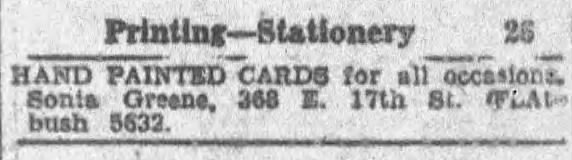

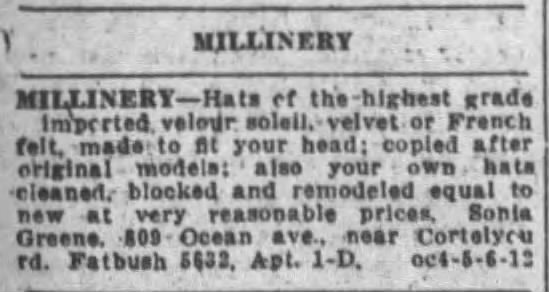
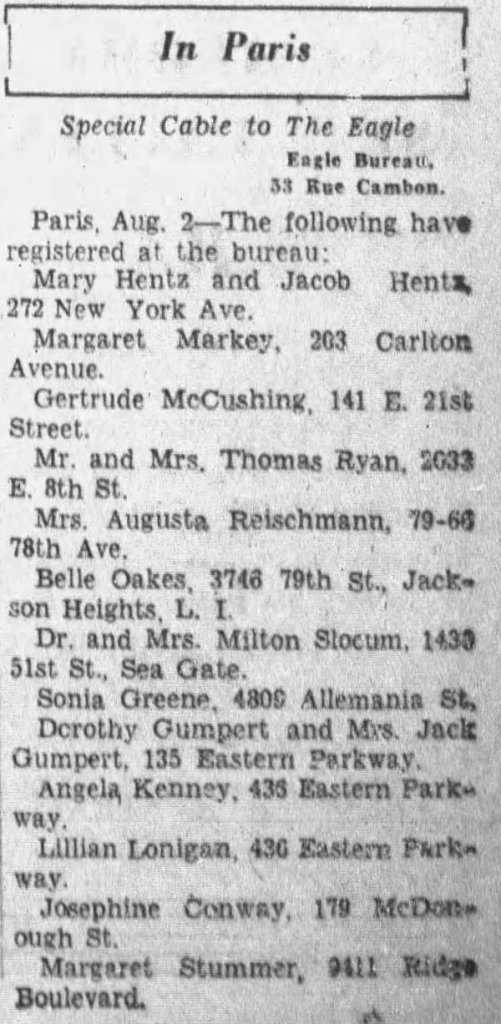

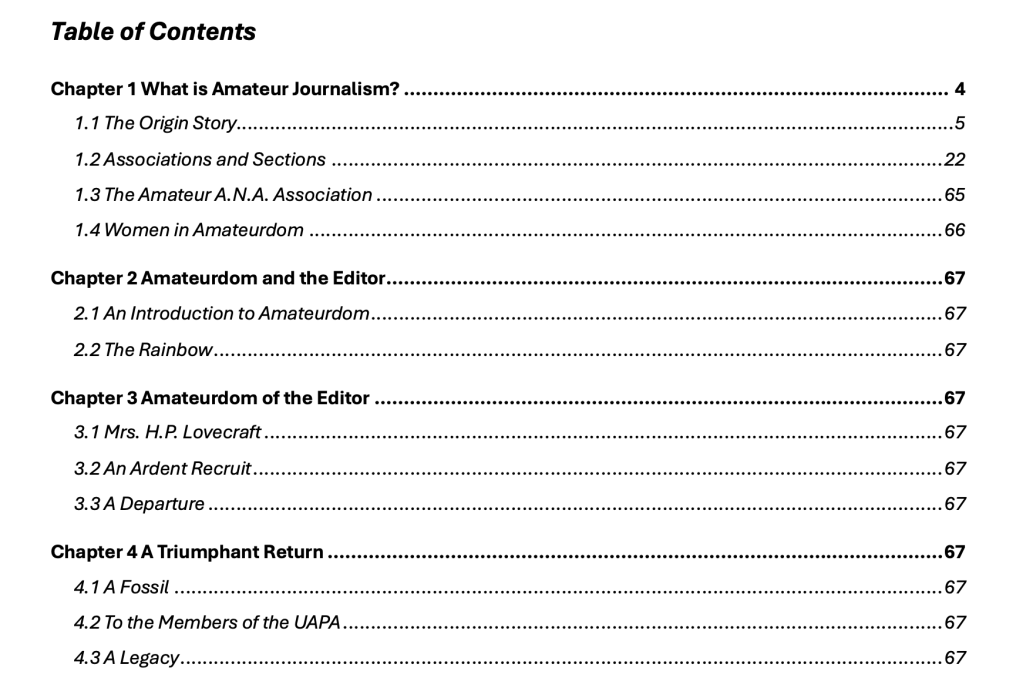


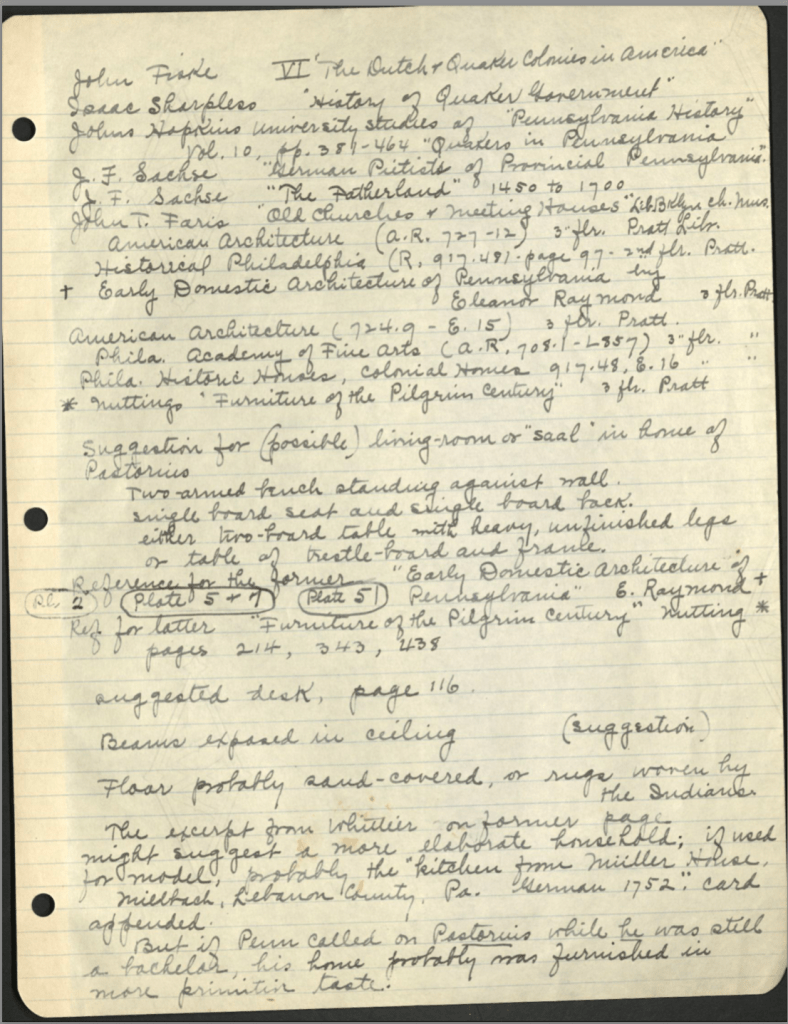
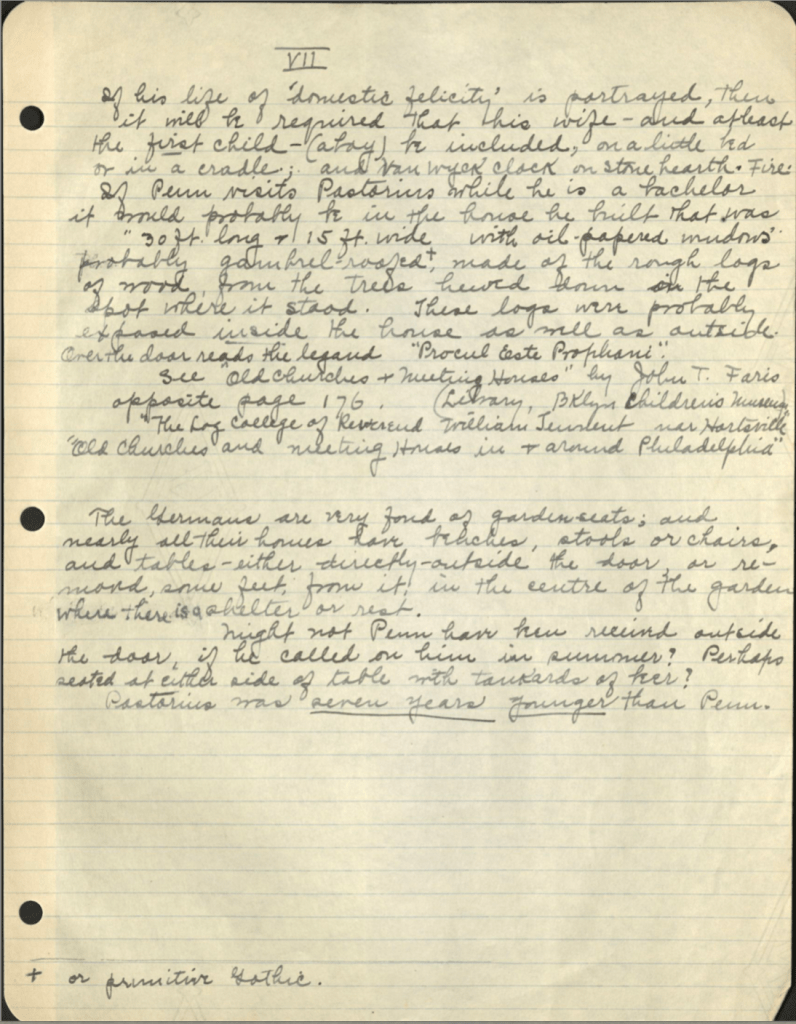

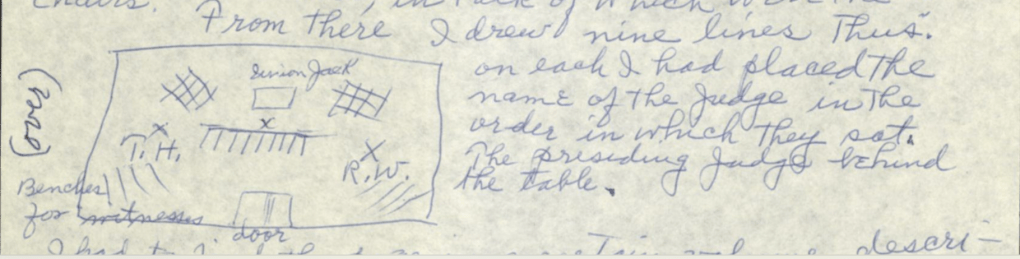
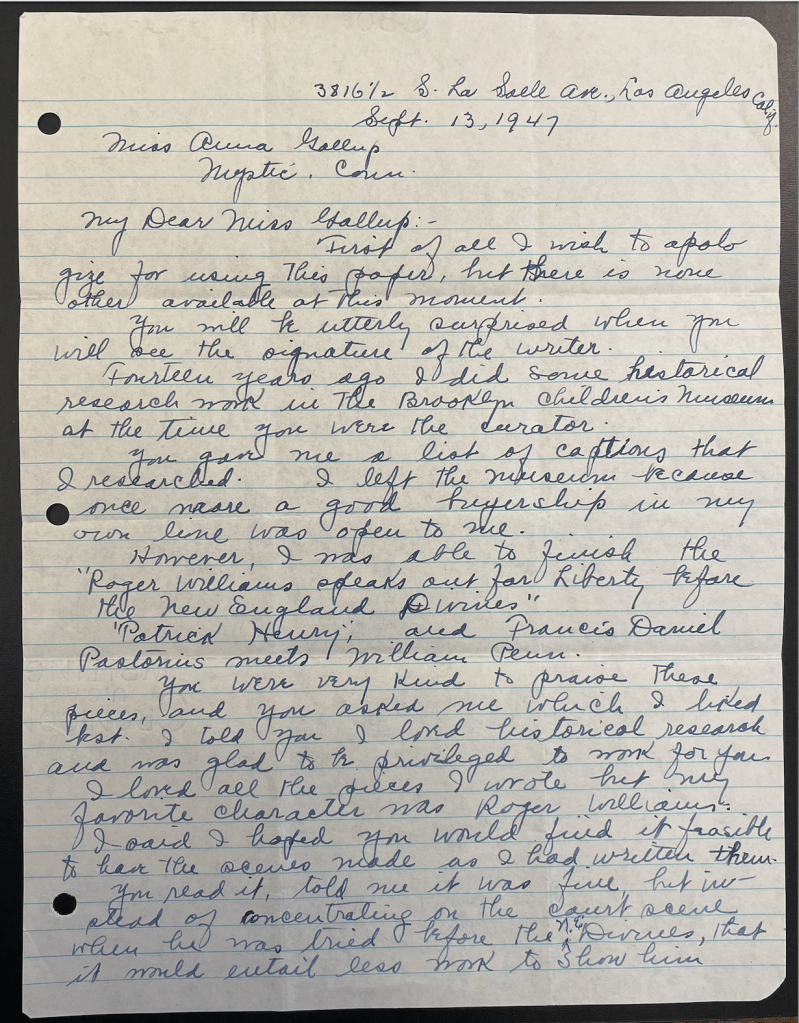


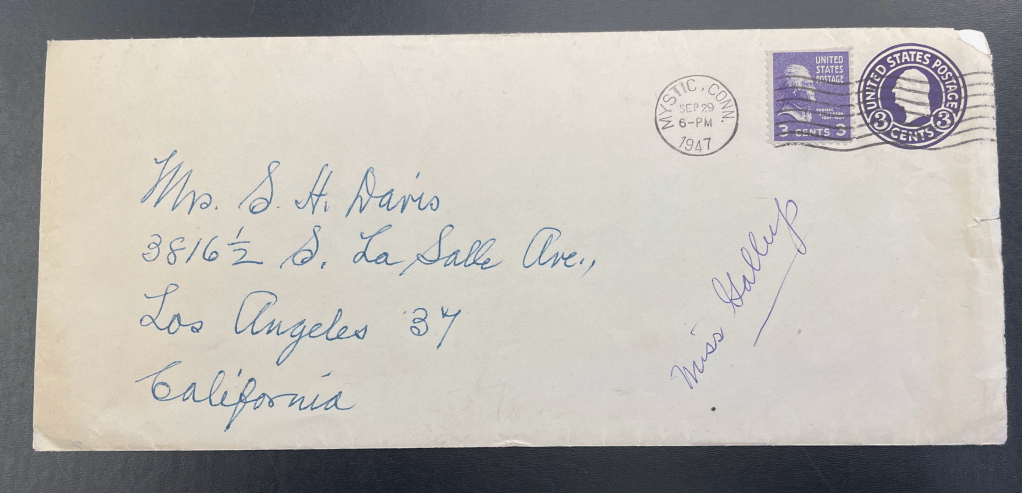
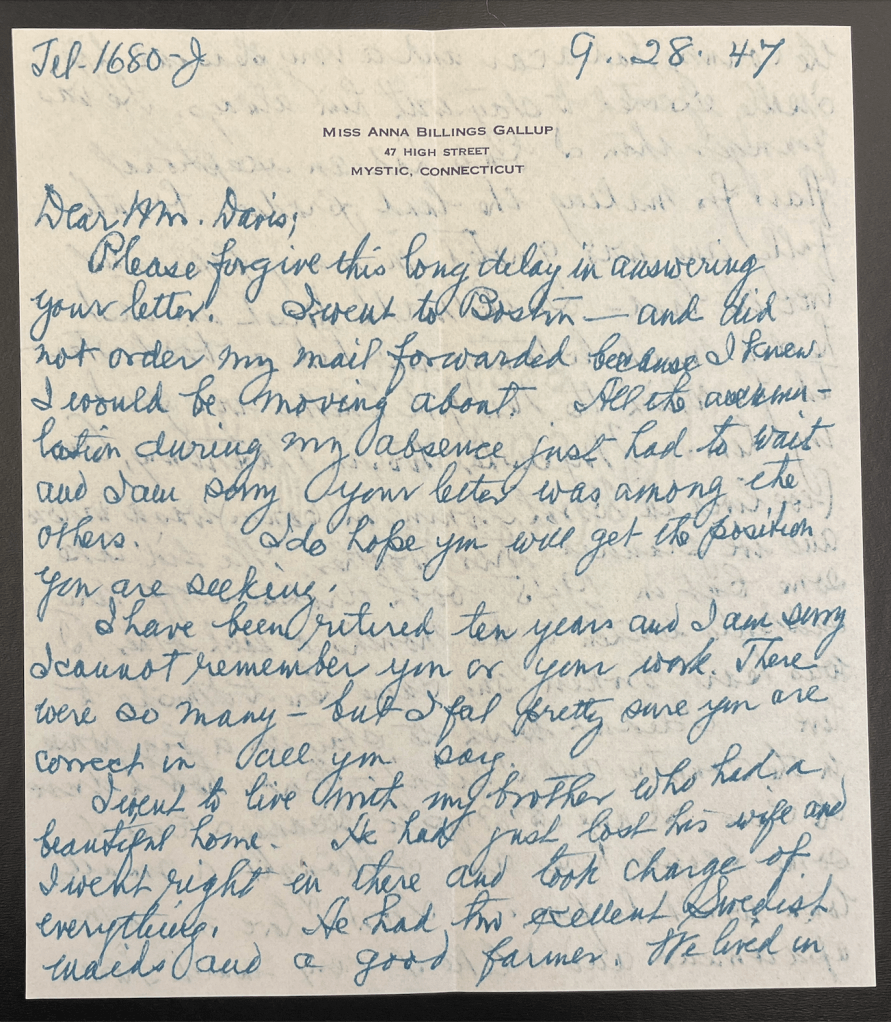

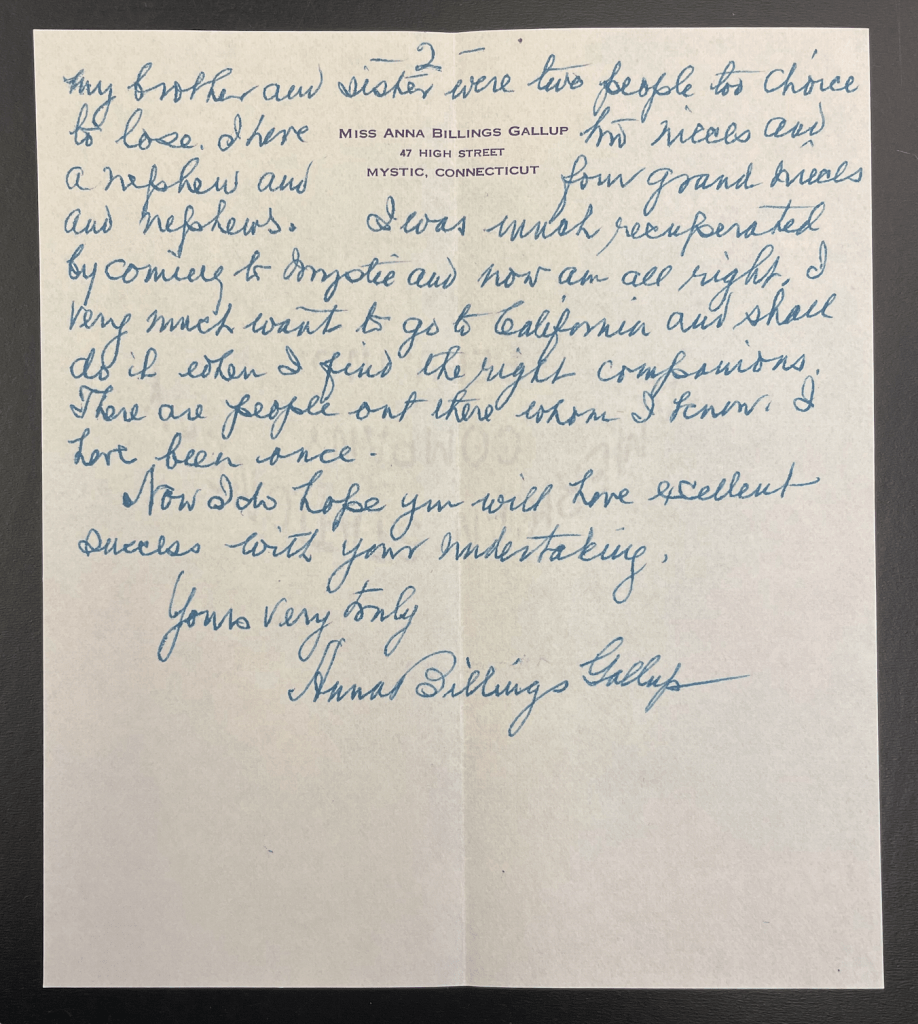


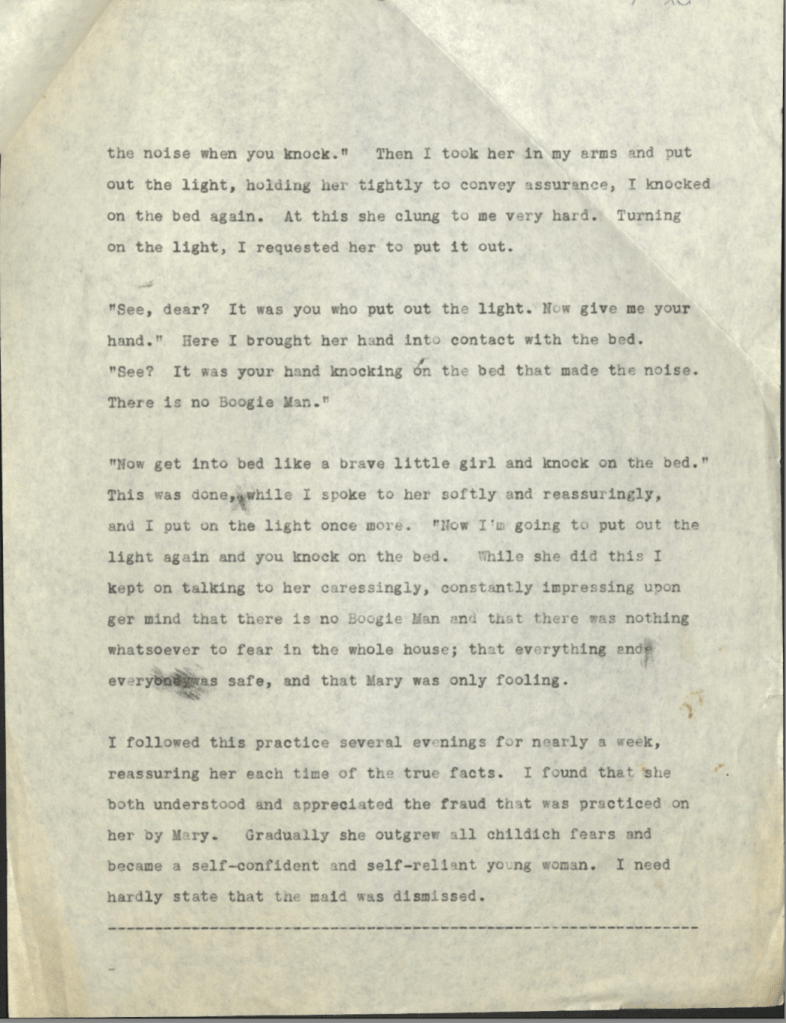
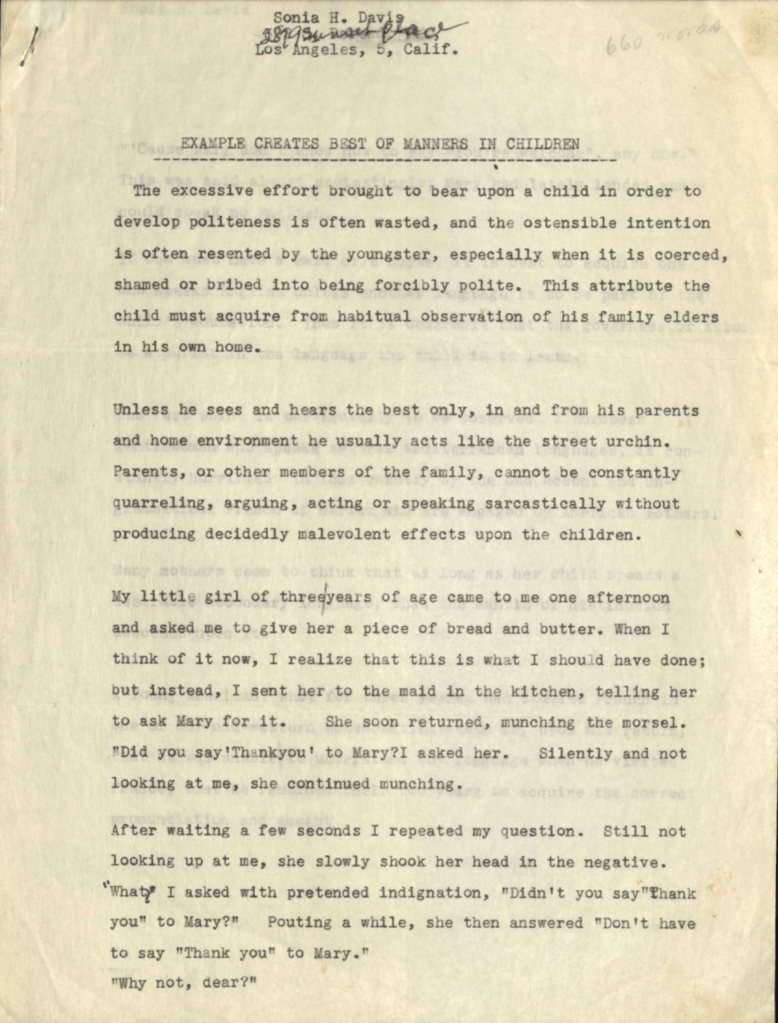

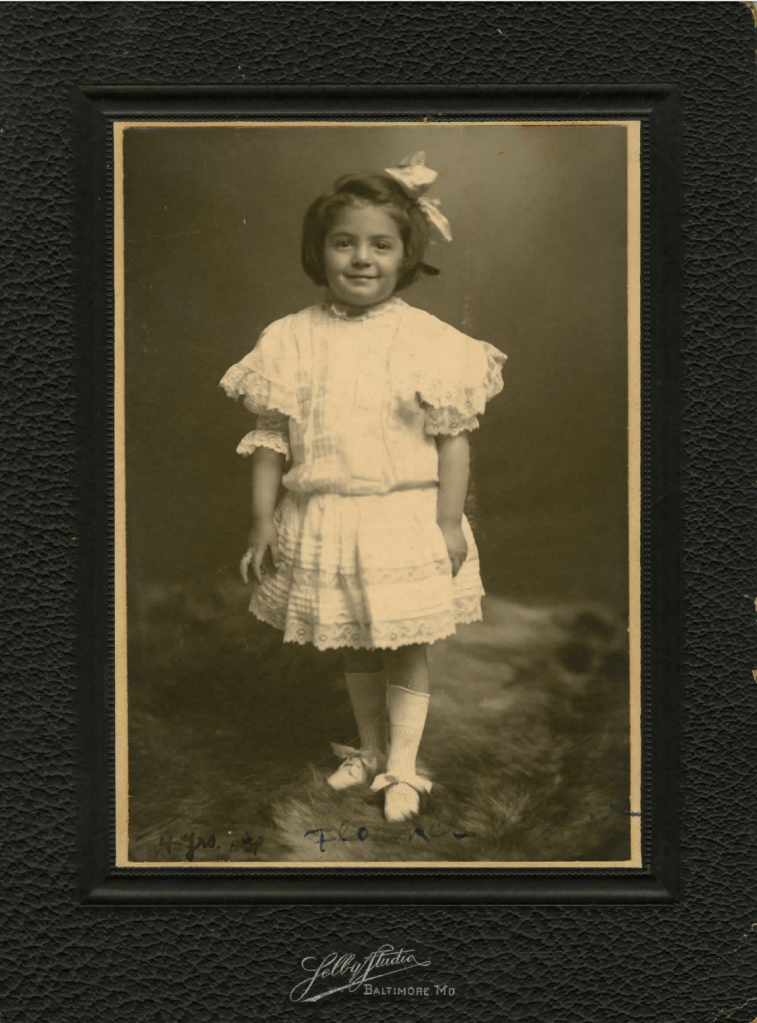
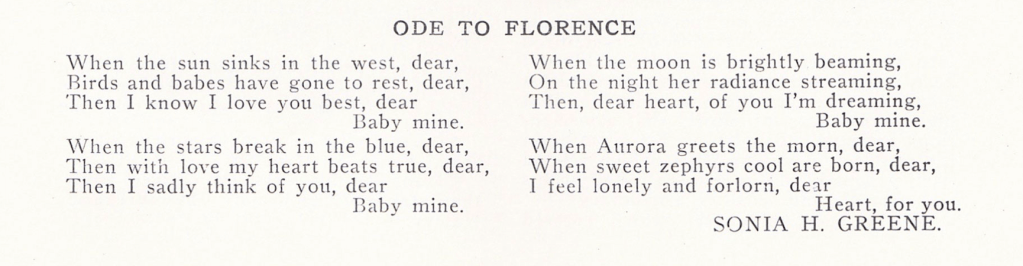


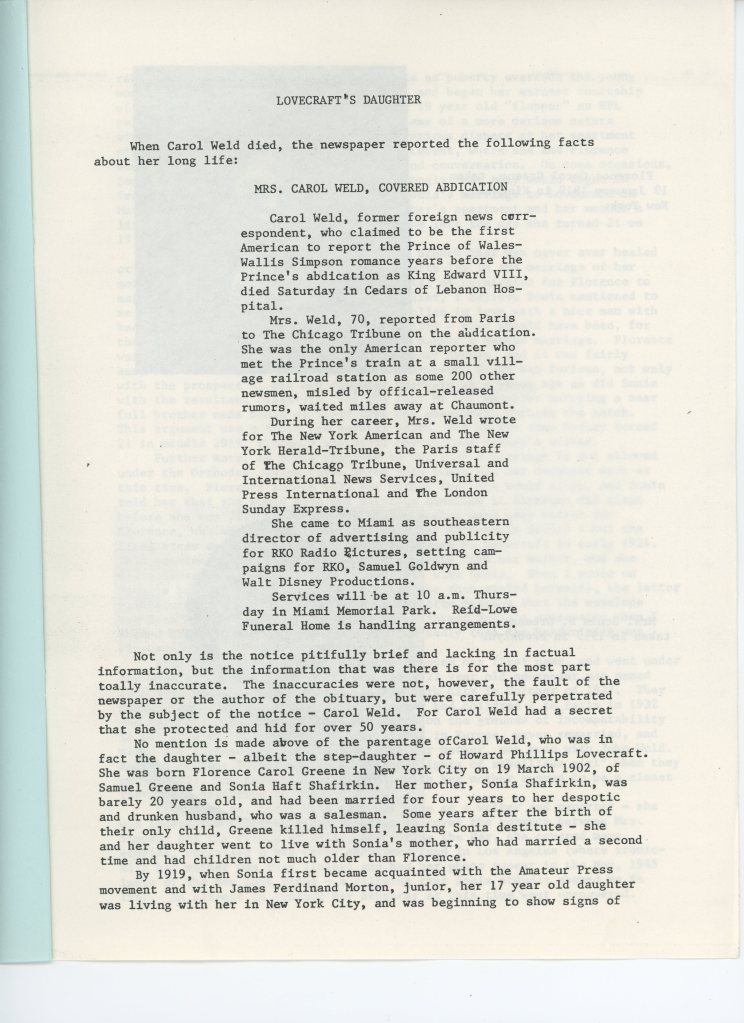
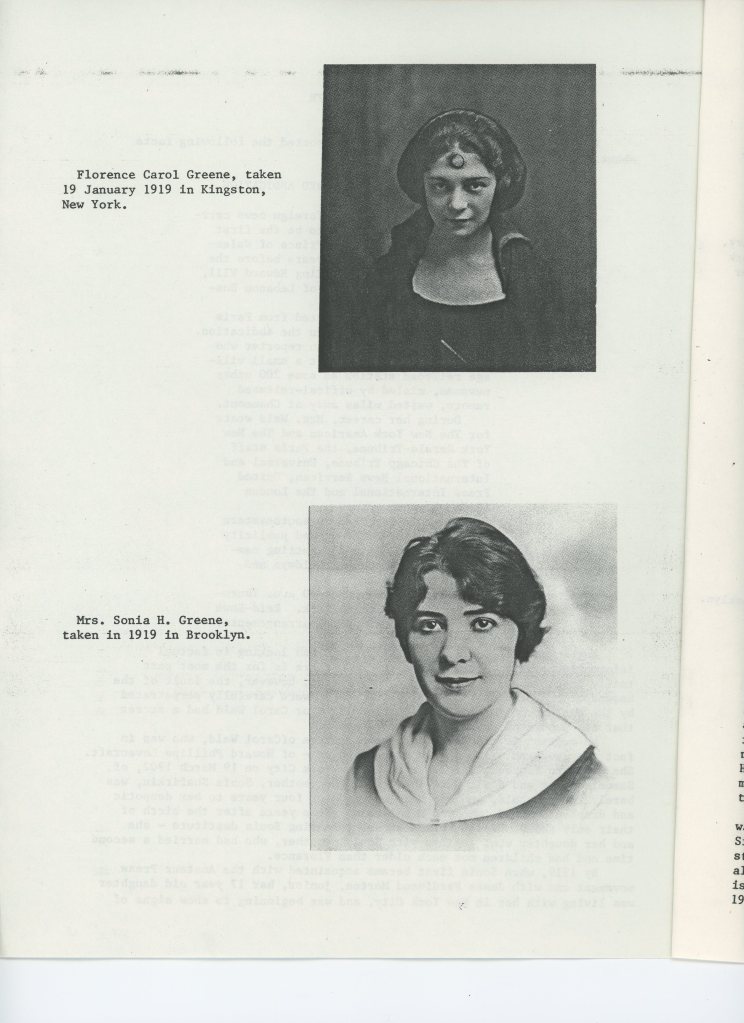
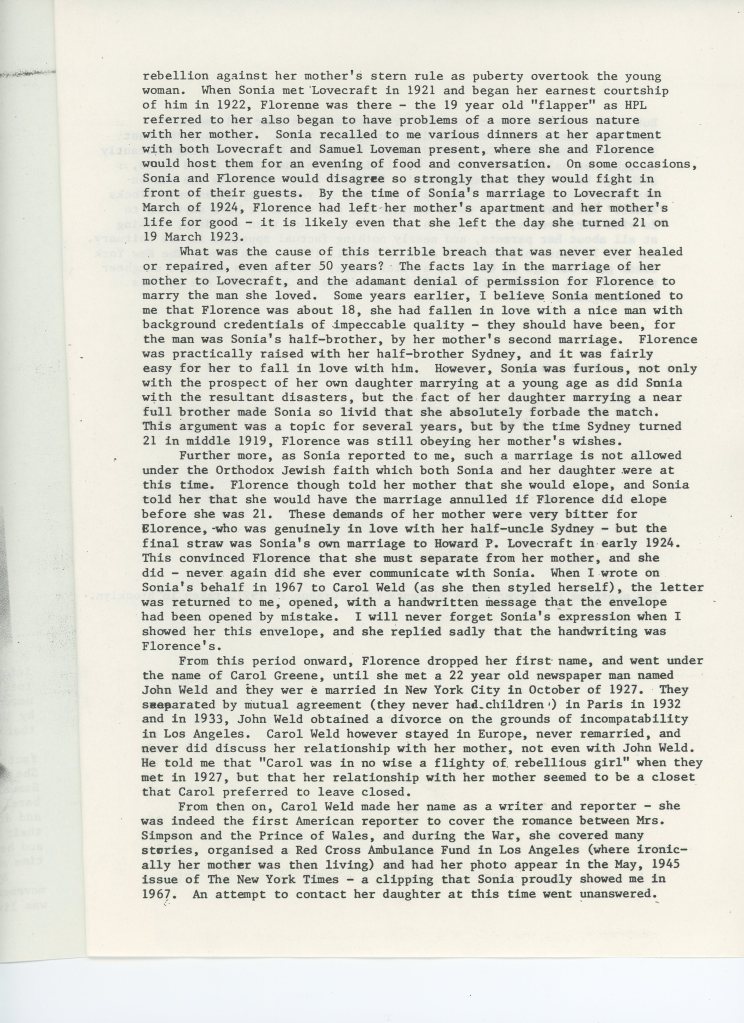


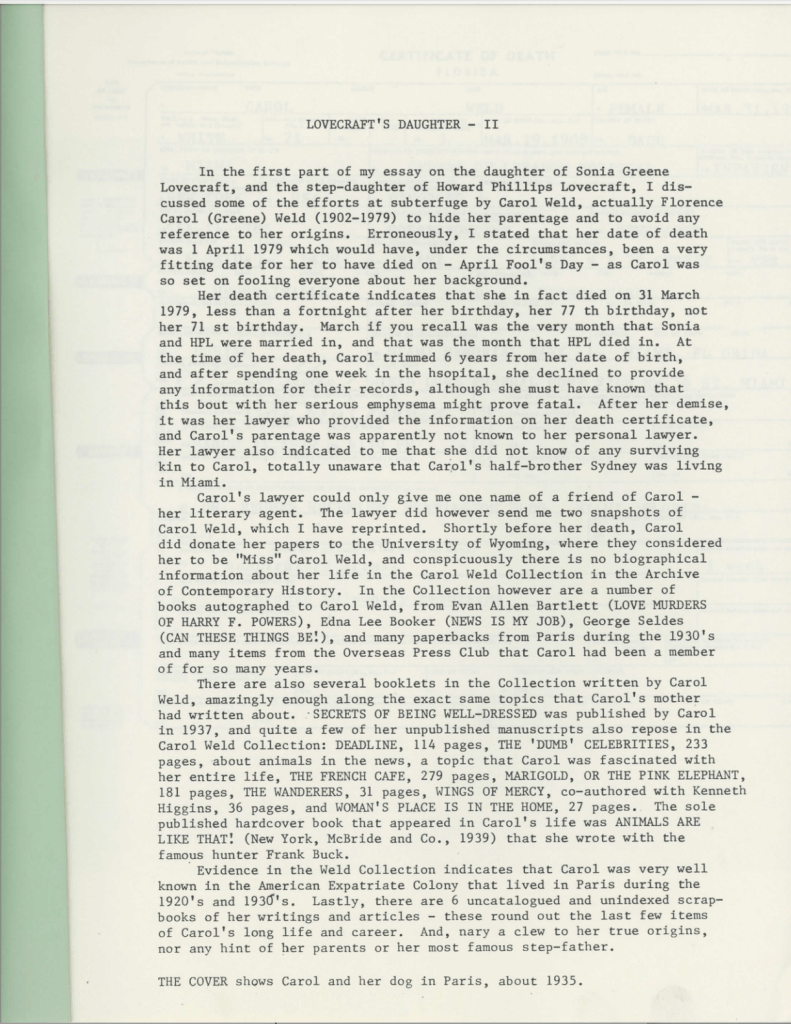
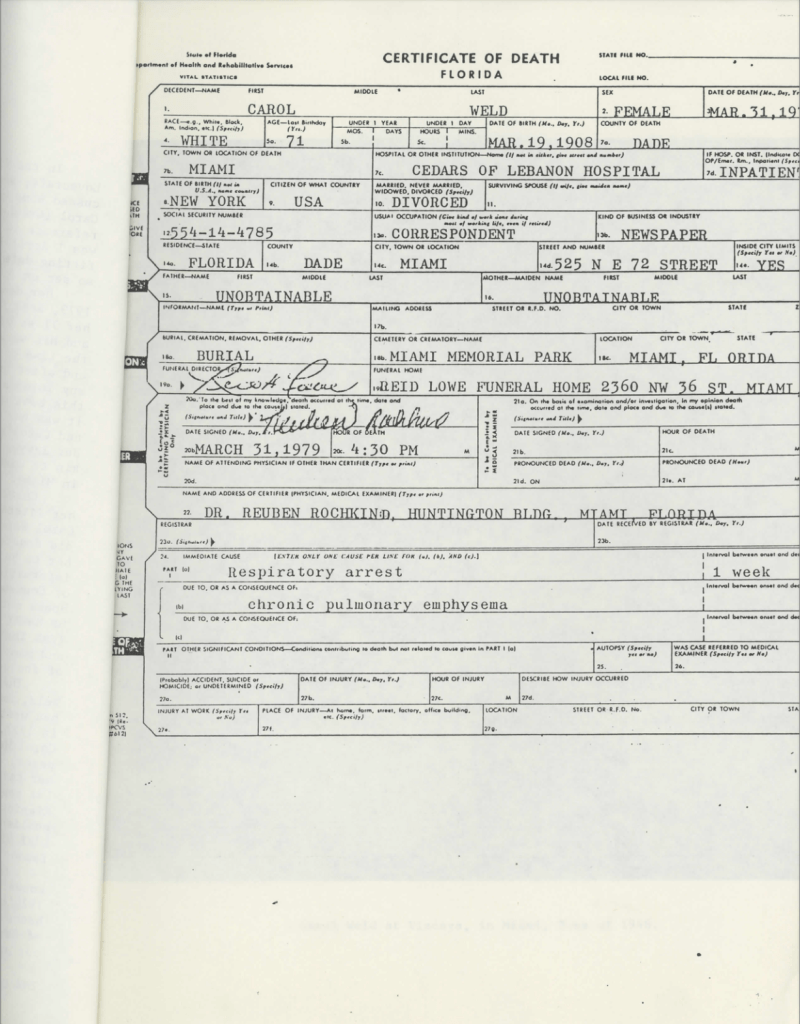
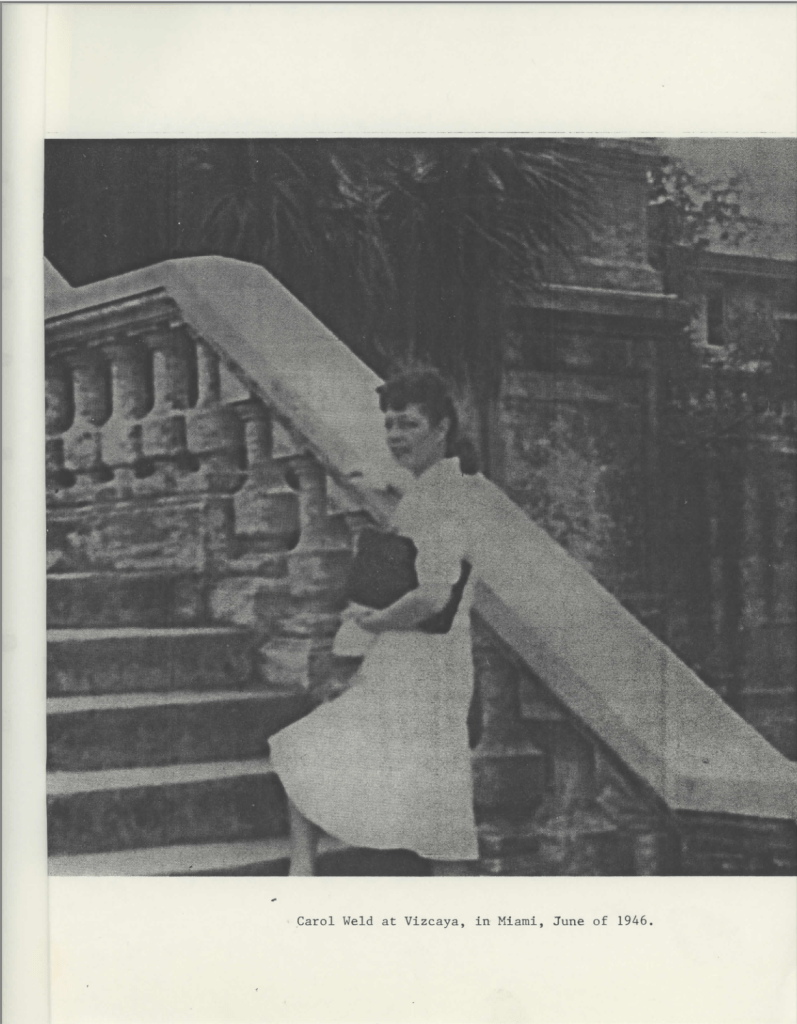

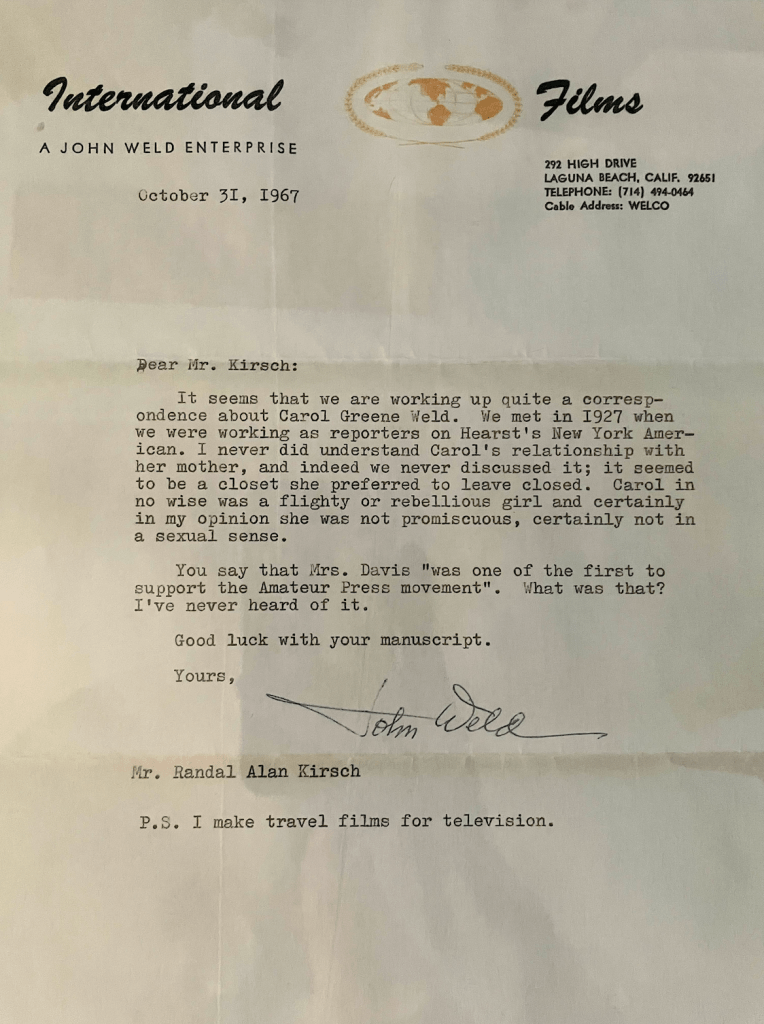

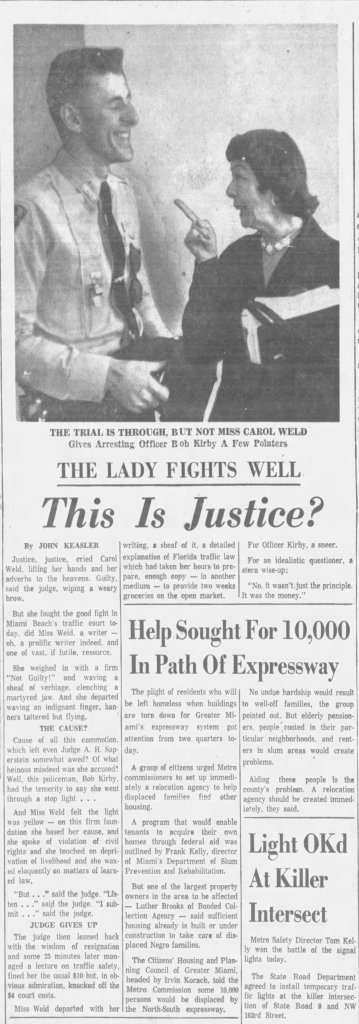

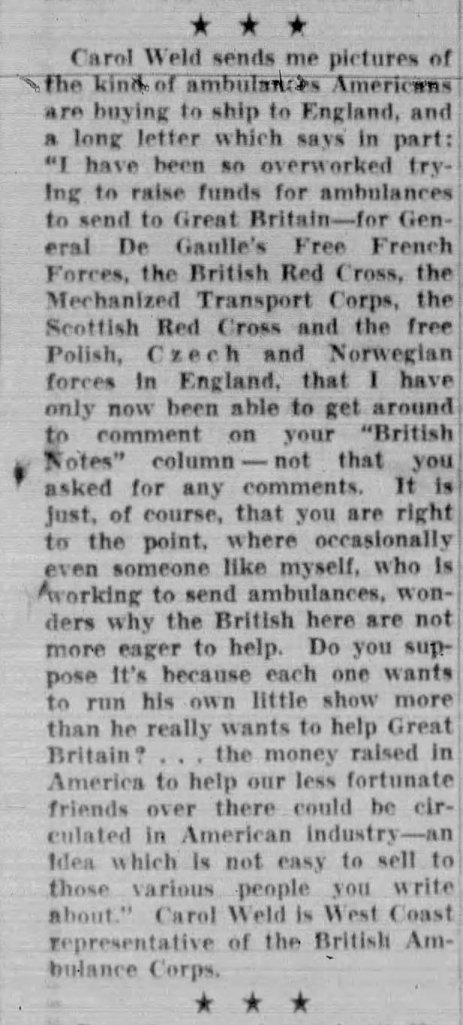
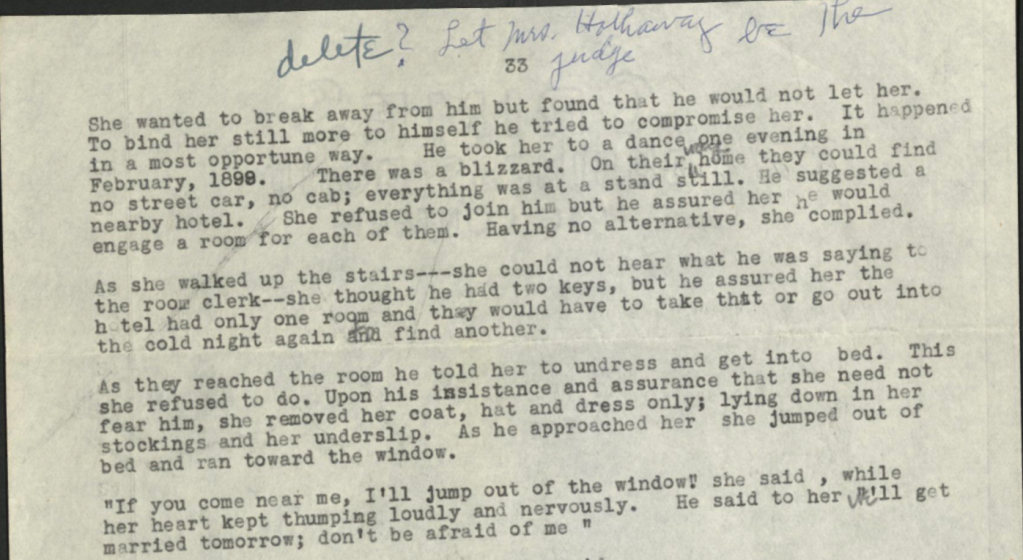
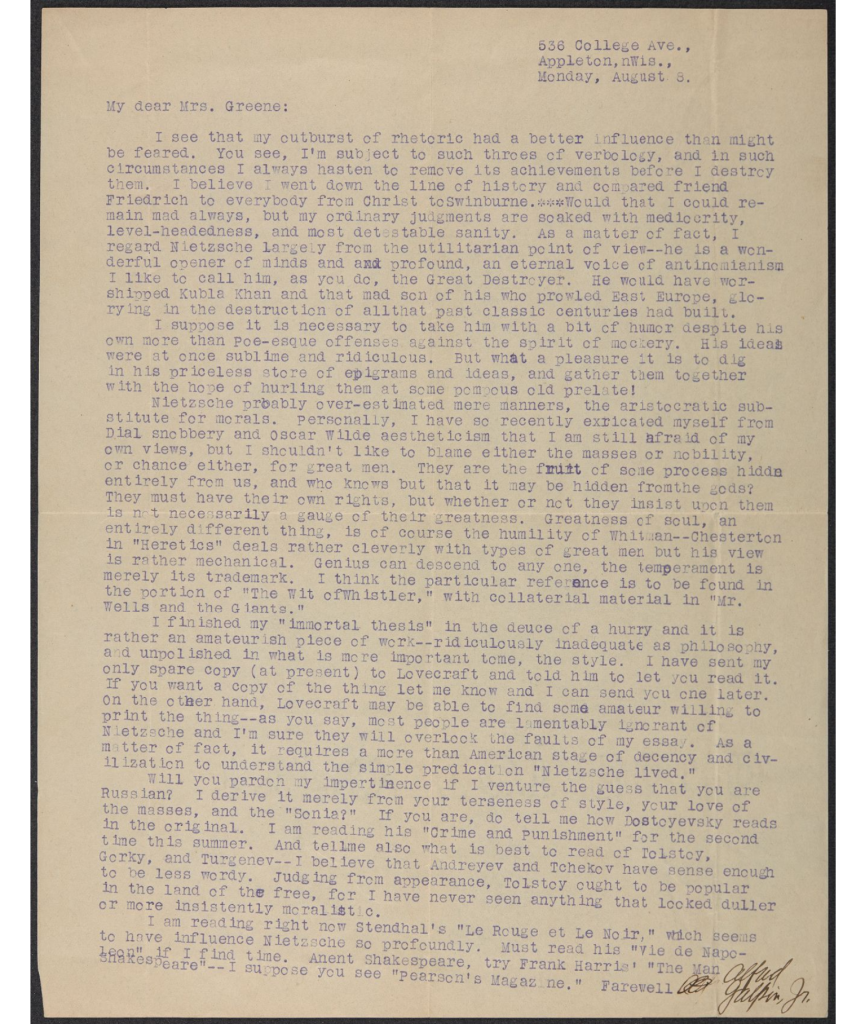
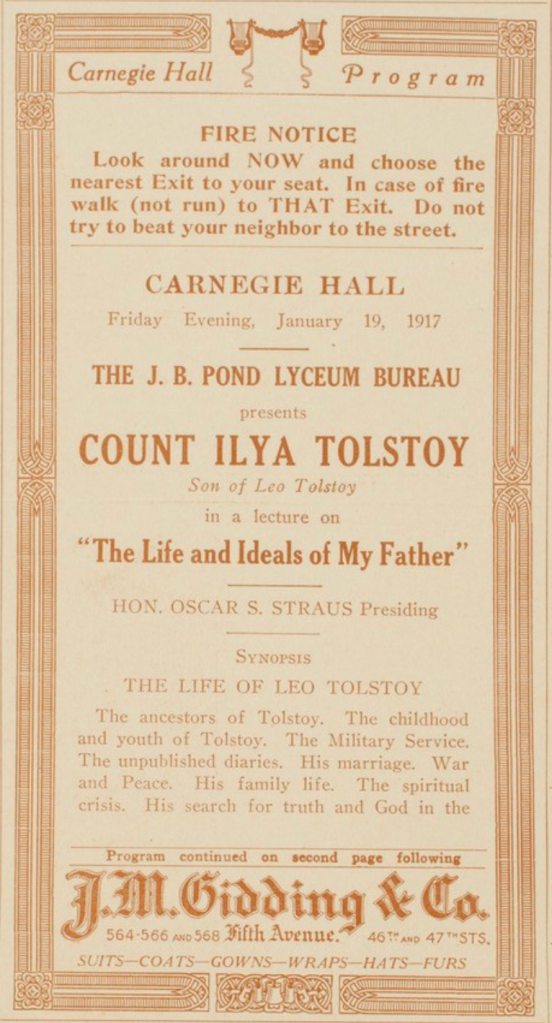
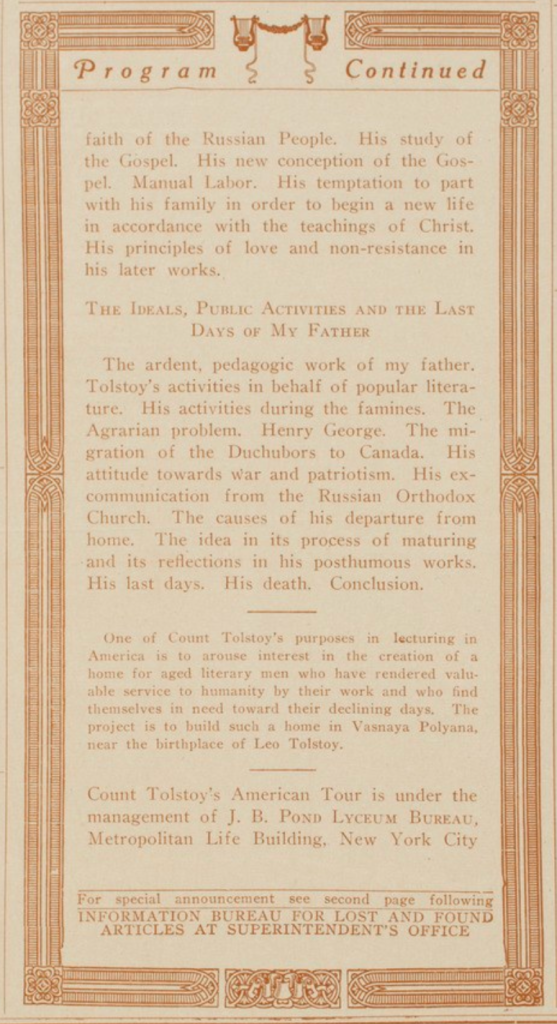
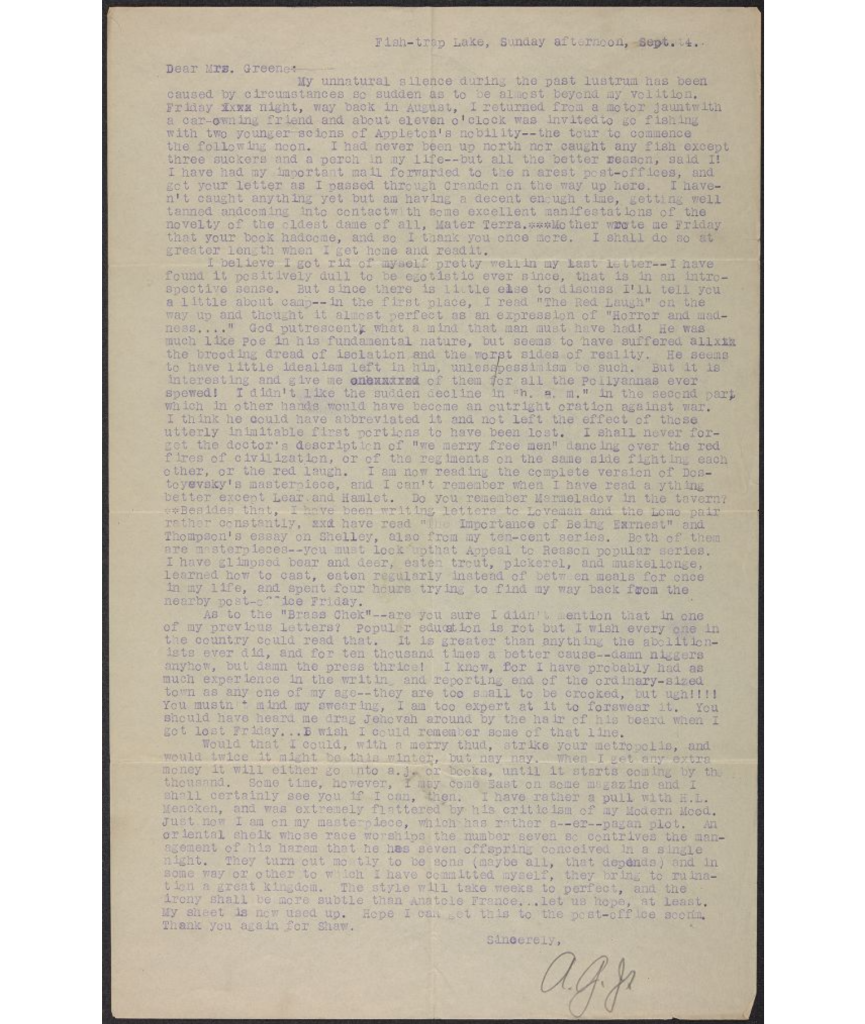
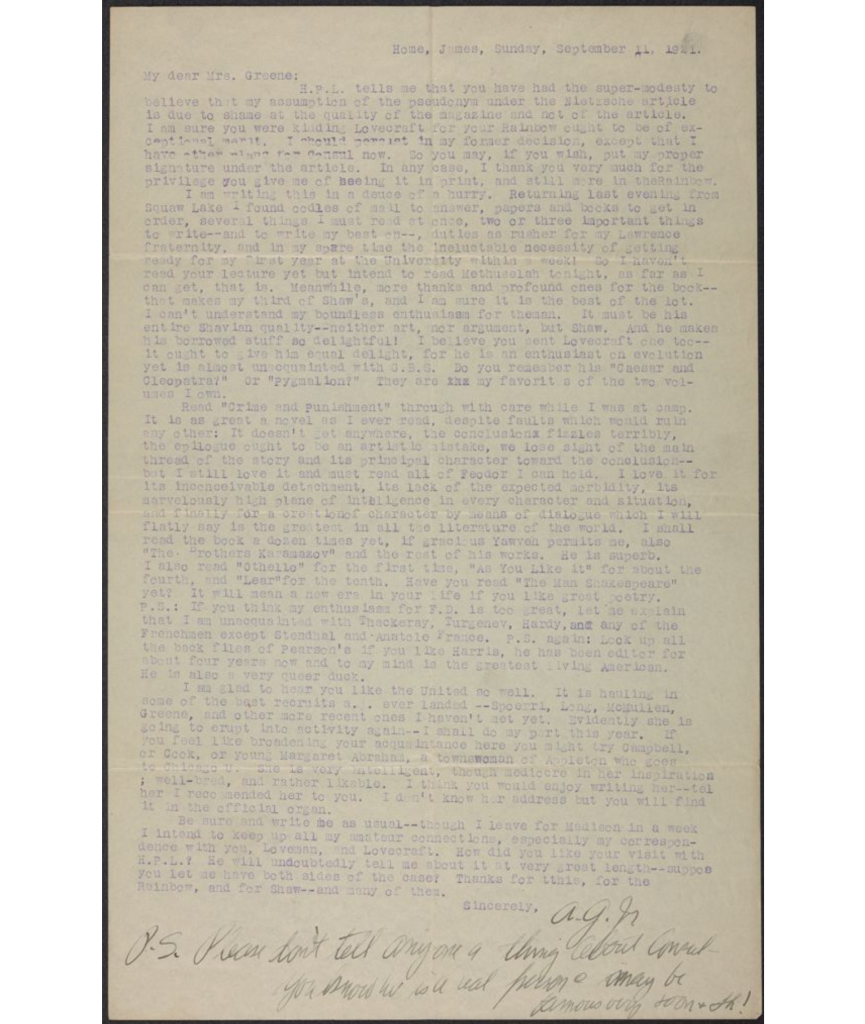
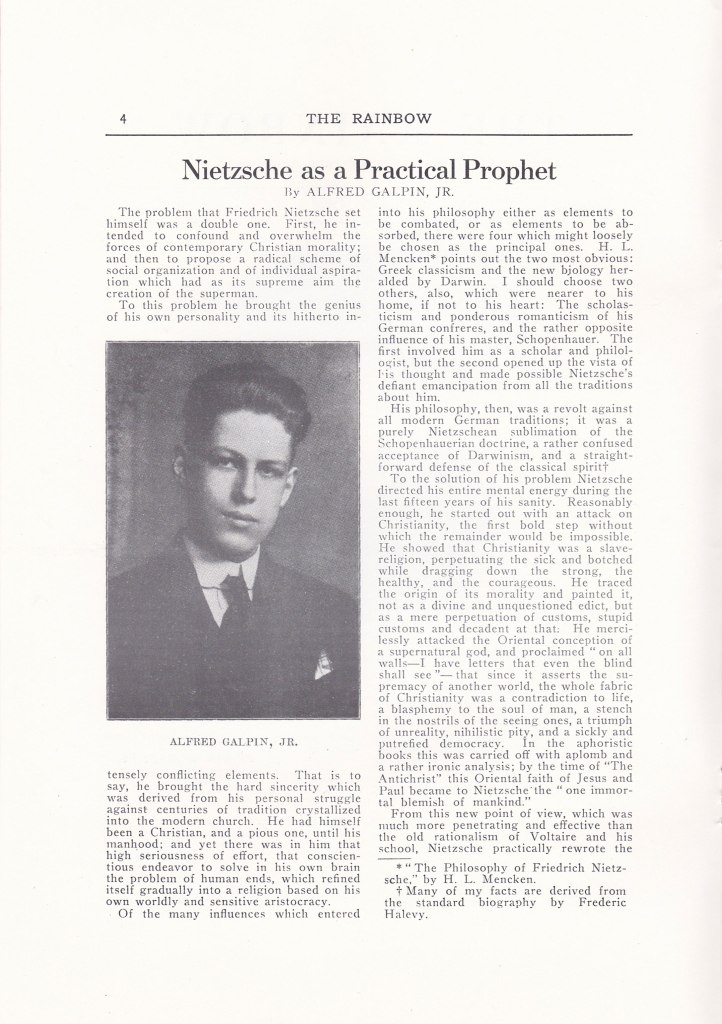
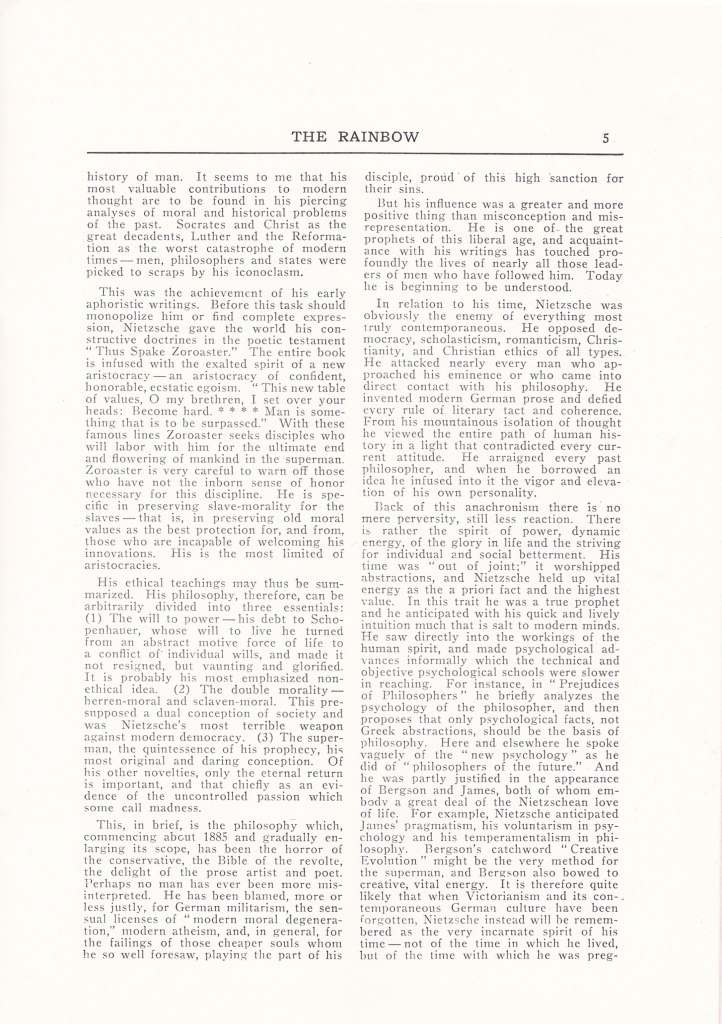
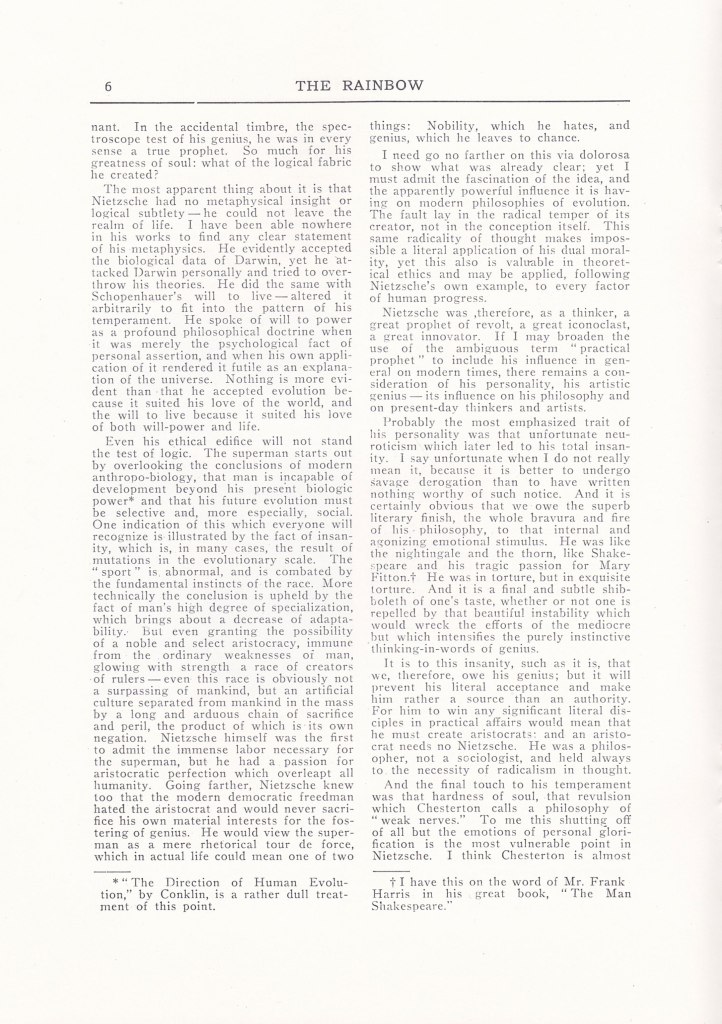
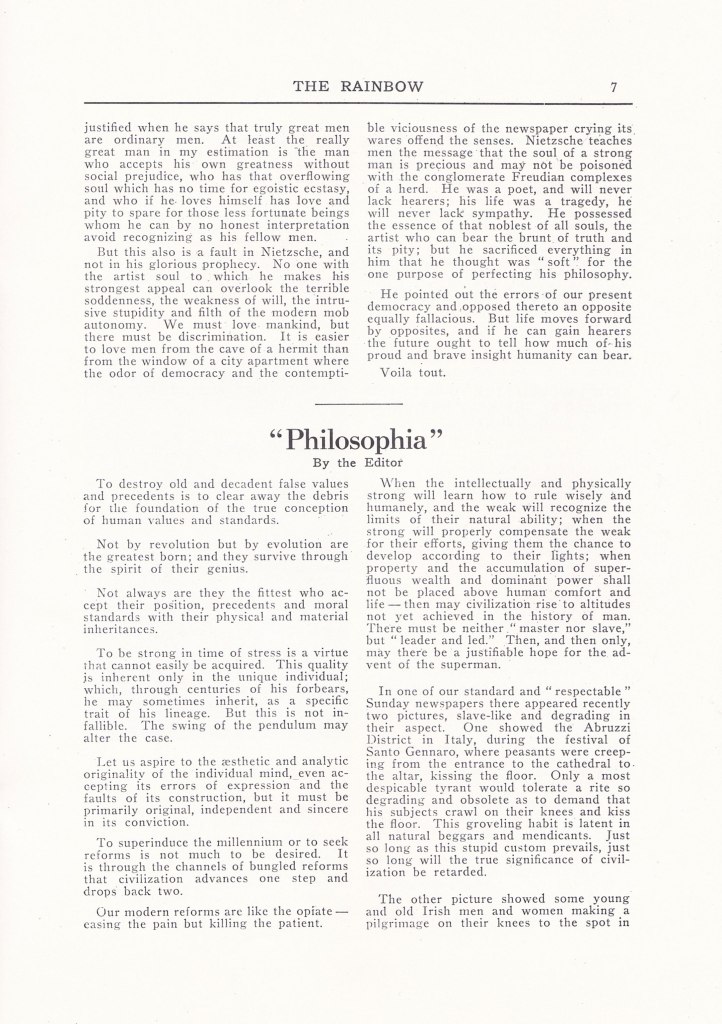
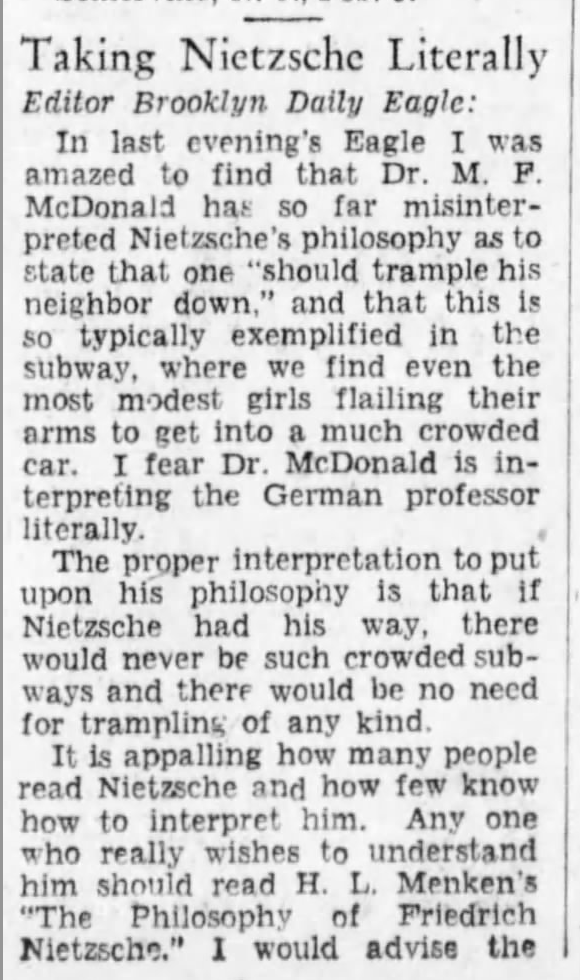
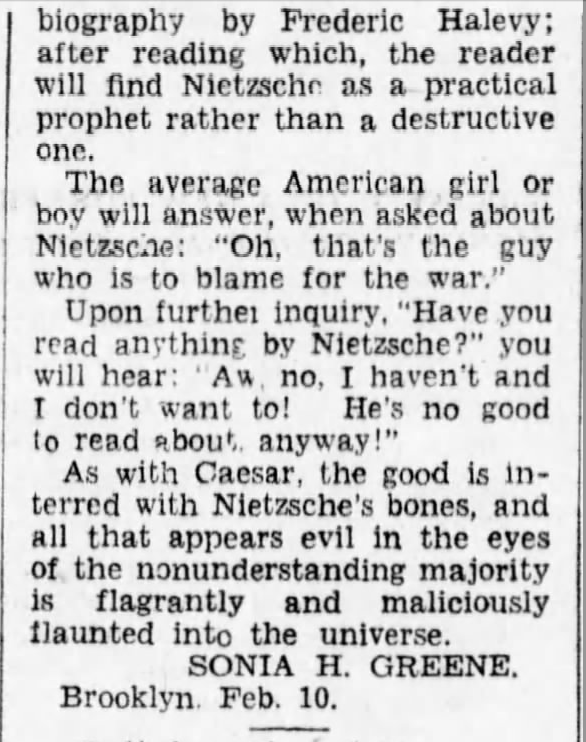
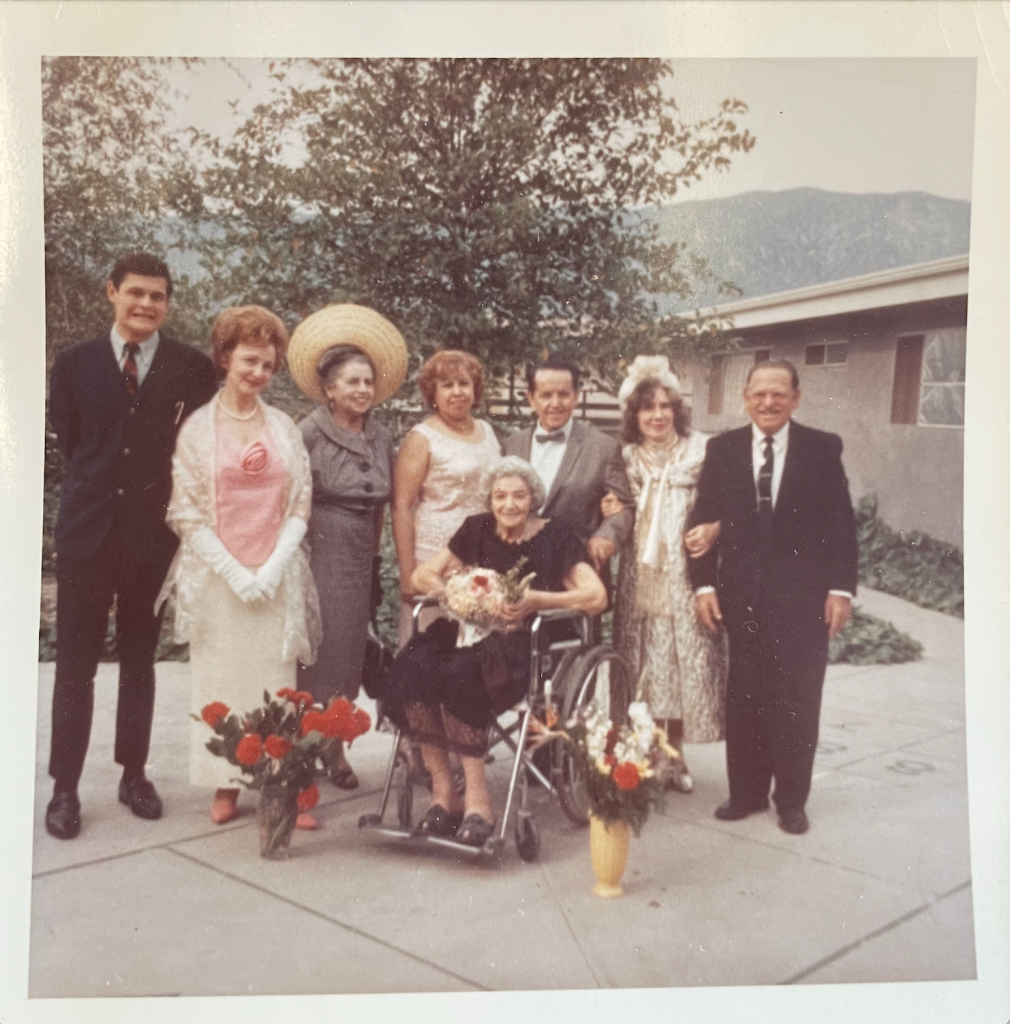
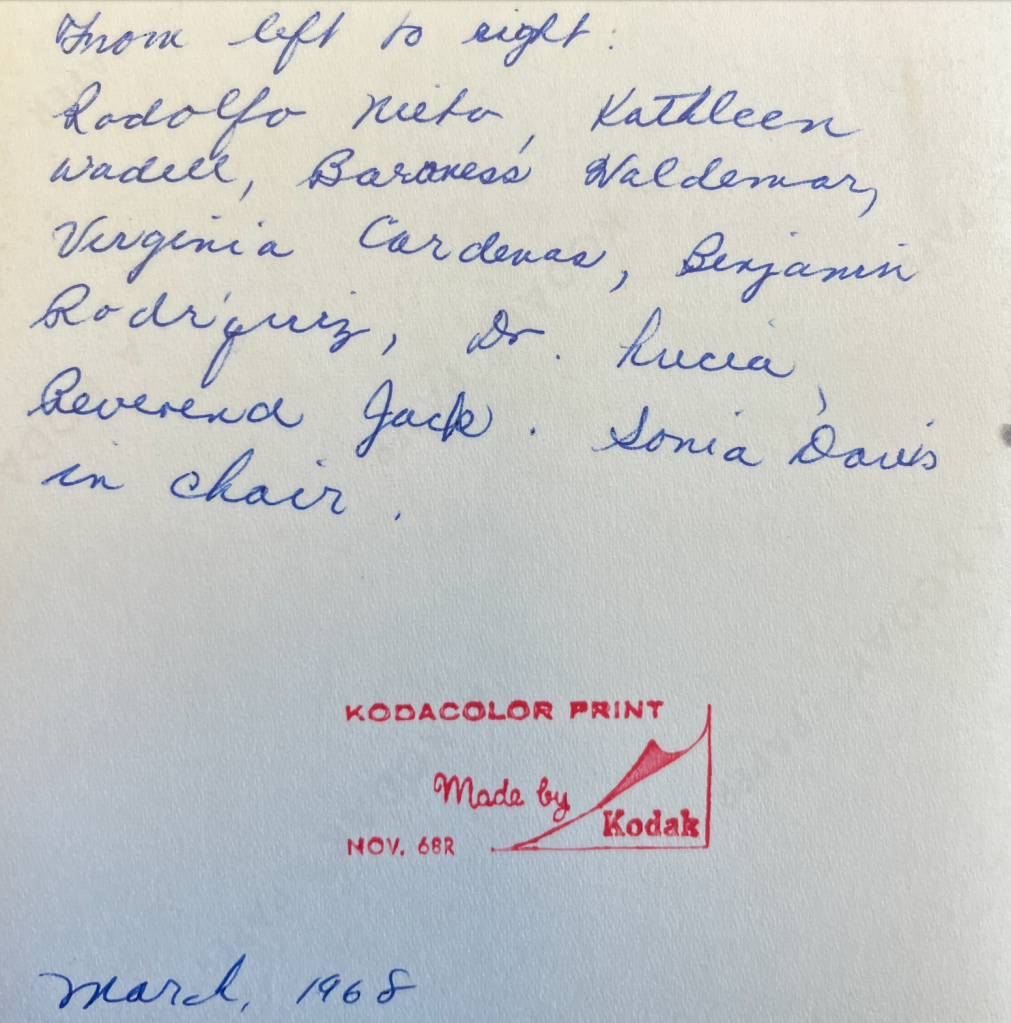
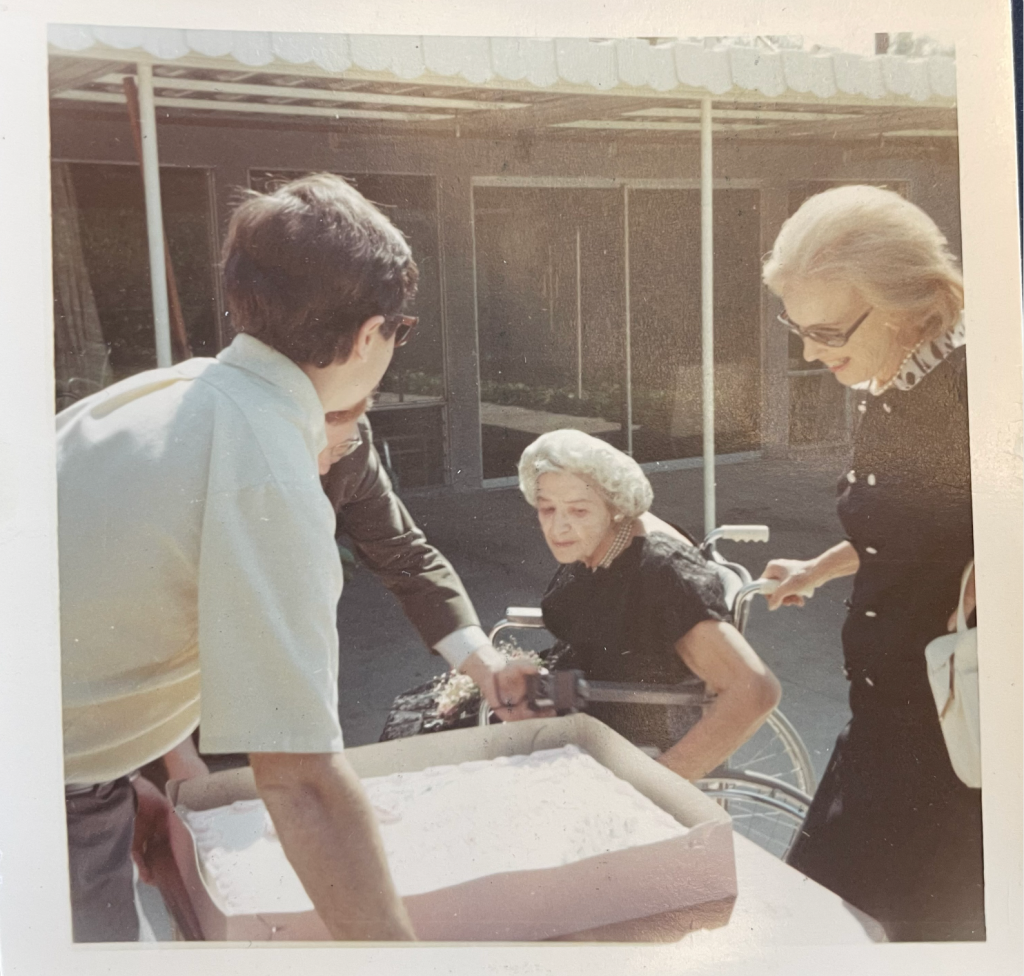
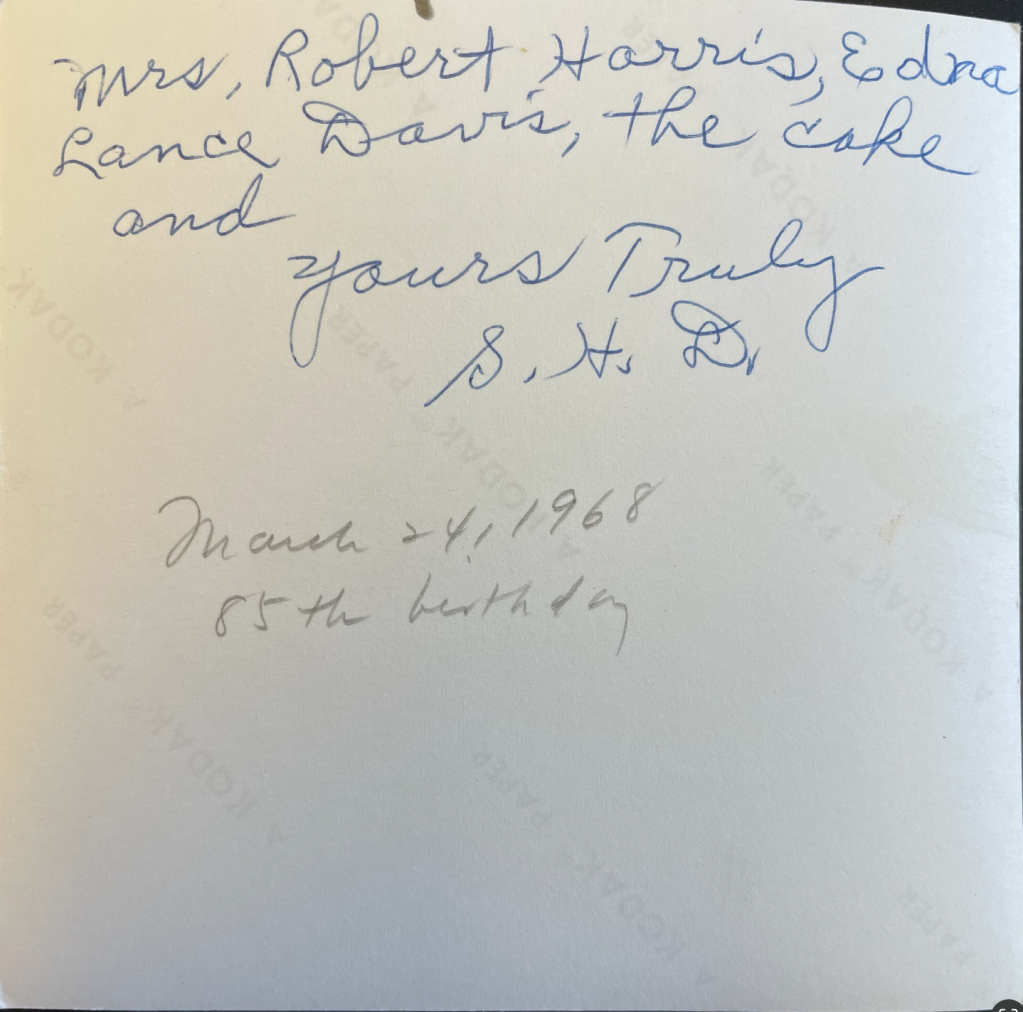
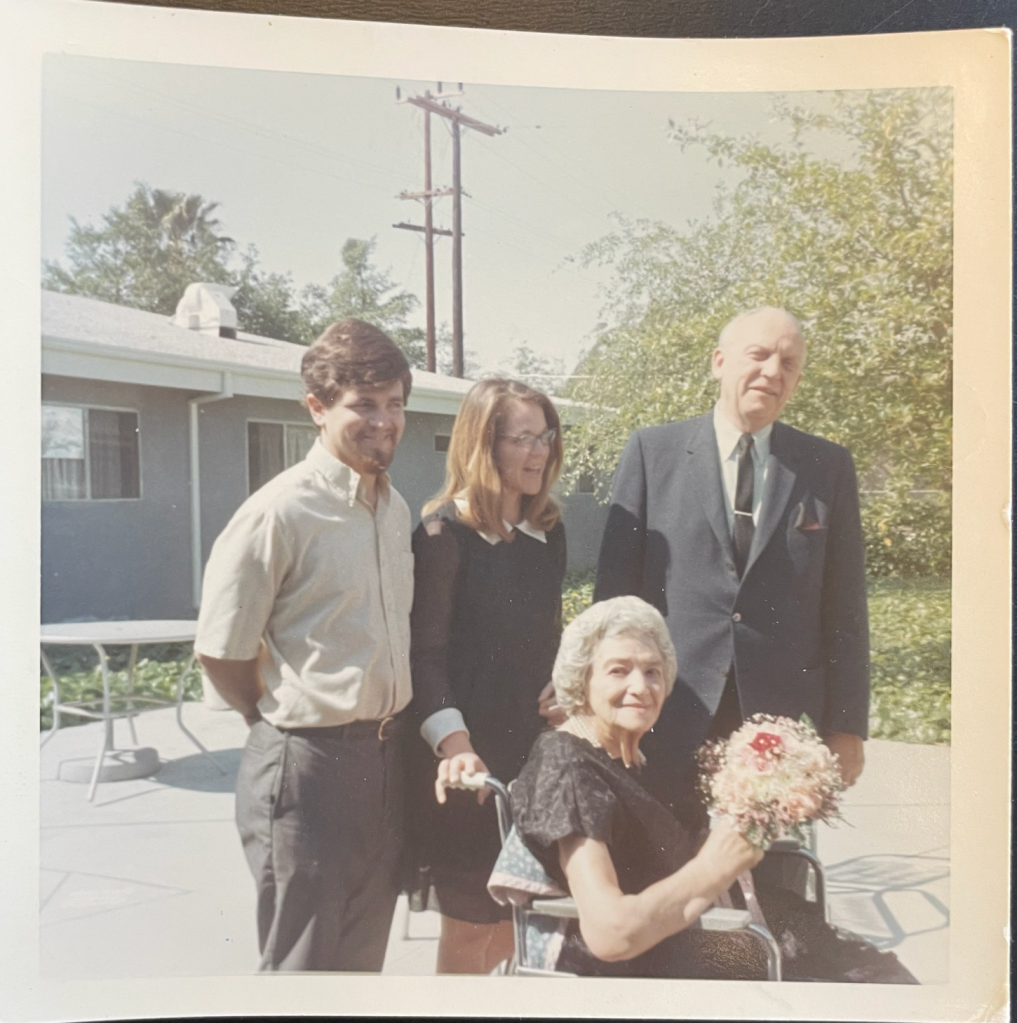
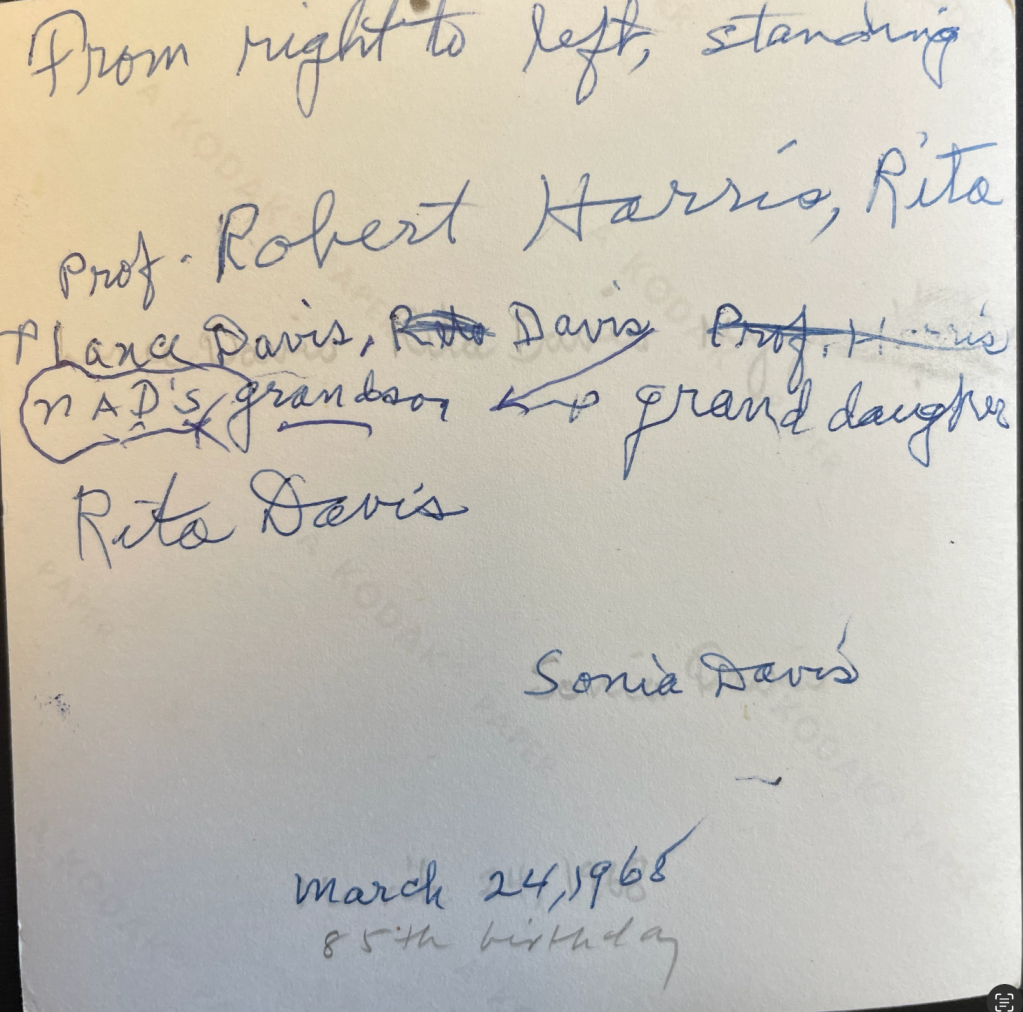


 The Papers of Sonia H. Davis