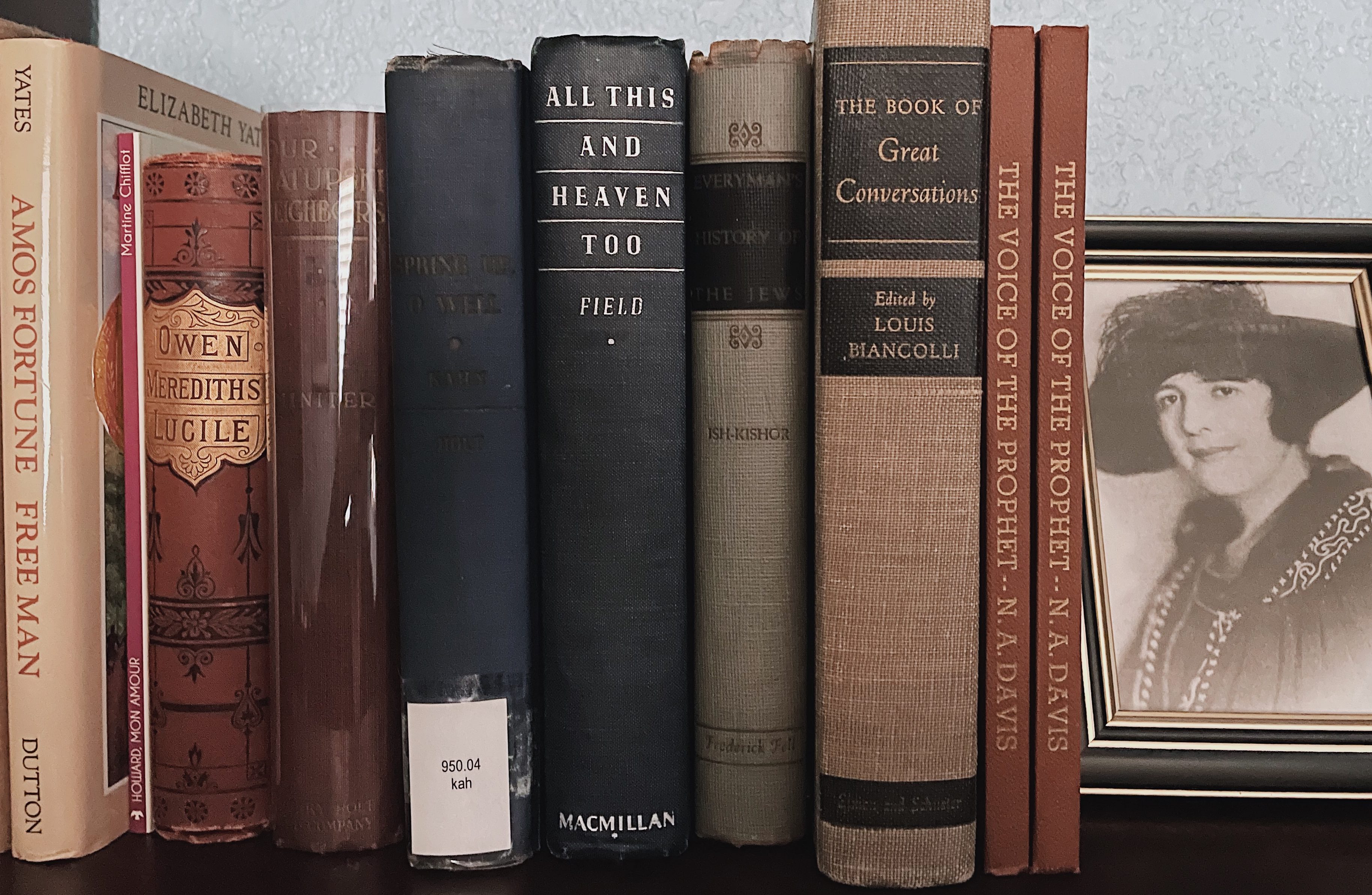
Having an inordinate affection for books, I thought for this month’s post I would focus on the books that Sonia loved, reviewed, and recommended. Sonia found joy in reading, and although she was not a voracious reader like her three husbands, she had indeed read an array of literature. In spite of her own assumptions of being ignorant, Sonia was very smart and upon arriving in America and beginning her American schooling, she jumped several grades due to her level of intellect.
At the end of the month, she took her examinations and passed into the third grade. Mr. Moseson’s daughter, who was two years Sonia’s senior, was still in the third grade. Miss Preswick, noticing that Sonia was far ahead of the class, called the principle’s attention to this, and she was placed after a few weeks, in the fourth grade.
Two Hearts That Beat as One manuscript.
However, as the autobiography further reveals, Sonia was inevitably forced to acquire a job at the age of thirteen. Although she genuinely tried to maintain her schooling and her millinery apprentice at the same, she was forced to forgo her education. That is, until she met Samuel Greene. It would be Samuel who would firmly set within her the desire for intellect and the pursuit for its beauty.
My first teacher, my first husband, Sam Greene, bamboozled me into marriage by interesting conversation—much of which I hardly understood; but when he introduced me to classic literature and then discussed it with me, I thought he was a ‘monstrous clever Fellow.’ I read the best of the pre-revolutionary literature produced by the best Russian writers, the German, French, English and American, and others which I no longer remember. Besdes [sic]the best English authors, Shakespeare was a must. Its [sic] true, Greene started me on the road to education, so I thought he was wonderful.
A letter to Sonia’s half-brother Sidney and his family, August 25, 1964.
It was Samuel’s cruel intention to “train” her, according to his needs, that inspired a love for reading within Sonia. It was this love of reading that inevitably carried into her second marriage with H.P. Lovecraft and into her third marriage with Nathaniel A. Davis, all of whom deepened this love all the more and inspired her further.
This list of books is arranged loosely from when she was sixteen and goes on until her elderly years. Each book is catalogued by its title, author, synopsis and followed by what Sonia had to say about the book. Also included in this list is the book that helped me tidy Sonia’s own life story into book form.
The Marie Antionette Series
- Author: Alexandre Dumas
- Synopsis: A series of classic French historical novels based on the life of Queen Marie Antoinette. (link)
She felt somewhat “highbrow” after reading such—what to her seemed—difficult books. Instead of full English translations, there were so many French words and phrases that much of the works often lost some of their meaning for her. So, Mr. Greene bought her a French dictionary. Within less than a year she had read nearly all of “The Queen’s Necklace” series.
Two Hearts That Beat as One manuscript.
Zanoni: A Rosicrucian Tale
- Author: Edward Bulwer-Lytton
- Synopsis: Zanoni, first published in 1842, was inspired by a dream. Sir Edward, a Rosicrucian, wrote this engaging, well-researched, novel about the eternal conflict between head and heart, between wisdom and love, played out by the Rosicrucians before the dramatic background of the French Revolution. He described his book Zanoni as “a truth for those who can comprehend it, and an extravagance for those who cannot.” Following his introduction, the novel is divided into seven parts, whose titles indicate the sevenfold path of spiritual development. The fourth section, “The Dweller of the Threshold,” is the book’s centerpiece, revealing significant esoteric facts and experiences. A novelist, a dramatist, a scholar, an editor, and an active member of Parliament, Sir Edward was an extremely successful author whose writings were widely read throughout England and Europe. He poured into this esoteric work all of the ancient esoteric wisdom that he felt he could reveal to the public during an age buried deeply in materialism. This work remains one of the great, pioneering landmarks of esoteric writing. (link)
“Zanoni” especially appealed to Sonia. In this book, mysticism, that opened a new world with new thoughts for her, encouraged her to read more along these lines. To her, these were not stories. She lived and loved and hated and feared and hoped with the different characters that to her were real persons.
Two Hearts That Beat as One manuscript.
She loved Lord Byron’s poetry, William Shakespeare, Alfred Tennyson, Robert Browning, especially Elizabeth Barrett (Mrs. Browning).
Two Hearts That Beat as One
Our Natupski Neighbors
- Author: Edith Miniter
- Synopsis: A novel that focuses on the life of polish immigrants living in New England. (link)
The six hours on the train were well spent, for they were happily occupied in reading your book “Our Natupski Neighbors.” As I neared the latter part of the story I became more and more enthusiastic, and while I am sure you have received much praise for your noble work, I cannot refrain from adding my expression of sincere admiration for your original efforts. It is one of the best works that I have read within the last few years and is the nearest approach to that wonderful literature, the Russian. Not because you have happened to select the Slav family for your subject, but because of the element of Russian-like thinking and fearless expression. This is the best tale that I have recently found from the pen of an American writer.
“Our Natupski Neighors”, The Rainbow, volume 1, 1921.
The Private Papers of Henry Ryecroft
- Author: George Gissing
- Synopsis: Friend to Henry James and H.G. Wells, and considered by some in a league with Thomas Hardy, British novelist GEORGE ROBERT GISSING (1857-1903) nevertheless remains uncelebrated today. But his works were popular and well-loved in his time. The Private Papers of Henry Ryecroft, perhaps the most successful of his 23 novels, is Gissing’s semiautobiographical tale of the struggles of a poor writer Realistic and unsentimental, this little-remembered but thoroughly enthralling novel will delight fans of Victorian literature. (link)
In order to understand Howard Phillips Lovecraft better than his life on the surface indicated, the reading of Gissing’s “Private Papers of Henry Ryecroft” would elucidate much. In fact he sent me this book early in the life of our romance.
The Private Life of Howard Phillips Lovecraft manuscript.
Amos Fortune, Free Man
- Author: Elizabeth Yates, Nora S. Unwin (Illustrator)
- Synopsis: Amos Fortune was born the son of an African king. In 1725, when he was 15 years old, he was captured by slave traders, brought to America and sold at auction. For 45 years, Amos worked as a slave and dreamed of freedom. At 60, he began to see those dreams come true. A Newbery Honor Book. (link)
Amos Fortune, Freeman [sic] is the story of a man who, born free in Africa, was sold in America as a slave. In time he purchased his own freedom and was able to give freedom to several other people. This dramatic story of a slave who achieved recognition as a free man and a worth-while citizen is based on the life of an actual person. Amos Fortune Freeman [sic] lived from 1710 to 1801 and is buried beside his wife in a little cemetery on a hill-top in Jaffrey, New Hampshire. The story of A. Fortune [sic] is a moving tale of a man who made the Democratic ideal come true.
Amos Fortune (A Review), manuscript.
Everyman’s History of the Jews
- Author: Sulamith Ish-Kishor
- Synopsis: WHETHER OR NOT you have read “Gentleman’s Agreement,” “Focus,” “Eagle At Your Eyes,” or have seen the motion picture “Crossfire,” you owe it to yourself to read EVERYMAN’S HISTORY OF THE JEWS, because by doing so you will know and understand the Jewish people. This book will fill a long-felt want—it is a popular, readable history and it is intended for Jews and Gentiles. It will tell the Jews so much that he has always wanted to know and it will give the Gentile an opportunity to become better acquainted with the people whose destiny remains headline news. As fascinating page after page unfolds, this book will give you—Jew and Gentile both—an insight into the hearts and minds of the Jews with whom you meet and mingle. It will tell you about their ancient heritage, their triumphs and tragedies, their victories and defeats, the reasons for the indomitable faith that has enabled the Jews to survive through the centuries—and the effect of history on the individual Jews. (link)
In trying to review Everyman’s History of the Jews, by Sulamith Ish-Kishor, I shall try to be brief, but brevity in this case will be difficult to achieve so you will get only the highlights of a very inadequate review. This is not a recent book, dated 1948. The story actually consists of much that we already know, but because some of us may have forgotten a few very important facts about ourselves, Miss Kishor, as you will find, very necessarily reminds us of them.
Everyman’s History of the Jews, reviewed by Sonia.
Spring Up, O Well!
- Author: Dorothy Ruth Kahn
- Synopsis: A story of the Jewish resettlement both urban and rural in Palestine, as Dorothy Ruth Kahn had seen it. (link)
One of the Jewish-English weeklies asked me to give a book-review and sent me the book called “Spring Up Oh Well! [sic]” by Dorothy Ruth Kahn. I read the book, took some help from N.A.D [sic] and made quite a success.
Autobiographical Writings, Box 9, Folder 1.
The Book of Great Conversations
- Editor: Louis Biancolli
- Synopsis: Here is an intimate adventure in eavesdropping among the great of many centuries. In these pages you watch Socrates as he gently and benignly prepares to drink the hemlock. You join Michelangelo in a private garden with Vittoria Colonna, one of the most brilliant women of all time, as they discuss art and the social amenities of refusing an invitation to tea with the Pope. You receive a week-end invitation to visit Voltaire at Ferney, as he discusses morals, books, and superstitions with Casanova. From Bernard Shaw and G. K. Chesterton to Lincoln and Oscar Wilde, H. G. Wells to Balzac—enjoy these authentic records of dialogues in dramatic form with biographical sketches! (link)
If you have the time and inclination, do read: “The Book of Great Conversations” by Louis Biancolli.
Part two of a letter to her niece Leonore, circa 1964.
The Story of Phillis Wheatley
- Author: Shirley Graham Du Bois
- Synopsis: A biography of Phillis Wheatley, a Boston slave girl who read the poets, wrote poetry, and translated Ovid at fifteen; despite being female and a slave, she was well received by George Washington and Governor Hutchinson. (link)
While the story of Phylis Wheatlet [sic] is as thrilling as any historical novel, it also points the moral of a way of life among some early white New England families; a way of life not only for themselves, but also for the “stranger within their gates”. The great strength of the book lies in the treatment of their slaves, by some of the white folks in Boston, Massachusetts.
Book Review of Phylis [sic] Wheatly First American Negro Poet, reviewed by Sonia.
The Return to Religion
- Author: Henry C. Link
- Synopsis: A nostalgic trip dating back to the great depression [sic] when many found themselves lacking in conviction and unable to find happiness in daily life. The personal views of one Henry C. Link, a psychologist with thousands of cases and over fifteen years of experience in the field. He explains how the general public’s increasing desire for libertarianism was leading our nation to ruin and our people to an inability to care for themselves. (link)
The Return to Religion” is not an entertaining book but it is packed chock full of valuable and instructive information that is useful and helpful.
A short review of the book entitled: “The Return To Religion”.
Evening in Spring
- Author: August Derleth
- Synopsis: The great novel of first love. (link)
The keen, wry sense of humor as expressed in “Evening in Spring” by “Grandfather Adams” is an art that cannot be learned; one either has it, or repeats jokes and anecdotes learned by rote, but yours are piquantly original. Your descriptions of nature in its seasons are—if I may make comparisons—even far superior to your newspaper columns.
A letter to August Derleth, November 20, 1965.
Walden West
- Author: August Derleth
- Synopsis: Derleth was a chronicler with his ear uniquely attuned to this northern region. In his Sac Prairie Saga, of which Walden West is the crowning volume, he captures the essences of midwestern village life with his distinctive combination of narrative and prose-poetry. The book is a seamless series of anecdotes, meditations, character sketches, evocations of the landscape, and celebrations of its human and animal life. In sections such as “The choir of the frogs,” and “Oh, the smell of the grass,” and “Mrs. Opal Kralz” we meet, in all their small-town particularity, rich symbols of America’s rural origins and experience. In other sections—“The voices of the wind are endless in their variety” and “If there is one winter voice informed with wildness”—we are treated to the music of the land. And in others still—“Millie Pohlmann,” “Old Mrs. Block,” “The Buchenau Women”—we sample the inimitable melody the people bring to their places. In all cases it is a feast. Derleth himself called Walden West “an exposition on three related themes: on the persistence of memory; on the sounds and odors of the country; of Thoreau—the mass of men lead lives of quiet desperation.” But one also comes away from these pages with a sense of the comedy and lyricism of the American rural experience, of the rootedness of its people to their land, and of the miraculous, teeming variety of the land itself. It is a gift to us all that the book is now available again. (link)
“In “Walden West” the detailed descriptions of the chief characters give the reader more than a glimpse of certain types of humanity and their psychological backgrounds; their hopes fears loves or lack of them; but each is actually a symbol of a type. Well defined.
The letter to August Derleth, November 20, 1965.
A Cold Boiled Potato at Midnight
- Author: N/A
- Synopsis: According to Sonia, a book about Butte, Montana.
I have forgotten the author’s name (a woman) but I remember the title of her book which has probably long ago, been confined to limbo. It was titled “A Cold Boiled Potato” [sic], describing Butte, some of its environs and middle class citizens. But at the time the book reached the market, its reputation had preceded it, because some critic had given it a far better review than it deserved.
The letter to August Derleth, November 20, 1965.
The Selected Letters of H.P. Lovecraft (Vol. 1)
- Author: H.P. Lovecraft, August Derleth and Donald Wandrei (Editors)
- Synopsis: The assembling and editing of the letters of the late Howard Phillips Lovecraft has taken August Derleth and Donald Wandrei more than a quarter century. Lovecraft wrote so voluminously to his correspondents that comprehensiveness in the published letters was neither desirable nor possible, and the editors found it necessary to edit and re-edit time and again. The first volume of the Lovecraft letters begins in 1911, when Lovecraft was 21, and ends in 1924, at the time of the dissolution of his brief marriage.
The Selected Letters of H.P.L” [sic] are very interesting! I’m glad that he told of my having dictated the Houdini hand script, because some one [sic], I no longer rember [sic] who, stated that it was done by a “public stenographer”.
A letter to August Derleth, April 7, 1967.
Marginalia
- Author: H.P. Lovecraft, August Derleth and Donald Wandrei (Editors)
- Synopsis: A collection of miscellaneous pieces such as revisions to other writer’s works, fragments, juvenilia, essays and more. (link)
…and also many refutations that I made when having read some parts of the MARGINALIA while in N.Y. And as the article was written while there and I had so little time to read the entire book, I probably allowed much to be by-passed for want of closer reading. The book was not permitted to leave the precincts of the library.
A letter to John E. Stanton, March 21, 1949.
Books she received but did not read or failed to express her opinions about them:
- The Shuttered Room
- The Dark Brotherhood
- Something about Cats
I wanted to save this particular title for last. Upon learning that Sonia was fond of this book, I decided to read it myself, especially since much of the layout was how Sonia wanted her own life presented. Immediately, this story possessed a special place in my heart. All This, and Heaven Too is a beautiful portrait of a governess, whose life was entangled in the scandal of the Praslin murder in 1847. The book is both lovely and sad. Although it’s not necessary, I recommend reading All This, and Heaven Too prior to reading Two Hearts That Beat as One that way the beauty that one lends to the other may be appreciated.
All This, and Heaven Too
- Author: Rachel Field
- Synopsis: This number-one bestselling novel is based on the true story of one of the most notorious murder cases in French history. The heroine, Henriette Deluzy-Desportes, governess to the children of the Duc de Praslin, found herself strangely drawn to her employer; when the Duc murdered his wife in the most savage fashion, she had to plead her own case before the Chancellor of France in a sensational murder trial that helped bring down the French king. After winning her freedom, Henriette took refuge in America, where she hosted a salon visited by all the socialites of New York and New England. This thrilling historical romance, full of passion, mystery, and intrigue, has laid claim to the hearts and minds of readers for generations. (link)
If you’ve read the book or have seen the movie: “All This and Heaven, Too,” [sic] you will know that the great-grand-aunt [sic] was the supply of information for most of the story. I thought perhaps, when you have the time you would like to write my story. . .
Sonia to her niece, Leonore, October 4, 1964
As extensive as this list may seem, it’s not a definitive one. As I continue to delve deeper in her essays and later into her correspondences with family and friends, I am sure more books will emerge. For now, these are the books that had touched Sonia’s life and mind when she was alive. Are there any books on this list that perhaps you, the reader, have read and enjoyed? If so, please leave a comment with your thoughts!
 The Papers of Sonia H. Davis