It is no secret that we, as fans and scholars of H.P. Lovecraft, want to know what he genuinely thought about “love”. Especially how he applied himself to the actual act of loving in an emotional and even physical sense. People love differently, for there’s love languages to prove it. There are different kinds of love, too, and The Psychic Phenomenon of Love begins with the descriptions of the various types. Like “Nietscheism [sic] and Realism”, Sonia provided an additional glimpse of her correspondence with Lovecraft. It’s obvious that only a wife (or a long-time lover) can provide intimate details of how a man loves when there isn’t a soul around to impress. In this case, Sonia was the only woman who could relay Lovecraft’s genuine thoughts on love, and his manner of loving her.
However, how much is her word really worth?
Recently, Bobby Derie sent me an eBay posting of the original handwritten draft of The Psychic Phenomenon of Love. The item was listed initially at $6,800. Imagine my great despair at the ten dollar shipping on top of the scandalous amount of dollars for the material! To think that thousands of dollars just couldn’t cover the shipping costs! Jokes aside, this was certainly the most amazing thing to have been discovered and shared with me, thanks to a friend, since its discovery has taught me (and is still teaching me) the value of Sonia.
The Psychic Phenomenon of Love is an essay that usually comes up when we seek to learn more about Lovecraft and Sonia. Especially how his perception of love would affect her, and later their marriage. Which is why discovering the original draft in Sonia’s own breezy penmanship is a very exciting moment in scholarship and easy to believe the material is extremely valuable! The first thing I wondered though, was how much did this original draft differ from what is freely provided in the Brown Digital Repository?
According to the eBay listing, “Brown University archives hold [sic] an incomplete facsimile of a typed version”. I’m not sure if this statement comes from a place of sheer ignorance or a blatant desire to overhype the scarcity of the item in order to sell high. What I do know is that Brown University owns two copies of the essay in their digital repository. The first copy is actually seven pages long, in which the sixth and seventh page mainly discusses an importance in understanding the sacredness of love. Just because one is married and has children does not mean there is actual love in the relationship. At the bottom of page seven, Sonia writes briefly about divorce, in which she believes divorce laws should be more flexible especially for the sake of children, whose parents are unable to reconcile. This conviction for flexible divorce laws clearly stems from her abusive marriage to Samuel Greene, in which she couldn’t easily divorce him and had to raise Florence in that toxic environment.
What makes this essay important from the rest, at least in my opinion, is what Sonia wrote on the back of the seventh page:
It was Lovecraft’s part of this letter that I believe made me fall in love with him; but he did not carry out his own dictum; time and place, and reversion of some of his thoughts and expression did not bode for happiness.
Sonia H. Davis, The Psychic Phenominon [sic] of Love, Brown Digital Repository.
Aside from the two additional pages, this essay is identical to the second copy in the digital repository. The second copy has two sheets of its own at the beginning of the essay which is a letter regarding Sonia from Lovecraft to an unknown recipient (later revealed to be his aunt Lillian D. Clark) taken from Selected Letters, Volume 2.
In comparison to the original draft that’s for sale, these essays are just as valuable. One might even argue they’re perhaps even more valuable for the tidbits of truth that Sonia provided additionally, which the original lacks. Clearly, there is no such thing as an “incomplete facsimile” from the Brown University archives. Even so, I took it upon myself to compare the handwritten draft to the copy from Brown, which had the Selected Letters excerpt, and I did this for two reasons. Firstly, I wanted to genuinely verify the seller’s statement of it being the complete draft. Secondly, by knowing the first reason, I would then understand the monetary value of the item. Moreover, I ultimately wanted to share my findings regarding this artifact because awareness is key.
It is understandable and easy to believe why someone might assume it’s worth thousands. But is it really?
The question, again, comes to how much is her word really worth? Is her word and name alone worth thousands? Or is her word and name only worth thousands because Lovecraft’s name is included? Where do we put the value in Sonia? In her actual handwriting or in her association?
Coming from a place where I have bought several original Sonia items, which have ranged from $53 to $2,500, I know full well where her value is placed. Her worth is (and always will be) more when associated with Lovecraft. You can probably imagine why one item of hers was $53 while the other was $2,500. Does that make it fair? Certainly not. Yet, that’s the way of the game. Regarding the original draft of the essay, however, is it worth what the seller is asking for when we now know it’s not a rarity of its kind?
In comparing the two essays, I discovered they’re identical, in that nothing is drastically different. Nothing more included or nothing else removed. While numerous, the differences are slight, such as a word and/or a sentence here and there changed, and commas included or removed. That is the only difference. Lovecraft’s passage in the original is exactly the same as that of the typed version. Occasionally I relied on the typed version to help me make out a word or two in the original. There were moments when the original and the typed conflicted with one another because of the corrections Sonia had made between the two.
After having transcribed both essays (not an easy feat transcribing from eBay photos), I printed the two and compared them side by side, line by line, highlighting the differences. The top slide show is the original handwritten draft while the bottom is the typed version. Please pardon my personal notes throughout the essays.
A quick note on my style of transcribing:
I copy the page exactly how I see it. If there’s a line in the middle of the passage to separate paragraphs, then I add a line. If words are typed together by accident and Sonia drew a line between the two words to signify spacing, then I add a “|” (or “/”) between the two words. For example: add|to. If I can’t make sense of a word because it’s either muddled in the text or crossed out beyond recognition, then I type “(illegible word)” in place of the word. Words that are italicized and in parenthesis are handwritten revisions by Sonia.
There are two things worth noting about the original essay. The first is her note: “The typed copy has been revised”. I’m led to believe the draft I used to compare alongside the original is the one she is referring to. It was certainly revised in some ways, appearing to be a second version of the draft, given by how some expressions were corrected while new errors emerged.
The second thing worth noting is Sonia’s additional note, revealing her uncertainty if Lovecraft’s part is the original quotation. His passage never changes throughout any of the copies available, and so what does that say? If this is not his original quotations, then how did she capture his written tone so well? Was it paraphrased elsewhere, and she merely copied it?
Sonia had burned Lovecraft’s letters at some point between 1947 and 1966. None of the copies of The Psychic Phenomenon of Love have dates, but it can only be speculated that at some point in the 1950s she wrote it. While she doesn’t mention the essay by name, Sonia revealed the work in a letter to August Derleth:
Before burning 400+ letters of H.P.L.’s I copied part of one, adding my own version. After many years, I came across it, and am sending you a copy for permission to try to sell it.
Sonia H. Davis to August Derleth, November 29, 1966, August William Derleth Papers, Wisconsin Historical Society.
The “copy” she sent him is likely the scanned copy included in the eBay listing, alongside the original, since the general item came from the “Barlow / Derleth Papers”. It’s interesting to read about her having copied the original quotations from his letter, and yet admitting in the original draft that she did not know if it was “his original”. It’s certainly a mystery, or a mere reminder on her part to ultimately verify the text. Whether she did or did not verify the text before burning the letters, we’ll never truly know. After sending the draft to Derleth, The Psychic Phenomenon of Love was printed as “Lovecraft on Love” in The Arkham Collector, No. 8 (Winter 1971). Everything Sonia wrote was removed in “Lovecraft on Love”, only publishing Lovecraft’s passage:
And so, how much is her word really worth? Obviously not much if someone can easily remove her part from the essay and only share Lovecraft’s part. Yet, how much is the essay worth if we can’t verify Lovecraft’s passage to be the absolute original? Is it still worth thousands? Hundreds? Or is it only worth thousands for mere bragging rights? If that’s the case, then what is this phenomenon doing in getting in the way of scholarship?
Addendum:
The post above was written a week before the item sold. The original draft of The Psychic Phenomenon of Love sold for $2,500 on March 29. Is that price reasonable? Or did someone fall into the trap of paying too much? At the end of the day, that is up to the reader to decide. As consumers, we put the value in an item, whether the price is worth it or not, because we’re emotionally driven creatures. Whether the final price was fair or not, we can at least appreciate the fact of having seen The Psychic Phenomenon of Love in its original form. Time will tell if we’ll get to see it again for sale in our lifetime.
A huge thank you to Bobby Derie for his help in providing materials for this post!
There must be a lot of different kind of people in the world. And I don’t think fighting anybody helps to understand them.
The Story of Phillis Wheatley, Shirley Graham Du Bois, p. 142.
But history often fails to record the many forgotten heroes and heroines of minority races because many historians, and the times in which they live, bear an unreasoning hostility to those minorities.
Sonia H. Davis, Book Review of Phillis Wheatley First American Negro Poet.
Having been an immigrant in Liverpool and then in America before becoming a U. S. citizen, it is not surprising that Sonia did not hold the same prejudices as her second husband H.P. Lovecraft. She understood what it felt like to live in a foreign country, trying to learn their language and their traditions while preserving her own. Even before their marriage, Sonia “wanted, if possible, to eradicate or partly remove some of his intensely fixed ideas”, and she would also say “that these underprivileged of all races and nations is what made America the great and strong Country that it is”. (The Private Life, unedited manuscript.) Yet since we only have his letters to reference, there is one particular passage that may reflect a tinge of prejudice from Sonia.
It seems that the direct communication of this park with the ever thickening Harlem black belt has brought its inevitable result, & that a once lovely soundside park is from now on to be given over to Georgia camp-meetings & outings of the African Methodist Episcopal Church. […] Wilted by the sight, we did no more than take a side path to the shore & back & reënter the subway for the long homeward ride…
H.P. Lovecraft to Lillian D. Clark, July 6, 1925, Letters to Family and Friends 1.310.
“Wilted by the sight, we”? Are we then to believe that Sonia was wilted by the sight that African Americans were gathered at the park, or wilted at the idea that they did not have the park to themselves for some quietude? There is a vast difference. For Lovecraft, it was the former, rather than the latter. But what about Sonia? We will never know, not if we are to depend on Lovecraft’s letters to give us an answer. Whatever it may have been, Sonia was more open about her desire for unity with all ethnic groups after her third marriage to Nathaniel A. Davis. He was an advocate for unity, regardless of creed and skin color, and Sonia, the ever-reflecting temperament of the men she married, also became an advocator for the very same things.
Sonia (in the first row in middle with Nathaniel) at a Race Relation meeting in 1939. Source: H.P. Lovecraft and His Legacy.
The question remains, however, was she always this advocator of the minority while married to Lovecraft. Sonia wrote The Private Life of Howard Phillips Lovecraft manuscript in the late 1940s, with an abridged version seeing publication on August 22, 1948, in The Providence Sunday Journal. Sonia of the 1940s was very different from the Sonia of the 1920s—she was very outspoken about the evils of white supremacy. Rightfully so. Although, I wonder how much of her memoir, specifically the passages regarding her responses to Lovecraft’s xenophobic flaws, was later rephrased and overly emphasized to fit her ideals at the time of writing it. If she wrote the memoir right after their marriage in 1929, would it still focus on HPL’s racism and her need to correct that part of him? How much of the memoir was swayed by her current thoughts, rather than of the time the moments occurred?
This isn’t in any way to portray her memoir in a negative light, but rather, to shine a possibility that The Private Life of Howard Phillips Lovecraft was perhaps shaded by the greater need to express equality to the minority. When it came to her ethnicity, however, she admitted:
As to H.P. not knowing that I was a Jewess until I told him; that was very natural, since I saw nor felt it any need to broadcast to the universe.
Sonia to Winfield Townley Scott, September 24, 1948, John Hay Library, Providence, R.I.
After marrying Nathaniel, she would think it necessary to broadcast it, writing essays of Jewish historical figures—expounding to the point that some of her papers were skewed and historically inaccurate. Her heart was certainly in the right place.
Tangent aside, reading Amos Fortune, Free Man and The Story of Phillis Wheatley further equipped Sonia to advocate for what was (and is) right. It isn’t quite clear when Sonia read these two remarkable books. Sadly, both book reviews are not dated. Amos Fortune, Free Man was published on January 1, 1950, while The Story of Phillis Wheatley was published on June 1, 1949. If we are to assume she read them as soon as they were released, our country was still very much segregated between whites and blacks—ultimately between whites and all ethnicities who were not white. California, however, was just slightly ahead of the curb in repealing Jim Crow laws with one minority group at a time. (For a timeline of the Jim Crow laws in California, you may read it here: Study the Past. These laws specifically targeted the growing Asian population.)
In 1913, writing about Los Angeles and Pasadena, W.E.B. Du Bois claimed, “Nowhere in the United States is the Negro so well and beautifully housed, nor the average efficiency and intelligence in the colored population so high.” (Chapter 5 – The California Reparations Report)
When The Story of Phillis Wheatley was published in 1949, California had already repealed in 1947 the 1866 segregation law which required separate schools for children of Chinese, Japanese, Mongolian parentage. (Study the Past) Additionally in 1947, the segregation of Mexican American children from public “white” schools was repealed. This change for Mexican Americans was brought on by the Mendez v. Westminster case in Orange County, which would later pave the way for the Brown v. Board of Education of Topeka—the landmark 1954 Supreme Court Case that ruled racial segregation of African Americans in public schools was unconstitutional. (OCDE Newsroom)
The case of Mendez v. Westminster began simply enough, with Gonzalo and Felicitas Mendez wishing to enroll their three children at 17th Street School, a public school in Westminster, in 1943. They were met with rejection, for this school with its beautiful playground, was only for white folk. The Mendez family, along with four other Mexican American families, sought legal action. In February 1946, the judge ruled to terminate discriminatory practices against students of Mexican descent. The ruling was upheld on April 14, 1947. (OCDE Newsroom) Sylvia Mendez, the daughter of Gonzalo and Felicitas Mendez, remembered the whole ordeal:
I remembered going (to court) every day and sitting in the front row, and not knowing what they were fighting for. I thought they were just fighting for me to get into the White school.
She says, ‘No, Sylvia. That’s not why we were fighting. We were fighting because under God we’re all equal. And you belong at that school, just like everybody else belongs at that school. And that’s what we were fighting for.
While the Mendez v. Westminster did not initially receive recognition at the time of its occurrence and favorable conclusion, the case of Brown v. Board of Education of Topeka certainly ran with the conviction further and spread it nationwide. Just like the Mendez family, Oliver Brown filed a class-action suit against the Board of Education of Topeka, Kansas, in 1951, when his daughter Linda Brown was denied entrance to an all-white school, which, too, was a public school. This extraordinary case challenged the “separate but equal” doctrine, sincerely proving its falsity. On May 17, 1954, the Supreme Court, the very court which had enacted the “separate but equal” doctrine in 1890, came to its decision, banning segregation in public schools. (History)
In 1955, Rosa Parks refused to relinquish her seat on a bus in Montgomery, Alabama, which sparked an array of boycotts, some of which were led by Martin Luther King Jr. In 1957, President Eisenhower deployed federal troops to protect nine students so they may enter Central High School in Little Rock, Arkansas. The Civil Rights Act of 1964 was passed, followed by the Voting Rights Act of 1965 and the Fair Housing Act of 1968. (History) It was in these turbulent times, yet liberating times, that Sonia read about two extraordinary historical figures, whose lives left immeasurable legacies in spite of the prejudices they faced because of their skin color.
Amos Fortune, Free Man
Transcription:
Amos Fortune
This is a distinguished + authentic biography of an African prince, At-mun, captured in 1725, transported to America and sold as a slave to a Quaker Weaver. Treated as a member of the family, named Amos, he was educated and trained. When offered freedom he refused it, but was sold, at his master’s death, to a tanner, who also appreciated him. He was given his freedom in 1769 after 40 years as a slave. Out of his small earnings he bought freedom for 3 women + a child. He established his own tannery in Jaffrey and bought land there. He was a benevolent and deeply religious man, always helping those in need. And he was a highly respected member in his community.
On his death he left money to the church and to the school. This is a very inspiring book, not only as a beautiful story with a tragic beginning + a happy ending but because of its great, moral, mental + spiritual values.
Amos Fortune, Freeman is the story of a man who, born free in Africa, was sold in America as a slave. In time he purchased his own freedom + was able to give freedom to several other people. This dramatic story of a slave who achieved recognition as a free man and a worth-while citizen is based on the life of an actual person. Amos Fortune Freeman lived from 1710 to 1801 and is buried beside his wife in a little cemetery on a hill-top in Jaffrey, New Hampshire.
The story of A. Fortune is a moving tale of a man who made the Democratic ideal come true.
(use this before ending with spiritual values.)
The photo on the right is the dust jacket, while the photo on the left is the design beneath the dust jacket.
Sonia’s book review is clearly a rough draft. This is the only copy of her thoughts on Amos Fortune. It is unclear whether she ever revisited the review and rewrote another version to completion. Given by her faithful summarization of the book, I would venture to guess she wrote much of what is presented after having immediately read it. Amos Fortune, Free Man was written by Elizabeth Yates and won the Newbery Medal in 1951 and the William Allen White Children’s Book Award in 1953.
At-mun, later Amos, was captured in 1725, and was brought to Boston to be sold. At the time of his capture, At-mun was fifteen years old and a prince of his tribe. When the ship arrived in Boston, At-mun was auctioned, like the many before him. Mr. Caleb Copeland, a Quaker, bought At-mun outright, knowing he would provide a Christian home for At-mun, now Amos. Mr. Copeland, along with his wife and children, helped teach and train Amos. As Sonia stated in her review, Amos was given an opportunity by Mr. Copeland to buy his freedom. However, as elaborated in the narrative, Amos rejected the opportunity because he had seen the slaves, who had bought their freedom, struggle on their own without any skills for an actual free and better life. Therefore, Amos learned Mr. Copeland’s trade, so when the time was right, he would be able to support himself.
With this conviction set in mind, Amos worked hard to earn for his freedom, and for others as well. He went on to save throughout the years enough money to buy the freedom of his first wife, Lydia Somerset, and later his second wife, Violate. After moving to Jaffrey, New Hampshire, Amos and Violate adopted a daughter, Celyndia. Their lives in Jaffrey prospered with their tanning business, in spite of the occasional prejudices toward their family.
While it is the story of a slave, who overcame all odds, it’s ultimately the story about the power of faith. As revealed in the book review, Amos was a deeply religious man, always helping others in need. In one particular passage, during his years with his wife and daughter in Jaffrey, further shines a light on his desire to help those in need. When hardship upon hardship met the Burdoo family, another African American family in Jaffrey, Amos swiftly considered donating his hard and long-earned funds to aid the family:
But after the evening with Lois Burdoo Amos had begun to think differently.
He told Violet how he felt as they sat outside the cabin after their noon day meal and Celyndia played nearby.
“It makes a hurt in my heart to see Lois so badly, sadly off since Moses died, and all those little children with hardly a roof over their heads or so much as a crust to eat,” he said, his eyes on the mountain but his hands resting on Violet’s hands that were folded in her lap.
“What are you fixing in your mind to do for that no-account family?” Violet asked warily, her idea of the Burdoos being far from his. “Buy a little house in the village for them,” he said slowly. “Lois can do a piece of work now and then and the children too. We’ll get them some new clothes and help them to a start in life.
Amos Fortune, Free Man, Elizabeth Yates, p. 131.
While Violate’s remark may seem cold and standoffish, she had seen the forest from the trees with this family. The Burdoo family had, by this point in the narrative, been receiving assistance from the town without proof of progressing in their circumstances. Yet, Violate’s observation of her husband in the ensuing pages truly captures the spirit of Amos and his generosity:
How many times, Amos Fortune, have you been standing on the way to laying hold of your own good life and how many times have you set it all aside? Three times. There was Lily, then there was Lydia, and then you put your all on me. I’m not wanting Lois Burdoo to live in hardship but I’m thinking you’ve got a right to live in dignity.
Amos Fortune, Free Man, Elizabeth Yates, p. 135.
While Amos Fortune, Free Man was originally considered a biography, it now leans more toward historical fiction. Being a middle grade book, much was left unsaid and/or details changed. One prime example being Amos’ wife, Violate, whose name was change to Violet in the narrative. Ultimately, this is a book for children who have yet to grasp the dark history of our country, and while the author didn’t shy away from describing the attitudes of racism, it certainly held back as not to overburden the reader with such hate. Even in the face of such injustices, Amos was a man who thoroughly trusted in God—a God who did not, has not, and will not discriminate. Many times in his life, as expressed throughout the pages of this book, he prayed for his place in this country. He was ever modest in his wishes, profoundly trustful in God’s ways; Amos Fortune represented Christianity at its humanly best.
Oh Lord,” Amos said, “You’ve always got an answer and You’re always ready to give it to the man who trusts You. Keep me open-hearted this night so when it comes I’ll know it’s You speaking and I’ll heed what You have to say.
Amos Fortune, Free Man, Elizabeth Yates, p. 140.
Some of the information presented in the overall story differ from actual events, but this can be easily remedied by learning more from reliable websites such as The Amos Fortune Forum. Prior to his death, and after separating a sum of his money for his wife and child, Amos donated the remaining funds to the church and to the town to support Schoolhouse Number 8, which to this day The Jaffrey Public Library administers the Amos Fortune Fund.
It is a shame that Sonia did not expand on her thoughts on Amos Fortune, Free Man. It is clear, however, that she was moved by the book. Followed by her unfinished review, Sonia copied chapters one and two. The first page is missing to this section, but with my copy of the book, I was able to compare her pages with the original text:
What she intended to do with these pages of the story is unknown. It’s quite possible she planned to use them as reference material to expound on her review. However, that’s simply speculation on my part.
The Story of Phillis Wheatley
Transcription:
BOOK REVIEW OF PHYLIS WHEATLY [sic]
FIRST AMERICAN NEGRO POET. By Sonia H. Davis
It is my privilege to present to you a short review of the life and work of Phylis [sic] Wheatley, the first poet of the negro race in America.
The story of Phylis [sic] Wheatley is written by Shirley Graham, and was published by Messner, in 1950. While the story of Phylis Wheatlet [sic] is as thrilling as any historical novel, it also points the moral of a way of life among some early white New England families; a way of life not only for themselves, but also for the “stranger within their gates”. The great strength of the book lies in the treatment of their slaves, by some of the white folks in Boston, Massachusetts. Although on the one hand there is great cruelty practiced by many of the slave-venders as well as by some of the slave holders , [sic] there are also many God-fearing persons who find slavery wrong and courageously speak out against it,
If I’m still alive, please return you may copy what you wish. S.H.D
manifesting by the treatment they accorded their own slaves how much they condemned the evil practice.
A clear picture of the every-day life of the Wheatley family and especially of the life of Phylis [sic] herself, emerges magnificently from the pages of the book. The biography tells of the remarkable life and attainments of a little Negro girl stolen from Africa when still a very small child, who was sold on the block to a kind and prosperous white family in Boston. She was educated by them the Wheatleys in the classical manner and she rewarded their efforts and their love by becoming well known for her poetry and her character both in the colonies and in England. She was actually lionized in England London and in Boston.
Phylis [sic] Wheatley was an Afro-American verse writer, born in Africa about 1758. In 1763 she was brought to Boston on a slave-ship. She was put up for sale in the market place and was purchased by Suzannah, [sic] the wife of Mr. Jhon [sic] Wheatley, while they were out on their errands of marketing.
When the gentle Mrs. Wheatley saw the frail, pathetic, naked little girl being exhibited for sale on the auction block, she persuaded her husband to let her buy the child. He tried to lead her away,telling [sic] her the auction block was not a place for a lady to attend. However, Mrs. Wheatley insisted upon going to the auction ; [sic] and although she almost fainted on seeing the poor, bedraggled little mite and the other stolen slaves, she insisted stubbornly upon buying the little girl and refused to go away. To her horror she saw the auctioneer pick up the naked little savage. Addressing her husband in a quavering voice she said “Jhon, [sic] it’s a little girl”! The child’s eyes were closed shut tight, and she shivered in the morning sunshine; and her whimpering was that of a terrified young animal. A man’s voice was heard to offer ten shillings. There were several other offers, but when the last was two and a half pounds, Mrs. Wheatley called out “I’ll give three pounds” whereupon the child was sold to her.
In astonishment Mr. Wheatley asked what she expected of a puny little black girl who was seemed to be about five or six years old and was as yet unable to do any effective work. She was so thin and weak she could hardly stand. To this question his wife replied that she could not bear to see the child abused; and that the others buyers appeared to be so cruel. The crowd standing nearby laughed at the child, and accused her of being dumb, so the auctioneer gave her a few resounding slaps on her bottom and she started to scream.
A string was tied around the child’s waist. Having bought and paid for her purchase, Mrs. Wheatley was about to go on her way, but the child did not move. “You gotta jerk the string” a tough, uncouth onlooker informed her as he stepped forward to show her how. Seizing the cord in his hand, he gave it a sudden, quick pull. “Oh no!” cried Mrs. Wheatley in a distressed voice as the child almost fell to the ground. The man handed her the cord, but Mrs. Wheatley’s distress was such that she did not thank him. Embarrassed by the child’s nakedness, she quickly stripped the scarf from her neck and wrapped it around the trembling body. As Mrs. Wheatley, accompanied by her husband, was leading the child through the streets, the gossiping towns-people [sic] saw them and snickered with amusement. When the Wheatleys walked to their waiting carriage, they did not find the one man-slave they owned. (he was really not a slave; Mr. Wheatley acquired him through a business transaction) So they they were obliged to walk all the way home. When Black Prince came home, he was asked where he had been and why he wasn’t waiting at the carriage. He said that whenever Mrs. Wheatley was doing her shopping on days when slave-ships came in, he would go to the dock, thinking there might be some one he knew. Needless to say he was quite forgiven. Black Prince did all sorts of work around the house and grounds, and also helped his master in the shop when it was busy. For this, Mr. Wheatley paid him a small wage.
The whimpering child, led by the string in Mrs. Wheatley’s hand, did not know what would happen to her; where she was going, or why, her baby mind was not able to conceive. All she knew was that she was cold and hungry and terribly unhappy. Many of the slaves during the voyage died on the ships, but the little girl’s sturdiness saved her for survival.
When they reached home the child broke away from Mrs. Wheatley’s grasp. With the string trailing after her, the child disappeared in the bushes. Upon hearing the commotion outside, their fifteen year old daughter,Mary, [sic] appeared on the porch and regarded her parents with wonderment and surprise. She heard her father say “Come, Mary, help your mother; she bought a slave at a street auction and now she let it get away.” Mrs. Wheatley pointed to the quivering bushes, indicating where the child is was.
With fruits and flowers she was finally enticed out of the bushes. While mother and daughter, with the help of another slave, Aunt Sukey, were engaged in trying to urge the child out of the bushes, Mary’s brother, Nathaniel,came [sic] along. Needless to say, upon seeing the little girl with the string tied under her arms, he was no less surprised than his sister. “They were auctioning her off on the block,” explained Mrs. Wheatley. “She was is so tiny and helpless” she added. The children understood, and helped their mother and Aunt Sukey to get her into the house.
The bewildered little waif then realized that they meant her no harm. At last she smiled and came out of the bushes. She was taken into the house and Aunt Sukey gave her a bath, and some clothing was found for her.
As the story unfolds it indicates the Wheatleys to have been predominantly good people. One day Mr. Wheatley was approached by a woman who had evidently escaped from one of the slave ships. She showed sign of terrible abuse. He gave her shelter in his shop and later took her home. Mr. Wheatley was a tailor, and although prosperous —for those times—he was probably not a very wealthy man. The Wheatleys cared for their slaves almost as if they were members of the family.
Aunt Sukey bathed and dressed the little savage, and gave her some food, for the want of which she had almost fainted. Mary Wheatley insisted that the little girl sleep in her room.
Being given flowers and greens as well as food,the [sic] child understood their kindness and responded appreciatively. Mary gave her the name of Phylis. [sic] To make her understand that that was her name, she pointed to her several times and called her by that name. She probably pointed to herself also and pronounced her own name, alternating the actions and the sounds until the child understood. Mary Wheatly [sic] had stretched her hand and picked a human bud that had been tossed among the rocks of New England. She transplanted it into her home and in her heart, and tended it with loving care. Mary’s patience in teaching the child to speak English must have been phenominal. [sic] She would touch a table or chair and call the article by its name several times. Her own name, by repetition, was probably taught her as animals are taught to understand their names.
Phylis [sic] seemed to be afraid of cats, but Mary’s kindly attitude soon dispelled all fear of unfamiliar things. Soon her brother Nathaniel took over the teaching of Phylis, [sic] and he found her to be an apt pupil. As she learned to read well, she soon exhibited a fondness for books, thus acquiring a superior education. She read Latin with facility and thoroughly understood it.
At an early age she began to express her thoughts in verse; and some of her poems, written at the age of fourteen, give evidence of her poetic ability. At nineteen she visited England, where she attracted much attention.
A volume of poems dedicated to the Countess of Huntington was published there, containing Phylis’ [sic] portrait and bearing the title “POEMS OF VARIOUS SUBJECTS RELIGIOUS AND MORAL”, by Phylis Wheatley,Negro [sic] servant to Mr. JhonWheatley, [sic] of Boston, in New England.”
After her return from England, she published several poems, among others, an address to General Washington. Her book was reprinted in Boston and passed through several editions. At first she received no credit for her poems but after she was examined by the best judges she was thought qualified to write them. This was signedby [sic] his Excellency, Thomas Hutchison, Governor. It was signed also by several other notables, namely, the Honorable Andrew Oliver, Lieut. Governor; Jhon [sic] Wheatley, her master; and several Clergymen.
The family of Mr. Wheatley having been broken up by death, after her return from England,during [sic] the distress and poverty after the revolution, she marries a Negro named Peters. In the 1790’s he practiced law in the Courts, altho’ in 1784 in 1784 he was thrown into debtors’ prison. (This was a custom of the times.) Her last days were spent in extreme want. From the opening scene on the slave-ship, to the close, trying to keep her baby warm, this is a tragic and thrilling story. It must be read to understand its significance and its beauty as well as its extreme tragedy.
I am confining this review to Phylis, [sic] that is why I am skipping much that the reader will find of other great interest in the book; such as the romance and marriage of Mary; the death of the tender, kindly Mrs. Wheatley, and the tragic end of the noble young Nathaniel who protected Phylis [sic] as he did his own sister against slanderous gossip that, among evil persons, crept up from time to time to harass him because of her close relationship to the family and particularly Nathaniel’s close propinquity as her teacher.
The Wheatleys, as the rapidly moving story indicates, loved Phylis [sic] very much. This is manifested in the patiencepracticed [sic] by each member of the family in teaching her and encouraging her to write; and although she often helped with the duties in the household she was at no time treated as a slave. In fact, what I can deduce from the story is that the Wheatley slaves had never been treated as such in any way at any time; and they were all cared for abundantly throughout their lives except Phylis [sic] who met with tragedy, especially during and immediately after, the revolution when every one suffered from a common, cause. In fact, Phylis [sic] was treated as a particular member of the family and had been much loved and respected not only by the family that adopted her, but by the entire city of cultured Boston, as well as by the other slaves who found no need for jealousy.
The story of the life of Phylis [sic] Wheatley is not only interesting but it is also important because she has contributed greatly to the cultural growth not only of her own people, but to the cultural growth of our Country. [sic] Her story is not unlike that of many other members of her race who found themselves suffering from disabilities in similar circumstances, circumventing their condition and rising to great heights. A fact that proves conclusivly [sic] that there is no such thing as an inferior race until the white man by his cruelty and injustice forces them into inferiority. Given the same opportunity as other normal persons in a free Country, [sic] the colored races, too, are capable of great deeds and great sacrifices, and can rise to commendable heights in their fields of artistic, cultural and scientific endeavors, and win success as well as any other; except that in their specific cases their heights are reached mostly through the hard, cruel way, made so difficult for them by their white brother. Nor do I mean that they attain to financial success only, although that, too, sometimes comes to them as a just reward along with a desrvedly [sic] earned recognition of their worth as human beings.
I speak chiefly of those successes which are they preceeded [sic] by their sincere efforts + which followed toward goodness and righteousness and decency in which they may well take a justifiable pride,along [sic] with the rest of similar humanity, for the world,in [sic] each case, is a better place for their having lived in it and achieved their successful objectives.
But hustory [sic] often fails to recordthe [sic] many forgotten heroes and heroines of minority races because many historians, and the times in which they live, bear an unreasoning hostility to those minorities. Failing to accord them that meed [sic] of credit which they deserve, those countries in which they have lived and served, and for which they have often died, repeatedly become poorer and in many cases, sometimes decline. Vide Spain, after the Inquisition; Germany, after Hitler; and Haym Salomon who, single handed, had financed our own American Revolution, yet whose glorious name and selfless deeds had never been entered in our history books, yet and whose great name and illustrious deeds are recorded in the archives in Washington, D.C.
Yet Many of these forgotten martyrs and heroes repay a thousand fold for the privilege that is theirs to serve mankind as a whole. Not the least of these had been the love that Phylis [sic] Wheatley had borne for humanity. And in this connection I should like to add that the glorious name of Phylis [sic] Wheatley—perhaps in a trifle more humble way—but just as great and just as effective, will go down in history and literature along with the names of the many other great writers, scientists and humanitarians, few of whom had attained recognition in their own day.
Although in a different field of endeavor, her name will stand forever beside the names of such heroes and heroines, poets and artists as Crispus Attucks, the first victim of the American Revolution; Josiah Henson, whose life was partly portrayed in Uncle Tom’s Cabin; Frederick Douglas, Sojourner Truth and all that galaxy of many wonderful, great and unselfish Negroes of our early history and of Abolishionist [sic] days who had lived and sufferred [sic] and worked and died, who have accomplished so much good for the greatest number, many of whom and had become triumphant in all their struggles in order that they might make life a little less difficult and perhaps much better not only for their own fellowmen who came after them, but for all humanity. Yet in all their achievements they remained humble. To mention but a few, of the past as well as some of the living heroes and heroines of today, many of whom have gone down into history, and many others who, I feel sure, will go down not only into history but also and into the Hall of Fame.
X “Booker T. Washington,, George Washingto [sic] Carver, Dr. Du Bois, the Dean of American Letters, Dr. Woodson,a [sic] great philosopher and writer, Mrs. Bethune, the Founder of a University, Dr. Ralph Bunche, one of the great diplomats, philosophers and teachers of today,” (1961) the late Dr. Leonard Stovall, the great humanitarian, Founder and President of the Out Door Life and Health Association, and in whose sanatorium were to be found patients of other colors and creeds, without prejudice, bigotry or discrimination, among whom I had found, upon a visit, white men as well as other men of other nationalities, was the first Negro doctor—at that time—elected as a member at an all-Caucasian convention of Doctors [sic] a few years before he died. All these, and many others were and are great men and women; and those who are still extant are the inheritors who are carrying on in the footsteps of their forerunners.
All have done—and are still doing—better jobs in the fields of their endeavors. Not least was the great American Negro poet, Phyllis [sic] Wheatley, who, at the age of nineteen years, was actually lionized both in London and Boston, in the late 1700’s, just before the Revolution.
Because of those of their race,who, [sic] before them,had [sic] contributed towards the paving of the way,each [sic] had hewn a cleft in his climb of that steep mountain of hardship, deprivation and discrimination by which their followers might find another step to reach the heights, we have, today, some of the most brilliant and excellent citizens among the Negro race, who are helping to make this a better America.
Because of the real liberty and freedom granted to the Negro race in California and several other other states, thousands of highly intelligent and capable Negroes are filling positions of trust and responsibility in our Post Offices, [sic] Libraries, [sic] banks and many other offices where honesty, integrity and capability are required and appreciated.
Let us not be too smug and complacent in believing that the white race is superior to any other. When given the chance of equality before the Law, this type of Negro is to be found among large groups of the highly intelligent and capable. There is no such thing as an inferior race until the white man makes such, of him. Let no one tell us that they are inferior. Given half a chance, they rise to the occasion and to their responsibilities, as indicated in the many foregoing names, and they prove themselves just as spiritually and intellectually superior and modest as white folks of similar capacity, and in some cases supercede [sic] them. Neille Sellasie’s [sic] Ancestors [sic] and the people they so kindly ruled, were an educated and cultured race while their white brethren —metaphorically—still hung from the tree-tops by their tails.
It was not Jefferson , [sic] but Thomas Payne [sic] who first said “All men are born equal.” It has been alleged that it was Payne, [sic] as Jefferson’s friend, who gave him a few ideas regarding The Declaration of Independence. Neither Paine nor Jefferson, I beleive, [sic] meant that all men were born equal intellectually, spiritually or financially. Payne [sic] must have meant—and passed the idea on to Jefferson —that all men were born equall [sic] in having been expelled from the mother’s womb. But every living child after it has been born, regardless of its race or color deserves an equal chance to “Life, Liberty and Happiness.” Given that chance in a democratic country, the Negro can be and is a capable human entity with all the physical and psychological attributes of a normal white man. He has the same desires and feelings of hunger and thirst, love and hate,—love [sic] for his friends of any color or race—and hate for his enemies, even of his own. And even his blood, like that of any other white or colored race, is red. Had Were not the foregoing names of the great Negroes aforementioned not had the chance, we would not have benefitted from thair [sic] services. To mention but one, of recent vintage, but who, unfortunately, passed away too soon.
The late Dr. Leonard Stovall and his highly educated and cultured wife, mother-in-law, sister-in-law (music teacher in the public schools) his daughter, an excellent practicing physicien, [sic] as is also his son; all of them exceedingly handsome by the best standards of beauty, having had the chance in a free democracy—as the standards of their ethics may well attest, may well be emulated by some of the wealthiest white clods.
I must not leave out another highly ethical, cultured couple, Dr.John [sic] and Dr. Vada Somerville his beautiful and gracious wife. Dr John came from the West Indies, as a student in an American High School and…
The Story of Phillis Wheatley was written by Shirley Graham Du Bois. The second wife of W.E.B. Du Bois. In my research on the book, I was unable to find out if the story had won any awards. Whether it did or did not, this book is certainly a gem. It’s unclear as to why Sonia referred to the book as Phillis Wheatley First American Negro Poet, for that is not its title, and the only book I was able to find with that name was Phillis Wheatley: First African-American Poet by Carol Greene published in January 1995. Therefore, not the book that Sonia had read. (And no, Carol Greene is not related to Sonia—only a fitting coincidence!)
Sonia had a great deal to say about this book. The book review may seem incomplete, but I have recently found its last page in another PDF which has yet to be transcribed. In some ways, Sonia’s review on Phillis Wheatley was very much an essay to prove the validity of African Americans in our society. This book review/essay was something of a banner for her to wave with untiring advocacy. Nothing undaunted, Sonia integrated a portion of it in her letter to Vice President, Lydon B. Johnson.
Transcription:
Sonia H. Davis
667 S. Hoover St
L.A.5 Feb. 11, 1961
To His Honor
Lydon B. Johnson
Vice-President of the U.S.A
The Capitol, Washington D.C.
My Dear Mr. Vice-President
Greetings. As the presiding officer of the Senate please permit me to call your attention to what I believe to be an oversight—intentional or otherwise—regarding Mr. Weaver, the new Housing administrator.
In the L.A. Times of Feb. 9 I read that Mr. Weaver, as the National Chairman of the NAACP, was, according to my interpretation, persona non grata. Perhaps not quite openly—but tacitly—he was accused of being a radical and a subversive. If this be true, how is it that he was endorsed for his present office? This tacit accusation, was after all, it seems to me, the out cropping, of—shall we say—a mild form of racial bias?
I do not know Mr. Weaver. I have never met him. But if the NAACP is believed to be a subversive organization, then it is a slur upon a fine, religious and dedicated Jew, who has long ago passed on, and who had originally organized the NAACP a great many years ago. I believe he was the father of the late beloved Rabbi, Stephen S. Wise of the former Free Synagogue of N.Y. City.
Rabbi Wise, Senior, as stated above, was a very religious and dedicated Jew, and could not have been a communist, a Socialist or any other sort of radical + subversive. If he can be called radical, so was Abraham Lincoln, the Great Imancipator [sic].
In the early 17th century, the Negro did not emigrate of his own accord. Chained, ill nourished, and badly abused, only 11 survived out of the original 44 that were kidnapped and brought to Jamestown by foul means of force, and sold to such colonists as had the means to buy them.
These slaves and others, that followed by way of the kidnappers, became a great traffic in the South. (Unfortunately, a few northerners were also guilty. In a short time, aided by their white masters, they multiplied far beyond the number that were “shanghai-ed”.
The good Rabbi, in his compassion and wisdom, who well knew that Liberty and Freedom were both born of the Old Testament, sought this freedom for the Negro, who, he knew that under the circumstances would be with us always, and wanted the negro in America to be the best negro in the world. That is why he organized—with the help of others—the National Association for the Advancement of the Colored People.
In 1853, five (5) Jews had banded to-gether [sic] in an effort to save a runaway slave and would not relinquish him to the State Marshall who would have sent him back to his cruel master to be strung to a post and brutally whipped.
The names of these men were: Michael Greenbaum, George Schneider, Adolph Loeb., Julian Rosenthal and Leopold Mayer.
These five men, whose (illegible word) fell upon later Jews, and a few Christians, all took up the spiritual and humane cudgels for the negroes when Lincoln became President. They were among the first to prevail upon him to free the slaves, and were the first to sign the formal demand—calling attention to the Old Testament—for the Declaration of Emancipation.
If this can be called subversive or radical, then Lincoln was subversive and radical and all those compassionate Jews in the South whose homes, business-establishments and Synagogues were pillaged, burned or otherwise destroyed recently, because they wanted to help the negro integrate in the schools and stop the beginning of a civil war, must also be called subversive; as did also many white nonJews, [sic] who tried to do the same, as did President Eisenhower, and I believe our new President also entertained the same idea. This must have been the idea of all those true Americans in the Capitol who endorsed Mr. Weaver.
A great many of the negroes have become spiritually and intellectually of age. And now they deserve to come into their own. Given the same chance before the Law as all other first class citizens, there is no stopping them from becoming the type of American for which Rabbi Wise had hopes.
“Booker T. Washington, George Washington Carver, Dr. Du Bois, the Dean of American Letters, Dr. Woodson, Mrs. Bethune, the Founder of a University, Dr. Ralph Bunche, one of the greatest diplomats, philosophers and teachers of today; the late Dr. Leonard Stovall, the first negro Doctor invited to an all-white doctors convention, a few years before he died; all these were great men and great lovers of humanity, and those who are still extant are the inheritors who are carrying on in the footsteps of their. All forerunners still have done and are doing, better jobs in the fields of their endeavors. Not least was the great American negro poet, Phylis [sic] Wheatley, who, at 19 yrs. of age, was actually lionized both in London and Boston; in the late 1700’s just before the Revolution.
Because of those of their race, who, before them, had hewn a cleft for them in their trudge of that steep mountain of hardship and deprivation by which their followers might find another step to reach the heights, we have, today, some of the most brilliant and excellent citizens among the negro race, who are helping to make this a better America.
When given the chance of equality before the Law, this type of negro is to be found among large groups of the highly intelligent and capable, filling positions of trust and responsibility, where honesty, integrity and capability are required and appreciated.
Let us not be too smug and complacent in believing that the white race is superior to any other. There is no such thing as an inferior race until the white man makes such, of him. Let no one tell us that they are inferior. Given half the chance they rise to the occasion and to their responsibilities, and prove themselves just as spiritual + intellectually superior and modest as white folks of similar capacity.”
(Last 4 paragraphs are quotations from my essay on Phyllis [sic] Wheatley, the First Negro Poet of renown in America.)
(This writer is a Jewess)
Please believe me to be, my dear Sir, most respectfully and humbly yours
“For an America that may remain Immutably American”
Sonia Haft Davis
This letter is chock full of tidbits worth analyzing. Mr. Weaver was Robert C. Weaver, and he was national chairman of the National Association for the Advancement of Colored People (NAACP) for only a year. In 1966, despite his reservations regarding Weaver’s political stance, Lyndon B. Johnson, now president, elected Robert Weaver as head of the new Department of Housing and Urban Development in 1966. (Britannica) Another thing worth noting is that it was not a single Jew who originally organized the NAACP. Emil G. Hirsch was one of many who helped fund the NAACP, and other founders consisted of W.E.B. Du Bois, Wells-Barnett, and Mary White Ovington. (Google)
Three years after her letter to the vice president, Sonia briefly mentioned her book review of Phillis Wheatley in a letter to her niece, Leonore Goldberg:
Sonia to Leonore, September 11, 1964, Box 1, Folder 1, From S.H. Davis 1944-1970, John Hay Library, Providence, R.I.
Transcription:
I’ve written several things, but they are resting peacefully in their crypts.
I gave a book-review [sic] on ‘The First Negro Poet in America” the author is or was a negro writer, Shirley Graham. Of course that cannot be published.
It’s a mystery as to why Sonia did not think it publishable. If I had to speculate, I’d say she feared disturbing any copyrights surrounding the work. The last thing she ever wanted, and this was a fear instilled within her by August Derleth, was getting sued for publishing articles regarding someone else’s work.
Unlike her faithful summarization of Amos Fortune, Free Man, Sonia’s review on The Story of Phillis Wheatley contains some errors. As much as I’d love to go through all of them and give proper corrections, I’m only going to focus on the obvious and minor mistakes for the sake of length and time. For one, the great strength of the book doesn’t entirely rest in the treatment of slaves, nor does it frankly reveal the vile treatment of slaves. While we do get a glimpse of those for and against slavery during the auction block passage, the actual horror of slavery was hinted at, elaborated through glimpses such as this excerpt:
He brought the ship in without mishap, docking so close to the Old Feather store that the prow almost touched its side; then without a backward glance he slowly made his way to the rail and, climbing overboard, dropped on to the almost deserted wharf. For this sailor was a Boston man; he wanted to get off the ship and away so that no one would know he had shipped on a slaver. He fled from his disgrace but he could not escape the knowledge of what was going on behind him.
They were prying open the hatches, loosing such sights and sounds and smells as would stagger hardier souls than the young pilot. Human beings had been packed and chained and fastened in that hole for three long months.
Water had been passed down and food tossed into the hole but no one on the ship had dared go down. At first the screaming and shouting and wailing had gone on day and night. After a time the awful silence was even more horrible. Of course on every trip much of the cargo “spoiled” but what was left brought a good price. For slavers were men who kidnaped black people in Africa and brought them all the way across the seas to be sold as slaves in America. They referred to themselves as traders in “black ivory.” So many of the Africans died on the way that losses were heavy. It was a nasty business, avoided by decent seamen. So before the people of the town were astir the young sailor had lost himself in the jumble of warehouses and dramshops surrounding the piers. He resolved to choose his next ship more carefully.
The Story of Phillis Wheatley, Shirley Graham Du Bois, pp. 14-15.
The great strength of the book lies on Phillis’ adjustment to her new surroundings—relinquishing certain tribal rites and overcoming fears such as learning the difference between the house cat and a jungle cat—then inevitably on her genius. After the ship’s arrival with the “black ivory”, the reader is immediately introduced to John Wheatley and his wife, Susannah Wheatley, enjoying a morning out in the market. Yet, like a dark cloud rolling in to overrun a sunny day, their simple outing was darkened by the commotion at the auction block.
We can only ever imagine the vending savagery of auction blocks, and we get a crisp and daunting picture of such a scene when Mr. and Mrs. Wheatley came upon the sight. Immediately, we share in the same anguish as Susannah Wheatley, refusing to believe that such wickedness could be presented with such shameless transparency. In spite of her husband’s insistence to walk and look away, Susannah stood boldly and refused to turn a blind eye:
“Here, my dear, never mind Prince. Don’t look at them. We’ll go this way!” He was endeavoring to lead her away. But Mrs. Wheatley held back.
“No, no, John! Let’s not run away. They’re human beings.”
The Story of Phillis Wheatley, Shirley Graham Du Bois, p. 18.
Her declaration was a testament to how the Wheatley family treated their slaves. In fact, the first sentence in the following passage gives another reminder of the family’s opposition toward slavery:
The Wheatleys had three slaves, though they would have indignantly repudiated the system. Aunt Sukey had been with Susannah Wheatley’s family since Mrs. Wheatley was a girl and had gone with her young mistress to her new home on King Street. There she had organized the house and nursed the twins through many ailments.
Now she was old and did little work, though she continued to keep a sharp eye on everything and would countenance no “sass” from the children. Lima was a very black Portuguese woman. Mr. Wheatley had come across her one evening down on the wharves where she was begging for work, declaring that she was “va’ strong” and good cook.” It was evident that she had escaped from one of the ships, but as she showed signs of horrible abuse, he gave her shelter in the shop and later took her home where she proved to be even better than her word. “Board and keep” was all she asked for long and faithful work and she soon slipped into a permanent place in the kitchen.
Black Prince, the third slave, was a different matter. Mr. Wheatley had obtained him through a business transaction which he always suspected as being shady. Prince was a well-proportioned, intelligent young fellow. After a time master and slave entered into a bargain whereby the slave would buy his own freedom. Prince did all sorts of odd jobs during his spare time. In rush seasons he worked in the tailor shop and Mr. Wheatley paid him a small wage.
The Story of Phillis Wheatley, Shirley Graham Du Bois, p. 32.
In that passage, we get further insight on the slaves who helped the Wheatley family. Particularly of the ones that Sonia mentioned in her review, such as Black Prince and Lima, the woman John Wheatley rescued. Upon purchasing the little girl, who would become Phillis Wheatley, Sonia did accurately paraphrase, and in some places even copied word for word, the exchange of Susannah and the onlooker:
“You gotta jerk the string” a tough, uncouth onlooker informed her as he stepped forward to show her how. Seizing the cord in his hand, he gave it a sudden, quick pull. “Oh no!” cried Mrs. Wheatley in a distressed voice as the child almost fell to the ground. The man handed her the cord, but Mrs. Wheatley’s distress was such that she did not thank him.
Sonia H. Davis, Book Review of Phillis Wheatley First American Negro Poet.
“You gotta jerk the string!” an onlooker informed her.
He stepped forward, “Here, I’ll show you.” Seizing the cord in his own hand he gave it a sudden, quick pull.
“Oh, no!” The cry was wrung from Mrs. Wheatley as the child almost fell to the ground.
“See, that does it,” the man handed her the cord.
“Now, she’s moving.”
Mrs. Wheatley’s distress was such that she did not thank him.
The Story of Phillis Wheatley, Shirley Graham Du Bois, p. 23.
After this ordeal was behind them, Phillis Wheatley was welcomed and adored by the rest of the family. Mary Wheatley, the daughter of John and Susannah, would take it upon herself to teach and raise Phillis. As glossed over by Sonia, the narrative elaborates on some of the teaching moments between Mary and Phillis:
Mary sat on a stone bench, a table strewn with papers and books in front of her. Now she placed her finger on the table, fixed her eyes sternly on the child and asked, “What am I touching?”
“Rocky! Rocky! Rocky!” The small one made a song, rocking in rhythm to her words.
“No, Phillis!” At the sharp command the child stopped and her eyes grew large.
“Hear me, now!” Once more Mary made a large gesture of pressing her finger against the table. “Tell me. What do I touch?”
The child’s attention was focused. For a moment she was very still, her eyes wrinkled. Then her lips formed a syllable.
“Wa-” she stopped, watching Mary’s face. And Mary shook her head.
“What is this, Phillis?” Mary asked again, unhurried, patient. “Remember, I told you yesterday. Ta—” she started the word and stopped.
At this a broad smile spread over the little dark face.
“Tay-bah!” she shouted the word triumphantly.
“Table! That’s it, Phillis, that’s it!”
The Story of Phillis Wheatley, Shirley Graham Du Bois, pp. 39-40.
While Nathaniel Wheatley, Mary’s brother, also taught Phillis, his “tragic end”, as described in the book review, was not because he was harassed for his “close propinquity as her teacher”. The truth is, many families in Boston knew Phillis and loved her poetry. A lot of the wives in the neighborhood would invite her over for tea. The only ones who did not entirely join her side were the husbands of these very wives, and that was only when Mary sought to publish Phillis’ poetry. It wasn’t until Phillis proved herself the poet that she was publicly accepted. Granted, the narrative perhaps doesn’t reveal the darker sides of these accounts, since it, too, is a children’s book. A single sentence, however, reveals the death of Nathaniel Wheatley:
Years later he learned that the reason Nathaniel Wheatley did not come to them that summer of 1783 was that he had passed away in London.”
The Story of Phillis Wheatley, Shirley Graham Du Bois, p. 166.
The “he” in the sentence was Phillis’ husband, John Peters. He had hoped Nathaniel would come to visit his family, but when he did not, he grew resentful. The actual cause of Nathaniel’s death was not explained in the narrative.
While the life stories of Phillis and Sonia are different in many ways, they are similar in other smaller ways. They both endured the initial hardships of living in a foreign land, ultimately rising the ranks of high society, then meeting with hardships toward the end of their lives. One line that particularly sealed the undeniable similarity between the two women is from Sonia’s review:
“Her last days were spent in extreme want.”
It’s a simple sentence, but heavy words that Sonia most certainly felt—probably even while writing the book review. After the passing of Nathaniel A. Davis on April 6, 1945, Sonia struggled with her finances and sadly, she had struggled with it to the very end of her life. Sonia understood what it felt like to be in need, in spite of the small gifts of money that her family occasionally provided for urgent necessities.
Life in Boston was difficult after the American Revolution, and after marrying and beginning a family with John Peters, Phillis struggled. John Peters tried his best to provide for his family, but after accruing a great amount of debt, he was sent to prison. Selling everything of value, and barely making enough as a scullery maid, Phillis scarcely had enough for bare necessities. On December 5, 1784, at the age thirty-one, Phillis passed away. Phillis had contracted pneumonia, and most sources claim that was the single cause of death. Another source claims that while dealing with pneumonia, Phillis passed away after giving birth to her daughter, who also passed away on the same day. The narrative and the Phillis Wheatley Historical Society claims Phillis was buried with her baby daughter.
The life stories of Amos Fortune and Phillis Wheatley, on the other hand, are far similar than different. Amos and Phillis lived simultaneously in Boston, Massachusetts, until Amos went to live in Jaffrey, New Hampshire in 1781. The obvious differences lie in their profession and age. Unlike the fiction of Jesmyn Ward, whose dark prose reveals the harrowing shades of slavery, the lighter prose of Amos Fortune, Free Man and The Story of Phillis Wheatley gives proof that there’s always hope when all seems dark—kindhearted rescuers in a crowd of evil-minded suppressors. Both Amos and Phillis were taken in by caring, Christian folk, who stood against slavery, even though these kind “masters” were put in the difficult position of participating in the auctioning block in order to save these slaves. Living in Boston, who knows how often Amos and Phillis crossed paths in the markets, in the streets, attending to their masters.
After reading the two books myself, I can see why Sonia was impacted by these books, and why she admired them. They portray what a person can achieve when they believe and trust, regardless of the hardships one faces. Each book was beautifully written in their own way. I know how these books stirred my own soul, and I can only imagine, given the times Sonia lived in, how much more they moved her, giving her reason to speak up against prejudices. I personally recommend acquiring copies of these two books. The Story of Phillis Wheatley by Shirley Graham Du Bois is harder to come by at a reasonable price, but the Internet Archive does have it available to borrow for an hour. Amos Fortune, Free Man by Elizabeth Yates is affordable and easily attainable.
While transcribing Sonia’s essays, I feel as though I am learning more about her than when I first began her autobiography. This is not in any way to discredit the autobiography, for it’s indispensable, and it holds information that hasn’t seen publication. However, Sonia gave away special little tidbits of herself in the essays that she did not share in her autobiographical writings.
In the beginning of this month, I was transcribing an introductory speech for a celebration that Sonia was hosting after recovering from a six-month long illness. The celebration was held on Sunday, October 24, 1954, and as for the illness she might have been alluding to, was her broken hip. The speech is only four pages long, typed on very small paper. In it, she introduces quite a number of her personal friends, all of whom are very talented singers, artists, and theatre actors. One friend, however, is especially dear to Sonia: Laya Machat-Smyth.
While each one of you is a very dear friend of mine, I must speak of one who was my very first and best after I had left my girlhood home. In fact we were like sisters. Her good husband, after many years of association with the Los Angeles Museum as a scientist, has very recently retired. Besides his vocation as an outstanding scientist in his own field of science his AVOCATION lies in the realm of art; specifically in architecture and construction; his cultured wife, my girlhood friend, is a former Grand Opera star. She was the Diva of the San Carlos Opera Co., The Mexican, and the South American Opera Companies. She too, is now retired. Permit me to introduce Dr. Eugene Graywood Smythe [sic] and his good wife, Laya Machat Smythe. [sic].
Sunday, October 24, 1954.
Laya Machat was born in Ponyri, Russia on May 18th, 1890. Her parents were Max Machat and Fanny R. Machat, and at some point, after Laya’s birth, her family immigrated to New York. Max Machat became a dry goods merchant in Kings County, Brooklyn, supporting his wife and children. Laya had two older siblings, Sadie S. Machat and Jules Machat. In the 1910 census, Sadie and Jules were still living with their parents. At the time of the census, Sadie was a teacher at a public school while Jules was unemployed. Sadie was twenty-three years old, while Jules was twenty-one.
Interestingly enough, Laya was not recorded in that census and can’t be found in any other during this time. According to her request for a passport in 1917, she claimed to have lived in Italy from 1911 through 1915, which could very well be the reason why she was not in the 1910 census.
Although before leaving for Italy, Laya was Sonia’s first and best friend. Originally, I believed Sonia meant Ukraine when she referred to her “girlhood home”, but upon reflecting on her adolescent years as she wrote them, what she actually meant was her stepfather’s home. Mr. Solomon Moseson was Racille’s (aka Rachel) second husband, who she married after living in New York for nearly two years.
Mr. Moseson had three children of his own from a previous marriage, but he genuinely disliked his new stepdaughter. According to her recollections of her stepfather, he harassed Sonia and sought to make her life miserable even while she was sick. Mr. Moseson was eager to send her out and work—and it got so bad that Sonia was forced to live with a nearby family when she was thirteen.
A friend of Racille’s said she would take Sonia into her home until both the friend and the mother could decide what was best for the child. Because after all, Racille could not leave her husband and take care of the children also. Yet whenever Mr. Moseson went on his trips which usually lasted about ten days, Sonia would come back home such as it was, and when the husband was expected, she would hie back to Mrs. Balch. This lady was a widow who had a very large house and a family to match. The youngest daughter, Eva, a girl about the same age as Sonia, was studying music. She and Sonia became very good friends..
Two Hearts That Beat as One, Chapter 8.
Side Note:
I searched through genealogical records in hopes of finding the Balch family. The effort produced one name: Mrs. Josephine Balch. She was a widow, and she had a daughter named Margaret June Balch. They lived in Pennsylvania though, and at some point, between 1920 through 1930, they moved to Elmira. Regrettably, they are not the family that Sonia had moved in with.
Another possibility is Eva could very well be Laya. The surname Balch has a strong visual similarity to Machat, and Sonia was notorious for changing people’s names, i.e., “Stanley Greene” for Samuel Greene and “Samuel Morris” for Solomon Moseson. Moreover, Laya went on to pursue music as a career and was also the youngest of the family.
After her millinery apprenticeship, Sonia went to live in Passaic, New Jersey while Laya seemed to have remained in Brooklyn all through her adolescent years and young adulthood. Sonia was sixteen when she moved in with Samuel in 1899, which would have made Laya nine years old. It does make me wonder if Sonia ever vented to Laya about her marriage to Samuel while in the midst of it.
Eugene Graywood Smyth and Laya’s record of matrimony. Source: FamilySearch
Laya studied music and became an opera singer. She traveled and performed in various locales outside of the United States. On March 9, 1916, Laya married Eugene Smyth in San Juan, Puerto Rico. Eugene Graywood Smyth was born on July 28, 1886, in Topeka, Kansas. He, too, was the youngest, having an older sister, Edna M. Smyth, and a brother, Charles Smyth. In the 1900 census, his father was a widow, while Edna was already twenty-six years of age, Charles was twenty-three, and Eugene was fourteen. The census also shows Bernard B. Smyth, Eugene’s father, as having worked as a librarian while his son Charles worked as a printer. Eugene ultimately became an entomologist, traveling for his work.
Sonia left New York for Los Angeles on January 6, 1934, in what she believed to be only a vacation. Loving the climate and city, she decided to remain. She met Nathaniel A. Davis late in March of 1936 at a Board of Education lecture, marrying him on April 7, 1936.
Sonia is number twenty on the passenger list. Source: FamilySearchNathaniel and Sonia’s marriage certificate. Source: FamilySearch
Eventually, Laya relocated to Los Angeles as well. By the 1940 census, Eugene and Laya were already living in Sonoma, California. Prior to Sonoma, they had lived in South America. In 1950, Eugene was still working as an Entomologist, which by 1954, Sonia would then introduce him as recently retired from this field.
We can only hope, once living in Los Angeles, Sonia and Laya resumed their sisterly bond as it was when they lived in New York. It is rather sad that as much as Sonia considered Laya as a sister, so little was spoken of her. If it weren’t for this small four-page introduction at a party, we never would have known of Laya Machat-Smyth, specifically of her close relationship with Sonia. Perhaps, once I’ve gone through Sonia’s personal correspondence, we will find more pieces of this friendship.
After Sonia’s celebratory event, information about Laya becomes scarce once more. Sonia would sadly pass away on December 26, 1972, while Eugene Smyth would pass away on July 30, 1975. It is fascinating to see how these best friends, regardless of the different paths they took, their fates inevitably linked again in the end. Their adolescent friendship stood the test of time and proved that when a friendship is true and sincere, it doesn’t matter whether time and space separates them, best friends will always pick up precisely where they left off.
While the autobiography is undergoing the final stages of corrections, I have been transcribing the essays of Sonia. The topics range from adolescent delinquency to Jewish ideals. Love, however, is a prominent topic among her theses. The thing is, I often wonder: are the essays personal or researched? How much of what Sonia is writing arises from personal experience or how much of it is researched? Sonia genuinely enjoyed researching new things, such as her time as a historical researcher during the Great Depression.
I was given a sheet of paper with subjects named, for which I was to search out all I could regarding “Roger Williams Speaks Out for Liberty Before the New England Divines.” I must have read at least 20 books on the life of R.W [sic]. I found it most interesting and enchanting. The Banker, Mr. P, told me it did not pay much, but enough to keep the wolf from the door. I accepted the job with alacrity and loved it.
Autobiographical Writings, Box 9, Folder 8.
If there is anything I’m certain of is, Sonia spoke from experience regarding a husband’s philandry. The essay that particularly confirmed this fact (and inspired this post) was Love, Marriage and the Philanderer. The majority of the article focuses on the true significance of love, and what truly makes a marriage work. She references the marriages of the Brownings, Dr. Samuel Johnson, Napoleon Bonaparte, and others, to further strengthen her points. And yet, when she begins to elaborate on the philanderer, Sonia’s tone shifts toward resentment. There’s a conviction in the words. What was a collected and composed essay paragraphs prior, the concluding paragraphs regarding philandry betrays her wounds in the matter.
Mental philanderers usually go about telling other women that their wives do not understand them. The truth of the matter is, that the wives understand them only too well, and would probably quite cheerfully divorce such husbands and let them go merrily to the devil in their own philandering ways were it not either for the sake of the children, or other compelling considerations, such as the damage they would do to their homes, their lives and the loss of their social prestige. Were it not for the children more than for any thing [sic] else, many such wives would feel they are well rid of such husbands.
Love, Marriage and the Philanderer.
It is no secret Samuel Greene, Sonia’s first husband, was a vile man. He was a notorious philanderer. In her autobiographical writings and even in her letters, Sonia wrote openly about the abuse she endured while being married to him. It was so bad that she believed her dying would liberate her completely from him. Fortunately, certain circumstances allowed her to leave him without having to die. While she wasn’t someone to dwell on the past, she divulged much of her past to her half-brother, Sidney, his wife, Florence, and to his daughter, Leonore.
I hired a maid who was very good to the baby girl born in Marh [sic]. I soon lost the maid. S G [sic] would pester the life out of her until she was obliged to tell me why she was leaving. Then he became enamored of my medical nurse when the little girl was born. By little and little I was gaining in my trade, both experience and money. I simply closed my eyes to his philanderings [sic].
Sonia to her half-brother, Sidney and his family, August 25, 1964.
Even though Sonia closed her eyes to his philanderings, she did not remain a victim in the marriage for the sake of her daughter, Florence. Instead, she strove for higher positions within her trade so she could provide for the both of them. Ultimately, she succeeded, but in the end, we will never truly grasp the amount of trauma this ordeal likely had on both Sonia and Florence, even if they lives were for the better after Samuel left them alone.
The physical chemistry alone, under the influence of which so many men and women marry, is not enough. Soon they are bored with one another, since there is nothing else of interest to hold them together.
Love, Marriage and the Philanderer.
Let be known that Sonia was not a well-sexed woman. She was not a woman who bribed for sexual favors, she was not seeking and marrying men for the pursuit of sex. In fact, she was far from that reality, and was rather reserved about sex. Proof of this fact was her marriage to H.P. Lovecraft, a man who was equally close-mouthed about the act. For Sonia, intelligence trumped over physical attraction, but it was a bonus if the man was both smart and handsome. Every relationship that led to her marriages was first ignited by intellect. These men first seduced her mind, then very lastly, her body.
It is unbecoming a gentleman to broadcast such nonsense—in fact, a gentleman doesn’t—he incidentally loses the very admiration and respect of those whose approbation he most desires. Such a man is a mental philanderer. A refined and cultured man usually possesses sufficient poise and self-control not to be wish-thinking out loud for freedom from the chains that bind him in marriage. Supposing his wife went about saying the same thing to men! A circuitous invitation for men to make love to her?
Love, Marriage and the Philanderer.
Sonia did not put special emphasis on sex, but she agreed it holds a unique place within a marriage. Sex is not, however, everything that should encompass a relationship or the only reason for marriage. She goes into great detail about this in her essay, The Influence of Sex in Love, Marriage and Happiness, which I covered in the post: What Love Meant to the Lovecrafts.In Hermaphrodite or Deviate, Which? Sonia gives away her frustrations on the excessive talk of sex.
In another thesis, in which personal experience abounds, is The Love of Youth and Old Age. Although Sonia doesn’t reveal the educator’s name, this following passage closely resembles the actions of Nathaniel Davis.
One interesting case in point is that of an educator, artist and poet, who, at the age of seventy-eight, after many years of wedded bliss, was still sufficiently alert to remember his wife’s birthday and their wedding anniversary; and every year upon each occasion throughout his lifetime he would compose an original love-poem and place it beside her dinner-plate as a mark of his loving remembrance. With an exquisite tenderness upon one occasion, he assured her that when she was a baby her mother could not have loved her more than he did. Withought [sic] being uxorious, he was sufficiently demonstrative in his love for her and for his tenderness toward her, to have loved her, not only as he might have loved his own child, but he loved her as his trusted friend, his beloved mistress and his adored wife. Few men seem to be capable of this greatest of all arts—a tender, devoted, romantic love for one woman.
The Love of Youth and Old Age.
He never forgot our wedding anniversary nor my birthday. On such occasions I always found a poem beside my plate.
Autobiographical Writings, Box 9, Folder 8.
Nathaniel was nearly 79 years old when he passed away. Sonia elaborated in several accounts that he was very much alert to have a discussion with his friends, a Mr. Jackson and Mr. Wheeler Dryden, while in the gurney prior to his death.
That Thursday night Mr. Jackson and Mr. Dryden accompanied us to the hospital; they stayed until one o’clock in the morning. Then a very tired and sleepy intern was awakened to see NAD’s [sic] wound. When our two friends left, they said: “NAD [sic], get well quickly; we have much to talk about. We’ll see you as soon as you get out of the hospital. [sic] We all knew, including NAD [sic], that this was the last time any of us would see him in the flesh.
Autobiographical Writings, Box 9, Folder 8.
Side Note:
While transcribing the first page of Mothers and Daughters, I thought the writing sounded rather familiar. I decided to compare the page with the first page of The Psychic Phenomenon of Love, and much to my surprise, they were a match! The top image is from The Psychic Phenomenon of Love, and the bottom image is from Mothers and Daughters.
One would think that Sonia would’ve been very knowledgeable in the ways of motherhood to give a speech about it. Sadly, she had to research the matter. It’s well known by now that Sonia had a rocky relationship with Florence. Some assume the reason for the fallout was because Florence wanted to marry Sonia’s half-brother, Sidney. I beg to differ, and the problem was quite simple: Florence had a temper. Several accounts surrounding Florence portray her of having a temper, and being the daughter of Samuel Greene, it’s no surprise that Sonia and Florence argued much as the latter grew older.
According to Sonia, regarding the essay, the President of Hadassah, a Jewish group, asked Sonia to speak about mothers and daughters.
Once I was asked by the Hadassah President whether I could give them a talk on “Mothers and Daughters” I said if they didn’t mind my reading an essay on the subject, I’d be happy to accomodate [sic] them. I did a lot of research in the library and then added my comments. They gave me the date of the dinner* to which NAD [sic] was also invited. (*At the Ambassador Hotel).
“Part of Biography”, Autobiographical Writings, Box 9, File 1.
It is unclear how many pages the essay is—I only have page one and twelve in my digital possession, and page twelve is cut off in midsentence. Given by what is available, Sonia focuses primarily on love and the power of it. As mentioned above, the first page is identical to the first page of The Psychic Phenomenon of Love. Certain passages of Mothers and Daughters reads very similar as well to the other “love” essays that Sonia had penned. I can’t say for sure how much of herself was included in Mothers and Daughters; although having studied what I have, it is still quite possible she included a part of herself that might have done things differently with Florence. Perhaps, the essay is a form of criticism to herself and feedback to others. Unfortunately, we can only speculate until the missing pages someday (hopefully) emerge.
In short, the reality is a little bit of Sonia can surely be found in her own essays. Whether certain topics expose her experiences completely or not, what she had to say was and is worth a perusal. She was sharp and intelligent, and she felt deeply about things. If not to persuade, her only hope was to shine a light, to provide insight on a subject that could interest others.
I will conclude these remarks; anxious that I be not thought to make a mountain from a molehill, but that my words be understood to constitute what they really do…a little document of genuine human feeling, proffered for whatever slight good might be extracted from it.
Boy Scouts.
In Memoriam
While outlining this post, I received word that Randal Alain Everts and his wife were in a vehicular homicide in April. Sadly, she passed away in the accident, while Randal was hospitalized. I understand the tension that arises at the mention of R. Alain Everts, and regardless of what has occurred in the past, please set it aside and keep his family in your thoughts and prayers. Mr. Everts has been a major supporter of my efforts in my research of Sonia’s life, and is therefore a dear friend of mine.
On an overly marketed day, “Love” loses its luster and depth. Love suddenly becomes an action or a product on a day such as today. Sonia, however, was not a woman easily wooed by words or gifts.
“Where most young women expected flattery, she disdained it.”
Two Hearts That Beat as One manuscript, p. 55.
“Compliments did not interest her. She had the unique desire to be wanted for what might have been just herself, and not for merely a pretty face or being a meal ticket to a ‘gigolo’.”
Two Hearts That Beat as One manuscript, p. 81-82.
Sonia certainly endured relationships devoid of love, and with the addition of her “stunning” appearance, her views on love were ultimately shaped by the aforementioned. Her first marriage to Samuel Greene was turbulent, and although she does not fully elaborate on the physical abuse in her autobiographical writings, it is insinuated he was violent towards her. Upon first meeting Sonia, Samuel was suave, but initially she did not take the bait.
“Have you ever heard that trite saying ‘Love at first sight’?” he asked.
She waited a moment, then added, “Yes, I’m sorry to admit that I’ve heard it nearly every time I meet a young man for the first time, and I’ve been hearing it frequently for the past few months. It does not flatter me one bit. I refuse to be swept off my feet.”
Two Hearts That Beat as One manuscript, p. 54.
Unfortunately, Sonia inevitably married Samuel and suffered throughout that marriage. Although he taught her an array of interesting subjects, he also taught her, by his cruel actions, what she did not want in a man. She was prepared for such a man and was able to avoid it going forward in her life. It wasn’t until she met Howard Phillips Lovecraft that she finally found someone who shared in thought the same views on love. Granted, he is perhaps the last person anyone would consider having any expertise on love, but in one of his letters to Sonia, which she would later include in the essay, The Psychic Phenomenon of Love, portrays the notion of which Sonia held in high regard. Even though Lovecraft did not practice what he preached, it would be Nathaniel A. Davis who would inevitably fulfill the role of the “man of my dreams” that Sonia had initially assumed was Lovecraft.
It is uncertain how the topic of love emerged between Lovecraft and Sonia in their correspondence. Regrettably, Sonia admitted to having burned over 400 letters from Lovecraft, and for that reason, we will never entirely know the conversations they held over the years. However, we have much to be grateful for Sonia having preserved these following excerpts from Lovecraft. The Psychic Phenomenon of Love and The Influence of Sex in Love, Marriage and Happiness are nearly identical in what they’re trying to convey. The only variance between the two are the passages by Lovecraft in The Psychic Phenomenon of Love, and even so, what he expounds is in line with what Sonia relates in her much longer thesis, The Influence of Sex in Love, Marriage and Happiness.
First and foremost, there are two copies of The Psychic Phenomenon of Love. They are both available in the Brown Digital Repository. The two copies begin in the same way, and yet one ends slightly different from the other. In the first version, a carbon copy, starts with a letter by Lovecraft referring to Sonia. It’s a typed letter that was transcribed and published in the Selected Letters; the essay follows immediately right after, and it reaches its conclusion with the sad reality of one who lives a life seeking only “free love”. However, she concludes on a somewhat hopeful note:
“We hear more of unhappiness in love and marriage than we do of happiness—except in novels and plays where both are plentiful; because unhappiness cries out loud its misery into the universe; it exhales its sad and bitter fumes upon the circumambient air disturbing the passerby as he approaches, but true happiness, ever serene, rests in the shady nooks of happy memories.”
Sonia H. Davis, The Psychic Phenomenon of Love, p. 5.
In the second version, a photocopy, starts immediately with the essay. It does not have the typed letter as the other copy. It continues just the same as the other, however, after that somewhat hopeful conclusion in the other, Sonia continues for two additional pages. Rather than focusing on the tragedy and consequences of seeking “free love”, she delves in the sacredness of marriage and parenting. She drives the point that even though many may be married and have children, it does not mean they understand the true blessing and beauty of each role. She concludes the essay with the overall goodness of those who appreciate their marriage and children, and how the unhappy envy its very sight, even if they don’t admit it to themselves.
“They have found what they wanted and they worship it among themselves, while the unhappy seekers are usually the snivellers who go about telling the world that their wives or the husbands, as the case may be, ‘do not understand them.’ And the unmarried hunters vent their perpetual hypochondriac plaints upon the universe in general. They always seem capable of producing perfectly good alibis for their riotous lives, but in the secrecy of their souls they envy the happily married, who are proud Fathers and Mothers to their children, as well as friends to each other, and good citizens + neighbors to their community in general. This can be accomplished only where the love impulse is a sacred one, and not one of biological necessity only.”
Sonia H. Davis, The Psychic Phenomenon of Love, p. 7.
On the back of this essay, Sonia wrote a small note, which means a great deal.
In The Psychic Phenomenon of Love, Sonia starts off the thesis with the very different types of love. There is the love for a mother, father, friends, arts, sciences, and so on. Each of these loves, although they each have a basis for existing, there’s an even deeper need in the human soul which goes beyond the physical.
“The great inner need in most of mankind is to love and be loved; that is—love entirely free from the sex-urge or sex-expression.”
Sonia H. Davis, The Psychic Phenomenon of Love, p. 1.
This statement alone is the very heart of The Psychic Phenomenon of Love and The Influence of Sex in Love, Marriage and Happiness. It’s this main point that reveals how identical these essays are, and with Lovecraft’s excerpts in The Psychic Phenomenon of Love, we are made aware of how similar in thought Lovecraft and Sonia were about love.
“Very often ostentatious passion belonging to the exquisteness [sic] of a few early years, is erroniously [sic] regarded as love and is essentialy [sic] incompatible with maturity.”
H.P. Lovecraft, The Psychic Phenomenon of Love, p. 2.
“The tragic mistake is in fancying that normal marriage can rest for any appreciable length of time on the erotic phenomenon of youth and novety [sic] so popularly termed “sex-appeal”. Now what about this erotic magnetism that hastens two incompatible persons into marriage, blinds them to each other’s true natures for a while, and then leaves them stranded on the rocks of boredom, misunderstanding and uncongeniality! And what is its relation to those finer marriages which actually do remain permanent, contented and inspiring? I am afraid we can never know until we rid ourselves of the illusion that sex and love are one; an illusion that the lighter writings and pseudo-science of the moment tend to bolster up.”
Sonia H. Davis, The Influence of Sex in Love, Marriage and Happiness, p. 15.
In each essay both Lovecraft and Sonia ventured to prove the profoundness of love. Unfortunately, love gets muddled or grouped as one with other types of casual affection. Lovecraft and Sonia strongly believed that love goes beyond the physical. To them, true love was not some flighty emotion exacted in passionate exertion— it went deeper than the flesh. True love is a mutual appreciation for another and their shared memories; an innocent love that does not focus on physical appeal, but rather on personality and intellectual attractiveness. This kind of love, in their opinion, can only be achieved by the length of years.
“There is a universal difference between the romances of youth and of maturity. By forty or perhaps fifty a wholesome replacement process begins to operate, and love attains calm, cool depths based on tender association beside which the erotic infatuation of youth takes on a certain shade of cheapness and degradation. Mature tranquillized love produces an idyllic fidelity which is a testimonial to its sincerity, purity and intensity.”
H.P. Lovecraft, The Psychic Phenomenon of Love, p. 3.
“If a man of delicately evolved sensibilities marry upon a basis of mental and spiritual equality, providing there be love and sufficient sympathetic and harmonious relationship between him and his choice, in the fields of the physical, the aesthetic and the cultural, he will find no need, as the years advance, to seek all over again his inspiration and ideal in some silly, bovine, flippant bobby-soxer. His ideals will have taken root where he first planted them, growing, flowering and richly expanding with the advance of the years, of which he enjoys the richest fruits.”
Sonia H. Davis, The Influence of Sex in Love, Marriage and Happiness, p. 8.
Like in The Psychic Phenomenon of Love, The Influence of Sex in Love, Marriage and Happiness talks about admiring physical attractiveness, and once again, Lovecraft and Sonia mirror one another’s opinion on the matter.
“Mature men and women might regard youthful beauty as an exquisite statue or carving, to be admired but not necessarily desired, while more mature or elderly persons would be regarded simply like themselves, interesting or otherwise, to be liked and admired or conversely—according to their personalities and sociability.”
H.P. Lovecraft, The Psychic Phenomenon of Love, p. 3.
“A man whose love is founded on such rare ideals would not exchange one gray hair of her belov’ed [sic] head for a veritable Venus. To him a youthful woman is simply to be admired in her proper place but not necessarily desired by him.”
Sonia H. Davis, The Influence of Sex in Love, Marriage and Happiness, p. 9.
The Influence of Sex in Love, Marriage and Happiness is Sonia’s argument to those whose only focus, whether in action or conversation, is sex. In contrast to The Psychic Phenomenon of Love, Sonia begins this massive essay with the exorbitant price for the sole pursuit of sex and “of its preposterous elusiveness”. She criticizes those who dwell incessantly on the topic, and how in reality, these people are actually poor in thought. If stripped of the element of sex, these persons lack the capability to socialize with others on an intellectual level. From this stance on the matter, Sonia weaves her real point which is also the same point in The Psychic Phenomenon of Love: a matured love is love in its truest form.
However, Sonia admits that even the elderly can fall victim to the sway of “free love” or the pursuit for a young lover. This concept is briefly touched on in The Psychic Phenomenon of Love while in The Influence of Sex in Love, Marriage and Happiness Sonia elaborates further.
“Then again, there is a species of man who, regardless of his advanced age, like Endimion [sic], although not asleep, flatters himself into believing that he is eternally young, and finds that he cannot be happy or even decently content unless he has at various times, some young woman near the age of twenty. Because of this self-deluded belief in his perennial youth, he often becomes susceptible to the questionably intoxicating glamour of the beautiful but mediocre scatter-brain.”
Sonia H. Davis, The Influence of Sex in Love, Marriage and Happiness, p. 10.
“Were our erstwhile Endimion [sic] to analyse himself, he would find that at his age, the period of emotional intoxication is past and he ought not to fancy that youthful beauty can forever be a stimulous [sic] to his jaded appetites. Time is time, and in settled middle age he ought to see that the only permanent foundation for a home is genuine companionship based on similarity of tastes and interests and the possession of a sufficient fund of shared information and enthusiasm to furnish a lifetime of congenial conversation independent of transient physical attractions and the lure of novelty and adventure. When a man does not wish to found a home on permanent companionship and mental congeniality, he will never be content with one home, long. True love for one’s companion easily engenders true love for one’s home, and such love has its innumerable roots and tendrils which, with the years become increasingly difficult to disentangle or destroy. Such love does not cheapen or debase itself by seeking changes in objects of affection; it is so deeply ingrained and becomes so inextrcably [sic] a part of its original objective that all the hopes and dreams and achievements of the lover become fully identified with the Belov’ed [sic].”
Sonia H. Davis, The Influence of Sex in Love, Marriage and Happiness, p. 11.
To Sonia, this is the most tragic: when an elderly person continues his or her conquest for “free love” rather than having appreciated the rewarding love of growing old with a spouse. In her eyes, such a person has no anchor and therefore will never be content if he or she is always seeking the false glimmer of adolescent love.
“He knows no true home to welcome him, no true love, no wife, no child, and in his old age he usually becomes a pitiable and despicable derelict of life; for life returns to him what he gave to it.”
Sonia H. Davis, The Psychic Phenomenon of Love, p. 4.
While The Psychic Phenomenon of Love focuses on love and its true form, The Influence of Sex in Love, Marriage and Happiness also focuses on the proper place of sex in love, and the consequences if it’s put in the place of love or other vital issues.
“I am not wholly unaware of the relative importance of sex in its rightful place in the life, welfare and happiness of the human species and therefore in society and civilization, and that its place is by no means insignificant, nor so unimportant as many of our puritanic censors would persuade us to believe; yet, that importance and its various phases need usurp no major part of our concern regarding its disposition.”
Sonia H. Davis, The Influence of Sex in Love, Marriage and Happiness, p. 3.
Although it is evident that Lovecraft and Sonia held the same views on love, the question that remains is at what point did Sonia finally realized its full significance in her own life? In her autobiography, Sonia relayed an epiphany which might have sparked these essays. Toward the last days of Nathaniel’s life, their interactions were becoming extremely emotional. In one exchange, Nathaniel told Sonia that he would always be with her, that only his body would be leaving her. To this she responded:
She would tell him that she could not imagine the real Nathaniel without a body.
“I want to hold you in my arms,” she would say. “I want to look at your beautiful head and eyes. I want to feel your kisses. I want to feel your arms around me. I want to see you at your typewriter, steal up behind you and kiss you, and you’d grab my hand, kiss it, and tell me how much you love me. I used to think that only the youth knew how to love, but youth will have to become old in body and young in mind and spirit to know how to love truly. I wish we had met when we were young.”
Two Hearts That Beat as One manuscript, p. 171.
Sonia had once assumed that only the young knew how to love, but much like her two essays, she came to understand and experience that true love could only become genuine once it has matured. Although neither of the essays have a clear date as to when she wrote them, it is safe to assume they were both written late in her life and about the same time, which is precisely why they are very similar to one another.
In some respects, Lovecraft and Sonia were a perfect match when it came to the theory of love. Regardless of their marital outcome, this is what love meant to the Lovecrafts. There remains so much more to be said about each essay, both in comparison and in contrast. However, the conclusion is The Psychic Phenomenon of Love and The Influence of Sex in Love, Marriage and Happiness deserve to be read and presented together, because where one lacks, the other provides.
For this Thanksgiving special, I will be focusing on Sonia’s short essay Columbus and Thanksgiving Day. The essay is only two pages long and in it, she discusses the legendry of Columbus and his ethnicity. Although Columbus was thought to be a Spaniard, due to his fluency in Spanish, it is rumored that he was secretly a Jew. (Times of Israel) For instance, his departure date, August 3, 1492, to the New World coincides with the date in which Jews were met with expulsion from Spain. On March 31, 1492, the order to expel Jews was issued, but the Jews had until the end of July to leave the country. (History)
Celso García de la Riega, a Spanish historian and author, made it his mission to prove Columbus was a Spanish Jew. In short, a Sephardic Jew. (Britannica) De la Riega held a public conference on the night of December 20, 1898, to share his research on the matter. The title of his presentation was Cristobal Colón Español?(Online Books) The documents that de la Riega presented, which he claimed to have found in Pontevedra in Galicia, contained the names of the Colón family and the Fonterossa family. By some means, de la Riega linked Columbus with the Colón family while his wife was linked with the Fonterossa family, whose ancestors were known to be Jewish.
Taking de la Riega’s research further, Maurice David wrote Who was “Columbus”? which provided additional “proof” consisting of photostatic reproductions of 40 letters written by Columbus. The book was published in 1933 by Research Publishing Company. According to Maurice David, the cryptic, triangular form of Columbus’s signature was deciphered into “an abbreviation of the ‘last confession’ of the Jews and also a substitute for the Kaddish.” Moreover, the obscure monogram at the top left corner of most of Columbus’s intimate letters was suggested by Maurice David that it was “nothing more nor less than an old Hebrew greeting”.
However, the article Columbus & the Jews by Jonathan D. Sarna takes all of these sources and presents a wholly different and adequate reality from trustworthy Jewish scholars, particularly from the scholarly research of Rabbi Meyer Kayserling. (Brandeis) At the request of the Spanish government on the 400th anniversary of America’s discovery, Kayserling wrote Christopher Columbus and the Participation of the Jews in the Spanish and Portuguese. (Jewish Virtual Library) It can be claimed with certainty, thanks to Kayserling’s research, that Jews played a role in the pilgrimages of Columbus. Luis Santángel, a third generation converso, was the Spanish treasurer who chiefly helped achieve the funds for Columbus’s expedition.
“Most important of all, Kayserling showed that Columbus’s reward was paid out of funds expropriated from Jews being expelled from Spain in 1492, and that the same source—not the Queen’s jewels, as popular myth had it, but her Jews—would defray the costs of his second voyage as well.”
Jonathan D. Sarna
His interpreter, Luis de Torres, had converted into Christianity, but was of a Jewish descent. Certainly, the possibility of other Jews having joined Columbus in his voyage is very likely, especially when Jews were seeking any opportunity to flee from the country that was openly torturing and/or banishing them.
Being a Sephardic Jew, Nathaniel A. Davis, Sonia’s third husband, was also fascinated with this topic. He wrote a play about Columbus, which has yet to be sent to me in its entirety by my proxy researcher. Thankfully, Sonia included a small sample of the play in her essay. Nathaniel also wrote the poem, Cristobal Colón. The poem was published in his volume of religious poetry, The Voice of the Prophet, and will be posted down below. Regrettably, Nathaniel and Sonia’s belief in Columbus as a Jew is not supported factually enough to be held as true, but their patriotism in the deep Jewish roots in America is not wrong.
Well, how does all of this tie into Thanksgiving? According to Maurice David’s book, he explained an incident surrounding Columbus and one of his voyagers, which involved the shooting of a “tuki” (Hebrew name for parrot, but perverted over time into turkey), thought to be a peacock at first. (Jewish Boston) Interestingly enough, Sonia takes this scenario and expounds on it in the form of a play. Unfortunately, it is only a fragment of the play. It is doubtful if the rest will ever be found.
The ancestry of Christopher Columbus shall always remain a mystery. That is, unless his birth certificate miraculous emerges and finally sheds the necessary light on the “Admiral of the Ocean Sea.” (Britannica) Nevertheless, we have many reasons to be grateful and even more reasons to celebrate on this special day. May grace and peace be with you and yours.
Cristobal Colón by Nathaniel A. Davis:
After leafing through The Voice of the Prophet, I found another poem dedicated to Columbus.
This is a newspaper clipping from The Los Angeles Times, Friday May 6, 1949, taken from page 31. Courtesy of Newspapers.com.
The manner in which children are dealt with by parents and teachers, guardians and nurses either aids or hinders the progress and future welfare of the individual and of society.
Sonia H. Davis
Child Delinquency is an essay that focuses primarily on the proactive methods of raising children to have the best mental hygiene. Sonia was the guest speaker for the group Mental Hygiene Group in Los Angeles on May 1949, and she presented this piece of writing at the meeting. In the essay, spanning over 19 pages, Sonia elaborates on the importance of understanding the sensitivity of children and the necessity to guard their mental formation at the earliest age possible, for it is within these tender years that will ultimately form the personality they will adopt into adulthood.
This is a clipping from the California Eagle, Thursday May 26, 1949, taken from page 10. Courtesy of Newspaper.com.
Punishment avails nothing. For centuries, the endeavor to correct or eliminate the delinquent and criminal tendencies of; and regenerate, the wrong-doer, has been pursued and combatted with fallacious methods. These methods, usually, have been tried along governmental, political, legal and even social lines by measures of punitive enforcement but always, have they not only failed to eliminate or decrease waywardness and crime, but conversely, they have encouraged and developed crime to almost an exact science.
Sonia H. Davis
Sonia brings attention to the psychological results regarding punishment—punishment from parents, teachers, and public authorities. These punishments vary in presentation and range from sheer impatience to the severe physical, and regardless of which it may be, each are damaging to the child. For one minor example, when a child persists to ask question upon question, it is how the parent reacts that matters the most. A parent could become instinctively impatient and respond with lies just to get the child to stop asking questions, or simply dismiss the child’s constant interrogation altogether by telling him or her to drop the matter and go play elsewhere. Although these reactions are natural, Sonia, however, stresses the importance to see this opportunity as a duty and as well as a pleasure to become involved and seek the correct answers for their children. The endless questioning is simply a child’s groping for knowledge. It is best that they receive an answer from their parents than to seek it elsewhere on their own, or to grow frustrated with unfulfilled curiosities.
A teacher is equally as important as a parent when helping the mental development of children. Although teachers are called to primarily instruct, there are moments in which a teacher must exact a correction in behavior and/or the progression of learning. Even though classrooms are abounding with an array of adolescent personalities, which therefore makes it difficult to rein in the student’s complete attention, Sonia still advises the teacher to take a moment to collect oneself if the need arises for a necessary correction. The quick instinct to punish for wrongdoing or for a child’s lack of knowledge, in Sonia’s opinion, is a short-sighted reaction. Teachers are encouraged to approach each issue with patience and with an understanding of what is done today will ultimately affect a future.
A teacher is not to spotlight a student for wrongdoing in front of his fellow students, or to heavily criticize a student’s work in belittling ways. Sonia argues that in just the same way that a teacher would not want to be put down before their fellow staff by their boss, so the teacher must not bring such tactics into the classroom. The teacher must strive to build confidence and curb unwanted behavior in ways that will bring about positive habits within the youth. Of course, Sonia admits, all these theories are always easier said than done. Nevertheless, it is encouraged to put them into practice.
In spite of its many poignant points, this single keynote stands out the most due to the historical significance in which it was relayed. The beliefs that are passed on from generation to generation also gives rise to delinquency in children. Parents are unknowingly (or knowingly) developing in their children the complex of either inferiority or superiority by the handing down of pre-conceived racial prejudices and sectional hate. When Sonia completed Child Delinquency, the year was 1959. Segregation of the whites and blacks was still prevalent throughout America. Although California was progressive in terms of abolishing certain degrees of segregation before the rest of the nation, the beaches in Los Angeles, for example, were still very much segregated by color.
Therefore, for Sonia to claim (in her own backyard, practically) that these prejudices are taught by parents and not learnt from children socializing among different ethnicities is a very bold statement for its time. Sonia was challenging parents to really step beyond their unwarranted prejudices in order to give their children the freedom to love others equally and without constraint. To do otherwise is to breed competition within their children against other people due to their rank in society, rather than sharing the joy of mutual successes regardless of superficial differences.
Through and through, Child Delinquency is a phenomenal essay. It deserves a special place in parental outlets, such as in books, periodicals, or online forums. The underlying message of this essay is simple: Sonia advises to ignore negative reinforcements, but to put positive reinforcement into practice for the sake of our children’s future.


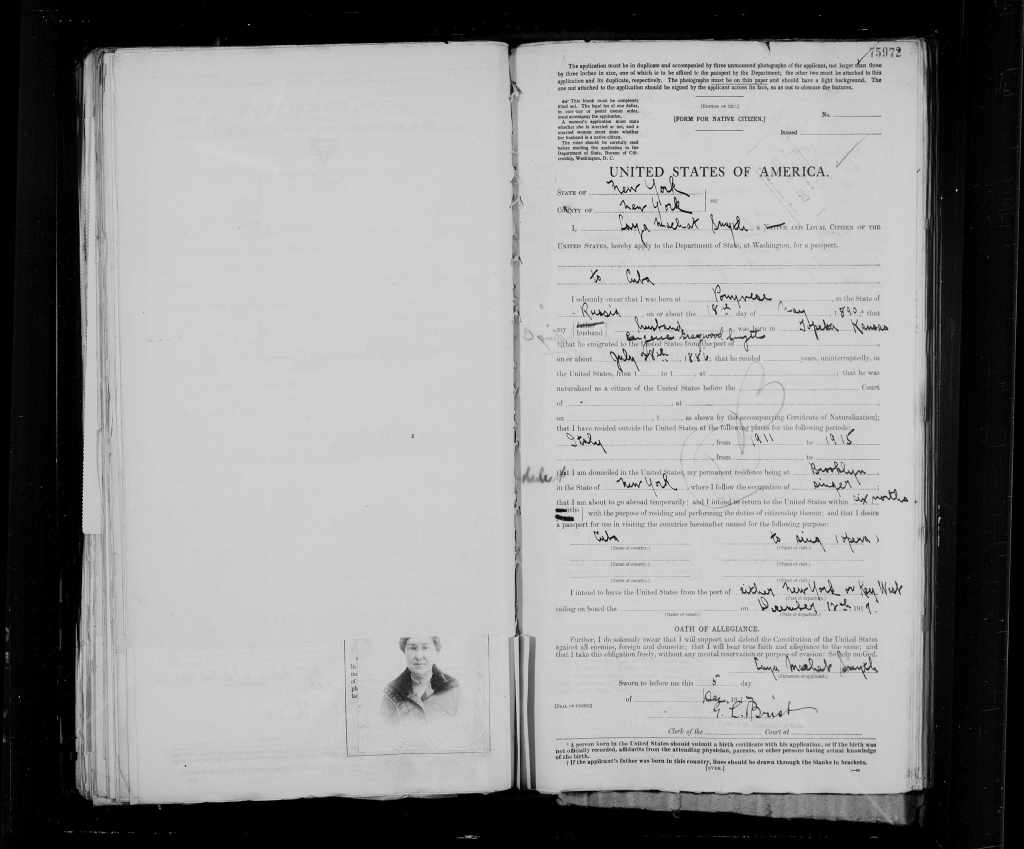
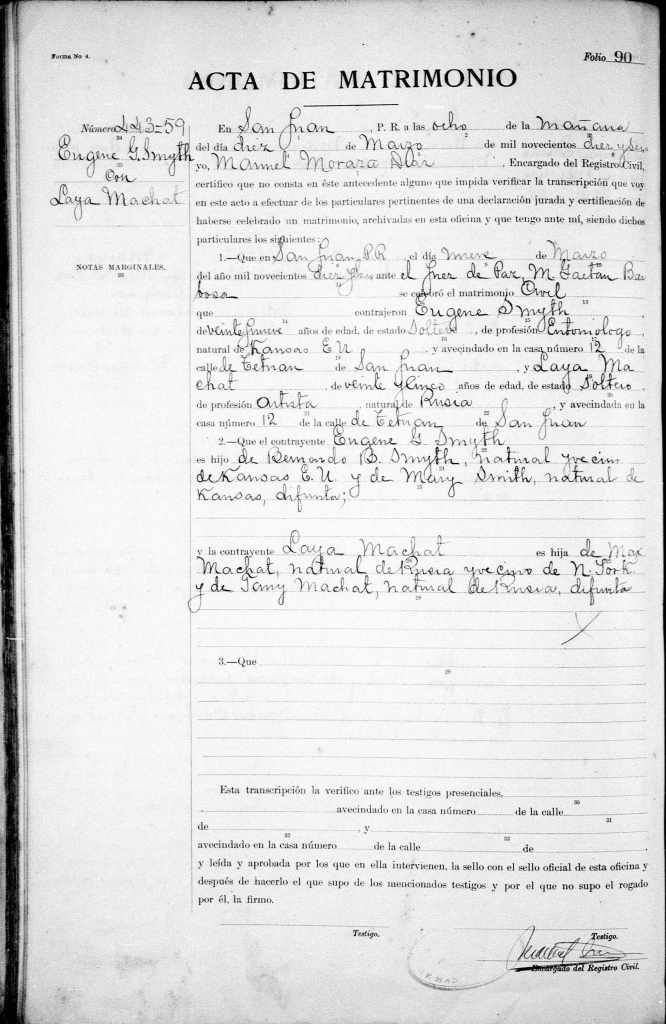
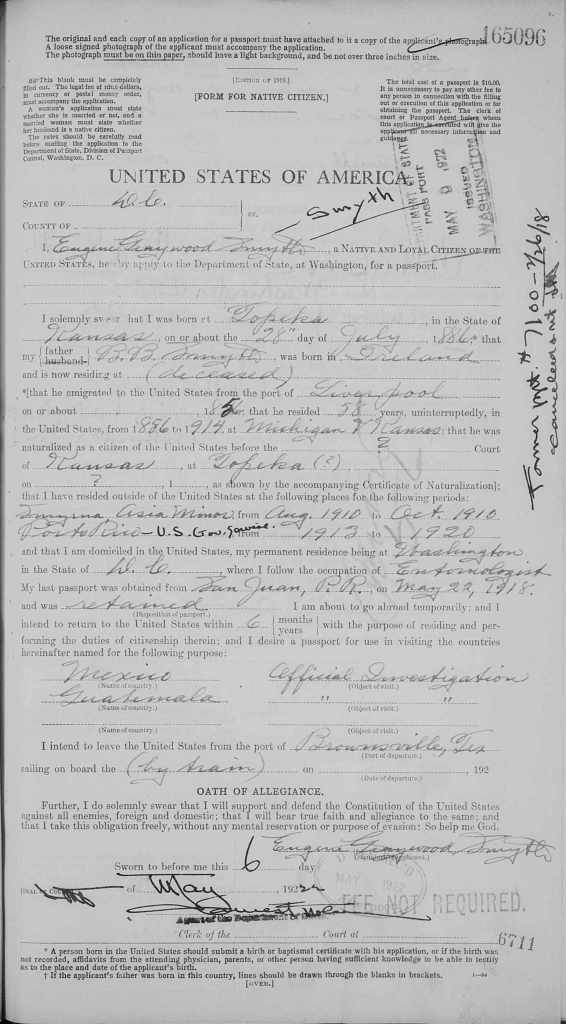


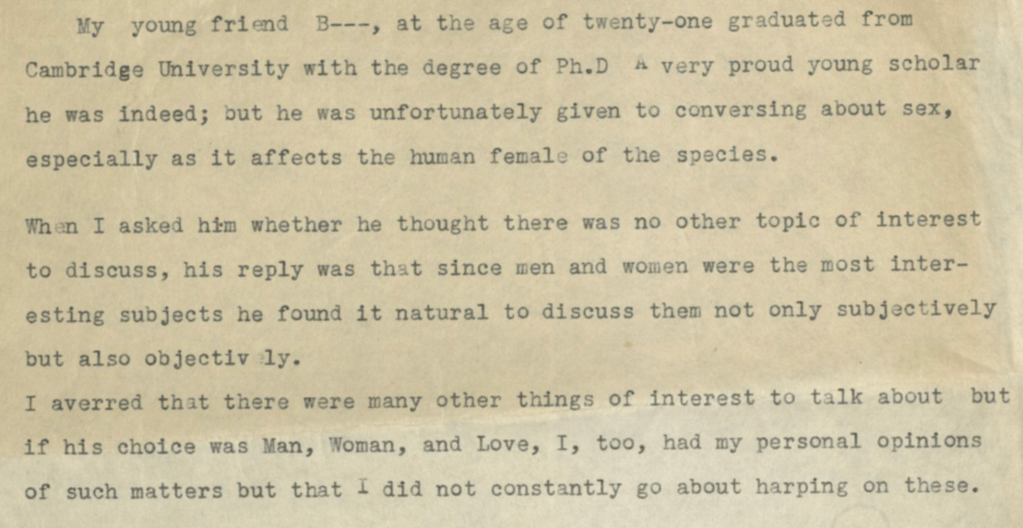


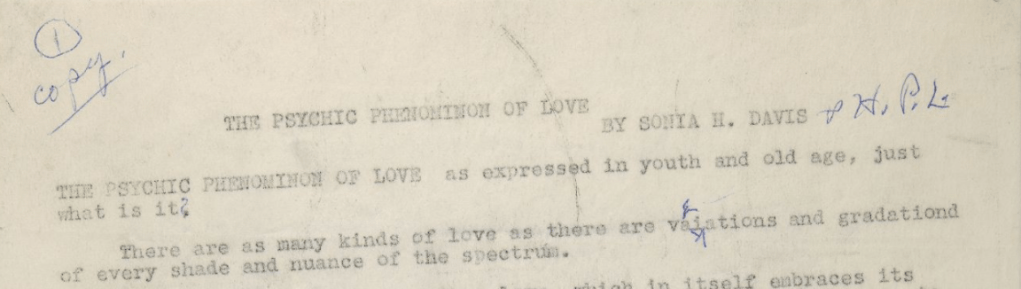
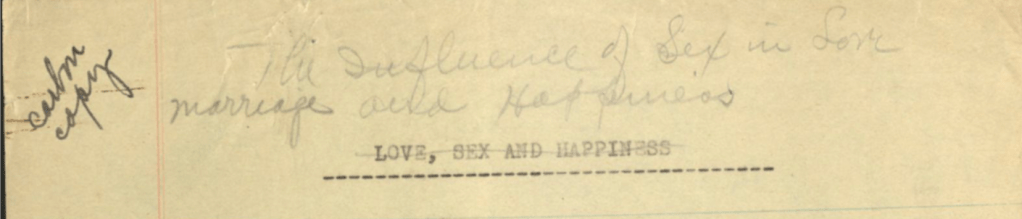




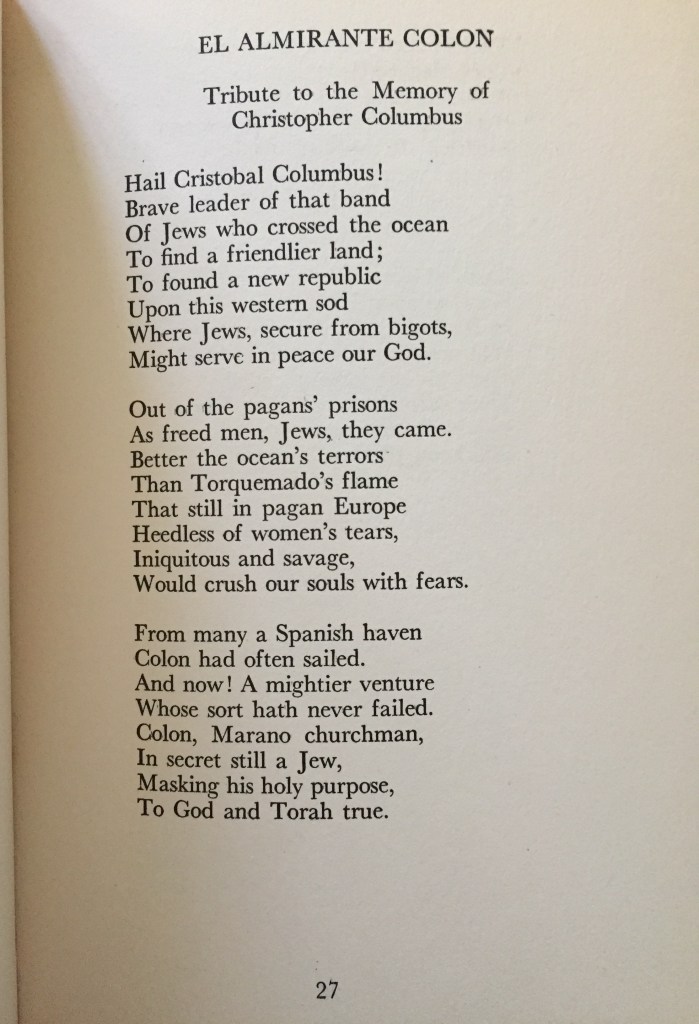


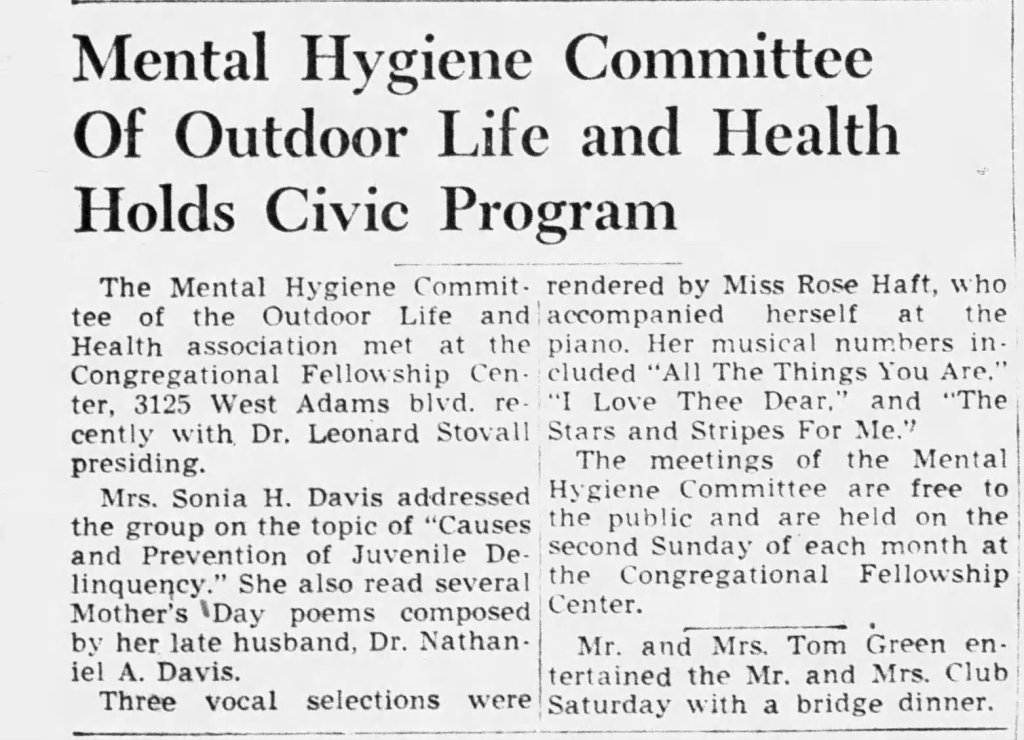
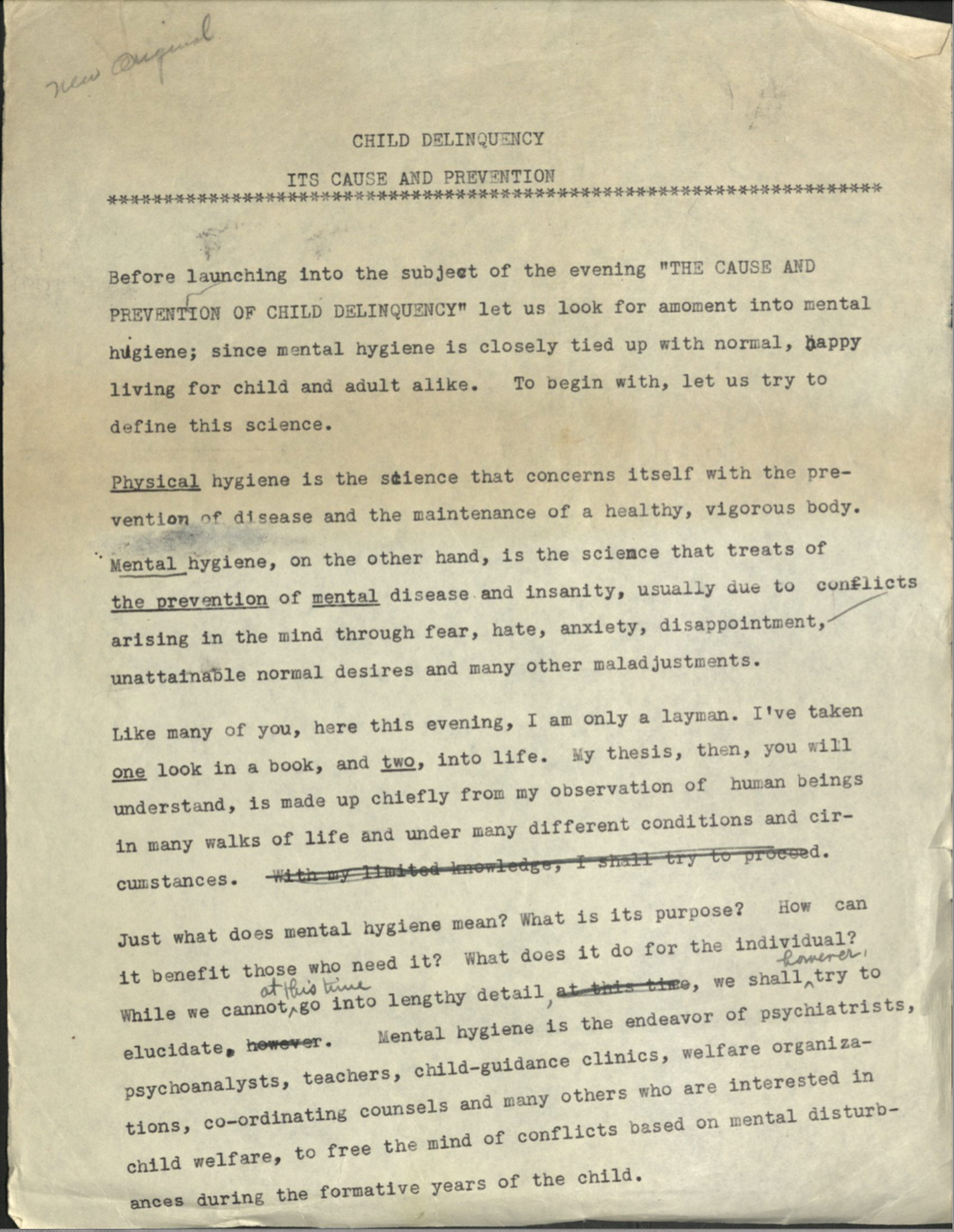
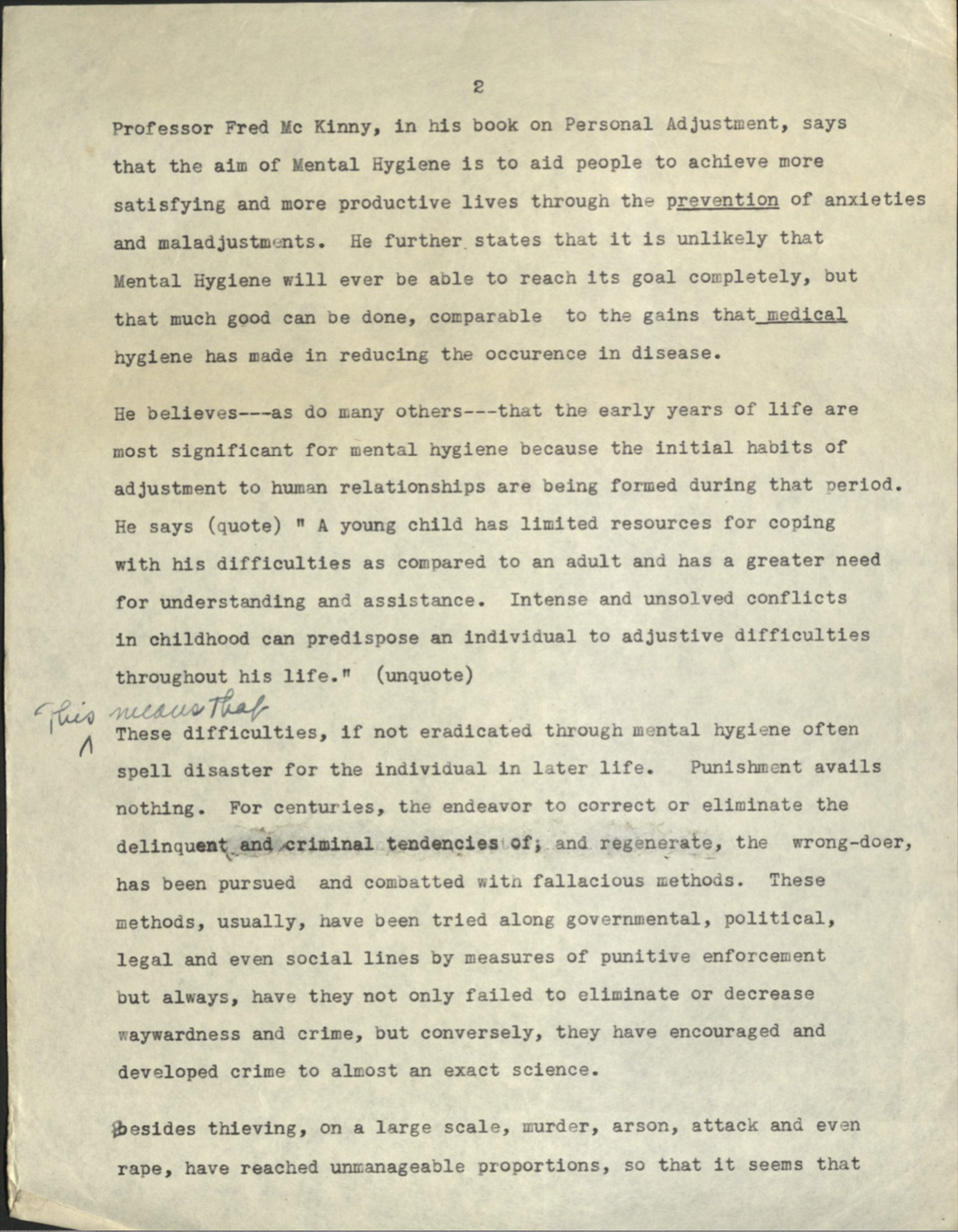



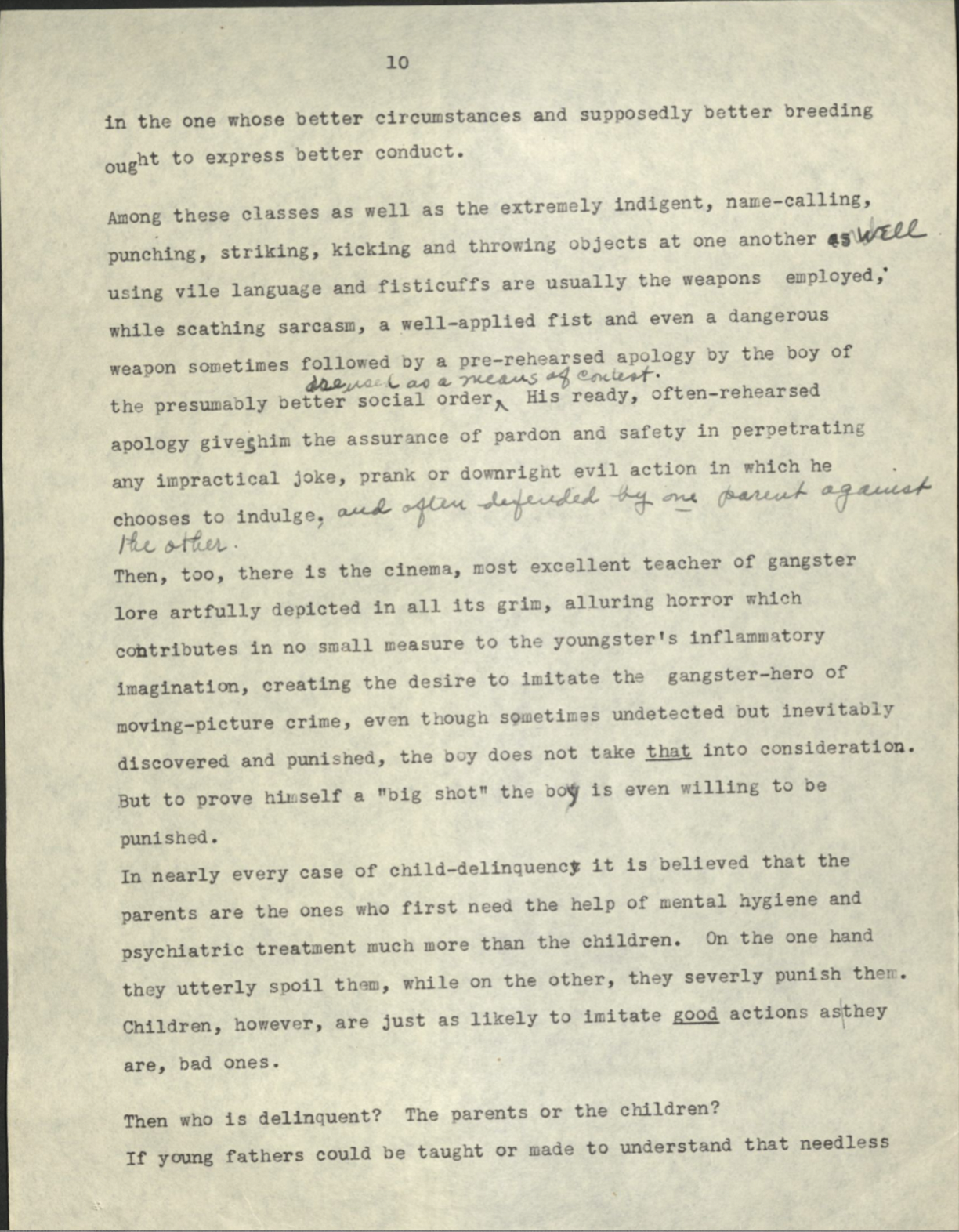


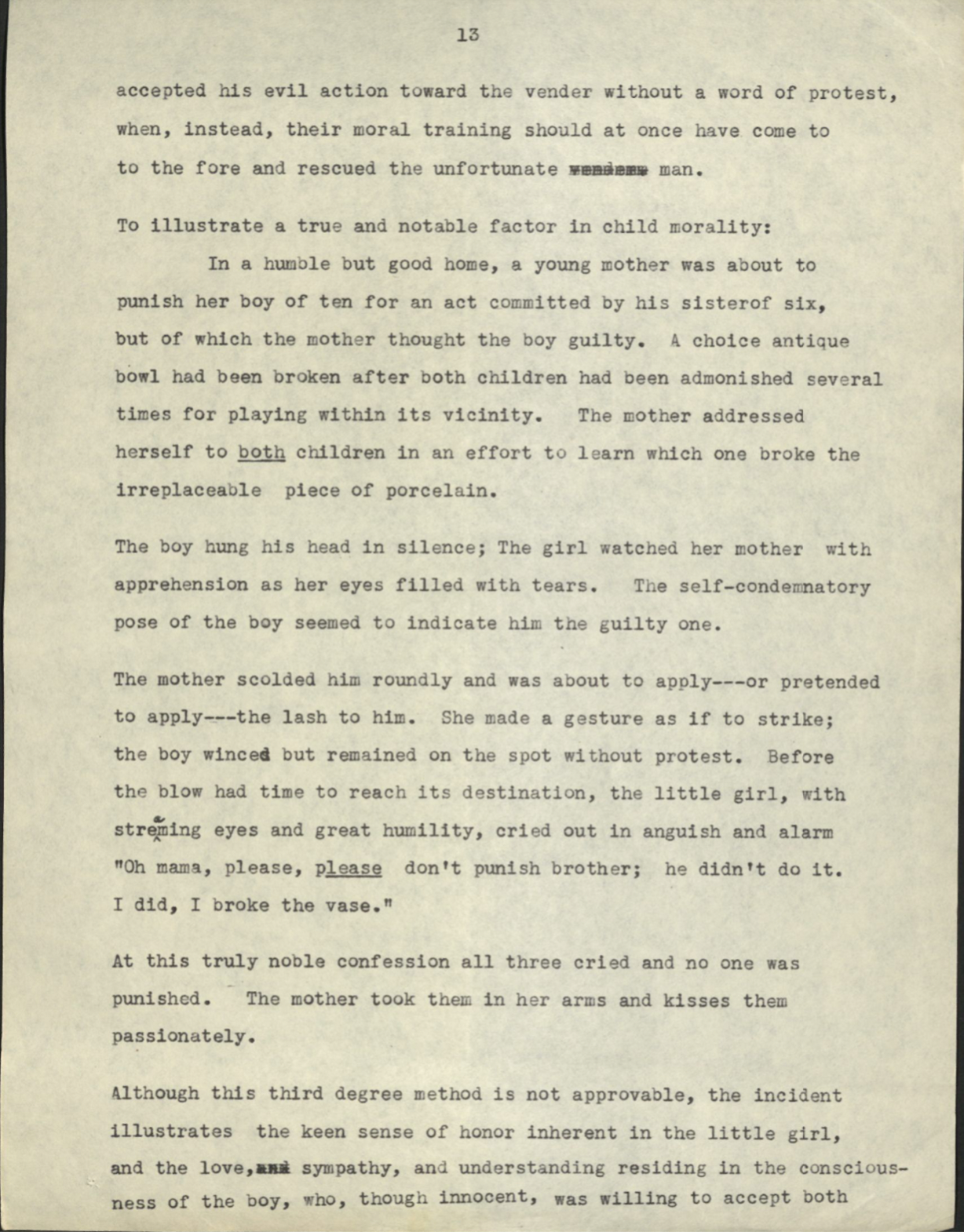


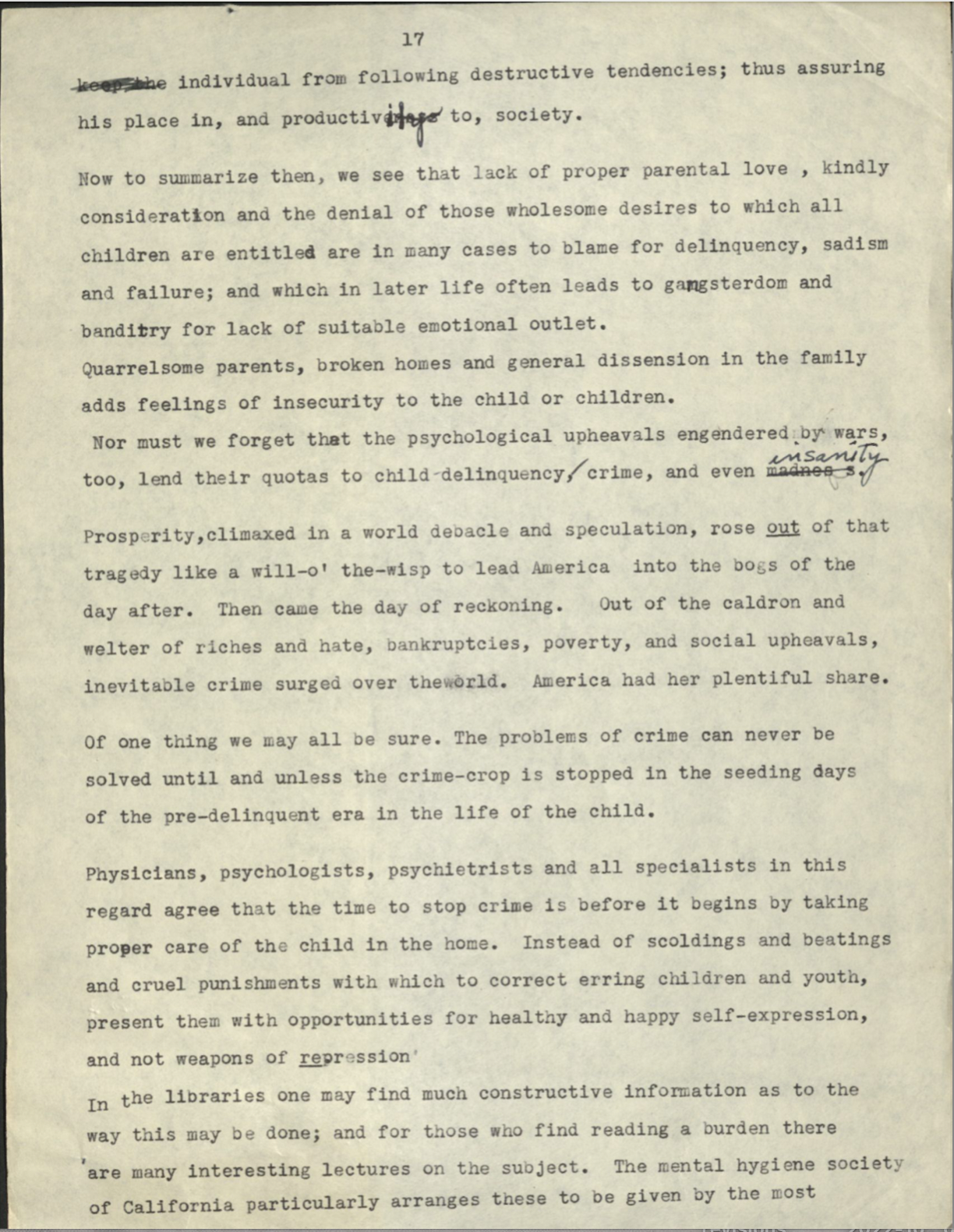
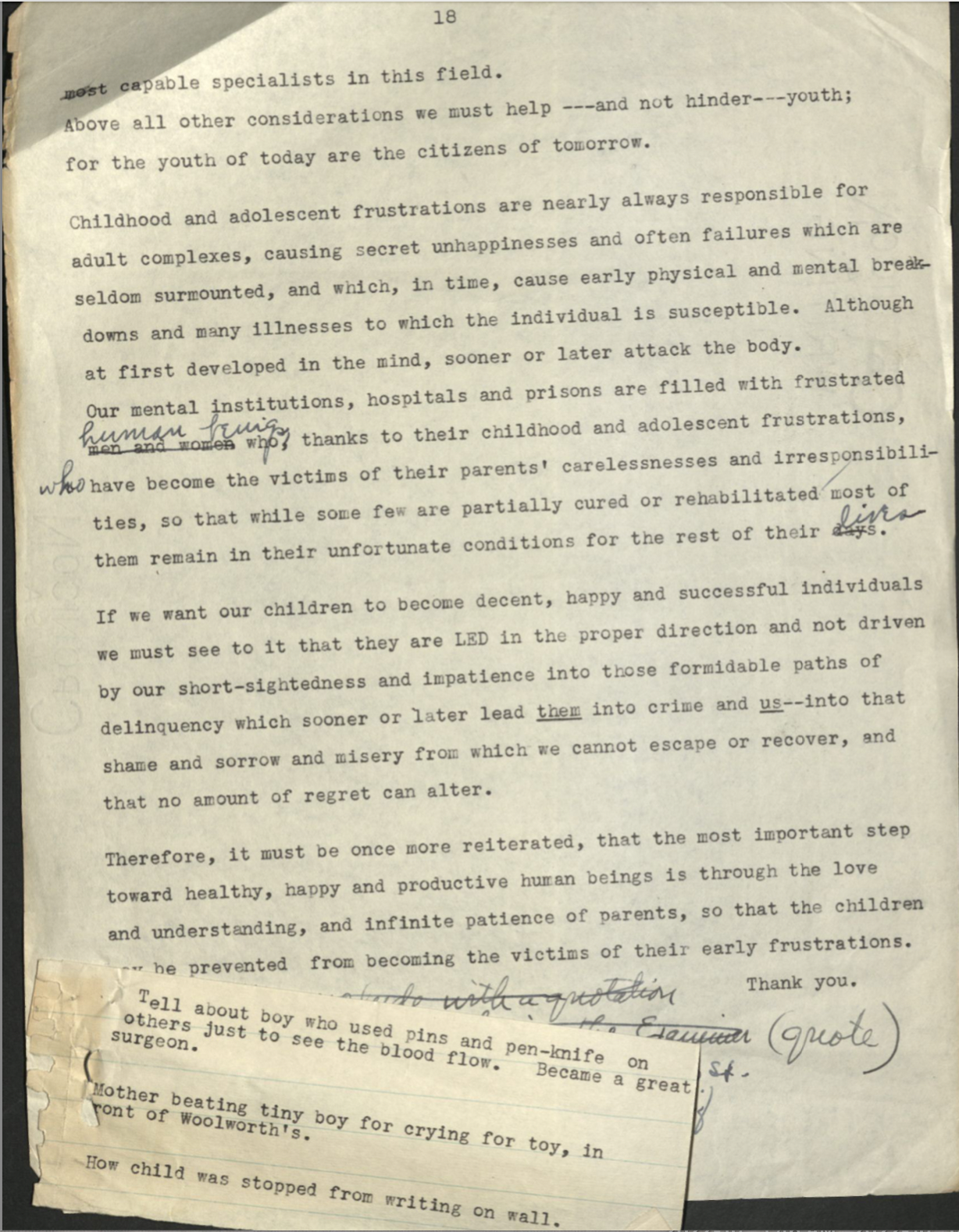

 The Papers of Sonia H. Davis