“My 88th birthday concert was a ‘knock out’ and now I am planning my 89th…”
Sonia H. Davis, Autobiographical Writings, Prose Fragments, 1.22b.
While March 15th marks the death of Howard Phillips Lovecraft, March 16th marks the birth of Sonia (Shafirkin) Haft Greene Lovecraft Davis. Over 140 years ago, Sonia Shafirkin was born and against all odds, (she was a premature baby), she lived a very long and fruitful life. While today is the perfect day to remember her, it is also an ideal day to reflect on the great feats which are happening today for Sonia.
Processed with VSCO with a4 preset
Certainly, great things are happening for Sonia. After a year and a half of studying and compiling her autobiographical writings, Sonia’s first ever full-length autobiography is in the final stages of preparation. It has only taken 50 years to finally see this day come to pass. No doubt there have been several scholars before me who had the intentions of seeing this project through, but with anything in life, things get put in the back burner and become forgotten. I feel very fortunate, especially today out of all the days, to reflect on this feat in making Sonia’s dream come true at last. She had wanted someone, other than herself, to advocate for her worth and achievements, to prove that she was more than just Lovecraft’s wife, and especially more than just an immigrant.
The autobiography is, indeed, coming along very nicely. The most recent accomplishment was another round of revisions on the manuscript which I completed at the beginning of this month. The next step will consist of several more editorial and proofreading passes to be sure the information is properly arranged, and grammatical errors are mended before facing publication. Once that’s all done with, the manuscript will be sent to the printer and if everything goes well with the time frame allotted for printing, we will hopefully be holding the physical book before the year is out. (Just please be patient if it’s not—delays do happen even in the best circumstances.) Not only is that news extremely exciting, but there’s still more to share.
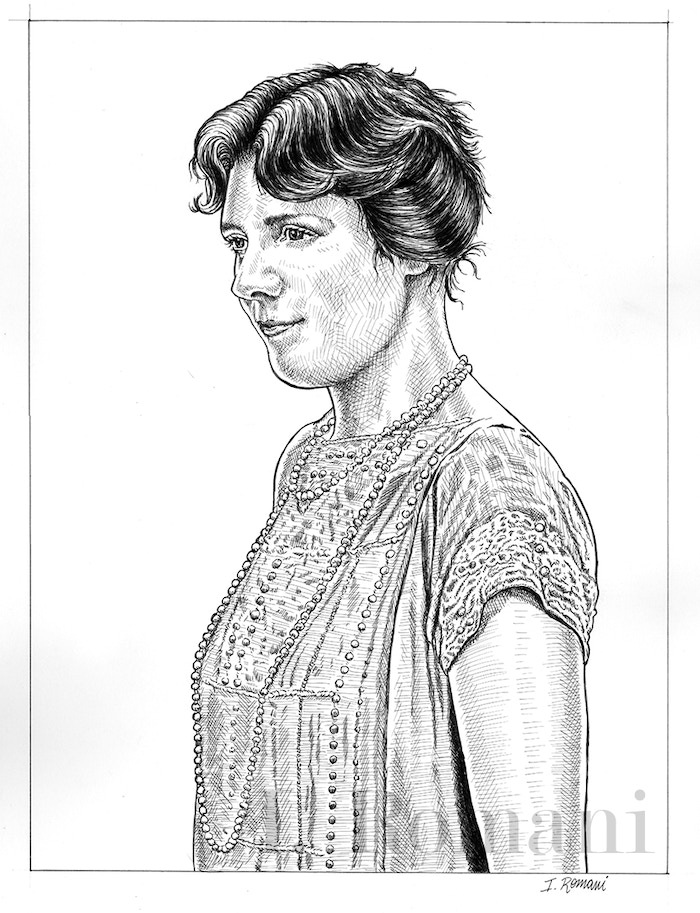
Not long ago, the artist, Iberê Romani Braga, was commissioned to create an original frontispiece for the autobiography. The preliminary sketch of Sonia is everything we hoped and more. I can say with confidence, having already seen the final frontispiece, that you, the supporter, will appreciate the masterpiece once you’ve received the physical copy of the book. Until then, please enjoy this initial sketch for your viewing pleasure.
I can’t stress enough how thankful I am to have undertaken this project. Never did I think my wish would come true. A year and a half ago, I only imagined the possibility of bringing Sonia’s story to life, never thinking of it with real certainty. It was just another idea in my writer’s commonplace book. When I began researching the best methods to write a biography, one article suggested to write interview questions as though preparing to interview the person. I thought the idea was wonderful, but I never created the questions I would’ve asked Sonia. However, in that year and a half, while going through her autobiographical writings, I learned a lot about Sonia and all in her own words as though I’d spent day in and day out with her physical self. The reality is there was nothing I could’ve expertly written to express her life as beautifully as she did.
Above all, I am grateful for those who have taken my venture seriously enough to support it. It’s true, some may not consider Sonia to be as worthy as someone as Lovecraft to deserve any scholarly attention. Her own words may not even change their opinion, yet there will always be the faithful few who will see the value in her words and will enjoy these steps taken to bring her story to book form at last. Therefore, let us have some cake and celebrate!
On an overly marketed day, “Love” loses its luster and depth. Love suddenly becomes an action or a product on a day such as today. Sonia, however, was not a woman easily wooed by words or gifts.
“Where most young women expected flattery, she disdained it.”
Two Hearts That Beat as One manuscript, p. 55.
“Compliments did not interest her. She had the unique desire to be wanted for what might have been just herself, and not for merely a pretty face or being a meal ticket to a ‘gigolo’.”
Two Hearts That Beat as One manuscript, p. 81-82.
Sonia certainly endured relationships devoid of love, and with the addition of her “stunning” appearance, her views on love were ultimately shaped by the aforementioned. Her first marriage to Samuel Greene was turbulent, and although she does not fully elaborate on the physical abuse in her autobiographical writings, it is insinuated he was violent towards her. Upon first meeting Sonia, Samuel was suave, but initially she did not take the bait.
“Have you ever heard that trite saying ‘Love at first sight’?” he asked.
She waited a moment, then added, “Yes, I’m sorry to admit that I’ve heard it nearly every time I meet a young man for the first time, and I’ve been hearing it frequently for the past few months. It does not flatter me one bit. I refuse to be swept off my feet.”
Two Hearts That Beat as One manuscript, p. 54.
Unfortunately, Sonia inevitably married Samuel and suffered throughout that marriage. Although he taught her an array of interesting subjects, he also taught her, by his cruel actions, what she did not want in a man. She was prepared for such a man and was able to avoid it going forward in her life. It wasn’t until she met Howard Phillips Lovecraft that she finally found someone who shared in thought the same views on love. Granted, he is perhaps the last person anyone would consider having any expertise on love, but in one of his letters to Sonia, which she would later include in the essay, The Psychic Phenomenon of Love, portrays the notion of which Sonia held in high regard. Even though Lovecraft did not practice what he preached, it would be Nathaniel A. Davis who would inevitably fulfill the role of the “man of my dreams” that Sonia had initially assumed was Lovecraft.
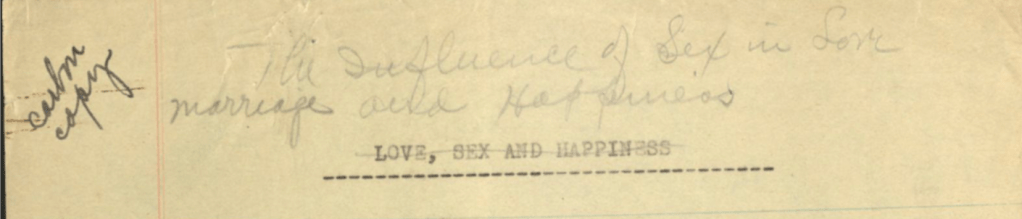
It is uncertain how the topic of love emerged between Lovecraft and Sonia in their correspondence. Regrettably, Sonia admitted to having burned over 400 letters from Lovecraft, and for that reason, we will never entirely know the conversations they held over the years. However, we have much to be grateful for Sonia having preserved these following excerpts from Lovecraft. The Psychic Phenomenon of Love and The Influence of Sex in Love, Marriage and Happiness are nearly identical in what they’re trying to convey. The only variance between the two are the passages by Lovecraft in The Psychic Phenomenon of Love, and even so, what he expounds is in line with what Sonia relates in her much longer thesis, The Influence of Sex in Love, Marriage and Happiness.
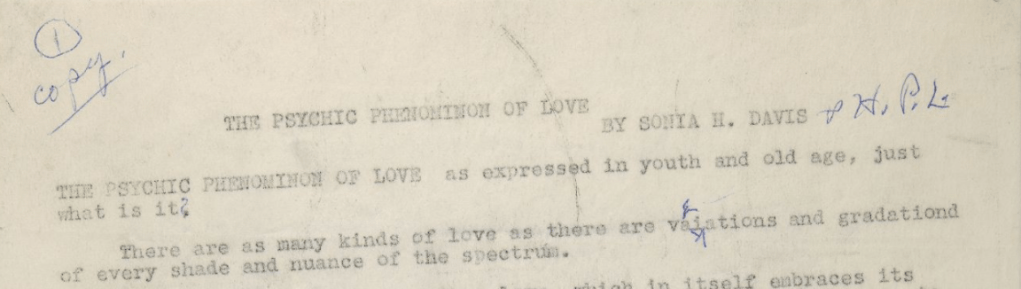
First and foremost, there are two copies of The Psychic Phenomenon of Love. They are both available in the Brown Digital Repository. The two copies begin in the same way, and yet one ends slightly different from the other. In the first version, a carbon copy, starts with a letter by Lovecraft referring to Sonia. It’s a typed letter that was transcribed and published in the Selected Letters; the essay follows immediately right after, and it reaches its conclusion with the sad reality of one who lives a life seeking only “free love”. However, she concludes on a somewhat hopeful note:
“We hear more of unhappiness in love and marriage than we do of happiness—except in novels and plays where both are plentiful; because unhappiness cries out loud its misery into the universe; it exhales its sad and bitter fumes upon the circumambient air disturbing the passerby as he approaches, but true happiness, ever serene, rests in the shady nooks of happy memories.”
Sonia H. Davis, The Psychic Phenomenon of Love, p. 5.
In the second version, a photocopy, starts immediately with the essay. It does not have the typed letter as the other copy. It continues just the same as the other, however, after that somewhat hopeful conclusion in the other, Sonia continues for two additional pages. Rather than focusing on the tragedy and consequences of seeking “free love”, she delves in the sacredness of marriage and parenting. She drives the point that even though many may be married and have children, it does not mean they understand the true blessing and beauty of each role. She concludes the essay with the overall goodness of those who appreciate their marriage and children, and how the unhappy envy its very sight, even if they don’t admit it to themselves.
“They have found what they wanted and they worship it among themselves, while the unhappy seekers are usually the snivellers who go about telling the world that their wives or the husbands, as the case may be, ‘do not understand them.’ And the unmarried hunters vent their perpetual hypochondriac plaints upon the universe in general. They always seem capable of producing perfectly good alibis for their riotous lives, but in the secrecy of their souls they envy the happily married, who are proud Fathers and Mothers to their children, as well as friends to each other, and good citizens + neighbors to their community in general. This can be accomplished only where the love impulse is a sacred one, and not one of biological necessity only.”
Sonia H. Davis, The Psychic Phenomenon of Love, p. 7.
On the back of this essay, Sonia wrote a small note, which means a great deal.
In The Psychic Phenomenon of Love, Sonia starts off the thesis with the very different types of love. There is the love for a mother, father, friends, arts, sciences, and so on. Each of these loves, although they each have a basis for existing, there’s an even deeper need in the human soul which goes beyond the physical.
“The great inner need in most of mankind is to love and be loved; that is—love entirely free from the sex-urge or sex-expression.”
Sonia H. Davis, The Psychic Phenomenon of Love, p. 1.
This statement alone is the very heart of The Psychic Phenomenon of Love and The Influence of Sex in Love, Marriage and Happiness. It’s this main point that reveals how identical these essays are, and with Lovecraft’s excerpts in The Psychic Phenomenon of Love, we are made aware of how similar in thought Lovecraft and Sonia were about love.
“Very often ostentatious passion belonging to the exquisteness [sic] of a few early years, is erroniously [sic] regarded as love and is essentialy [sic] incompatible with maturity.”
H.P. Lovecraft, The Psychic Phenomenon of Love, p. 2.
“The tragic mistake is in fancying that normal marriage can rest for any appreciable length of time on the erotic phenomenon of youth and novety [sic] so popularly termed “sex-appeal”. Now what about this erotic magnetism that hastens two incompatible persons into marriage, blinds them to each other’s true natures for a while, and then leaves them stranded on the rocks of boredom, misunderstanding and uncongeniality! And what is its relation to those finer marriages which actually do remain permanent, contented and inspiring? I am afraid we can never know until we rid ourselves of the illusion that sex and love are one; an illusion that the lighter writings and pseudo-science of the moment tend to bolster up.”
Sonia H. Davis, The Influence of Sex in Love, Marriage and Happiness, p. 15.
In each essay both Lovecraft and Sonia ventured to prove the profoundness of love. Unfortunately, love gets muddled or grouped as one with other types of casual affection. Lovecraft and Sonia strongly believed that love goes beyond the physical. To them, true love was not some flighty emotion exacted in passionate exertion— it went deeper than the flesh. True love is a mutual appreciation for another and their shared memories; an innocent love that does not focus on physical appeal, but rather on personality and intellectual attractiveness. This kind of love, in their opinion, can only be achieved by the length of years.
“There is a universal difference between the romances of youth and of maturity. By forty or perhaps fifty a wholesome replacement process begins to operate, and love attains calm, cool depths based on tender association beside which the erotic infatuation of youth takes on a certain shade of cheapness and degradation. Mature tranquillized love produces an idyllic fidelity which is a testimonial to its sincerity, purity and intensity.”
H.P. Lovecraft, The Psychic Phenomenon of Love, p. 3.
“If a man of delicately evolved sensibilities marry upon a basis of mental and spiritual equality, providing there be love and sufficient sympathetic and harmonious relationship between him and his choice, in the fields of the physical, the aesthetic and the cultural, he will find no need, as the years advance, to seek all over again his inspiration and ideal in some silly, bovine, flippant bobby-soxer. His ideals will have taken root where he first planted them, growing, flowering and richly expanding with the advance of the years, of which he enjoys the richest fruits.”
Sonia H. Davis, The Influence of Sex in Love, Marriage and Happiness, p. 8.
Like in The Psychic Phenomenon of Love, The Influence of Sex in Love, Marriage and Happiness talks about admiring physical attractiveness, and once again, Lovecraft and Sonia mirror one another’s opinion on the matter.
“Mature men and women might regard youthful beauty as an exquisite statue or carving, to be admired but not necessarily desired, while more mature or elderly persons would be regarded simply like themselves, interesting or otherwise, to be liked and admired or conversely—according to their personalities and sociability.”
H.P. Lovecraft, The Psychic Phenomenon of Love, p. 3.
“A man whose love is founded on such rare ideals would not exchange one gray hair of her belov’ed [sic] head for a veritable Venus. To him a youthful woman is simply to be admired in her proper place but not necessarily desired by him.”
Sonia H. Davis, The Influence of Sex in Love, Marriage and Happiness, p. 9.
The Influence of Sex in Love, Marriage and Happiness is Sonia’s argument to those whose only focus, whether in action or conversation, is sex. In contrast to The Psychic Phenomenon of Love, Sonia begins this massive essay with the exorbitant price for the sole pursuit of sex and “of its preposterous elusiveness”. She criticizes those who dwell incessantly on the topic, and how in reality, these people are actually poor in thought. If stripped of the element of sex, these persons lack the capability to socialize with others on an intellectual level. From this stance on the matter, Sonia weaves her real point which is also the same point in The Psychic Phenomenon of Love: a matured love is love in its truest form.
However, Sonia admits that even the elderly can fall victim to the sway of “free love” or the pursuit for a young lover. This concept is briefly touched on in The Psychic Phenomenon of Love while in The Influence of Sex in Love, Marriage and Happiness Sonia elaborates further.
“Then again, there is a species of man who, regardless of his advanced age, like Endimion [sic], although not asleep, flatters himself into believing that he is eternally young, and finds that he cannot be happy or even decently content unless he has at various times, some young woman near the age of twenty. Because of this self-deluded belief in his perennial youth, he often becomes susceptible to the questionably intoxicating glamour of the beautiful but mediocre scatter-brain.”
Sonia H. Davis, The Influence of Sex in Love, Marriage and Happiness, p. 10.
“Were our erstwhile Endimion [sic] to analyse himself, he would find that at his age, the period of emotional intoxication is past and he ought not to fancy that youthful beauty can forever be a stimulous [sic] to his jaded appetites. Time is time, and in settled middle age he ought to see that the only permanent foundation for a home is genuine companionship based on similarity of tastes and interests and the possession of a sufficient fund of shared information and enthusiasm to furnish a lifetime of congenial conversation independent of transient physical attractions and the lure of novelty and adventure. When a man does not wish to found a home on permanent companionship and mental congeniality, he will never be content with one home, long. True love for one’s companion easily engenders true love for one’s home, and such love has its innumerable roots and tendrils which, with the years become increasingly difficult to disentangle or destroy. Such love does not cheapen or debase itself by seeking changes in objects of affection; it is so deeply ingrained and becomes so inextrcably [sic] a part of its original objective that all the hopes and dreams and achievements of the lover become fully identified with the Belov’ed [sic].”
Sonia H. Davis, The Influence of Sex in Love, Marriage and Happiness, p. 11.
To Sonia, this is the most tragic: when an elderly person continues his or her conquest for “free love” rather than having appreciated the rewarding love of growing old with a spouse. In her eyes, such a person has no anchor and therefore will never be content if he or she is always seeking the false glimmer of adolescent love.
“He knows no true home to welcome him, no true love, no wife, no child, and in his old age he usually becomes a pitiable and despicable derelict of life; for life returns to him what he gave to it.”
Sonia H. Davis, The Psychic Phenomenon of Love, p. 4.
While The Psychic Phenomenon of Love focuses on love and its true form, The Influence of Sex in Love, Marriage and Happiness also focuses on the proper place of sex in love, and the consequences if it’s put in the place of love or other vital issues.
“I am not wholly unaware of the relative importance of sex in its rightful place in the life, welfare and happiness of the human species and therefore in society and civilization, and that its place is by no means insignificant, nor so unimportant as many of our puritanic censors would persuade us to believe; yet, that importance and its various phases need usurp no major part of our concern regarding its disposition.”
Sonia H. Davis, The Influence of Sex in Love, Marriage and Happiness, p. 3.
Although it is evident that Lovecraft and Sonia held the same views on love, the question that remains is at what point did Sonia finally realized its full significance in her own life? In her autobiography, Sonia relayed an epiphany which might have sparked these essays. Toward the last days of Nathaniel’s life, their interactions were becoming extremely emotional. In one exchange, Nathaniel told Sonia that he would always be with her, that only his body would be leaving her. To this she responded:
She would tell him that she could not imagine the real Nathaniel without a body.
“I want to hold you in my arms,” she would say. “I want to look at your beautiful head and eyes. I want to feel your kisses. I want to feel your arms around me. I want to see you at your typewriter, steal up behind you and kiss you, and you’d grab my hand, kiss it, and tell me how much you love me. I used to think that only the youth knew how to love, but youth will have to become old in body and young in mind and spirit to know how to love truly. I wish we had met when we were young.”
Two Hearts That Beat as One manuscript, p. 171.
Sonia had once assumed that only the young knew how to love, but much like her two essays, she came to understand and experience that true love could only become genuine once it has matured. Although neither of the essays have a clear date as to when she wrote them, it is safe to assume they were both written late in her life and about the same time, which is precisely why they are very similar to one another.
In some respects, Lovecraft and Sonia were a perfect match when it came to the theory of love. Regardless of their marital outcome, this is what love meant to the Lovecrafts. There remains so much more to be said about each essay, both in comparison and in contrast. However, the conclusion is The Psychic Phenomenon of Love and The Influence of Sex in Love, Marriage and Happiness deserve to be read and presented together, because where one lacks, the other provides.
It is no secret that Sonia first met H.P. Lovecraft at the National Amateur Press Association Boston Convention in 1921. Neither is it a secret that she wasn’t entirely a fan of his quirks.
“I first met him at the Boston Convention when the Amateur Journalits [sic] gathered there for this conclave, in 1921. I admired his personality but frankly, at first, not his person.”
The Private Life of Howard Phillips Lovecraft manuscript, p. 17, 1948.
However, what continues to remain a mystery is the precise details of their first introduction. There are several reports of who played cupid between the two, of who made it their mission to make their paths cross. You may read some of those particulars in this interview: Apropos of Sonia Greene. Well, Sonia had her own testimony on who introduced her to Lovecraft. Although she neglected to provide details, she maintained this statement consistently throughout her accounts surrounding her relationship with Lovecraft.
“And evenings the two men (Lovecraft and Samuel Loveman) would meet me and we would go to dinner and see a play, or sometimes have a conclave of “amateur” friends—James F. Morton Jr. (who had introduced me to Lovecraft)…”
Books at Brown, Vol. XI, Nos. 1 and 2, p. 4, February, 1949.
“This was a favorite spot of my good friend, the late James F. Morton whom I knew many years before I met H.P. In fact it was dear James who introduced me to that convention in 1921 where I met H.P.”
The Private Life of Howard Phillips Lovecraft manuscript, p. 31, 1948.
The events which transpired in Boston at the National Amateur Press Association Convention were thankfully recorded nearly in full, as far as I know, by two amateur journalists: George Julian Houtain and Edith Miniter, both of which shared insightful tidbits of both Lovecraft and of Sonia. According to Houtain, Sonia was amongst several others who accompanied him to Boston from New York on July 1, 1921:
“This time Rheinhart and I had company—our party aboard the Calvin Austin, which left New York at 5 p.m. included Ernest and Iva Dench, Albertus and Hazel Adams, Pearl Merritt, Sonia Greene and Dottie. We made Stateroom No. 190 our headquarters presided over by its occupants, Dottie and Sonia. It was a happy care-free party.”
The National Tribute, p. 13, August 1921.
Things were about to get even more fun, for Houtain thereafter discloses some very revealing details about Sonia. Certainly, this following excerpt would inevitably crown her the official vamp of the weekend.
“We are still guessing whether A . M. A. (Albertus M. Adams), because he permitted himself to be fed ginger-ale baby-fashion by Sonia, was a greater vamp than she. In any event, Albertus said that he had no option but to live up to his reputation, while Sonia insisted that the only way to measure up to Presidential standards was to get a ‘rep’— so she immediately started in to vamp all the boys by summoning the steward. This was neatly done, too. It only required the pressing of a little button set in the wall not more than a dozen feet from the floor. This she did with the point of her slipper, at the same time having it encase her dainty foot, the feat bringing forth resounding applause and putting to shame the best terpsichorean art of a Ziegfeld beauty.”
The National Tribute, p. 13, August 1921.
After enduring a storm while at sea, the group finally arrived at Boston the next day, July 2nd.
“We breakfasted aboard. Then in a drizzling rain, accompanied by Sonia, Dorothy, four suit-cases, two bags, one grip, a brief case, two rain-coats; three umbrellas, a hat box, a card index and a look of keen expectancy, I taxied to the Hotel Brunswick.”
The National Tribute, p. 14, August 1921.
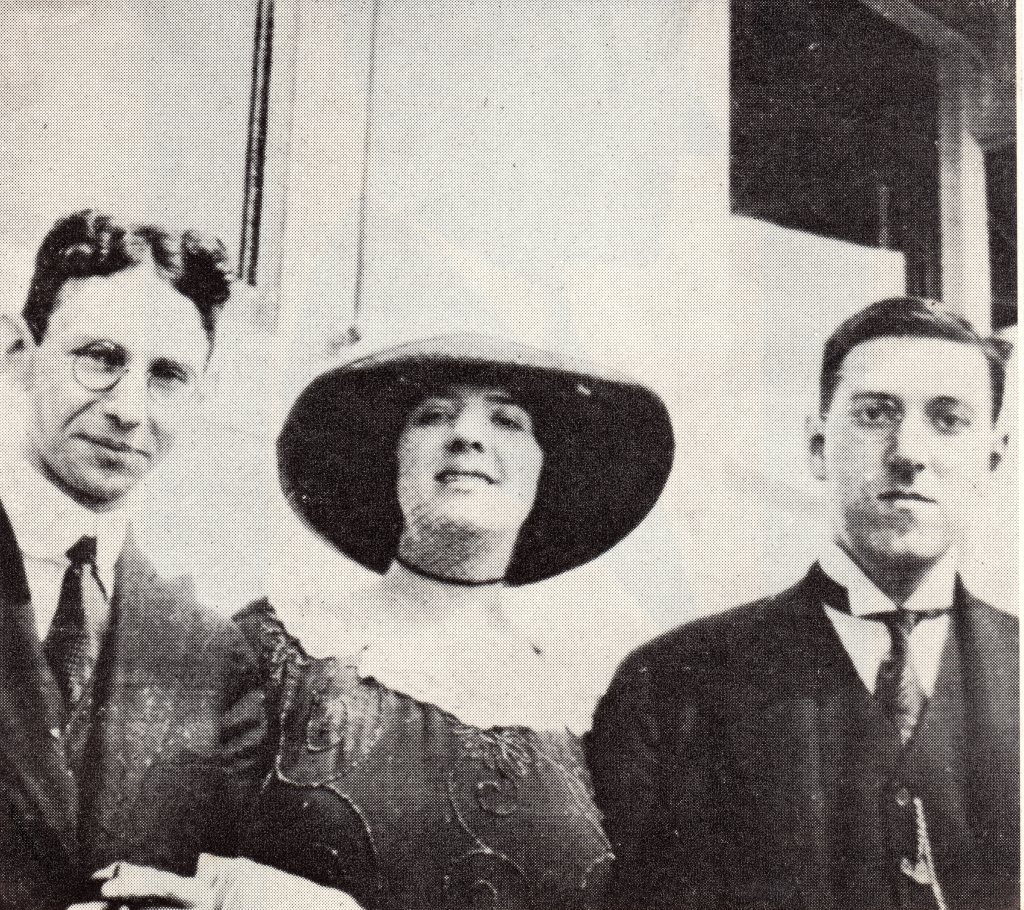
Houtain thereafter reveals that James F. Morton Jr. was already at Boston upon their arrival. In fact, he had left New York one month earlier. Unfortunately, Houtain did not elaborate on the time when Lovecraft arrived at the convention. However, if James F. Morton Jr. did in fact introduced Sonia to Lovecraft, then it was very likely on July 2nd. Houtain goes on to relay a curious instance which occurred on July 3rd, involving Lovecraft and Sonia. This account describes one very specific photograph that has been the embodiment of Lovecraft and Sonia as a couple.
“The time will never be when I will the less enjoy the splendidness of Howard Lovecraft. He is a big man in every way. Much to my delight he has proven himself to be the most human of documents. He possesses a sense of humor that is astounding, because one would doubt he possessed the gift. He is also a man with a deep sense of honor and can always be trusted. He is a modest man and great was my joy when I arranged with our official vamp, Sonia Greene, to steal up on him suddenly, get a half-Nelson clutch on his august form so that I could Brownie No. 2A him—which I did. Then the fun that followed with Lovecraft burlesquing himself as a victim of a blackmailing gang and accusing Sonia and me of being in cohorts—which we were.
Finally a deal was patched up that the negative of the said picture is to be placed under a certain rock on the corner of Broadway and 42nd Street, New York City, July 4, 1922. If Lovecraft is there at ten o’clock P.M. it is to be his—otherwise (and this is the dire threat) it is to be published immediately following the New York convention. Woe be unto him if he doesn’t appear.”
The National Tribute, p. 18, August 1921.
It is very clear by this shared moment that Sonia was comfortably acquainted with Lovecraft. Perhaps by this given time, they had already partaken in several conversations. Of course, we can only speculate the length of time which had passed between the statement above and their introduction, and how well that first meeting went. We can safely assume, however, given by the account above, that it obviously went well in spite of Sonia’s reservations about Lovecraft’s “person”.
The interactions between the two did not stop there. On July 4th, the two were quite busy with the proceedings of the convention. Although at one point of the day, the two banded together, amongst others, to help raise funds for Mrs. Hayes lunch-room and afterwards they went for a hike.
“Along about one o’clock, Sonia and Lovecraft, Bill and friend-wife Lucie, Rheinhart and Gladys, Iva and hubby Ernest, Van and Sandusky, Dottie and I, helped to create more dividends for Mrs. Hayes lunch-room on Huntington Avenue and later the rest of them took a ‘hike’ along the Charles River.”
The National Tribute, p. 23, August 1921.
Were there other instances in which they did things together? Who knows, but we have plenty to be grateful to George Julian Houtain for including these precious moments that Lovecraft and Sonia shared together, because ultimately it was these little instances which would shape a relationship into a marriage. It is tidbits like these which bring additional shades to the portrait of Sonia H. Davis, who at the time of the convention was known as Mrs. Sonia H. Greene.
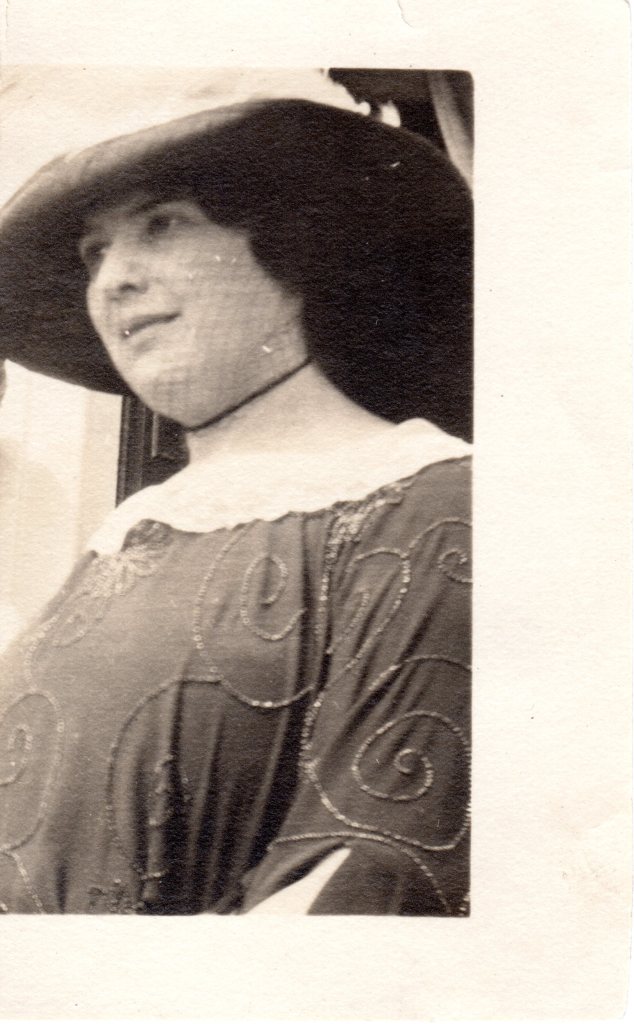
Rheinhart Kleiner, Sonia, H.P. LovecraftThis photo was cropped to only show Sonia, but in the original photo Ernest Dench and Elsie Houtain were standing next to Sonia. On the back of the original photograph it was written: “Sonia on right, a tall large woman—she had a millinery store—I bought a hat from her once $30.00.”
Whilst Houtain portrayed Sonia as the vamp, Edith Miniter’s account of Sonia at the convention was quite the opposite. As different as the reports are, they both paint a very realistic image of Sonia’s personality. She was both wildly fun and undoubtedly shy. She even reveals this much in her own autobiography. I shall, therefore, conclude this article with Edith’s touching remembrances of Sonia at the National Amateur Press Association Convention in 1921.
“Sometimes we missed the clever and interesting Mrs. Sonia Green [sic], but as she always explained that she was in her own room “absolutely absorbed in a book” we had to forgive her. At least I had to, the book being “Our Natupski Neighbors.” The same absorption explained (or I hope so) her getting lost whenever she went into the streets of Boston alone. Even when she departed from 20 Webster Street Saturday after the bean supper, with that book under her arm, she got lost. Said she was looking for a taxi—which was about as big a compliment to our part of Allston as asking change for $10 was to the coon.”
The Aftermath, p. 19, 1921.
“… Sonia Green [sic] had collected a few nickels as a blind and then presented the president-elect with a literal bucket of flowers…”
The Aftermath, p. 12, 1921.
“And one bewildered female may in Boston streets be seen A-seeking the convention halls—and that is Sonia Green [sic].”
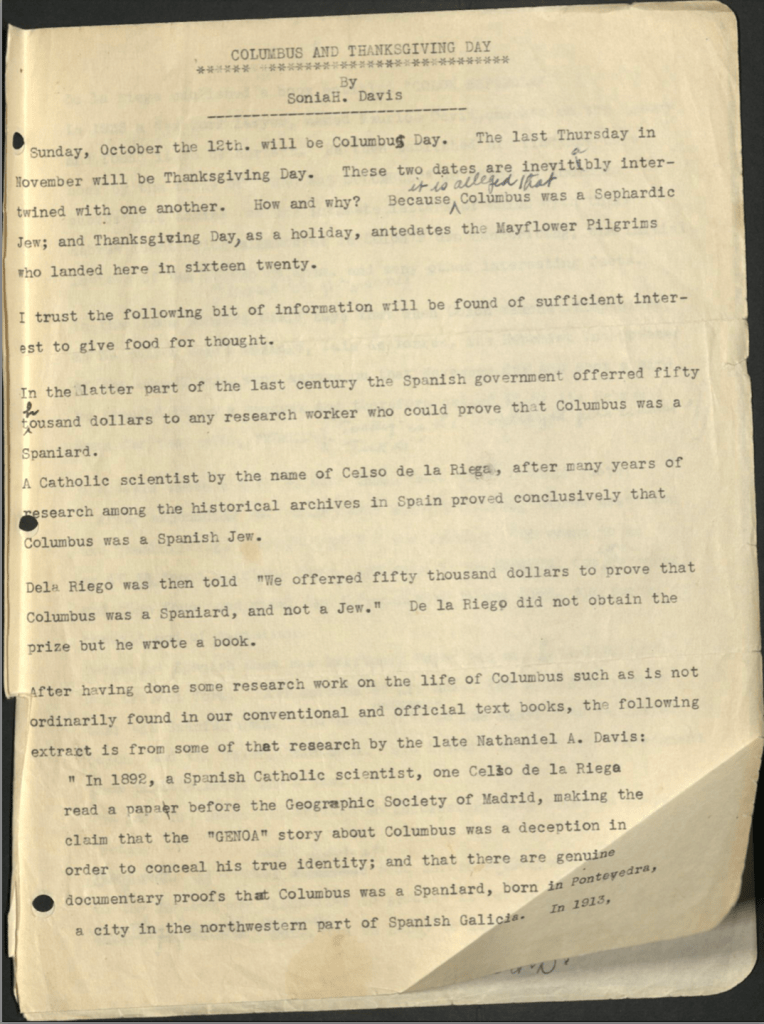
For this Thanksgiving special, I will be focusing on Sonia’s short essay Columbus and Thanksgiving Day. The essay is only two pages long and in it, she discusses the legendry of Columbus and his ethnicity. Although Columbus was thought to be a Spaniard, due to his fluency in Spanish, it is rumored that he was secretly a Jew. (Times of Israel) For instance, his departure date, August 3, 1492, to the New World coincides with the date in which Jews were met with expulsion from Spain. On March 31, 1492, the order to expel Jews was issued, but the Jews had until the end of July to leave the country. (History)
Celso García de la Riega, a Spanish historian and author, made it his mission to prove Columbus was a Spanish Jew. In short, a Sephardic Jew. (Britannica) De la Riega held a public conference on the night of December 20, 1898, to share his research on the matter. The title of his presentation was Cristobal Colón Español?(Online Books) The documents that de la Riega presented, which he claimed to have found in Pontevedra in Galicia, contained the names of the Colón family and the Fonterossa family. By some means, de la Riega linked Columbus with the Colón family while his wife was linked with the Fonterossa family, whose ancestors were known to be Jewish.
Taking de la Riega’s research further, Maurice David wrote Who was “Columbus”? which provided additional “proof” consisting of photostatic reproductions of 40 letters written by Columbus. The book was published in 1933 by Research Publishing Company. According to Maurice David, the cryptic, triangular form of Columbus’s signature was deciphered into “an abbreviation of the ‘last confession’ of the Jews and also a substitute for the Kaddish.” Moreover, the obscure monogram at the top left corner of most of Columbus’s intimate letters was suggested by Maurice David that it was “nothing more nor less than an old Hebrew greeting”.
However, the article Columbus & the Jews by Jonathan D. Sarna takes all of these sources and presents a wholly different and adequate reality from trustworthy Jewish scholars, particularly from the scholarly research of Rabbi Meyer Kayserling. (Brandeis) At the request of the Spanish government on the 400th anniversary of America’s discovery, Kayserling wrote Christopher Columbus and the Participation of the Jews in the Spanish and Portuguese. (Jewish Virtual Library) It can be claimed with certainty, thanks to Kayserling’s research, that Jews played a role in the pilgrimages of Columbus. Luis Santángel, a third generation converso, was the Spanish treasurer who chiefly helped achieve the funds for Columbus’s expedition.
“Most important of all, Kayserling showed that Columbus’s reward was paid out of funds expropriated from Jews being expelled from Spain in 1492, and that the same source—not the Queen’s jewels, as popular myth had it, but her Jews—would defray the costs of his second voyage as well.”
Jonathan D. Sarna
His interpreter, Luis de Torres, had converted into Christianity, but was of a Jewish descent. Certainly, the possibility of other Jews having joined Columbus in his voyage is very likely, especially when Jews were seeking any opportunity to flee from the country that was openly torturing and/or banishing them.
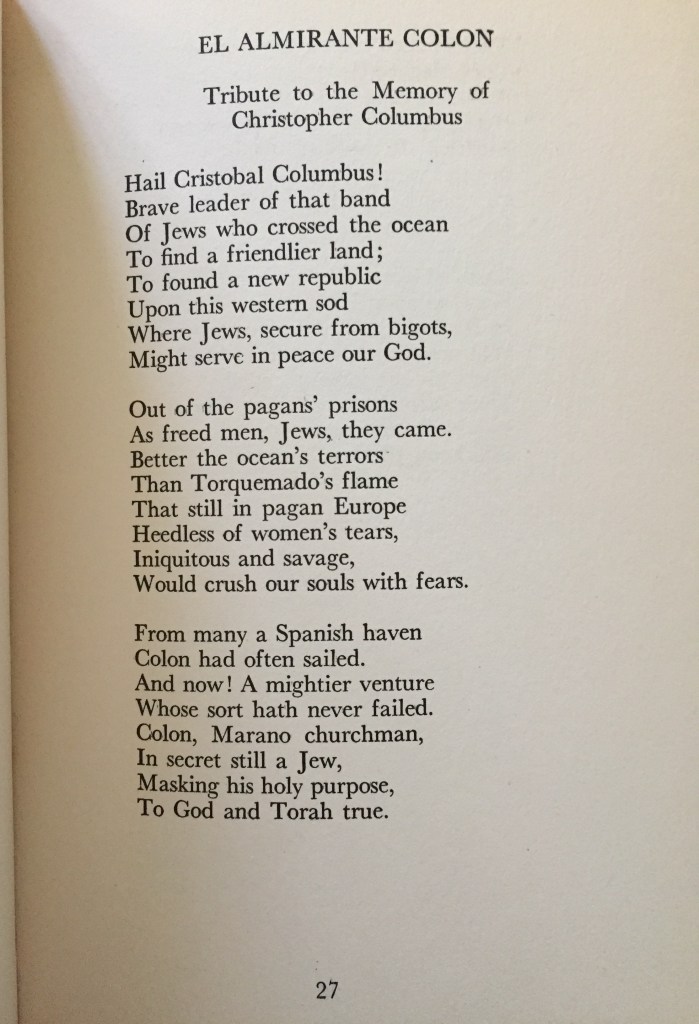
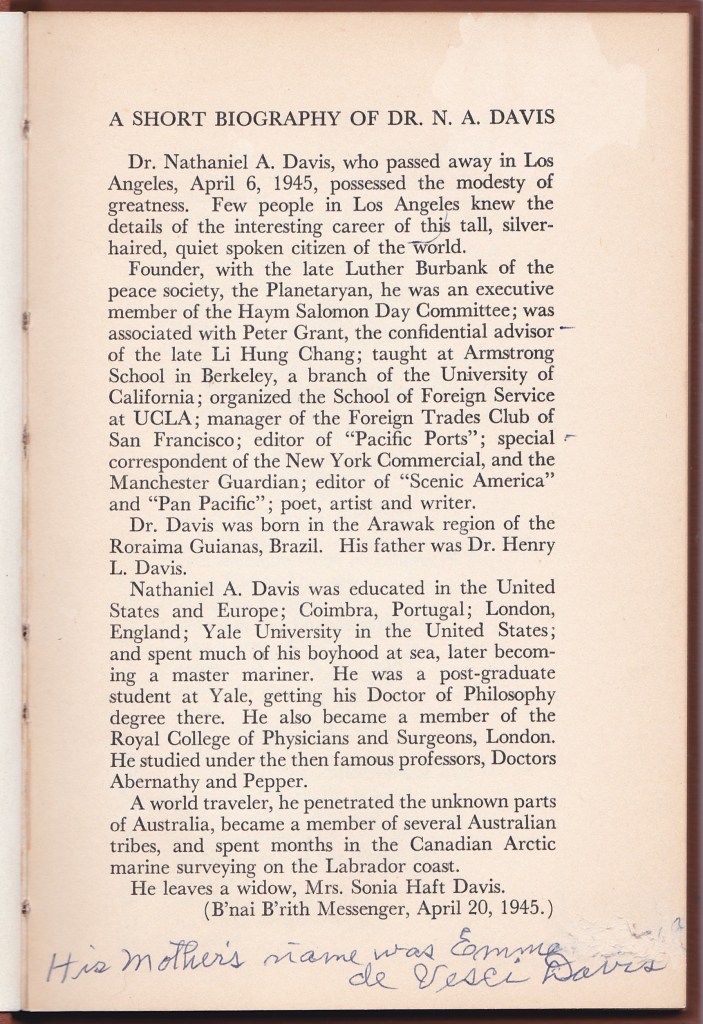
Being a Sephardic Jew, Nathaniel A. Davis, Sonia’s third husband, was also fascinated with this topic. He wrote a play about Columbus, which has yet to be sent to me in its entirety by my proxy researcher. Thankfully, Sonia included a small sample of the play in her essay. Nathaniel also wrote the poem, Cristobal Colón. The poem was published in his volume of religious poetry, The Voice of the Prophet, and will be posted down below. Regrettably, Nathaniel and Sonia’s belief in Columbus as a Jew is not supported factually enough to be held as true, but their patriotism in the deep Jewish roots in America is not wrong.
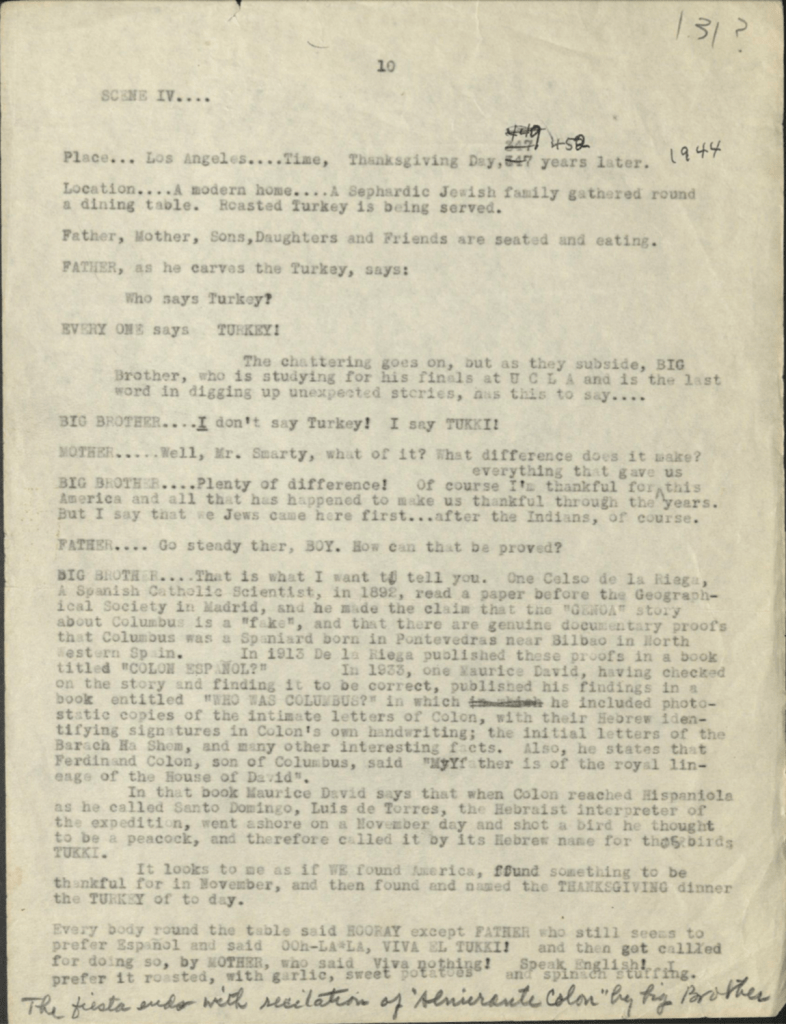
Well, how does all of this tie into Thanksgiving? According to Maurice David’s book, he explained an incident surrounding Columbus and one of his voyagers, which involved the shooting of a “tuki” (Hebrew name for parrot, but perverted over time into turkey), thought to be a peacock at first. (Jewish Boston) Interestingly enough, Sonia takes this scenario and expounds on it in the form of a play. Unfortunately, it is only a fragment of the play. It is doubtful if the rest will ever be found.
The ancestry of Christopher Columbus shall always remain a mystery. That is, unless his birth certificate miraculous emerges and finally sheds the necessary light on the “Admiral of the Ocean Sea.” (Britannica) Nevertheless, we have many reasons to be grateful and even more reasons to celebrate on this special day. May grace and peace be with you and yours.
Cristobal Colón by Nathaniel A. Davis:
After leafing through The Voice of the Prophet, I found another poem dedicated to Columbus.
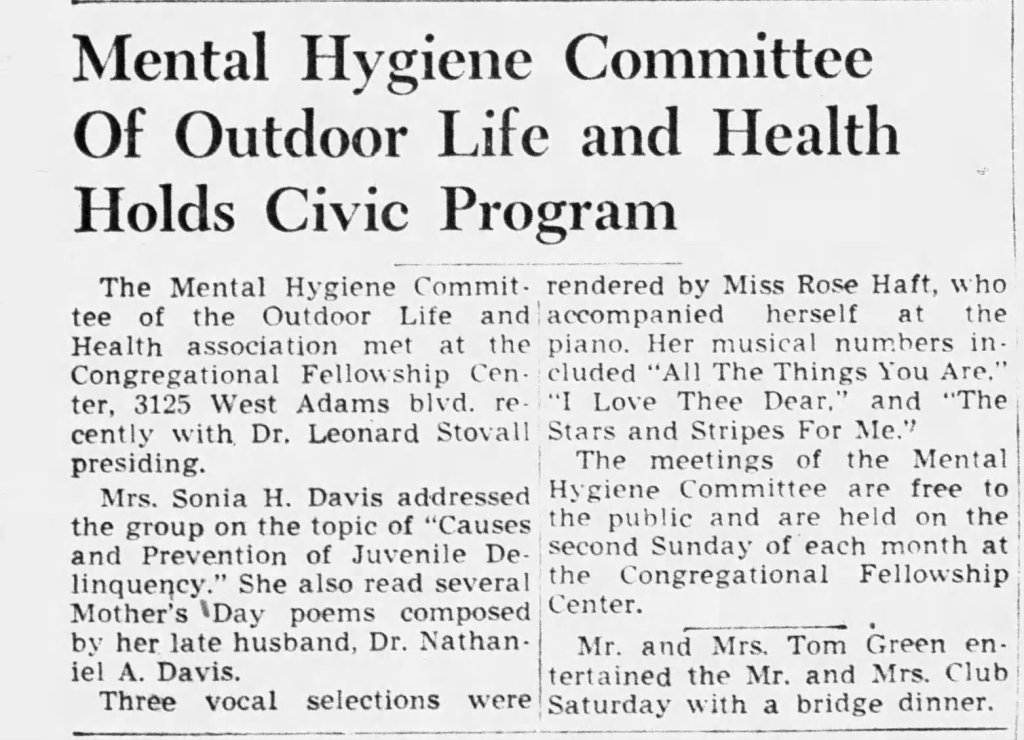
This is a newspaper clipping from The Los Angeles Times, Friday May 6, 1949, taken from page 31. Courtesy of Newspapers.com.
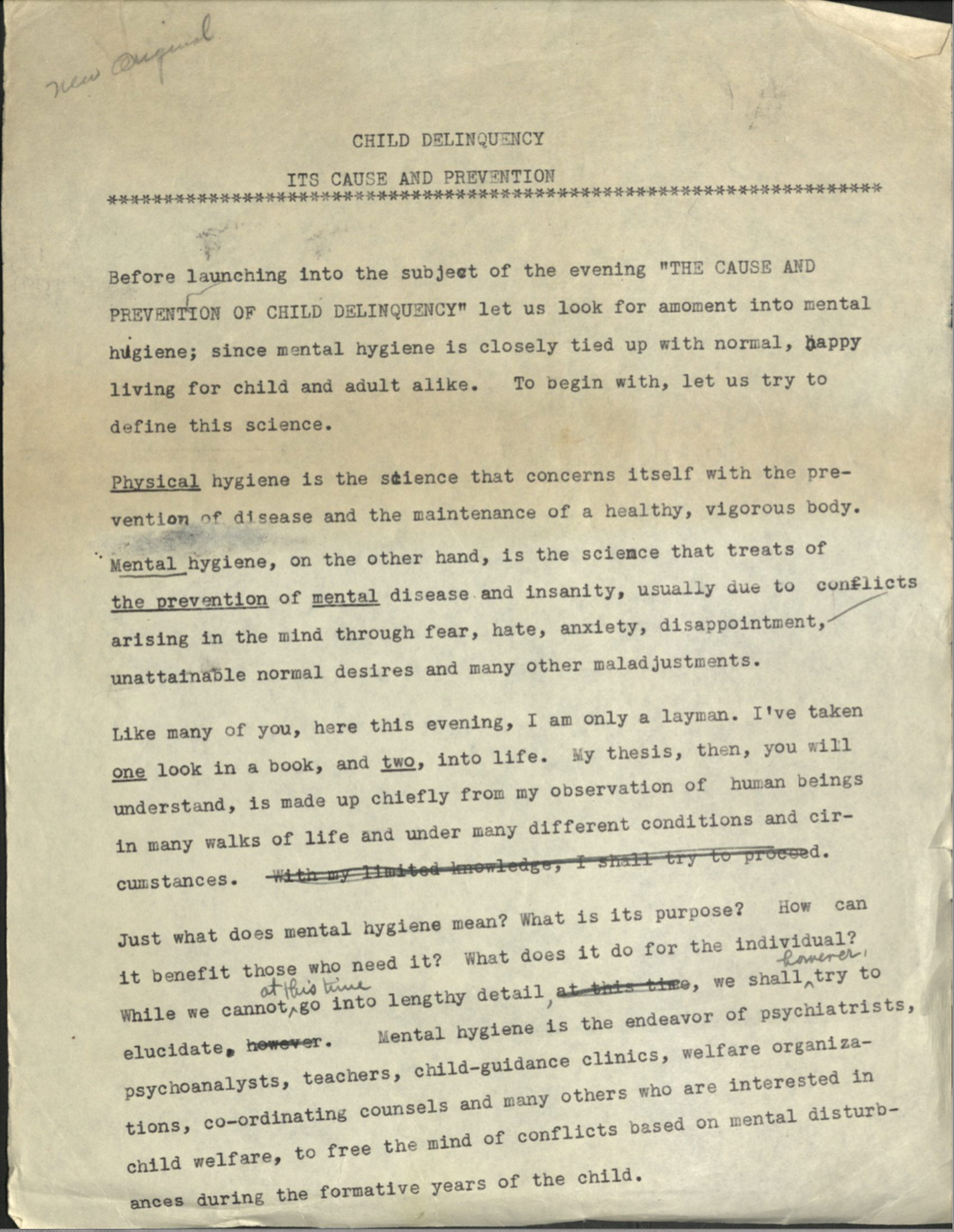
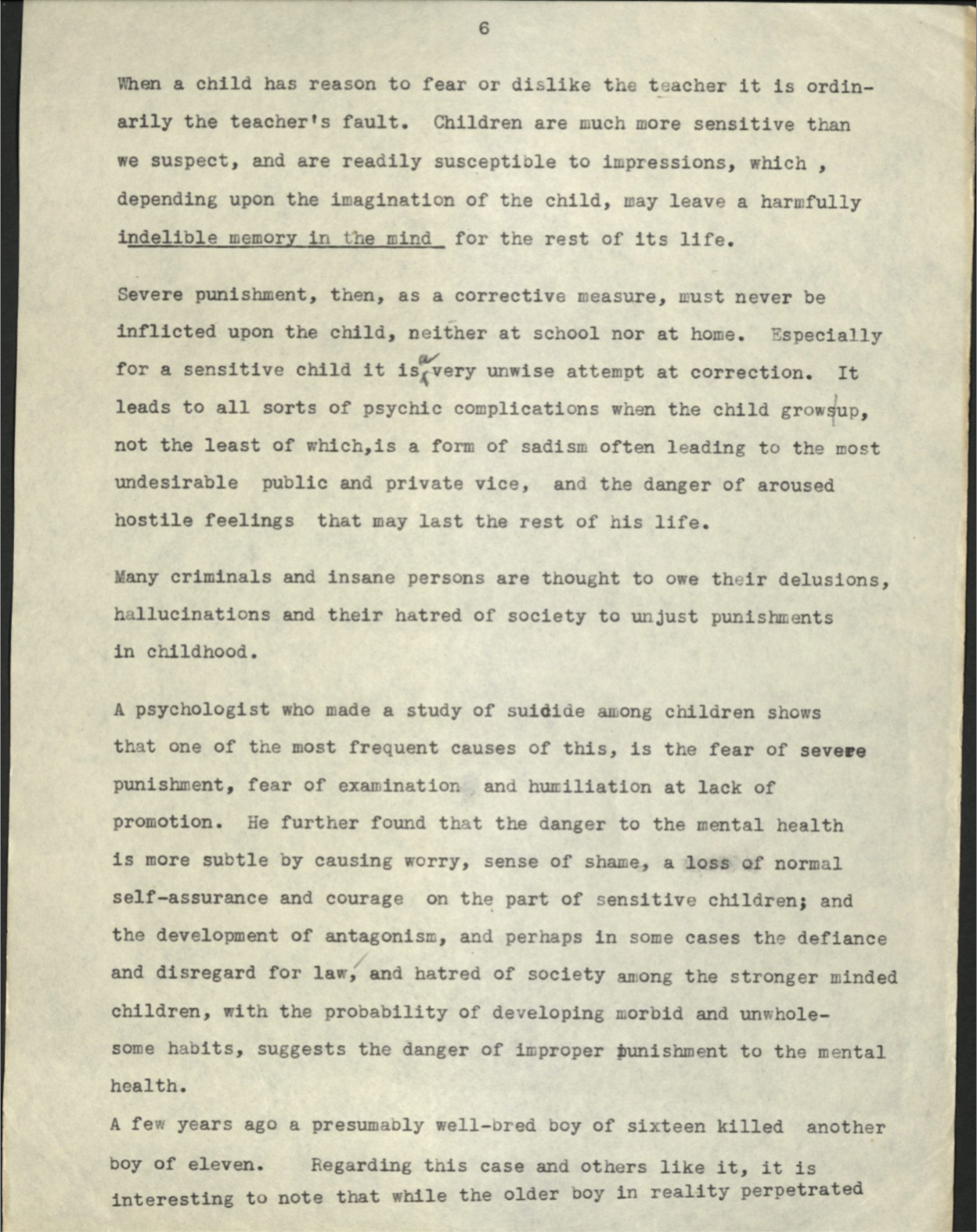
The manner in which children are dealt with by parents and teachers, guardians and nurses either aids or hinders the progress and future welfare of the individual and of society.
Sonia H. Davis
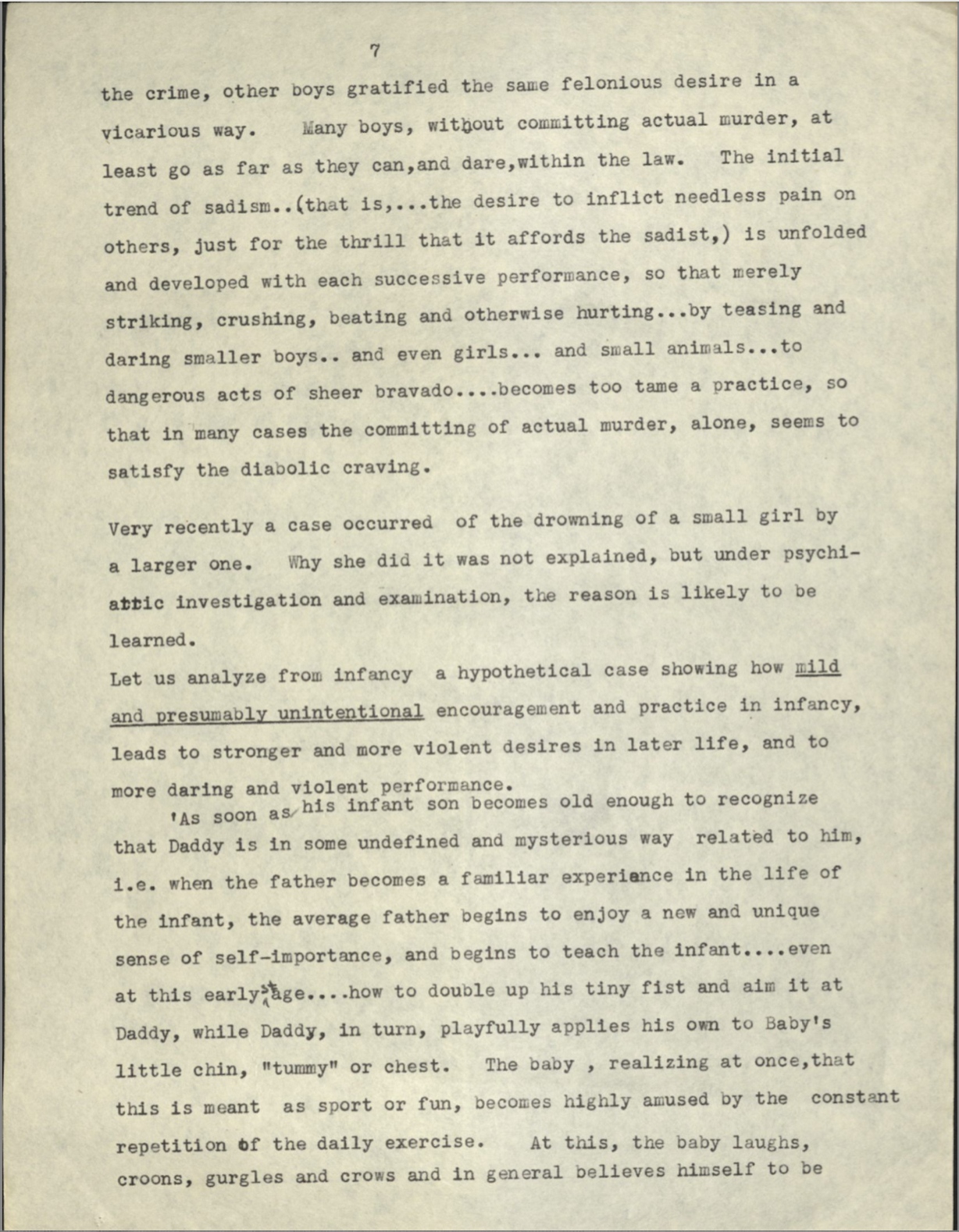
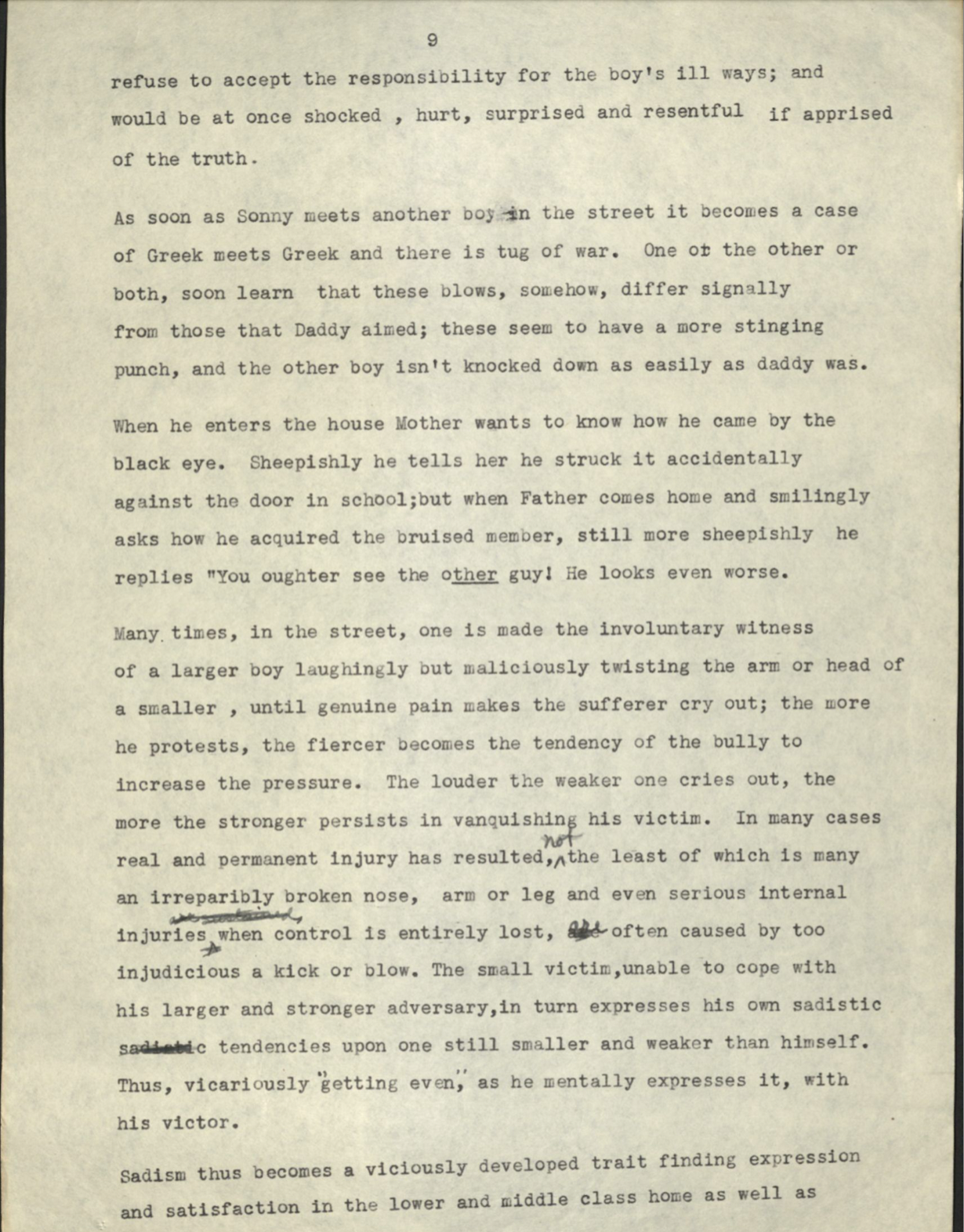
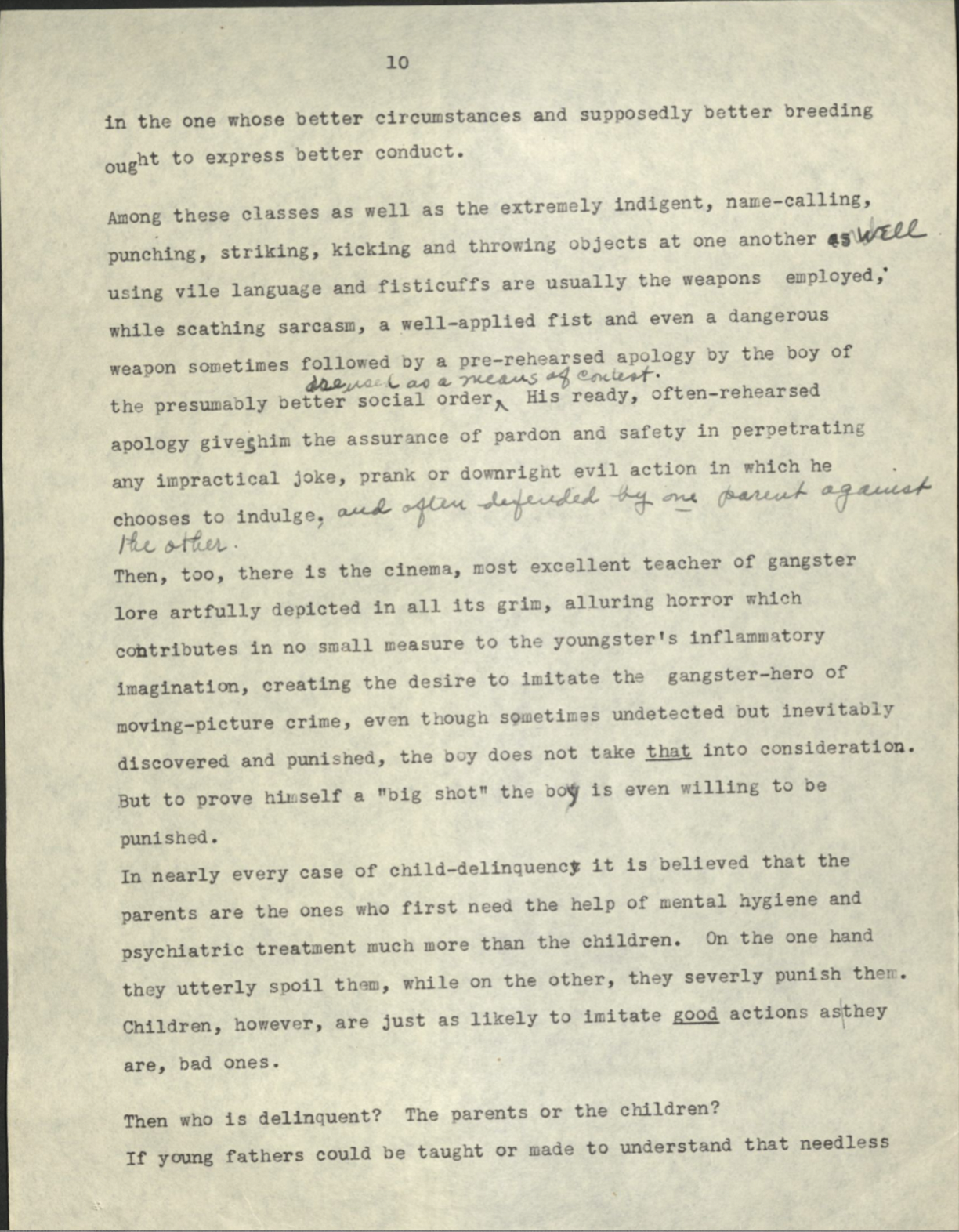
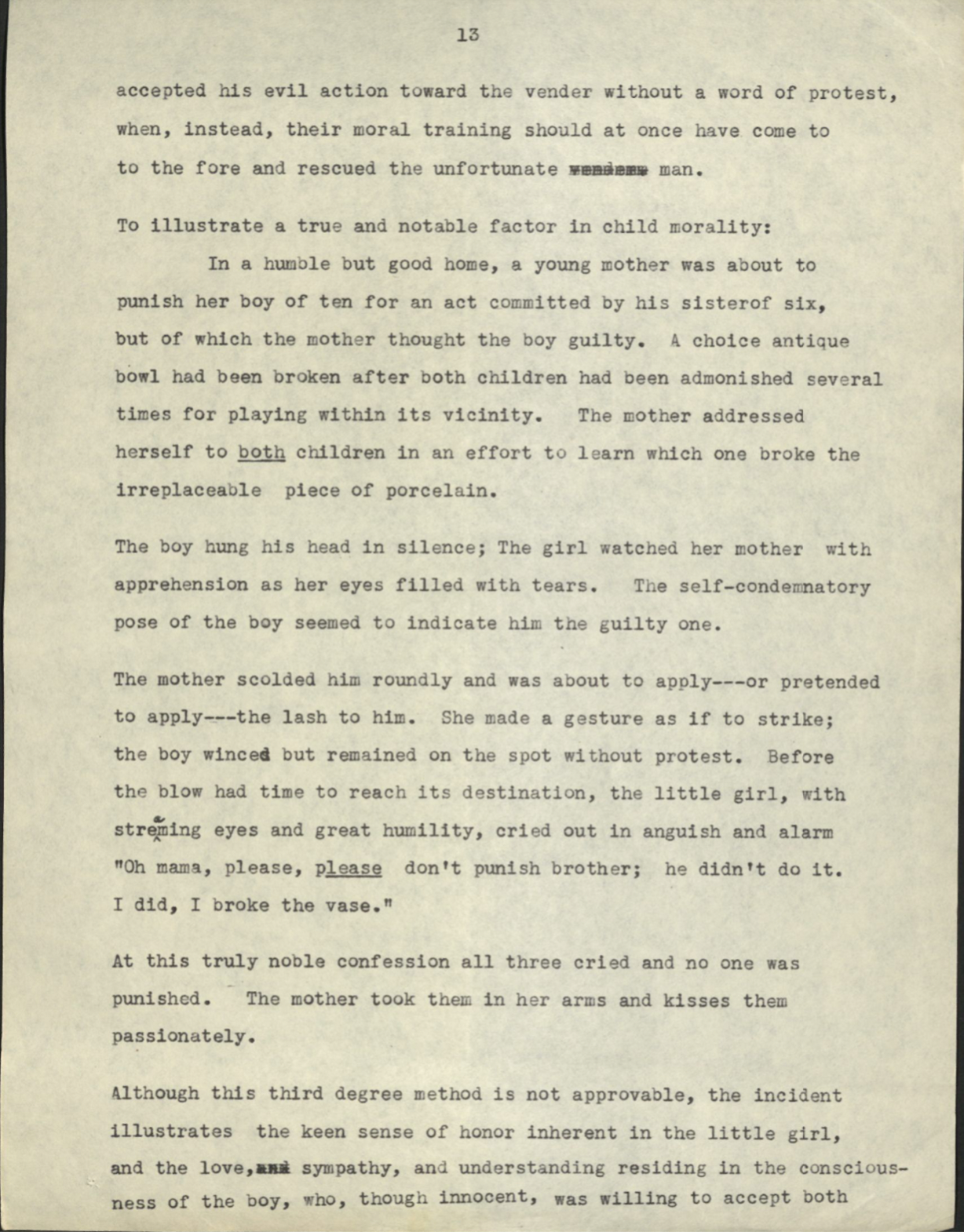
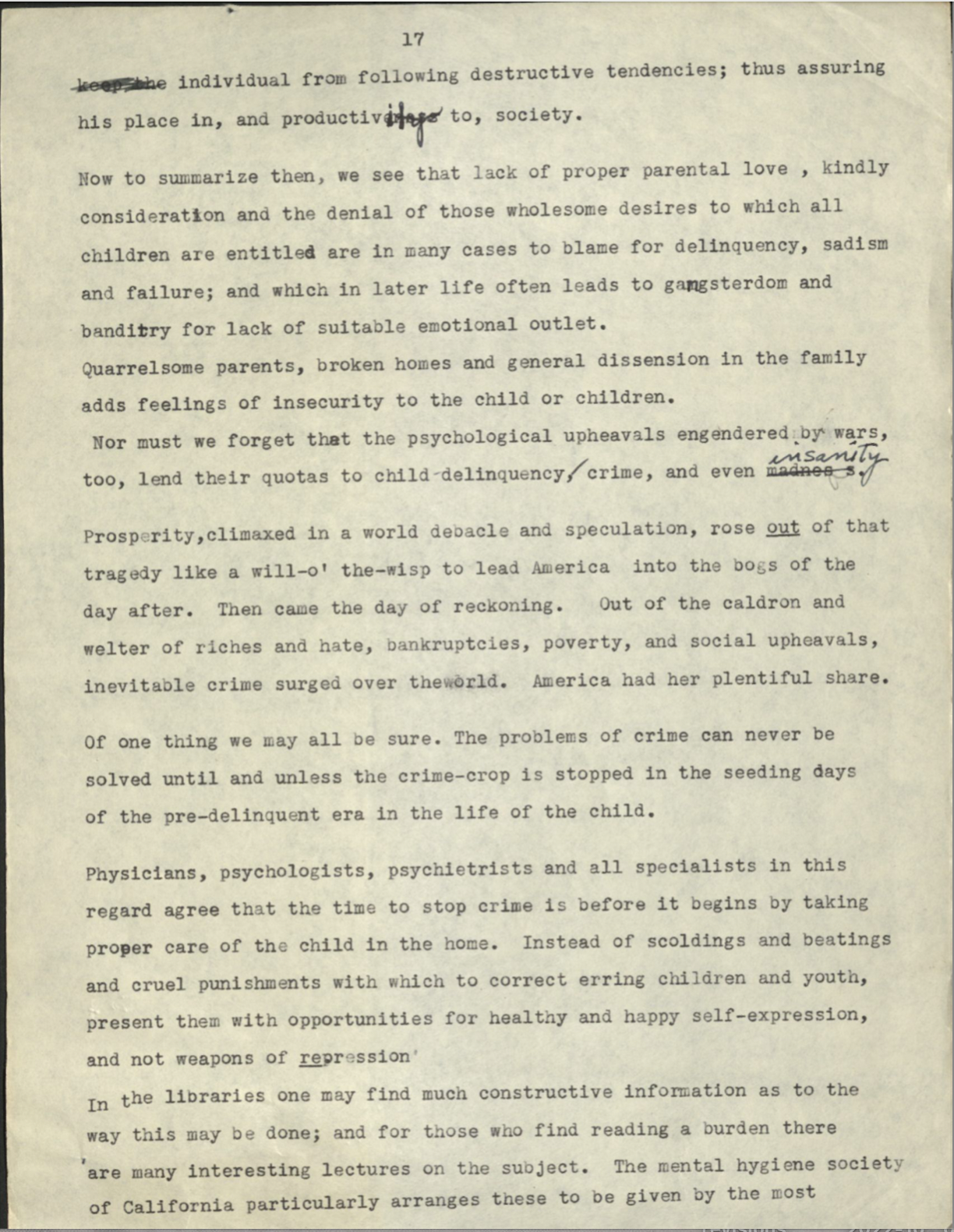
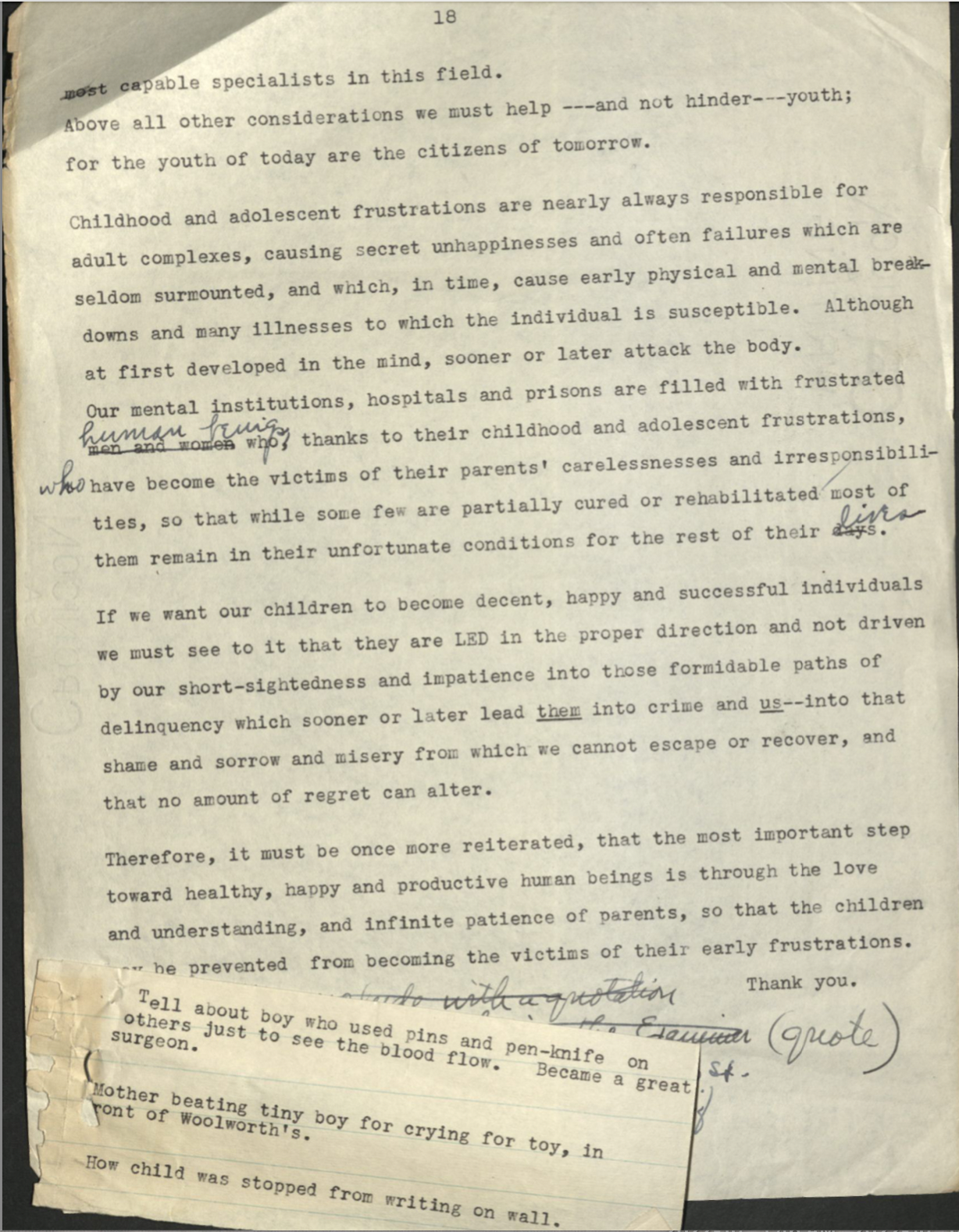
Child Delinquency is an essay that focuses primarily on the proactive methods of raising children to have the best mental hygiene. Sonia was the guest speaker for the group Mental Hygiene Group in Los Angeles on May 1949, and she presented this piece of writing at the meeting. In the essay, spanning over 19 pages, Sonia elaborates on the importance of understanding the sensitivity of children and the necessity to guard their mental formation at the earliest age possible, for it is within these tender years that will ultimately form the personality they will adopt into adulthood.
This is a clipping from the California Eagle, Thursday May 26, 1949, taken from page 10. Courtesy of Newspaper.com.
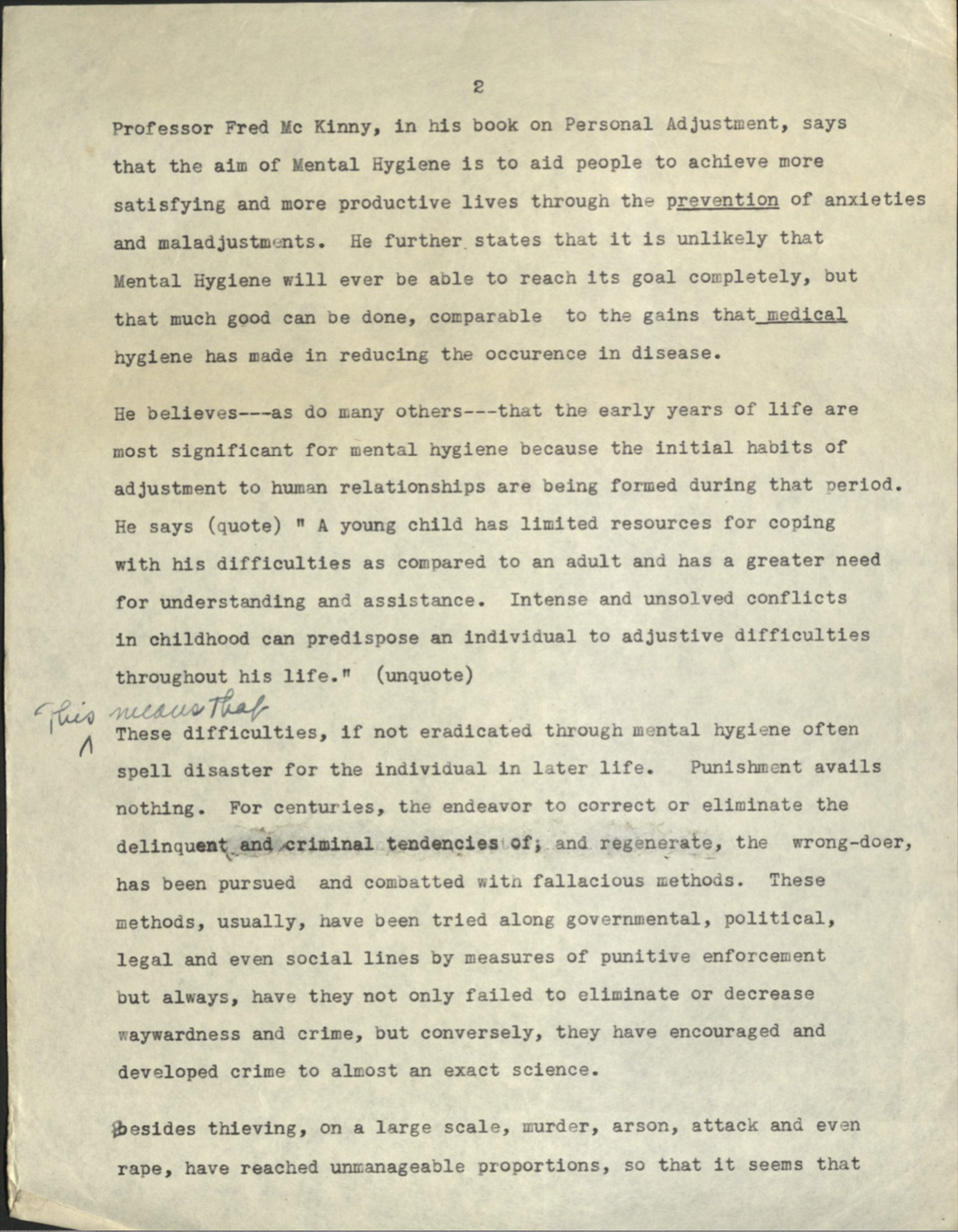
Punishment avails nothing. For centuries, the endeavor to correct or eliminate the delinquent and criminal tendencies of; and regenerate, the wrong-doer, has been pursued and combatted with fallacious methods. These methods, usually, have been tried along governmental, political, legal and even social lines by measures of punitive enforcement but always, have they not only failed to eliminate or decrease waywardness and crime, but conversely, they have encouraged and developed crime to almost an exact science.
Sonia H. Davis
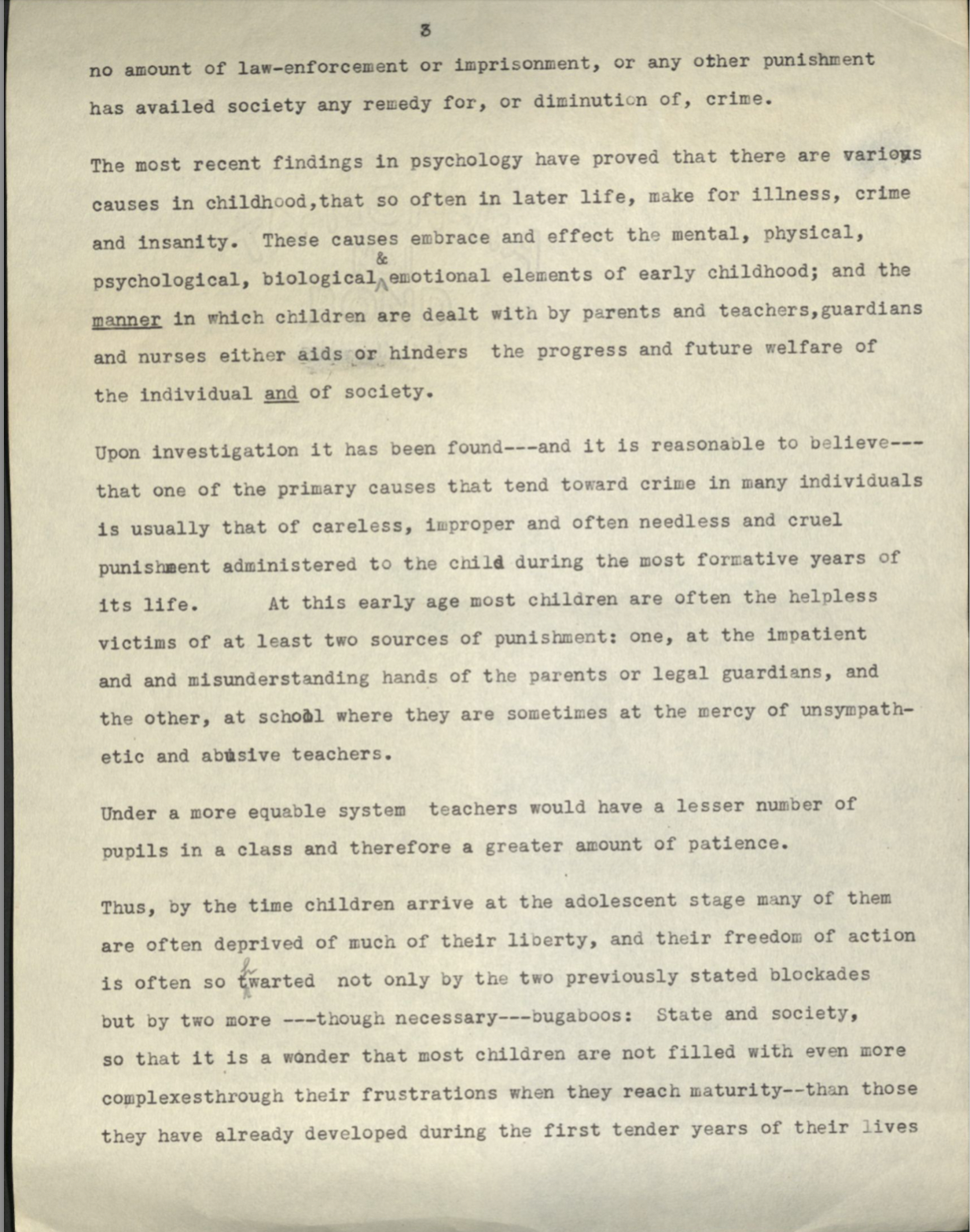
Sonia brings attention to the psychological results regarding punishment—punishment from parents, teachers, and public authorities. These punishments vary in presentation and range from sheer impatience to the severe physical, and regardless of which it may be, each are damaging to the child. For one minor example, when a child persists to ask question upon question, it is how the parent reacts that matters the most. A parent could become instinctively impatient and respond with lies just to get the child to stop asking questions, or simply dismiss the child’s constant interrogation altogether by telling him or her to drop the matter and go play elsewhere. Although these reactions are natural, Sonia, however, stresses the importance to see this opportunity as a duty and as well as a pleasure to become involved and seek the correct answers for their children. The endless questioning is simply a child’s groping for knowledge. It is best that they receive an answer from their parents than to seek it elsewhere on their own, or to grow frustrated with unfulfilled curiosities.
A teacher is equally as important as a parent when helping the mental development of children. Although teachers are called to primarily instruct, there are moments in which a teacher must exact a correction in behavior and/or the progression of learning. Even though classrooms are abounding with an array of adolescent personalities, which therefore makes it difficult to rein in the student’s complete attention, Sonia still advises the teacher to take a moment to collect oneself if the need arises for a necessary correction. The quick instinct to punish for wrongdoing or for a child’s lack of knowledge, in Sonia’s opinion, is a short-sighted reaction. Teachers are encouraged to approach each issue with patience and with an understanding of what is done today will ultimately affect a future.
A teacher is not to spotlight a student for wrongdoing in front of his fellow students, or to heavily criticize a student’s work in belittling ways. Sonia argues that in just the same way that a teacher would not want to be put down before their fellow staff by their boss, so the teacher must not bring such tactics into the classroom. The teacher must strive to build confidence and curb unwanted behavior in ways that will bring about positive habits within the youth. Of course, Sonia admits, all these theories are always easier said than done. Nevertheless, it is encouraged to put them into practice.
In spite of its many poignant points, this single keynote stands out the most due to the historical significance in which it was relayed. The beliefs that are passed on from generation to generation also gives rise to delinquency in children. Parents are unknowingly (or knowingly) developing in their children the complex of either inferiority or superiority by the handing down of pre-conceived racial prejudices and sectional hate. When Sonia completed Child Delinquency, the year was 1959. Segregation of the whites and blacks was still prevalent throughout America. Although California was progressive in terms of abolishing certain degrees of segregation before the rest of the nation, the beaches in Los Angeles, for example, were still very much segregated by color.
Therefore, for Sonia to claim (in her own backyard, practically) that these prejudices are taught by parents and not learnt from children socializing among different ethnicities is a very bold statement for its time. Sonia was challenging parents to really step beyond their unwarranted prejudices in order to give their children the freedom to love others equally and without constraint. To do otherwise is to breed competition within their children against other people due to their rank in society, rather than sharing the joy of mutual successes regardless of superficial differences.
Through and through, Child Delinquency is a phenomenal essay. It deserves a special place in parental outlets, such as in books, periodicals, or online forums. The underlying message of this essay is simple: Sonia advises to ignore negative reinforcements, but to put positive reinforcement into practice for the sake of our children’s future.
With leading companies such as Kickstarter, Crowdfunding, GoFundMe, and Indiegogo, the dreams of entrepreneurs are coming true. The concept behind crowdfunding is a genius one. Not only does it give the entrepreneur complete control over their product, but it gives the general public the utmost power. The faith that comes with trusting the masses to make or break one’s venture is both a scary and beautiful thing.
The fear always lurks, and the entrepreneur can’t help but wonder if their product will stand enough on its own to become fully funded, because at the end of the day, an entrepreneur can only promote so much in words as to why a consumer should fund a project. The beauty, however, outweighs this gnawing fear. It brings communities together to share in their mutual interests, to celebrate fully funded victories, and to inevitably witness a dream come to life for the enjoyment of consumers.
As I prepare to embark on the journey of crowdfunding for Two Hearts That Beat as One, I trust I have done all that I could’ve done to emphasize the importance of this dream. Not only Sonia’s dream, but mine too. Regardless of the outcome, the value of this autobiography will not be diminished. Sonia’s story will be told one way or another. I appreciate, nevertheless, the support I’ve received leading to this day, and the support to come thereafter.
Two Hearts That Beat as One is now officially available for purchase: here.
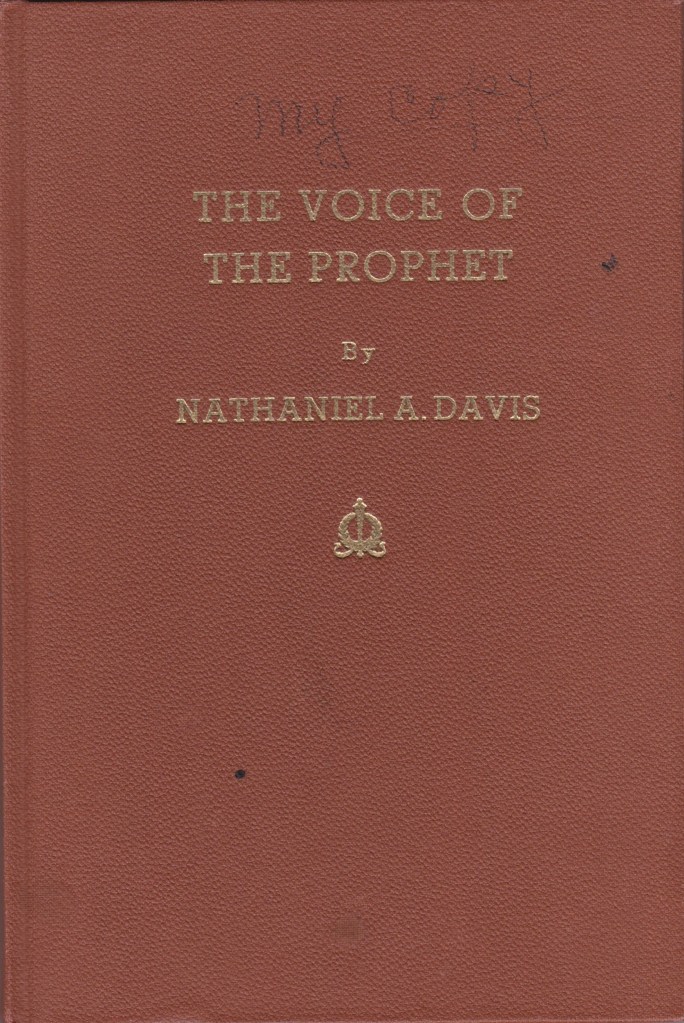
“…I had a cheap, paperback mimeographed copy of “The Faith, Hope, Tradition and Heritage of America” and a hard, brown covered, well printed copy of “The Voice of the Prophet”.
Sonia H. Davis, Two Hearts That Beat as One.
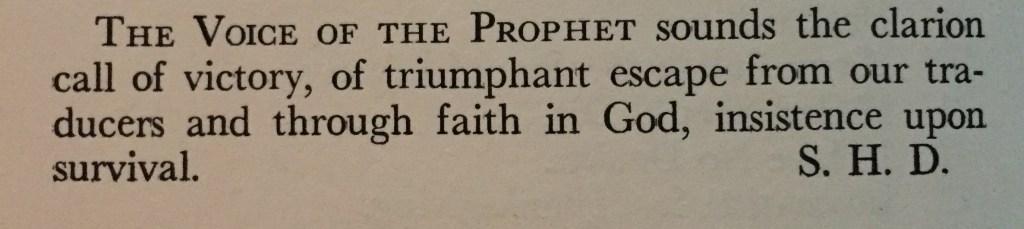
The Voice of the Prophet is a collection of poems by Dr. Nathaniel A. Davis based on the Jewish faith and traditions. Nathaniel was the third husband of Sonia, and genuinely the happiest marriage in comparison to her previous relationships. After Nathaniel’s passing in April 6, 1945, Sonia worked exceedingly hard to pay the debts she procured during his illness, and to save money to ultimately publish his poems. Unfortunately, when Sonia sought financial support from well-to-do individuals for her endeavor, she was met with rejection, and even in one instance, she was cruelly scammed by a publisher. Evidently, she persevered and was able to publish some of his poetry. Many of the poems she selected for publication were highly regarded by many persons from literary clubs, radio shows, and lectures.
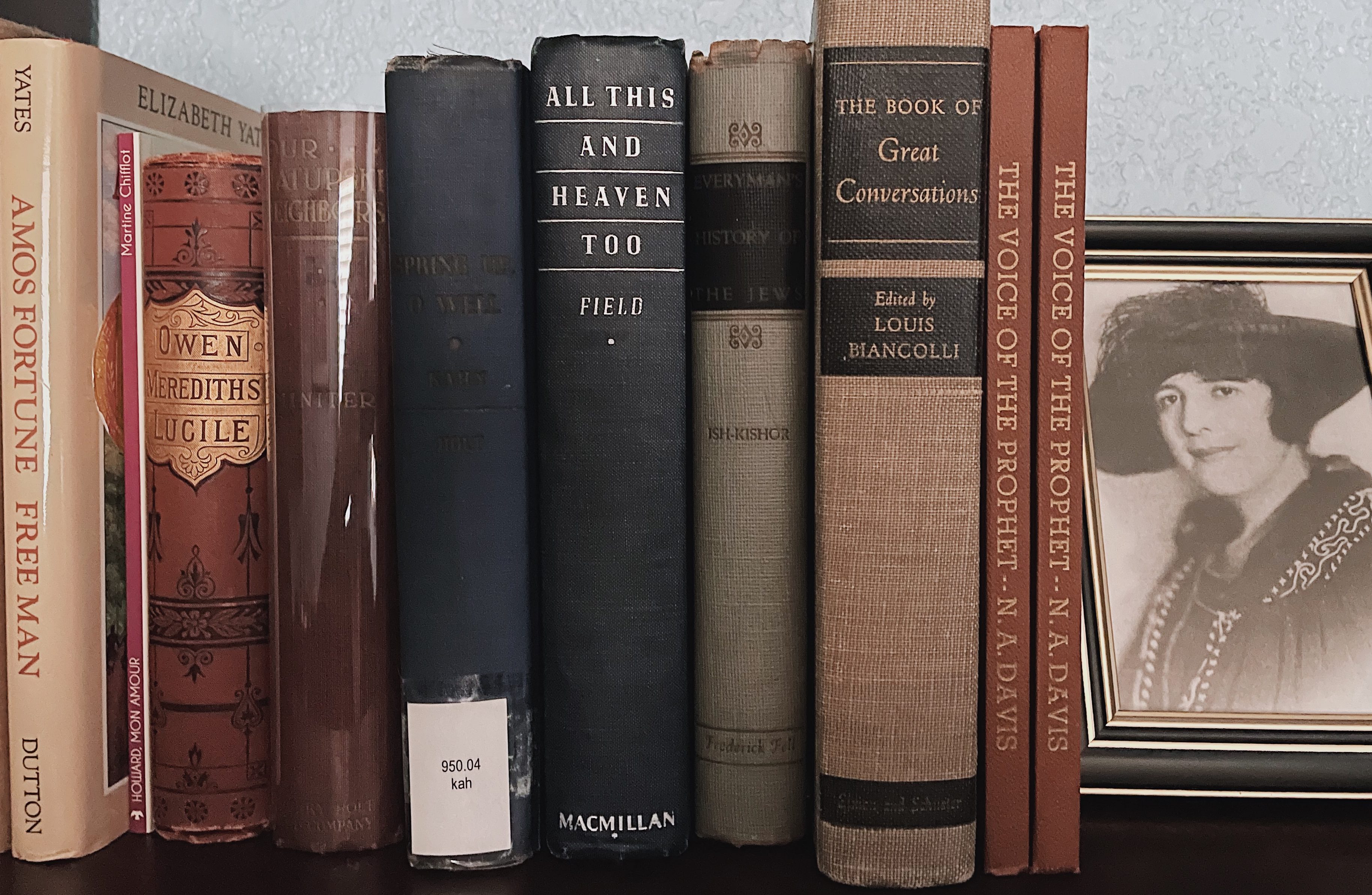
It is unclear, however, the number of copies Sonia made of The Voice of the Prophet. I, myself, own two copies, one of which has the most importance to me. On August 25, 2021, I found Sonia’s personal copy of The Voice of the Prophet for sale online. I bought it, thinking it was too good to be true, and it was the best decision I made in that season of my life. When I finally received the copy several days later, I was so amazed by the book that I emailed the bookseller in gratitude and to ask for the backstory of how he managed to acquire such a book. He emailed me in return with this account:
My friend and book-mentor, Roy A. Squires—whom you may’ve heard of—was a friend of August Derleth.After years of corresponding, Derleth informed Squires that Sonia was retired at the senior care facility I mentioned.Squires wrote to Sonia, because of his own great interest in H.P. Lovecraft, and asked if he could visit her.Sonia was very suspect, as she’d been visited not long before by an HPL enthusiast, who’d stolen valuable memorabilia from her, and wrote to Derleth to inquire about Squires. Derleth told her that Squires was the most trustworthy of men, and not to worry.Squires visited Sonia on some occasions, especially on her birthdays.She enjoyed his company.
After her death, and Sonia being estranged for years from her daughter, left no heirs. Diana Lynn Lodge asked Squires if he would come and take away her last few belongings. Squires retrieved what little she had left. Among those belongings were a few copies of your Nathaniel Davis book.
Terence McVicker
And thus, after nearly 50 years, this “well printed copy” has reached me and inspired me to look deeper into the life of Sonia Haft Greene Lovecraft Davis. I’ve always had a secret inclination to write her biography, but to never publish it because I ignorantly believed no one would find it of interest. This particular volume of The Voice of the Prophet was a challenge to that secret inclination, and I took the leap of faith to unearth Sonia’s life, regardless of the future readership. It is because of this volume that the many, who have been waiting for decades for her autobiography, can now appreciate the remarkable life and character of Mrs. Sonia H. Davis.