I have thought it necessary to collect every newspaper clipping concerning Sonia into a single documented record—a timeline of sorts. While this is not an exhaustive list, as additional clippings may yet be discovered, what follows is nonetheless a substantial catalog. Owing to the length of the documentation, this record has been divided into two parts, the second to appear in March. Any necessary commentary is reserved for the footnote section.
I am grateful to Bobby Derie for generously sharing several of the clippings included in this record.
Table of Contents
- October 1923
- April 1924
- March 1929
- April 1930
- June 1930
- October 1930
- February 1931
- August 1932
- May 1933
- April 1935
- March 1936
- April 1936
- November 1938
- April 1939
- November 1939
- April 1941
- April 1945
- September 1947
October 1923
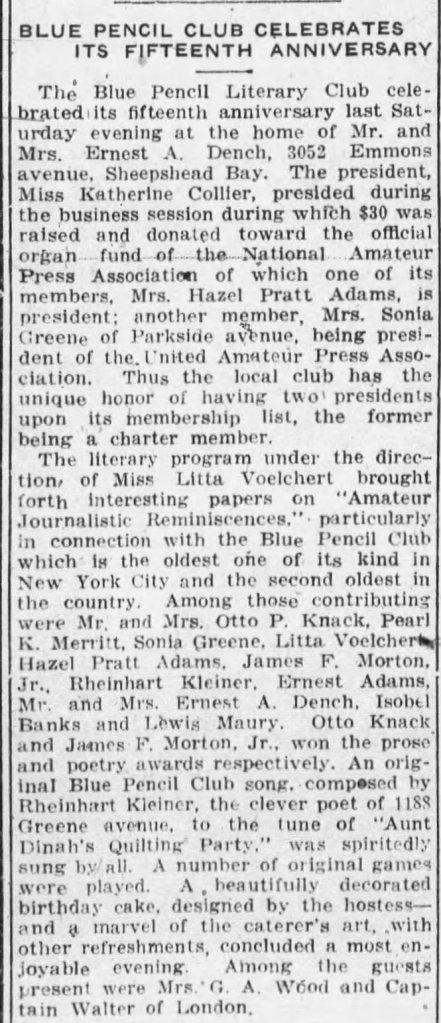
Blue Pencil Club Celebrates Its Fifteenth Anniversary
The Blue Pencil Literary Club celebrated its fifteenth anniversary last Saturday evening at the home of Mr. and Mrs. Ernest A. Dench, 3052 Emmons avenue, [sic] Sheepshead Bay. The president, Miss Katherine Coller, presided during the business session during which $30 was raised and donated toward the official organ fund of the National Amateur Press Association of which one of its members, Mrs. Hazel Pratt Adams, is president; another member, Mrs. Sonia Greene of Parkside avenue, [sic] being president of the United Amateur Press Association. Thus the local club has the unique honor of having two presidents upon its membership list, the former being a charter member.
The literary program under the direction of Miss Litta Voelchert brought forth interesting papers on “Amateur Journalistic Reminiscences,” particularly in connection with the Blue Pencil Club which is the oldest one of its kind in New York City and the second oldest in the country. Among those contributing were Mr. and Mrs. Otto P. Knack, Pearl K. Merritt, Sonia Greene, Litta Voelchert, Hazel Pratt Adams, James F. Morton, Jr., Rheinhart Kleiner, Ernest Adams, Mr. and Mrs. Ernest A. Dench, Isobel Banks and Lewis Maury. Otto Knack and James F. Morton, Jr., won the prose and poetry awards respectively. An original Blue Pencil Club song, composed by Rheinhart Kleiner, the clever poet of 1188 Greene avenue, [sic] to the tune of “Aunt Dinah’s Quilting Party,” was spiritedly sung by all. A number of original games were played. A beautifully decorated birthday cake, designed by the hostess—and a marvel of the caterer’s art, with other refreshments, concluded a most enjoyable evening. Among the guests present were Mrs. G. A. Wood and Captain Walter of London.
April 1924
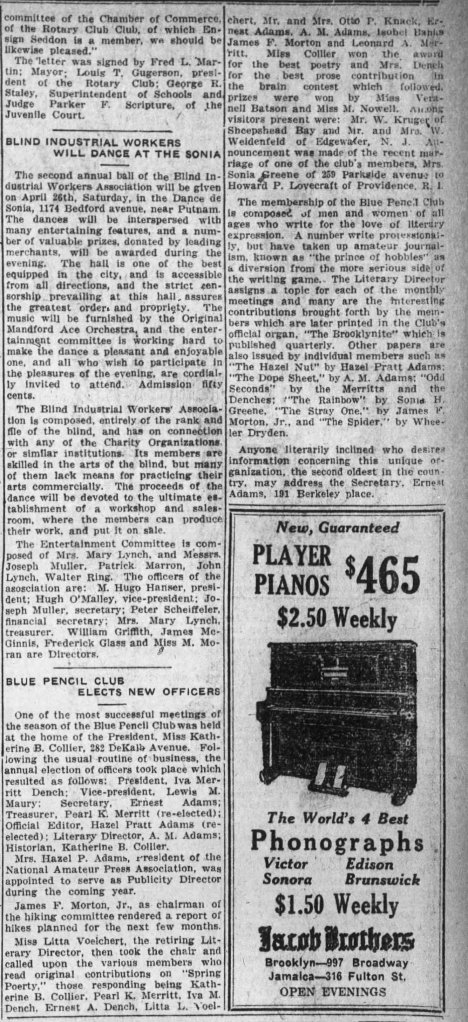
Blue Pencil Club Elects New Officers
One of the most successful meetings of the season of the Blue Pencil Club was held at the home of the President, Miss Katherine B. Collier, 282 DeKalb Avenue. Following the usual routine of business, the annual election of officers took place which resulted as follows: President, Iva Merritt Dench; Vice-president, Lewis M. Maury; Secretary, Ernest Adams; Treasurer, Pearl K. Merritt (re-elected); Official Editor, Hazel Pratt Adams (re-elected); Literary Director, A. M. Adams; Historian, Katherine B. Collier.
Mrs. Hazel P. Adams, president of the National Amateur Press Association, was appointed to serve as Publicity Director during the coming year.
James F. Morton, Jr., as chairman of the hiking committee rendered a report of hikes planned for the next few months.
Miss Litta Voelchert, the retiring Literary Director, then took the chair and called upon the various members who read original contributions on “Spring Poetry,” those responding being Katherine B. Collier, Pearl K. Merritt, Iva M. Dench, Ernest A. Dench, Litta L. Voelchert, Mr. and Mrs. Otto P. Knack, Ernest Adams, A. M. Adams, Isobel Banks, James F. Morton and Leonard A. Merritt. Miss Collier won the award for the best poem and Mrs. Dench for the best prose contribution. In the brain contest which followed, prizes were won by Miss Vernell Batson and Miss M. Nowell. Among visitors present were: Mr. W. Kruger of Sheepshead Bay and Mr. and Mrs. W. Weidenfeld of Edgewater, N. J. Announcement was made of the recent marriage of one of the club’s members, Mrs. Sonia Greene of 259 Parkside avenue [sic] to Howard P. Lovecraft of Providence, R. I.
The membership of the Blue Pencil Club is composed of men and women of all ages who write for the love of literary expression. A number write professionally, but have taken up amateur journalism, known as “the prince of hobbies,” as a diversion from the more serious side of the writing game. The Literary Director assigns a topic for each of the monthly meetings and many are the interesting contributions brought forth by the members which are later printed in the Club’s official organ, “The Brooklynite,” which is published quarterly. Other papers are also issued by individual members such as “The Hazel Nut” by Hazel Pratt Adams; “The Dope Sheet,” by A. M. Adams; “Odd Seconds,” by the Merritts and the Denches; “The Rainbow,” by Sonia H. Greene; “The Stray One,” by James F. Morton, Jr., and “The Spider,” by Wheeler Dryden.
Anyone literarily inclined who desires information concerning this unique organization, the second oldest in the country, may address the Secretary, Ernest Adams, 191 Berkeley place.
March 1929

Court Record
Howard P. Lovecraft vs. Sonia H. Lovecraft. Wilful [sic] desertion. Decision for petitioner. Ralph M. Greenlaw, counsel.
April 1930
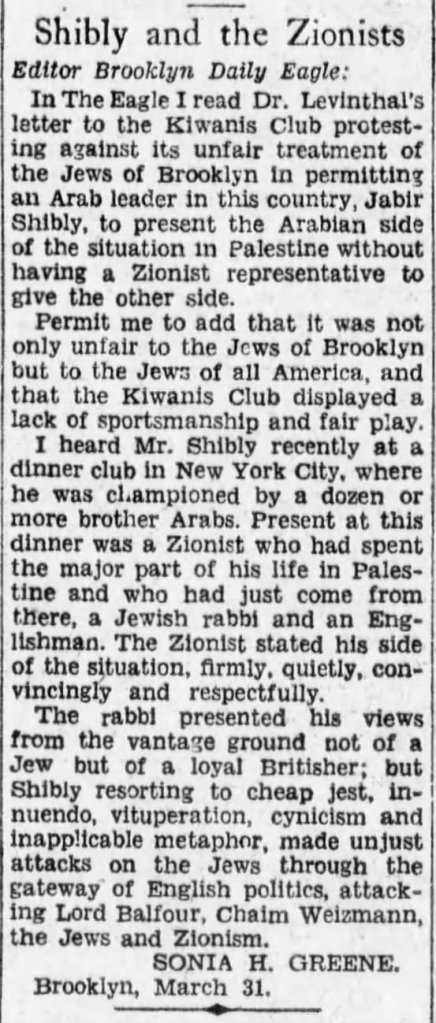
Shibly and the Zionists
Editor Brooklyn Daily Eagle:
In The Eagle I read Dr. Levinthal’s letter to the Kiwanis Club protesting against its unfair treatment of the Jews of Brooklyn in permitting an Arab leader in this country, Jabir Shibly, to present the Arabian side of the situation in Palestine without having a Zionist representative to give the other side.
Permit me to add that it was not only unfair to the Jews of Brooklyn but to the Jews of all America, and that the Kiwanis Club displayed a lack of sportsmanship and fair play.
I heard Mr. Shibly recently at a dinner club in New York City, where he was championed by a dozen or more brother Arabs. Present at this dinner was a Zionist who had spent the major part of his life in Palestine and who had just come from there, a Jewish rabbi and an Englishman. The Zionist stated his side of the situation, firmly, quietly, convincingly and respectfully.
The rabbi presented his views from the vantage ground not of a Jew but of a loyal Britisher; but Shibly resorting to cheap jest, innuendo, vituperation, cynicism and inapplicable metaphor, made unjust attacks on the Jews through the gateway of English politics, attacking Lord Balfour, Chaim Weizmann, the Jews and Zionism.
SONIA H. GREENE.
Brooklyn, March 31.
Hand Painted Cards
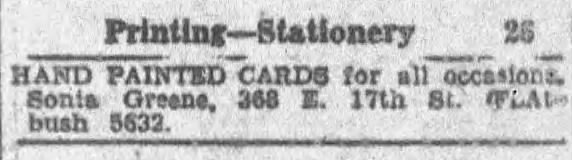
Printing—Stationery
HAND PAINTED CARDS for all occasions.
Sonia Greene, 368 E. 17th St. Flatbush 5632.
June 1930
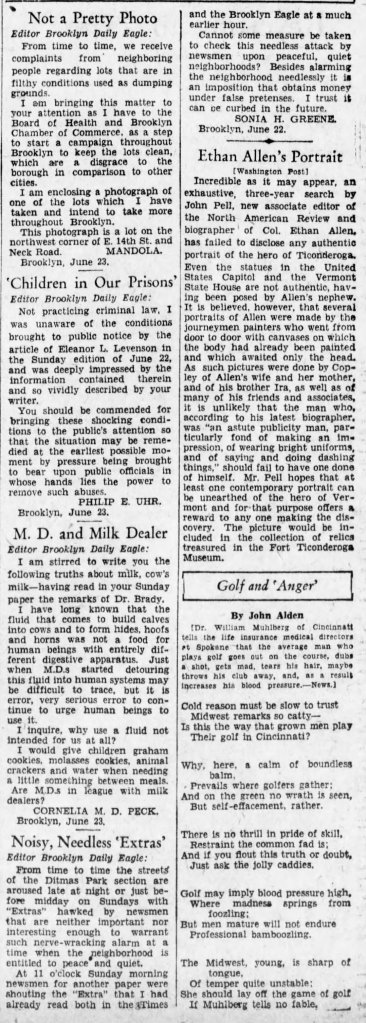
Noisy, Needless ‘Extras’
Editor Brooklyn Daily Eagle:
From time to time the streets of the Ditmas Park section are aroused late at night or just before midday on Sundays with “Extras” hawked by newsmen that are neither important nor interesting enough to warrant such nerve-wracking alarm at a time when the neighborhood is entitled to peace and quiet.
At 11 o’clock Sunday morning newsmen for another paper were shouting the “Extra” that I had already read both in the Times and the Brooklyn Eagle at a much earlier hour.
Cannot some measure be taken to check this needless attack by newsmen upon peaceful, quiet neighborhoods? Besides alarming the neighborhood needlessly it is an imposition that obtains money under false pretenses. I trust it can be curbed in the future.”
SONIA H. GREENE.
Brooklyn, June 22.
October 1930
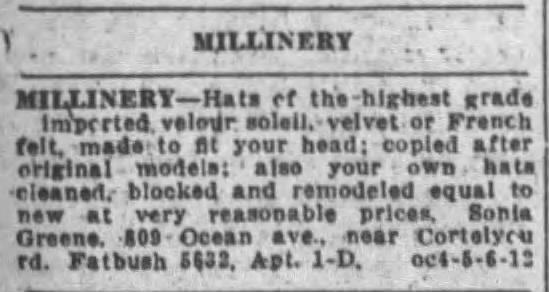
Millinery
MILLINERY—Hats of the highest grade imported, velour soleil, velvet or French felt, made to fit your head; copied after original models; also your own hats cleaned, blocked and remodeled equal to new at very reasonable prices. Sonia Greene, 809 Ocean ave., near Cortelyou rd. Flatbush 5632, Apt. 1-D.
February 1931
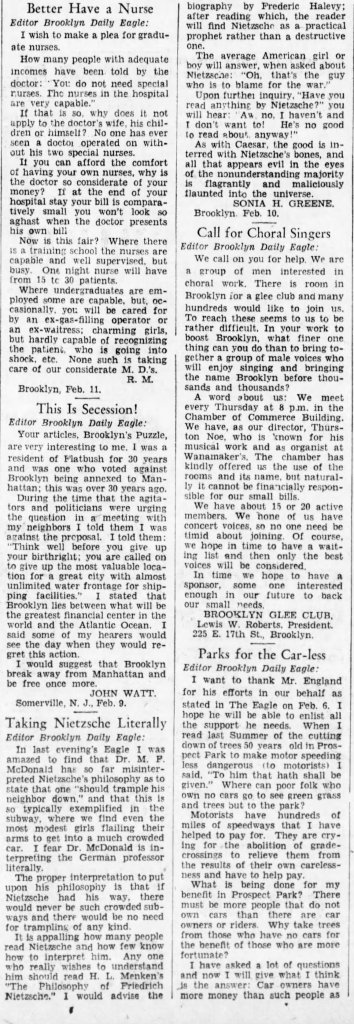
Taking Nietzsche Literally
Editor Brooklyn Daily Eagle:
In last evening’s Eagle I was amazed to find that Dr. M. F. McDonald has so far misinterpreted Nietzsche’s philosophy as to state that one “should trample his neighbor down,” and that this is so typically exemplified in the subway, where we find even the most modest girls flailing their arms to get into a much crowded car. I fear Dr. McDonald is interpreting the German professor literally.
The proper interpretation to put upon his philosophy is that if Nietzsche had his way, there would never be such crowded subways and there would be no need for trampling of any kind. It is appalling how many people read Nietzsche and how few know how to interpret him. Any one [sic] who really wishes to understand him should read H. L. Mencken’s “The Philosophy of Friedrich Nietzsche.” I would advise the biography by Frederic Halevy;1 after reading which, the reader will find Nietzsche as a practical prophet2 rather than a destructive one.
The average American girl or boy will answer, when asked about Nietzsche: “Oh, that’s the guy who is to blame for the war.”
Upon further inquiry, “Have you read anything by Nietzsche?” you will hear: “Aw, no, I haven’t and I don’t want to! He’s no good to read about, anyway!”
As with Caesar, the good is interred with Nietzsche’s bones, and all that appears evil in the eyes of the nonunderstanding majority is flagrantly and maliciously flaunted into the universe.
SONIA H. GREENE.
Brooklyn, Feb. 10.
August 1932
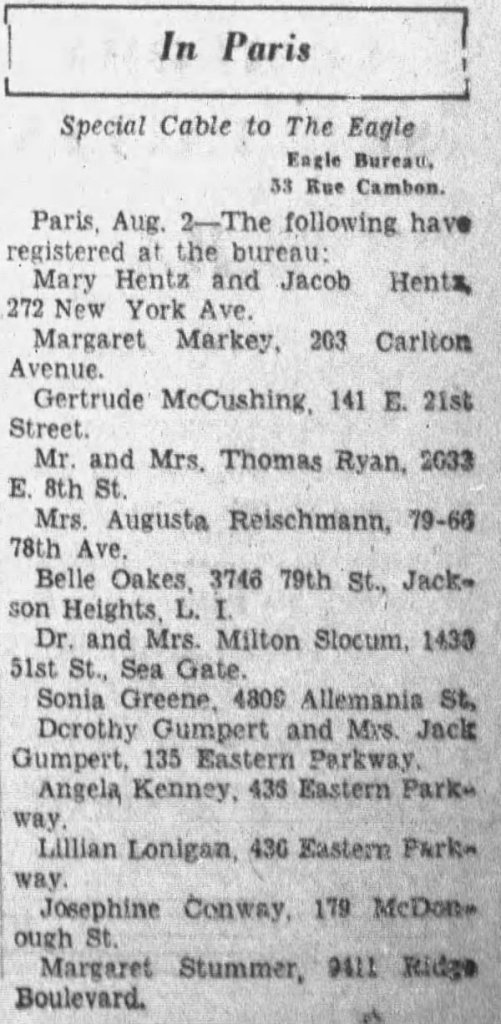
In Paris
Special Cable to The Eagle
Eagle Bureau,
53 Rue Cambon.
Paris, Aug. 2—The following have registered at the bureau:
Sonia Greene, 4809 Allemania St.
Found The Eagle in Paris Really Able to Help Her
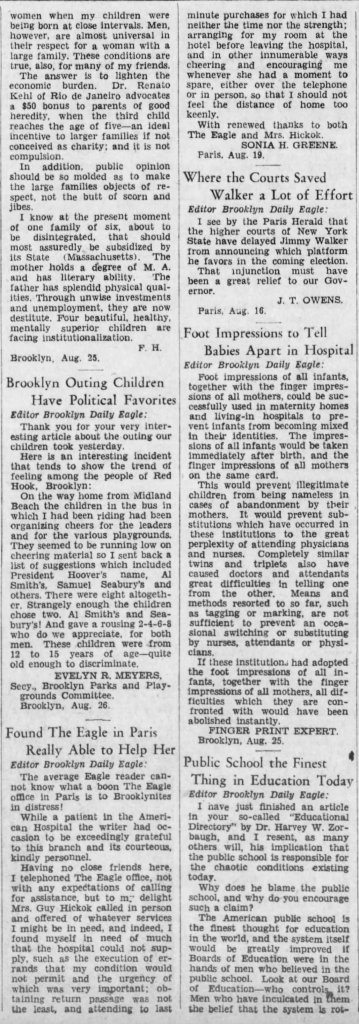
Editor Brooklyn Daily Eagle:
The average Eagle reader cannot know what a boon The Eagle office in Paris is to Brooklynites in distress!
While a patient in the American Hospital the writer had occasion to be exceedingly grateful to this branch and its courteous, kindly personnel.
Having no close friends here, I telephoned The Eagle office, not with any expectations of calling for assistance, but to my delight Mrs. Guy Hickok called in person and offered of whatever services I might be in need, and indeed, I found myself in need of much that the hospital could not supply, such as the execution of errands that my condition would not permit and the urgency of which was very important; obtaining return passage was not the least, and attending to last minute purchases for which I had neither the time nor the strength; arranging for my room at the hotel before leaving the hospital, and in other innumerable ways cheering and encouraging me whenever she had a moment to spare, either over the telephone or in person, so that I should not feel the distance of home too keenly.
With renewed thanks to both The Eagle and Mrs. Hickok.
SONIA H. GREENE.
Paris, Aug. 19.
May 1933
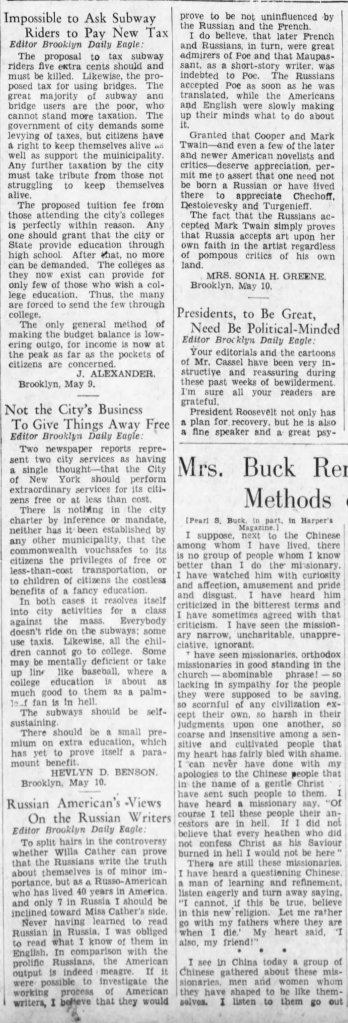
Russian American’s Views on The Russian Writers
Editor Brooklyn Daily Eagle:
To split hairs in the controversy whether Willa Cather can prove that the Russians write the truth about themselves is of minor importance, but as a Russo-American who has lived 40 years in America and only 7 in Russia I should be inclined toward Miss Cather’s side.
Never having learned to read Russian in Russia, I was obliged to read what I know of them in English. In comparison with the prolific Russians, the American output is indeed meagre.
If it were possible to investigate the working process of American writers, I believe that they would prove to be not uninfluenced by the Russian and the French.
I do believe, that later French and Russians, in turn, were great admirers of Poe and that Maupassant, as a short-story writer, was indebted to Poe.
The Russians accepted Poe as soon as he was translated, while the Americans and English were slowly making up their minds what to do about it.
Granted that Cooper and Mark Twain—and even a few of the later and newer American novelists and critics—deserve appreciation, permit me to assert that one need not be born a Russian or have lived there to appreciate Chechoff, Destoievesky and Turgenieff. [sic]
The fact that the Russians accepted Mark Twain simply proves that Russia accepts art upon her own faith in the artist regardless of pompous critics of his own land.
MRS. SONIA H. GREENE.
Brooklyn, May 10.
April 1935
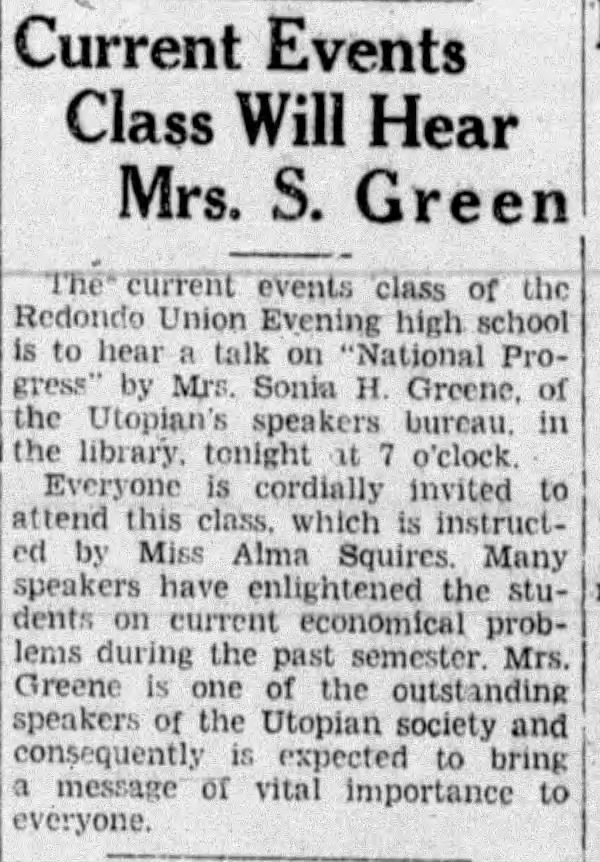
Current Events Class Will Hear Mrs. S. Green [sic]
The current events class of the Redondo Union Evening high school is to hear a talk on “National Progress” by Mrs. Sonia H. Greene, of the Utopian’s speakers bureau, in the library, tonight at 7 o’clock.
Everyone is cordially invited to attend this class, which is instructed by Miss Alma Squires. Many speakers have enlightened the students on current economical problems during the past semester. Mrs. Greene is one of the outstanding speakers of the Utopian society and consequently is expected to bring a message of vital importance to everyone.
March 1936
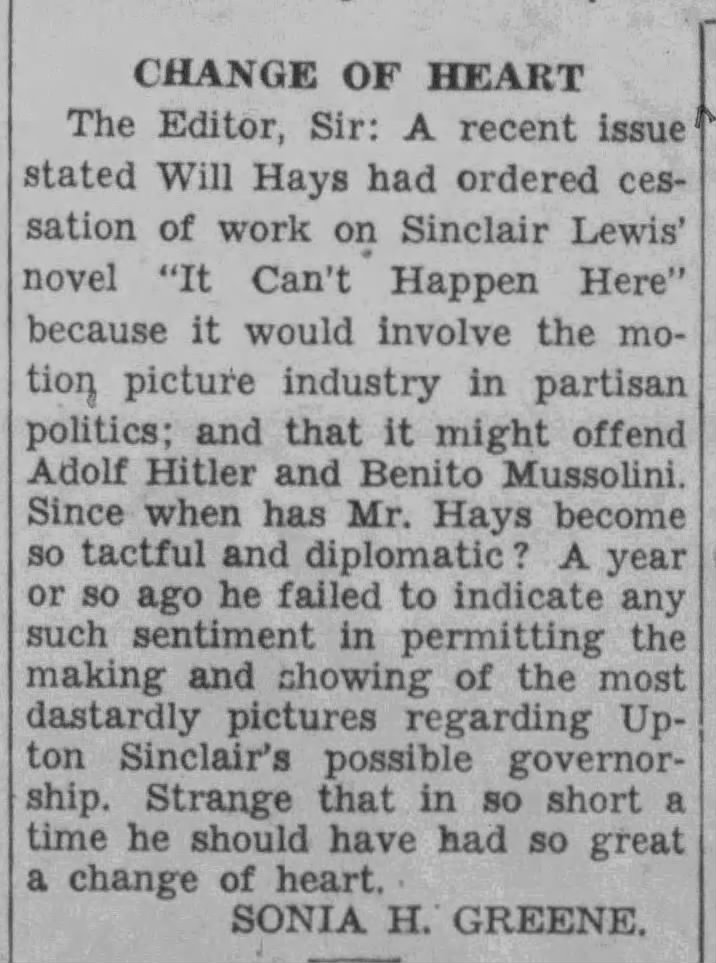
Change of Heart
The Editor, Sir: A recent issue stated Will Hays had ordered cessation of work on Sinclair Lewis’ novel “It Can’t Happen Here” because it would involve the motion picture industry in partisan politics; and that it might offend Adolf Hitler and Benito Mussolini. Since when has Mr. Hays become so tactful and diplomatic? A year or so ago he failed to indicate any such sentiment in permitting the making and showing of the most dastardly pictures regarding Upton Sinclair’s possible governorship. Strange that in so short a time he should have had so great a change of heart.
SONIA H. GREENE.
April 1936
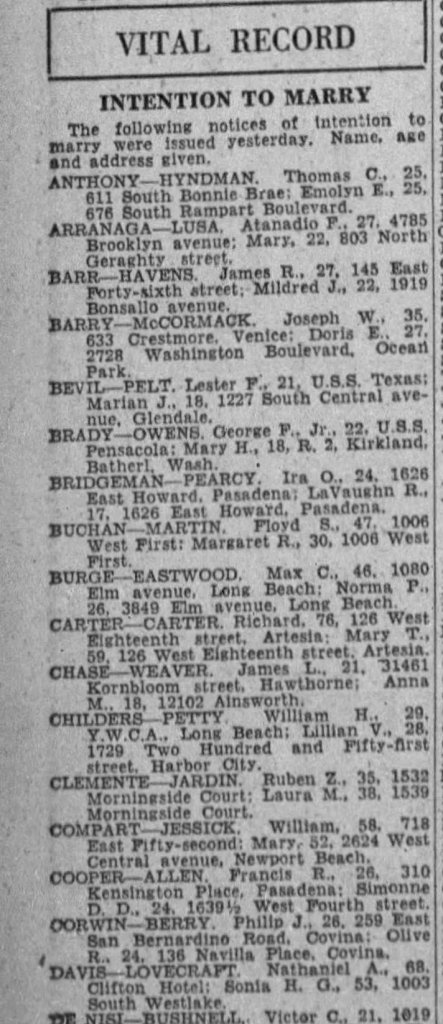
Intention to Marry
DAVIS — LOVECRAFT. Nathaniel A., 68, Clifton Hotel; Sonia H. G., 53, 1003 South Westlake.
November 1938
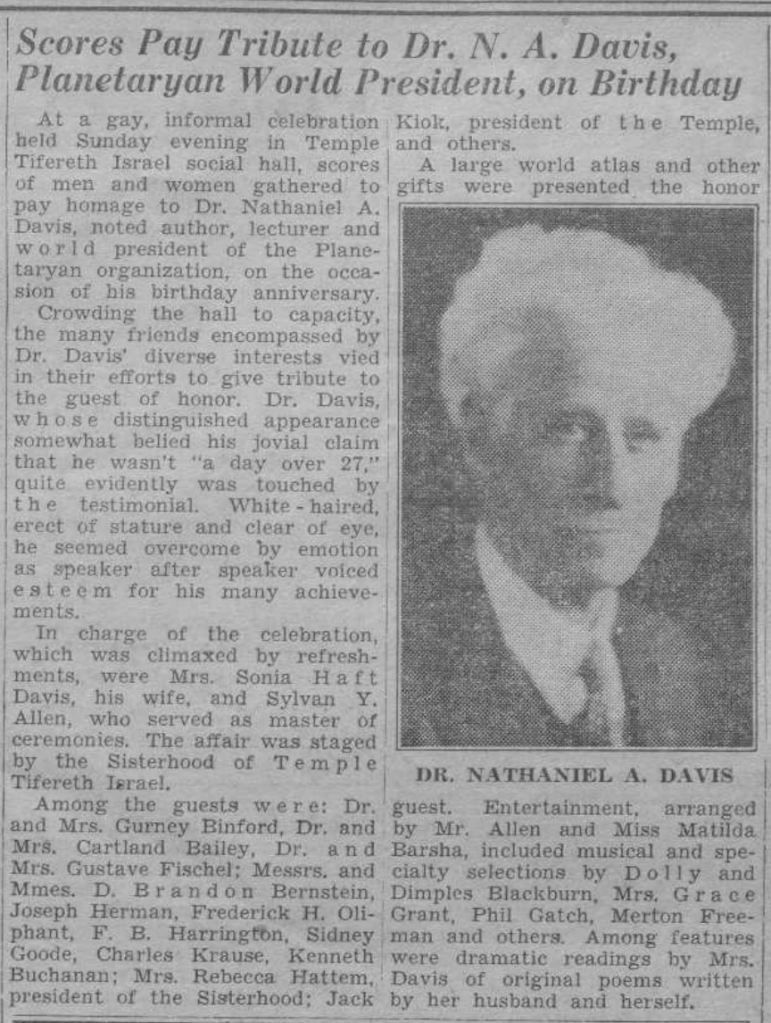
Scores Pay Tribute to Dr. N. A. Davis, Planetaryan World President, on Birthday
At a gay, informal celebration held Sunday evening in Temple Tifereth Israel social hall, scores of men and women gathered to pay homage to Dr. Nathaniel A. Davis, noted author, lecturer and world president of the Planetaryan organization, on the occasion of his birthday anniversary.
Crowding the hall to capacity, the many friends encompassed by Dr. Davis’ diverse interests vied in their efforts to give tribute to the guest of honor. Dr. Davis, whose distinguished appearance somewhat belied his jovial claim that he wasn’t “a day over 27,” quite evidently was touched by the testimonial. White-haired, erect of stature and clear of eye, he seemed overcome by emotion as speaker after speaker voiced esteem for his many achievements.
In charge of the celebration, which was climaxed by refreshments, were Mrs. Sonia Haft Davis, his wife, and Sylvan Y. Allen, who served as master of ceremonies. The affair was staged by the Sisterhood of Temple Tifereth Israel.
Among the guests were: Dr. and Mrs. Gurney Binford, Dr. and Mrs. Cartland Bailey, Dr. and Mrs. Gustave Fischel; Messrs. and Mmes. D. Brandon Bernstein, Joseph Herman, Frederick H. Oliphant, F. B. Harrington, Sidney Goode, Charles Krause, Kenneth Buchanan; Mrs. Rebecca Hattem, president of the Sisterhood; Jack Kiok, president of the Temple, and others.
A large world atlas and other gifts were presented the honor guest. Entertainment, arranged by Mr. Allen and Miss Matilda Barsha, included musical and specialty selections by Dolly and Dimples Blackburn, Mrs. Grace Grant, Phil Gatch, Merton Freeman and others. Among features were dramatic readings by Mrs. Davis of original poems written by her husband and herself.
April 1939
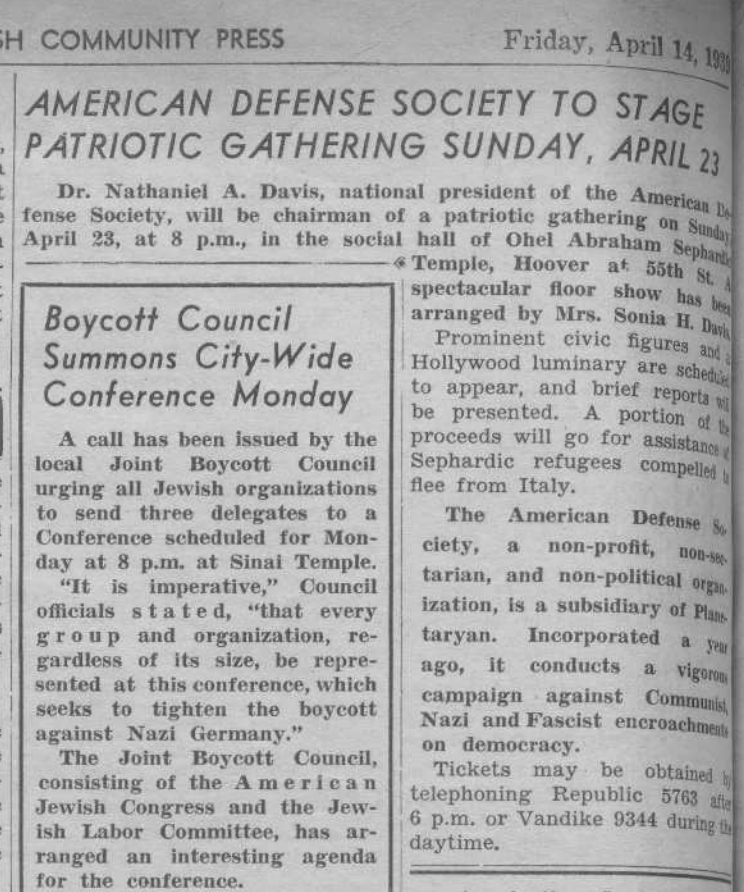
American Defense Society to Stage Patriotic Gathering Sunday April 23
Dr. Nathaniel A. Davis, national president of the American Defense Society, will be chairman of a patriotic gathering on Sunday, April 23, at 8 p.m., in the social hall of Ohel Abraham Sephardic Temple, Hoover at 55th St. A spectacular floor show has been arranged by Mrs. Sonia H. Davis.
Prominent civic figures and Hollywood luminaries are scheduled to appear, and brief reports will be presented. A portion of the proceeds will go for assistance of Sephardic refugees compelled to flee from Italy.
The American Defense Society, a non-profit, non-sectarian, and non-political organization, is a subsidiary of Planetaryan. Incorporated a year ago, it conducts a vigorous campaign against Communist, Nazi and Fascist encroachments on democracy.
Tickets may be obtained by telephoning Republic 5763 after 6 p.m. or Vandike 9344 during the daytime.
November 1939
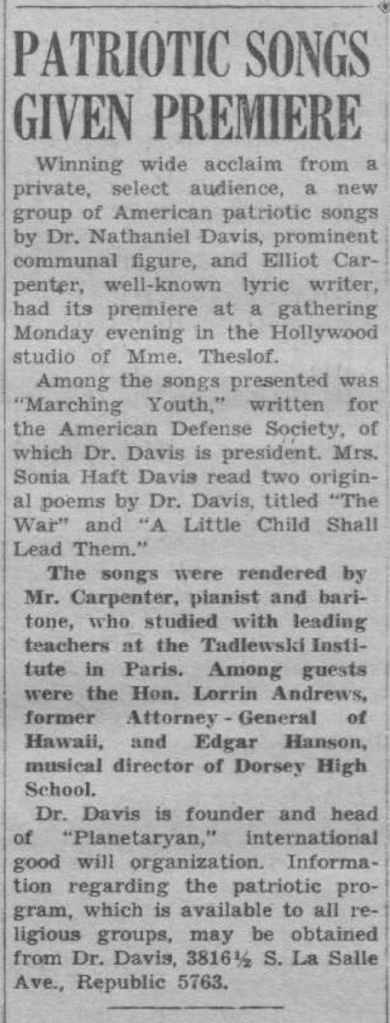
Patriotic Songs Given Premiere
Winning wide acclaim from a private, select audience, a new group of American patriotic songs by Dr. Nathaniel Davis, prominent communal figure, and Elliot Carpenter, well-known lyric writer, had its premiere at a gathering Monday evening in the Hollywood studio of Mme. Theslof.
Among the songs presented was “Marching Youth,” written for the American Defense Society, of which Dr. Davis is president. Mrs. Sonia Haft Davis read two original poems by Dr. Davis, titled “The War” and “A Little Child Shall Lead Them.”
The songs were rendered by Mr. Carpenter, pianist and baritone, who studied with leading teachers at the Tadlewski Institute in Paris. Among guests were the Hon. Lorrin Andrews, former Attorney-General of Hawaii, and Edgar Hanson, musical director of Dorsey High School.
Dr. Davis is founder and head of “Planetaryan,” international good will organization. Information regarding the patriotic program, which is available to all religious groups, may be obtained from Dr. Davis, 3816½ S. La Salle Ave., Republic 5763.
April 1941
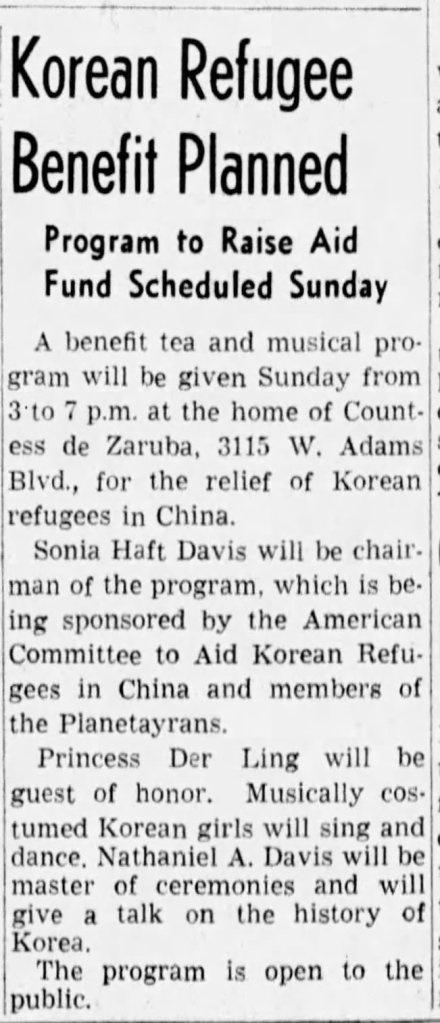
Korean Refugee Benefit Planned3
Program to Raise Aid Fund Scheduled Sunday
A benefit tea and musical program will be given Sunday from 3 to 7 p.m. at the home of Countess de Zaruba, 3115 W. Adams Blvd., for the relief of Korean refugees in China.
Sonia Haft Davis will be chairman of the program, which is being sponsored by the American Committee to Aid Korean Refugees in China and members of the Planetayrans.
Princess Der Ling will be guest of honor. Musically costumed Korean girls will sing and dance. Nathaniel A. Davis will be master of ceremonies and will give a talk on the history of Korea.
The program is open to the public.
April 1945
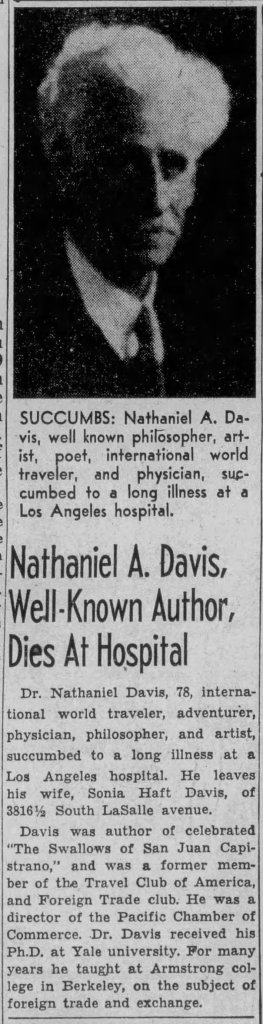
Nathaniel A. Davis, Well-Known Author, Dies at Hospital
[Photograph caption:]
SUCCUMBS: Nathaniel A. Davis, well known philosopher, artist, poet, international world traveler, and physician, succumbed to a long illness at a Los Angeles hospital.
Dr. Nathaniel Davis, 78, international world traveler, adventurer, physician, philosopher, and artist, succumbed to a long illness at a Los Angeles hospital. He leaves his wife, Sonia Haft Davis, of 3816½ South LaSalle avenue. [sic]
Davis was author of celebrated “The Swallows of San Juan Capistrano,” and was a former member of the Travel Club of America, and Foreign Trade club. He was a director of the Pacific Chamber of Commerce. Dr. Davis received his Ph.D. at Yale university. For many years he taught at Armstrong college in Berkeley, on the subject of foreign trade and exchange.
Dr. Davis, World Peace Advocate, Passes Away4
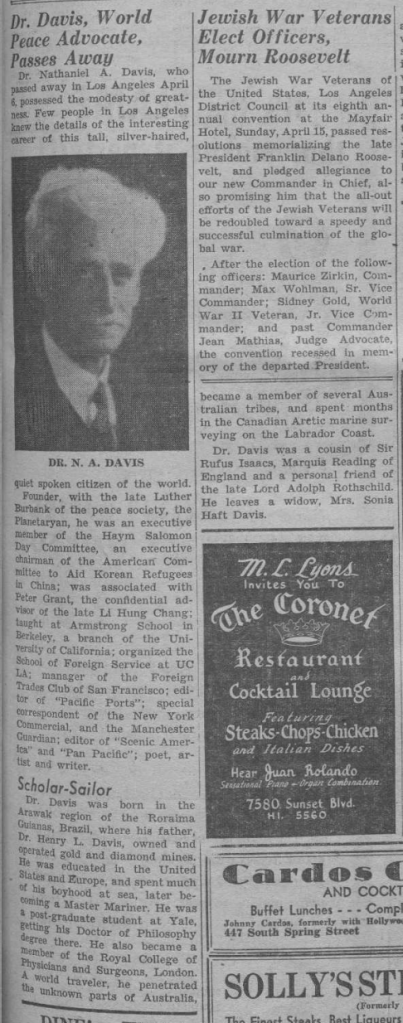
Dr. Nathaniel A. Davis, who passed away in Los Angeles April 6, possessed the modesty of greatness. Few people in Los Angeles knew the details of the interesting career of this tall, silver-haired, quiet spoken citizen of the world.
[Photograph caption:]
DR. N. A. DAVIS
Founder, with the late Luther Burbank of the peace society, Planetaryan, he was an executive member of the Haym Salomon Day Committee, an executive chairman of the American Committee to Aid Korean Refugees in China; was associated with Peter Grant, the confidential advisor of the late Li Hung Chang; taught at Armstrong School in Berkeley, a branch of the University of California; organized the School of Foreign Service at UCLA; manager of the Foreign Trades Club of San Francisco; editor of “Pacific Ports”; special correspondent of the New York Commercial, and the Manchester Guardian; editor of “Scenic America” and “Pan Pacific”; poet, artist and writer.
Scholar-Sailor
Dr. Davis was born in the Arawak region of the Roraima Guianas, Brazil, where his father, Henry L. Davis, owned and operated gold and diamond mines. He was educated in the United States and Europe, and spent much of his boyhood at sea, later becoming a Master Mariner. He was a post-graduate student at Yale, getting his Doctor of Philosophy degree there. He also became a member of the Royal College of Physicians and Surgeons, London. A world traveler, he penetrated the unknown parts of Australia, became a member of several Australian tribes, and spent months in the Canadian Arctic marine surveying on the Labrador Coast.
Dr. Davis was a cousin of Sir Rufus Isaacs, Marquis Reading of England and a personal friend of the late Lord Adolph Rothschild. He leaves a widow, Mrs. Sonia Haft Davis.
September 1947
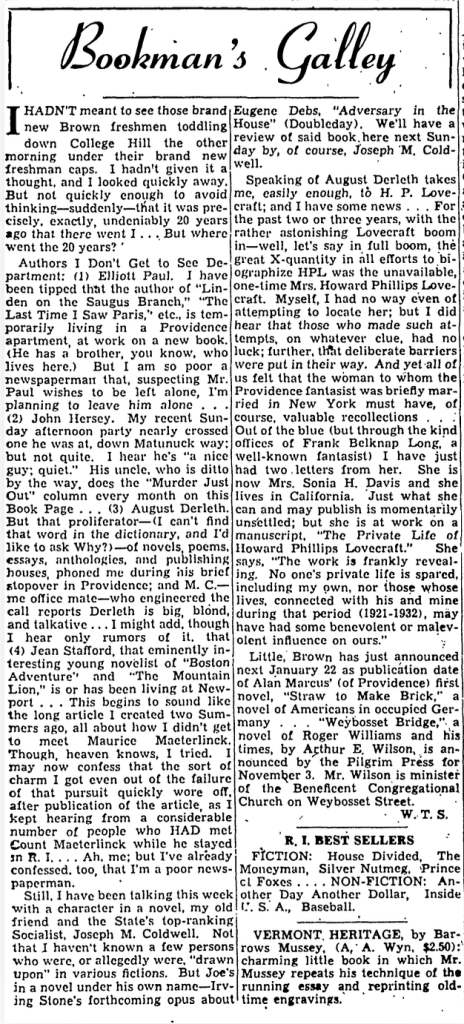
Bookman’s Galley
I hadn’t meant to see those brand new Brown freshmen toddling down College Hill the other morning under their brand new freshman caps. I hadn’t given it a thought, and I looked quickly away. But not quickly enough to avoid thinking—suddenly—that it was precisely, exactly, undeniably 20 years ago that there went I . . . But where went the 20 years?
Authors I Don’t Get to See Department: (1) Elliott Paul. I have been tipped that the author of “Linden on the Saugus Branch,” “The Last Time I Saw Paris,” etc., is temporarily living in a Providence apartment, at work on a new book. (He has a brother, you know, who lives here.) But I am so poor a newspaperman that, suspecting Mr. Paul wishes to be left alone, I’m planning to leave him alone. . . (2) John Hersey. My recent Sunday afternoon party nearly crossed one he was at, down Matunuck way; but not quite. I hear he’s “a nice guy; quiet.” His uncle, who is ditto by the way, does the “Murder Just Out” column every month on this Book Page. . . (3) August Derleth. But that proliferator—(I can’t find that word in the dictionary, and I’d like to ask Why?)—of novels, poems, essays, anthologies, and publishing houses, phoned me during his brief stopover in Providence; and M. C.—me [sic] office mate—who engineered the call reports Derleth is big, blond, and talkative. . . .I might add, though I hear only rumors of it, that [sic] (4) Jean Stafford, that eminently interesting young novelist of “Boston Adventure” and “The Mountain Lion,” is or has been living at Newport. . . This begins to sound like the long article I created two Summers ago, all about how I didn’t get to meet Maurice Maeterlinck. Though, heaven knows, I tried. I may now confess that the sort of charm I got out of the failure of that pursuit quickly wore off, after publication of the article, as I kept hearing from a considerable number of people who HAD met Count Maeterlinck while he stayed in R. I. . . . Ah, me; but I’ve already confessed, too, that I’m a poor newspaperman.
Still, I have been talking this week with a character in a novel, my old friend and the State’s top-ranking Socialist, Joseph M. Coldwell. Not that I haven’t known a few persons who were, or allegedly were, “drawn upon” in various fictions. But Joe’s in a novel under his own name—Irving Stone’s forthcoming opus about Eugene Debs, “Adversary in the House” (Doubleday). We’ll have a review of said book here next Sunday, of course, Joseph M. Coldwell.
Speaking of August Derleth takes me, easily enough, to H. P. Lovecraft; and I have some news. . . For the past two or three years, with the rather astonishing Lovecraft boom in—well, let’s say in full boom, the great X-quantity in all efforts to biographize HPL was the unavailable one-time Mrs. Howard Phillips Lovecraft. Myself, I had no way even of attempting to locate her; but I did hear that those who made such attempts, on whatever clue, had no luck; further, that deliberate barriers were put in their way. And yet all of us felt that the woman to whom the Providence fantasist was briefly married in New York must have, of course, valuable recollections. . . Out of the blue (but through the kind offices of Frank Belknap Long, a well-known fantasist) I have just had two letters from her. She is now Mrs. Sonia H. Davis and she lives in California. Just what she can and may publish is momentarily unsettled; but she is at work on a manuscript, “The Private Life of Howard Phillips Lovecraft.” She says: “The work is frankly revealing. No one’s private life is spared, including my own, nor those whose lives, connected with his and mine during that period (1921–1932), may have had some benevolent or malevolent influence on ours.”
Little, [sic] Brown has just announced next January 22 as publication date of Alan Marcus’ (of Providence) first novel, “Straw to Make Brick,” a novel of Americans in occupied Germany. . . “Weybosset Bridge,” a novel of Roger Williams and his times, by Arthur E. Wilson, is announced by the Pilgrim Press for November 3. Mr. Wilson is minister of the Beneficent Congregational Church on Weybosset Street.
—W. T. S.
- Alfred Galpin refers to H.L. Mencken’s The Philosophy of Friedrich Nietzsche and Daniel Halevy’s biography, The Life of Friedrich Nietzsche in his essay “Nietzsche as a Practical Prophet”. Both Sonia and Alfred are wrong on Halevy’s first name. However, it is apparent Galpin influenced Sonia enough to read these treatises ten years prior to the date of this letter to the editor. ↩︎
- “Nietzsche as a Practical Prophet” was published in The Rainbow, Vol.1, No. 1, 1921. See “My Dear Mrs. Greene” – His Letters to Sonia (Part II)” for full transcription of the essay. ↩︎
- See, “The Milliner and the Spy”. ↩︎
- This obituary was later reprinted by Sonia under the title “A Short Biography of Dr. N. A. Davis” in The Voice of the Prophet (Los Angeles, 1949), a self-published collection of Nathaniel A. Davis’s poems. ↩︎
 The Papers of Sonia H. Davis