She was, first and foremost, a milliner. When the slow seasons between the high demand came around, Sonia had side jobs. The side jobs were either still within her trade, i.e., creating hats for neighbors and friends, or seasonal positions elsewhere. The Wall Street Crash of 1929, however, was the prelude to the Great Depression, and this was a season in which Sonia had not calculated into her financial security:
After I returned from Europe in 1932 where I went both for a business as well as a vacation trip, I found, upon my return to N.Y., that many of my heretofore successfully financial patrons had at last been caught up by the Wall St. debacle of 1929 + 30s and many of them were no longer able to pay the prices of my exclusive merchandise that they had enjoyed heretofore. While visiting many places of interest in Germany, England, + France I did not neglect the buying of millinery models to take back home with me; thinking that both French merchandise and copies of my models would more than pay for the expensive trip, but I calculated without the climate of the times. Many fashionable women among my clientele were no longer able to pay the prices they once did. Many of them owed me money and could not pay, and I did not feel that I wanted to sue them, since many of them were my friends.
Sonia H. Davis, Autobiographical Writings, Box 9, Folder 7, John Hay Library, Providence, RI.
In a country when needs would suddenly outweigh the wants, Sonia took a hit in her millinery. With no work, her funds were certainly dwindling, and she described a meeting with her banker that ultimately changed her trajectory:
My own misfortune did not pass me by until 1933, when I returned from Paris.
My banker, having noticed the depletion of my account, after having liquidated all my debts, called me into his office and asked me what I intended to do. Facetiously, I replied, “Not what several of the tycoons did when they lost their entire fortunes in Wall St. or elsewhere. I love life in all its phases. He asked what education did I have. I told him I had taken a cultural course at Columbia, but have no degree.
Did I know anything about early American history. “A little” I replied.
“How would you like to do some historical research, for a Diorama that is being planned by the members of the Metropolitan Museum?” he asked.
“I wouldn’t know how to go about it.” I said.
“I am one of the supporters of the Metropolitan Museum of History, and we are engaging artists and researchers for Early Colonial History.” You will get all the help you need from the Librarian of the children’s department which is in a separate building in Brooklyn.”
“I can try,” I said. “Very well” and he gave me a card with his name and occupation, and I went to Brooklyn’s Museum of Natural History, where I was engaged.
Sonia H. Davis, Autobiographical Writings, Box 9, Folder 8, John Hay Library, Providence, RI.
The dioramas were planned for the Brooklyn Children’s Museum, and according to the museum’s guide to the “Photograph Collection”, one folder contains photographs of dioramas that were created through the WPA. (1.2.4: Dioramas, 1906 – 1936, p. 7) The Works Progress Administration was a program created by Franklin Roosevelt on May 6, 1935, to help provide work during the Great Depression. (History) The exact month and day of when Sonia was hired as a historical researcher is unknown, but it was certainly in 1933.
Her scribbled notes as a historical researcher are included in the “Sonia H. and Nathaniel A. Davis papers” over at Brown University Library, but the notes themselves are not organized together in one specific folder. The first three pages, including the envelope, are in “Prose – M – R, Box 1, Folder 29”, while the last three pages are in “Autobiographical Writings, Box 9, Folder 1.” Nowhere else has her research papers been presented in their entirety—not even in her autobiography—until now:
Transcript:
The Roger Williams Historical Group
A plea for its completion according to the original plan.
In any series of historic groups chosen on the principles implied in the B’klyn [sic] Children’s Museum’s list, it is difficult to see how proper completeness can be attained without the inclusion of the model entitled
“Roger Williams speaks out for liberty before the New England Divines”
as provided for in the original plan.
It seems clear from the given list that the intention is to present certain typical, crucial moments and events in the formation of the American nation and attitude as they are today, and that the chief standard of selection is (apart from pictorial or dramatic vividness) the importance of these moments or events as decisive factors in the historic stream.
Thus there are groups representing the Indian background, the coming of the European, the victory of English civilization, the fixation of African Slavery, the vindication of a free press, the revolution, the establishment of the constitution, the enthronement of a democratic ideal under Jefferson, and so on down the years of the age of mechanical invention and wholesale immigration. Each of these groups depicts whatever active event seems most decisive or symbolic in connection with the national characteristic to be illustrated.
Now it would be difficult to name a national principle more basically, distinctively, importantly and influentially American than that of the separation of church and state. In its purest form it is an original product of American Soil, and one aspect or another of it has been dominant in the whole process of colonization and social and governmental development. More than anything else it is the distinguishing mark of this continent’s peculiar culture; and it has, in addition, reached back to the Old World to form a (monumental??), human attitude whose value is increasingly (illegible/missing word) every fresh historic development.
Above all other institutions which the sojourn of Europeans on American soil has produced, this assertion of the individual’s freedom of thought and opinion stands out as a salient landmark in the history of the United States and of world civilization alike. It is, then, unthinkable that some illustration of it should not be included within the present series of groups.
Now it is clear that any effective illustration of this all-important principle must come from the life of Roger Williams, whose precedence in proclaiming it in its entirety, and with all its implications, is plain and unchallenged. There is no ambiguity whatever about Williams’s place in history as a major pioneer in human thought and institutions, as the presence of his figure on the great international monument of the Reformation at Geneva, and of his bust in the American Hall of Fame, amply attests. The only real question concerns the particular episode in his career to be shown.
But even this question would be very easy to decide, for what scene could possibly be more directly, visibly and dramatically related to Roger Williams’s championship of the libertarian ideal than that of his open confrontation of the procedure at Newtown in October 1635? Here he dispelled all doubt of his position, openly defied the ruling powers of the Puritan Theocracy and publicly outlined his conception of the separate functions of church and state with a full realization of the consequences. This—unmistakably and conspicuously—was the Rubicon whose crossing led ultimately to the establishment of soul-liberty as a cornerstone of American governmental policy and a prime ideal of advanced humanity as a whole.
In the planning of the original museum list by Dr. Fox, this line of reasoning was very obviously followed; and it is hard to see how its cogency can be successfully challenged. Of all the long list of proposed groups, this one would seem to be the least capable of omission, substitution or variation. What then is the cause of the proposed departure from the original design?
The change, we are told, results from the reluctance of artists to model the substantial number of figures needed to represent the history-making scene at Newtown. It is alleged that something simpler in composition, and therefore easier of mechanical execution, would be a preferable choice. But has it been shown that these objections are valid enough to warrant the abandonment of anything as vital and pivotal as Roger Williams’s great dramatic moment as a subject for exhibition in a pageant of American historic essentials?
The list of titles prepared by Dr. Fox is a deeply and sensitively intelligent one—one obviously prompted by a profound understanding of history and a keen perception of its vital moments. Nothing on it ought to be changed without the maturest reflection; least of all this crucial item which concerns not only an unique and paramount principle in American and worldwide thought, but one of the great colonizing geniuses who established the nation and helped to give it its solid foundation of material and spiritual life.
The writer therefore asks, with all due humbleness that the scene of Roger Williams’s great ordeal be not excised from the museum’s programme unless the really gravest objections be found to stand in the way of its inclusion.
It represents something supreme and not to be replaced, and deserves from researchers, artists and planners alike a willing, indomitable, constructive zeal reflecting something of the vision and stamina of its great subject.
S.H.G.
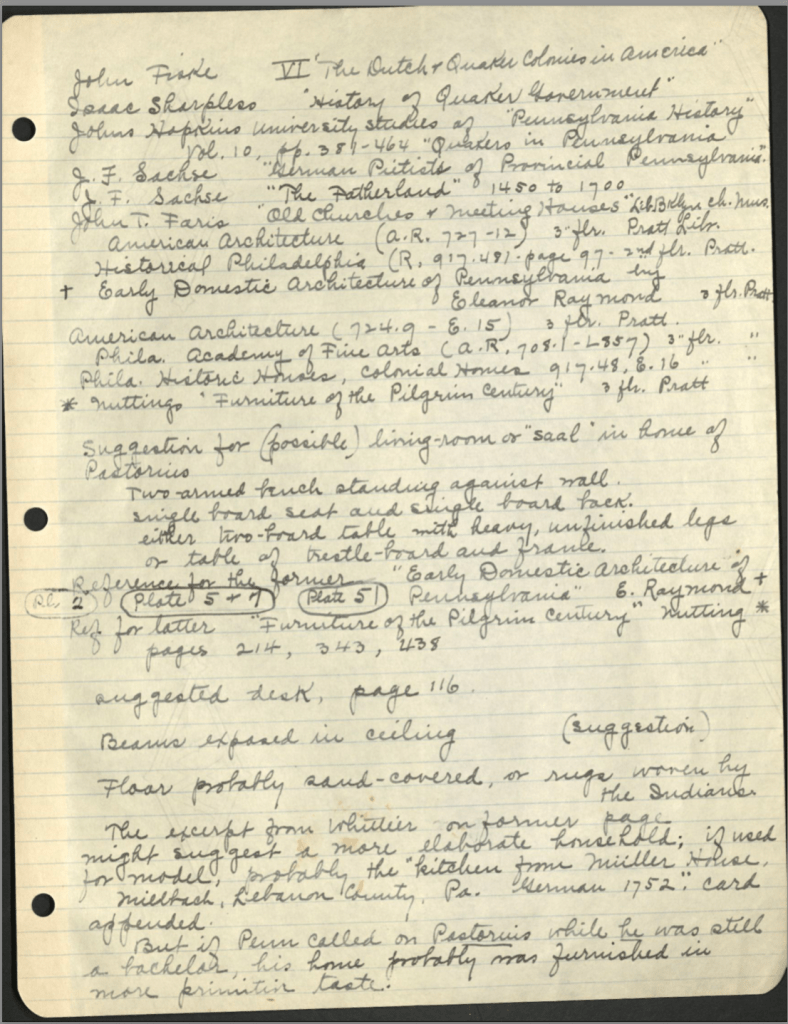
John Fiske “The Dutch + Quaker Colonies in America”
Isaac Sharpless “History of Quaker Government”
Johns Hopkins University Studies of “Pennsylvania History”
Vol. 10, pp. 381 – 464 “Quakers in Pennsylvania
J.F. Sachse “German Protists of Provincial Pennsylvania.”
J.F. Sachse “The Fatherland” 1450 to 1700
John T. Faris “Old Churches + Meeting Houses” Lib. Bklyn Ch. Mus.
American Architecture (A.R. 727 – 12) 3” flr. Pratt Lib.
+Early Domestic Architecture of Pennsylvania by Eleanor Raymond 3 flr. Pratt
American Architecture (724.9 – E. 15) 3 flr. Pratt.
Phila. Academy of Fine Arts (A.R. 708.1 – L857) 3” flr. ”
Phila. Historic Houses, Colonial Homes 917.48, E. 16 “ ”
*Mitting “Furniture of the Pilgrim Century” 3 flr. Pratt
Suggestion for (possible) living-room or “saal” in home of Pastorius
Two-armed bench standing against wall.
Single board seat and single board back.
Either two-board table with heavy, unfinished legs or table of trestle-board and frame.
Reference for the former
(Pl. 2) (Plate 5 + 7) (Plate 51)
“Early Domestic Architecture of Pennsylvania” E. Raymond+
Ref. for latter “Furniture of the Pilgrim” Mitting* pages 214, 343, 438
Suggested desk, page 116.
Beams exposed in ceiling (suggestion)
Floor probably sand-covered, or rugs woven by the Indians.
The excerpt from Whittier on former page might suggest a more elaborate household; if used for model, probably the “kitchen from Müller House, Millbach, Lebanon County, Pa. German 1752.” Card appended.
But if Penn called on Pastorius while he was still a bachelor, his home probably was furnished in more primitive taste.
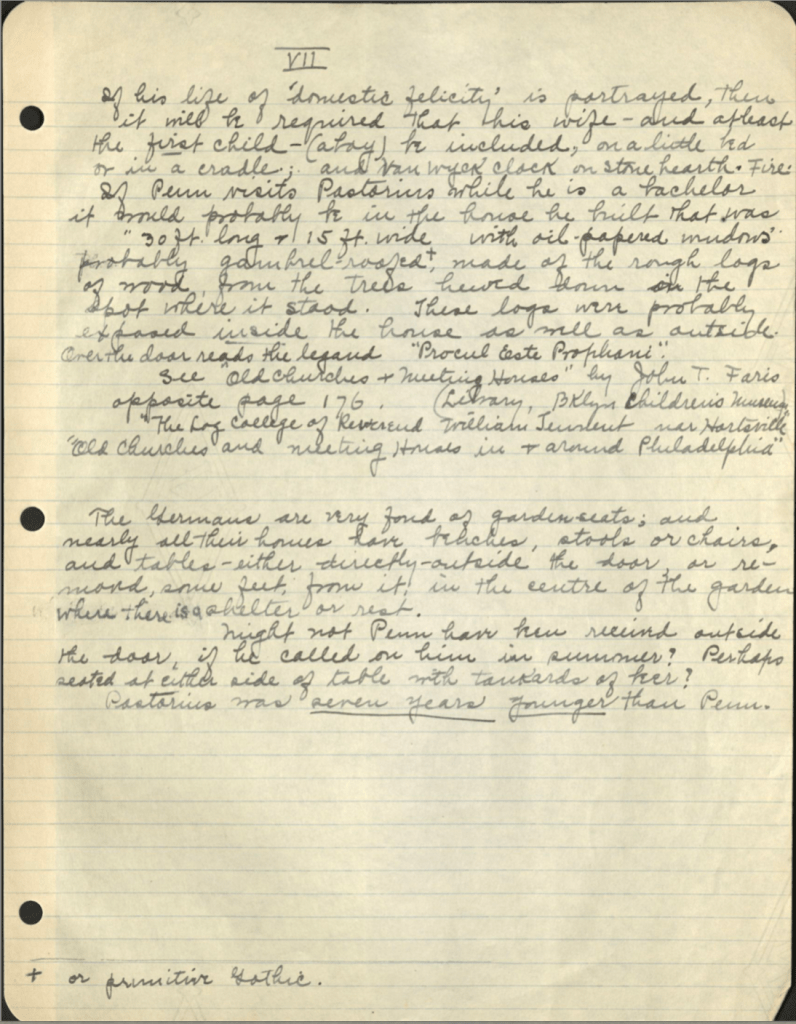
Of his life of ‘domestic felicity’ is portrayed, then it will be required that his wife—and at least the first child—(a boy) be included, on a little bed or in a cradle; and Van Wyck clock on stone hearth. Fire.
If Penn visits Pastorius while he is a bachelor it would probably be in the house he built that was “30 ft. long + 15 ft. wide with oil-papered windows” probably gambrel-roofed+, (+ or primitive Gothic) made of the rough logs of wood, from the trees hewed down on the spot where it stood. These logs were probably exposed inside the house as well as outside.
Over the door reads the legend “Procul Este Prophani.”
See “Old Churches + Meeting Houses” by John T. Faris opposite page 176. (Library, Bklyn Children’s Museum)
“The Log College of Reverend William Tennent near Hartsville”
“Old Churches and Meeting Houses in + Around Philadelphia”
The Germans are very fond of garden-seats; and nearly all their homes have benches, stools or chairs, and tables—either directly—outside the door or removed, some feet, from it, in the centre of the garden where there is a shelter or rest.
Might not Penn have been received outside the door, if he called on him in summer? Perhaps seated at either side of table with tankards of beer?
Pastorius was seven years younger than Penn.
For design of house see “The Log College of Rev. William Tennent near Hartsville”, in “Old Churches and Meeting – Places” by John T. Faris opposite page 176. Lib. Bklyn Chld. Mus.
The Germans are very fond of garden seats. Two might be shown in front of the house on either side of the entrance.
Pastorius is seven years younger than Penn and Anna is 7 years younger than Pastorius.
The floor was probably made of huge, broad beams hewn from the same timber as the logs from which the rest of the cottage was built.
It may have been covered daily with clean sand, a utilitarian custom of that day; but it is also not unreasonable to believe that may have been adorned with rugs supplied by the friendly Indians who owed much to Pastorius’ knowledge of medicine.
Sonia was not silent about her experience as a historical researcher, and she described her impressions of the work itself and working with the Curator-in-Chief, Miss Anna Billings Gallup:
I was given a sheet of paper with subjects named, for which I was to search out all I could regarding “Roger Williams Speaks Out for Liberty Before the New England Divines.” I must have read at least 20 books on the life of R.W. I found it most interesting and enchanting. The Banker, Mr. P, told me it did not pay much, but enough to keep the wolf from the door. I accepted the job with alacrity and loved it. When I read all I could find on the subject, beside the reading matter, I drew a chart to illustrate the scene.
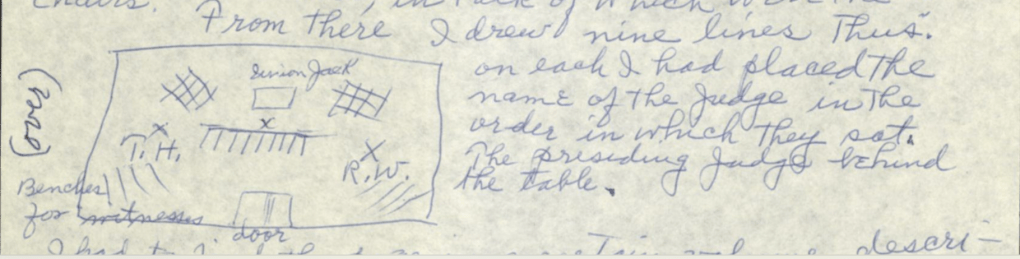
The Trial took place in “Newtown.” Well, I was obliged to find where “Newtown” was, once upon a time. It was on the ground where Harvard University stands. The courtroom was a wooden building with a sand floor. It had two diamond-paned windows in the eastern wall, if I remember. Between the windows, fastened to the wall was the Union Jack.”
For a lecturn [sic], before which the Judges sat, I sketched a line, in back of which were their chairs. From there I drew nine lines Thus:
on each I had placed the name of the Judge in the order in which they sat. The presiding Judge behind the table.
I had to find the page in a certain volume describing the age, and gown of each, etc. When all was finished, the Curator, Miss Gallup, said “You have too many figures.” Why don’t you have R.W. run away through the woods? That would be enough. I couldn’t change her mind. I pleaded with her. I said “This was his big moment; standing before the Divines and before his accuser, Thomas Hooker.
But she had it her way.
My second subject was intensely interesting “Francis Daniel Pastorius” meets William Penn in Germantown, Pa.”
This time the ‘personae dramatis were properly dressed and the scenery was correct except the Skulkill [sic] River was left out. The third subject was “Patrick Henry” in “Give Me Liberty or Give Me Death.
Sonia H. Davis, Autobiographical Writings, Box 9, Folder 8, John Hay Library, Providence, RI.
Sonia was adamant about her group’s research on Roger Williams, and her written plea from her research notes verifies her disagreement with Gallup in the autobiographical account. In the midst of this opportunity, Sonia felt the need to reconnect with H.P. Lovecraft. It is thus we have these excerpts from her memoir:
Upon my return to the U.S.A. I became quite ill. Upon recuperating I took a trip to beautiful Farmington, Conn. I was so enchanted with this beautiful Colonial built city that I wrote to Howard at once to join me there which he did. We explored not only the rare city of Farmington whose architecture, at that time even the newest, such as the Library and the new Bank and Chamber of Commerce, was of the early eighteenth century, but we went to Weathersfield, [sic] that ancient shrine where we paid our homage to the Church where George Washington worshipped, and to Thomas Hooker’s grave and other graves and places of historic character and interest.
[…]
Where was I? Oh, yes, back from Europe and once more in New England with Howard at my side exploring the grounds and places of cities more than three hundred years old. Yes, I believe I must have still loved Howard very much, more than I cared to admit even to myself.
[…]
When Howard and I parted for the night I said “Howard, won’t you kiss me goodnight?” His reply was “No, it is better not to.” The next morning we met again and explored Hartford.
At that time I was doing some historical research work for the Brooklyn Children’s Museum. Among the several pieces I was delegated to do was was [sic]one called “Roger Williams Speaks out for Liberty before the New England Divines.” Much of the research was done in the Fifth Ave. and Forty-Second St. Librarry [sic] in N.Y.C. But when I told HP what I had been doing along this line and would like more data he graciously led me to the Hartford Library and at once got busy inquiring for original books and hawling [sic]down tomes for me from the shelves. The sculptors at the Brooklyn Museum were then to make the figurines and the other scenery depicting the history included in my research. In parting for the night, I no longer asked for the kiss. I’d learned my lesson well. I did several pieces of research for the Museum, which is a branch of the Metropolitan; among others was one of great interest yet hardly heard of in the public High Schools, namely: “Francis Daniel Pastorius meets William Penn in Germantown, Pa. But since at that time historical research was not properly remunerative work, I returned to my own.
Sonia H. Davis, The Private Life of Howard Phillips Lovecraft, unedited manuscript, John Hay Library, Providence, RI.
As much of a blessing this job might’ve been for Sonia, especially at time when there was little work to be had, the pay wasn’t enough for long term means.
On my free time I was still seeking a millinery Buyership, found one at a much better figure than that as a historical researcher worker, and accepted it.
Both Miss Gallup and the Librarian expressed their sincere regrets at my leaving. I accepted my new job in August, in Newberg, N.Y. in 1933, worked there until one day before Christmas.
Sonia H. Davis, Autobiographical Writings, Box 9, Folder 8, John Hay Library, Providence, RI.
What followed after that Christmas of 1933 would be Sonia’s decision to visit California, leaving for that trip on January 6, 1934. (FamilySearch) While visiting, she decided to remain in California and after settling and remarrying, her life in New York would remain a distant memory. What was past, however, would inevitably become her present again. After Nathaniel Davis’s death, Sonia was financially struggling. Coincidence or not, Sonia penned the following letter to Anna Gallup during the time she began her reminiscences of Lovecraft. In fact, she wrote this very letter while visiting New York on the same day she was responding to August Derleth’s threats about not publishing her memoir The Private Life of H.P. Lovecraft.
Transcript:
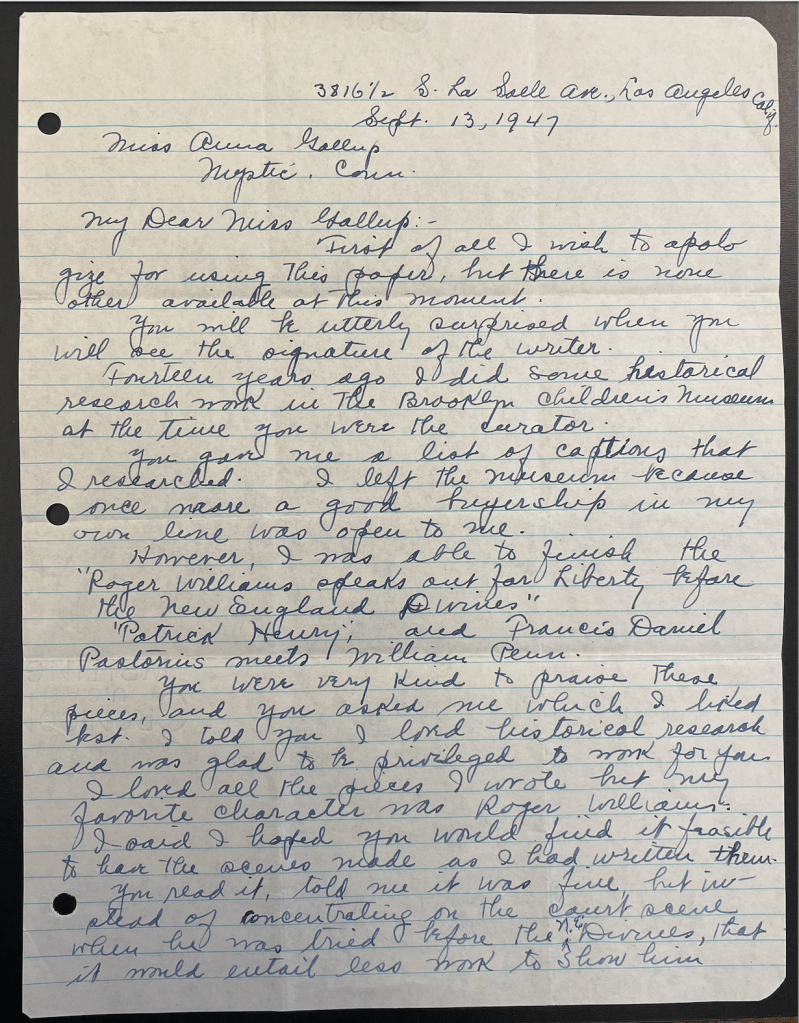
Sept. 13, 1947
My Dear Miss Gallup: —
First of all I wish to apologize for using this paper, but there is none other available at this moment.
You will be utterly surprised when you will see the signature of the writer.
Fourteen years ago I did some historical research work in the Brooklyn Children’s Museum at the time you were the curator.
You gave me a list of captions that I researched. I left the museum because once more a good buyership in my own line was open to me.
However, I was able to finish the “Roger Williams speaks out for Liberty before the New England Divines”
“Patrick Henry”, and Francis Daniel Pastorius meets William Penn.
You were very kind to praise these pieces, and you asked me which I liked best. I told you I loved historical research and was glad to be privileged to work for you.
I loved all the pieces I wrote but my favorite character was Roger Williams.
I said I hoped you would find it feasible to have the scenes made as I had written them.
You read it, told me it was fine, but instead of concentrating on the court scene when he was tried before the N.E. Divines, that it would entail less work to show him as he was fleeing from his enemies.
I pleaded with you to give his memory the full meed of credit that he deserved, that the trail scene depicted the “Big Moment” in his life and was the most interesting part of his life and history. I wonder whether you recall it!
However, I came back to N.Y. after 14 years, for a visit, a very short one, only two weeks.
I had wondered whether these scenes were ever made. What was my delight and surprise upon visiting the museum two days ago to find the three scenes there, even if you did order the one of R.W. with the least number of figures.
I just love the Pastorius + Penn, it is utterly splendid.
And the Patrick Henry is almost faultless! (The pulpit was up high in the actual church, but the artist made it on a level with the floor. But all in all they are splendid.
I spent a pleasant half-hour with Miss Sheppen and asked her for photograph reproductions, but she had none.
However, she promised to try to get them. Now here is where I wish to ask you for a very great favor, would you be good enough to state on paper, i.e. in a letter to me that I was the researcher? It would probably mean a life time job for me in the cinema field, a field most difficult to enter.
If you will be good enough to make your statement on this sheet and also return the rest of this letter I would appreciate it abundantly. (This would be my credential.) I would consider it a great favor indeed.
With every good wish for your health and prosperity, and many thanks in anticipation of your favor, I am
Very Sincerely Yours
Sonia (Greene) Davis.
P.S. You will see by the added surname that I was married. My dear late husband passed away two years ago. And please write me about yourself!
Mrs. Sonia (Greene) Davis, according to her own statement was one of the research workers on a series of historical groups in American History. I cannot recall the circumstances but I believe Mrs. Davis is correct because she recalls in detail the composition of the groups much better than I can do. I sincerely hope this statement will help her because I know she had to do good work in order for us to make the groups.
I was Curator-in-Chief of The Brooklyn Children’s Museum at the time the groups were made and we had consultants who helped us with the details of accuracy.
Very truly yours,
(Miss) Anna Billings Gallup
Sonia direly needed a job, and she was lining up whatever opportunity she could that would bring the necessary funds. Not only was she corresponding with Derleth during the trip, but they met also with her hopes of selling her memoir for as much as she could.
Meanwhile, did I tell you Sonia Lovecraft Davis turned up with some laughable idea of cashing in on HPL’s “fame” and the desire to publish a “frank” book, entitled THE PRIVATE LIFE OF H. P. LOVECRAFT, and quoting generously from his letters. She read me part of the ms. in New York, and in it she has HPL posing as a Jew-baiter (she is Jewish), she says she completely supported HPL for the years 1924 to 1932, and so on, all bare-faced lies. I startled her considerably when I told her we had a detailed account of their life together in HPL’s letters to Mrs. Clark. I also forbade her to use any quotations from HPL’s letters without approval from us, acting for the estate. I told her by all means to write her book and I would read it, but it was pathetically funny; she thought she could get rich on the book. She said it would sell easily a million copies! Can you beat it! I tried to point out that a biographical book on HPL by myself, out two years, had not yet sold 1000 copies, and that book combined two well-known literary names. She thought she should have $500 advance on her book as a gift, and royalties besides! I burst into impolite laughter, I fear.
August Derleth to R.H. Barlow, October 23, 1947, Wisconsin Historical Society.
Returning to the main thread, however, Sonia’s letter to Anna Gallup perfectly correlates with what has been written in her autobiographical writings. It’s unclear what aspect of cinema Sonia was trying to break into, but if I had to speculate, it likely had to do with set designing since her job as a historical researcher was a foundation for the creation of the dioramas. What’s sad about the letter is Anna’s reply. Given the scale of the project, it’s easy to understand why Anna might’ve forgotten Sonia. The Brooklyn Children’s Museum, however, remembered Sonia and her work, for they had her research papers in their archives for some time prior to sending them back to her.
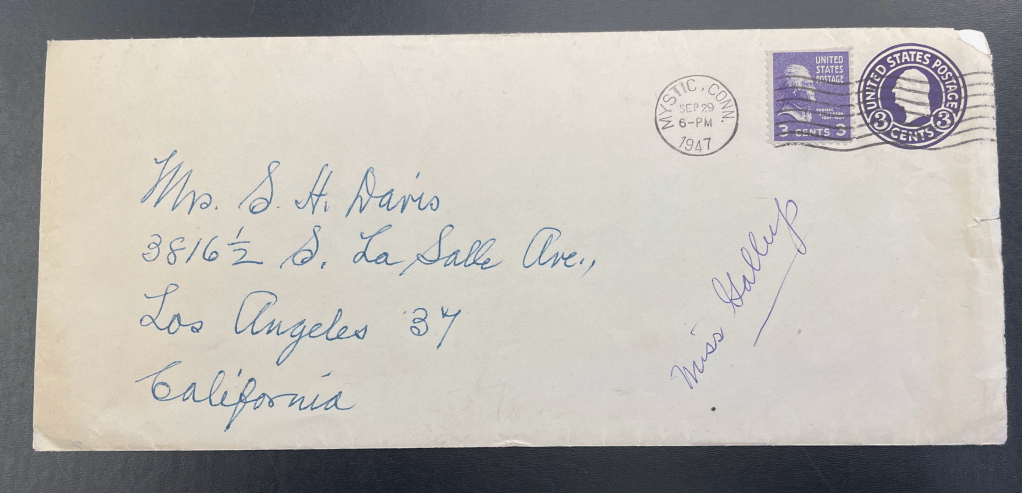
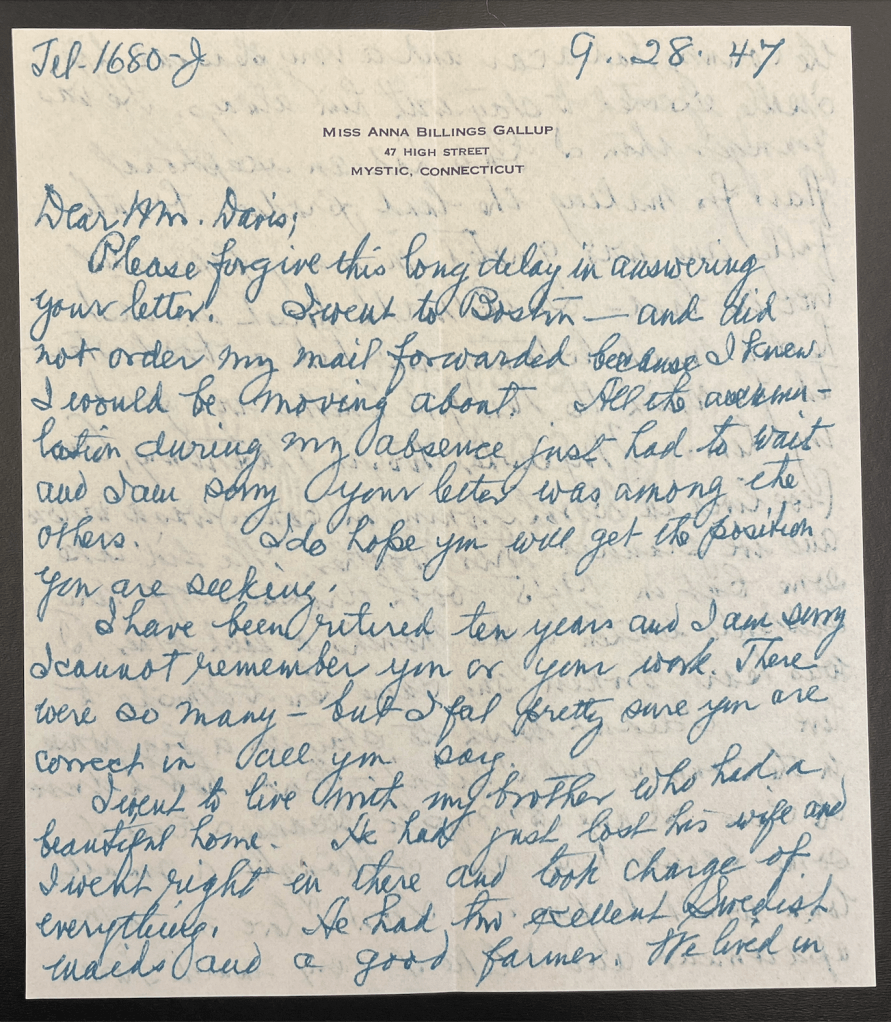
Anna was still kind of enough to respond to Sonia:
Transcript:
Dear Mrs. Davis:
Please forgive this long delay in answering your letter. I went to Boston—and did not order my mail forwarded because I knew I would be moving about. All the accumulation during my absence just had to wait and I am sorry your letter was among the others. I do hope you will get the position you are seeking.
I have been retired ten years and I am sorry I cannot remember you or your work. There were so many—but I feel pretty sure you are correct in all you say.
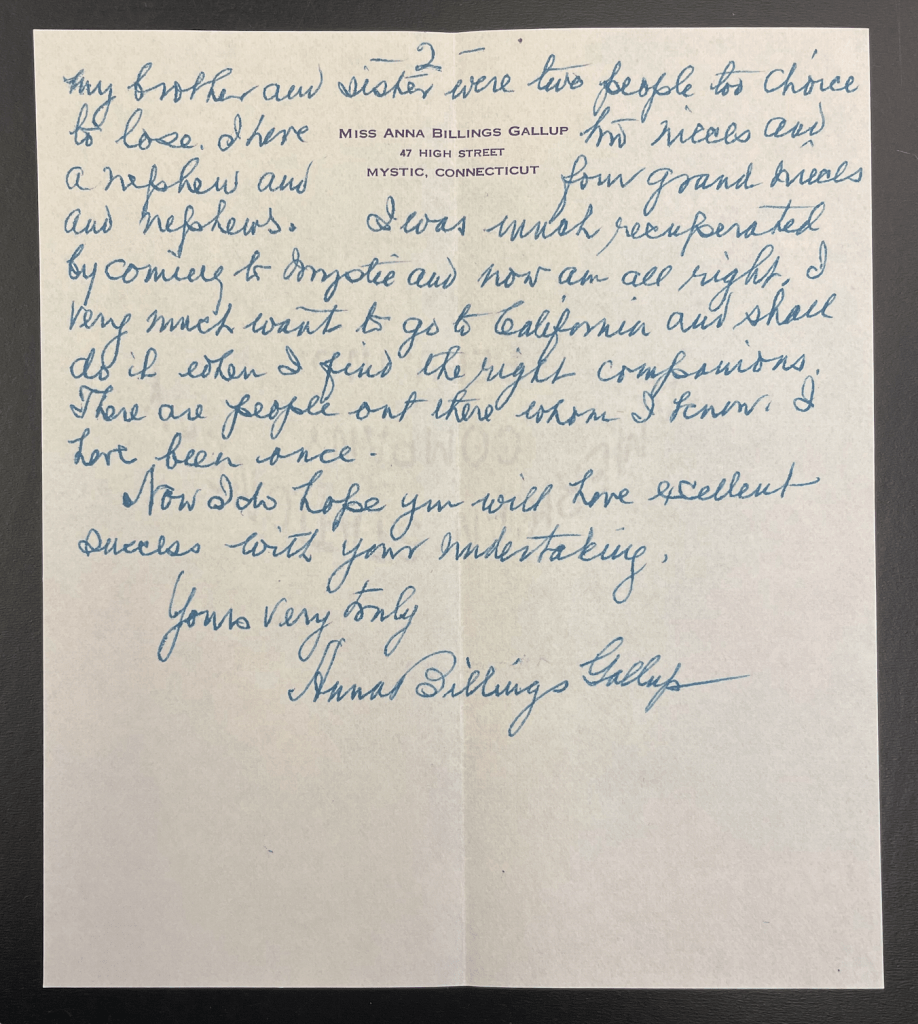
I went to live with my brother who had a beautiful home. He had just lost his wife and I went right in there and took charge of everything. He had two excellent Swedish maids and a good farmer. We lived in the country, had a car and a very pleasant life. I really expected to stay with him always. He was younger than I but had an exceptional flair for making the land produce bountifully and was quoted in many papers all over the land. In the Middle West and East he did much catering and had a book started for which the New York Editors were pushing him. My sister too, in Waterbury, Conn. (we lived in North Stonington Conn.) was a widow and we planned trips together. We did take some but in 1945 both dropped off very suddenly within a few months of each other. I was heartbroken and came here to Mystic to live. I didn’t wish to stay in a log house in the country and I didn’t know how to drive a car. I came to Mystic because I know some people here and I thought a small town would be fine. Now I have my own apartment and I like it very much though my brother and sister were two people too choice to lose. I have two nieces and a nephew and four grand nieces and nephews. I was much recuperated by coming to Mystic and now am all right. I very much want to go to California and shall do it when I find the right companions. There are people out there whom I know. I have been once.
Now I do hope you will have excellent success with your undertaking.
Yours very truly,
Anna Billings Gallup
Anna Billings Gallup was born on November 9, 1872, in Ledyard, Connecticut. Her parents were Christopher Milton Gallup and Hannah Eliza Lamb. (FamilySearch) Christopher was a farmer while her mother took care of the household. (FamilySearch) Anna was the middle child, with an older sister and a younger brother. Her sister, Harriet Tooker Gallup, was born on March 29, 1869. Harriet married Darragh de Lancey on October 30, 1897, having three daughters and a son. (FamilySearch) Although, that bit of information conflicts with what Anna wrote about having two nieces and a nephew. Anna’s brother, Christopher Milton Gallup III, was born on February 10, 1876. He married as well, marrying Christine Richmond Ewing on October 28, 1899, and it appears the couple didn’t have children. (FamilySearch)
Anna remained single but pursued a career as curator. In the 1905 New York Census for the Brooklyn, Kings borough, she was rooming with Florence Kilburn and was already listed as a curator for the Brooklyn Children’s Museum. (FamilySearch) Then in the 1910 census, she moved in with her mother, Hannah Gallup, residing in Brooklyn, Kings. (FamilySearch) As her letter reveals, Harriet passed away May 16, 1945, while her brother, Christopher, passed away on December 27, 1945. Yale University published an obituary for Christopher (FamilySearch):
Transcript:
CHRISTOPHER MILTON GALLUP
PH B 1897
Born February 10, 1876, in Ledyard, Conn
Died December 27, 1945, in Westerly, RI
Father, Christopher Milton Gallup, a farmer in Ledyard, son of Christopher Milton and Anna Stanton (Billings) Gallup of Ledyard Mother, Hannah Eliza (Lamb) Gallup, daughter of Samuel Stillman and Eliza (Gallup) Lamb of Groton, Conn Yale relatives include Nathan Gallup (B A 1823) (great -uncle), Herbert S Griggs, ’82, C Milton Griggs, ’83, and Everett G Griggs, ’90 S (cousins), Darragh de Lancey (B F A 1925) (brother-in-law), Darragh de Lancey, Jr (LL B 1932) (nephew)
Norwich (Conn) Free Academy
Enlisted as seaman Second Division Naval Battalion, Connecticut National Guard, April, 1897, served aboard receiving ship Minnesota, Boston harbor, discharged August 6, 1898, on staff City Engineer (in charge of pavements), Hartford, Conn, 1898–1903, free lance writer and editor Somerset Independent, Skowhegan, Maine, 1903–05, editor Maine Farmer, Augusta, 1905–10, underwriter Travelers Insurance Company, Hartford, 1913 until retirement 1928, resided in North Stonington, Conn, 1928–45, experimented with new biochemical methods of agriculture especially suited to Connecticut, promoted radio weather service for farmers, secretary New London County Farm Bureau, representative from Connecticut on forestry committee of New England Council, member board and president Connecticut Forest and Park Association 1940–45, president West Hartford Chamber of Commerce 1922 and on advisory council Proportional Representation League, West Hartford, acting secretary Norwich Chamber of Commerce 1931–33 and vice-president, chairman board of assessors North Stonington 1941–45, in World War I chairman West Hartford Savings Committee and in World War II vice-chairman Selective Service Board 20B, organized, and president Gallup Family Association for several years, trustee Denison Family Association, on forty-five year Class reunion committee, member First Church of Christ Scientist, Boston.
Married (1) October 28, 1899, in Hartford, Christine Richmond, daughter of the Honorable Henry C Ewing and Rachael Whittier (Root) Ewing No children Mrs Gallup died June 17, 1937 Married (2) February 28, 1940, in Norwich, Ruth Kinney Gaines, daughter of Charles Newcomb and Julia Huntington (Hutchinson) Kinney
Death due to coronary occlusion Buried in Gallup Cemetery, Ledyard Survived by wife and a sister, Anna Billings Gallup (B S Massachusetts Inst Technology 1901) of Mystic, Conn.
At the age of 83, Anna Billings Gallup passed away on October 21, 1956.
Ultimately, Sonia neither got the cinema job nor her hundreds of dollars for her memoir of H.P. Lovecraft. Instead, she studied to become a nurse:
With Ann’s And [sic] Sid’s frequent help I got along. I went to a nursing school and was so glad when I could write to Sid and Ann that I thanked God I could now make my own living as a nurse. I worked until I was seventy two years old.
Sonia to Sidney, Florence, and Leonore Moseson, August 25, 1964, Autobiographical Writings, Box 9, File 1, John Hay Library, Providence, RI.
Even after everything came and passed, Sonia certainly loved her job as a historical researcher because she loved learning. We can now see how much work she incorporated into the simple position, and because of it, we also get to learn about Anna Gallup and her role as curator. Moreover, this opportunity gave Sonia another chance to spend with Lovecraft, which sadly would be the last. Sonia’s time as a historical researcher was both the closing of one chapter of her life and the promise of a new chapter.
[…] A long new post on Lovecraft’s wife Sonia as a historical researcher. This was her paid role with the Brooklyn Children’s Museum, undertaken in 1933, and which […]
[…] Florence Carol Greene, her correspondence with both Samuel Loveman and Alfred Galpin, her time as a historical researcher, and her friendship with a Korean spy, Kilsoo Kenneth Haan. The posts of 2024 were a remarkable […]








 The Papers of Sonia H. Davis
2 responses to “The Historical Researcher”
[…] A long new post on Lovecraft’s wife Sonia as a historical researcher. This was her paid role with the Brooklyn Children’s Museum, undertaken in 1933, and which […]
LikeLiked by 1 person
[…] Florence Carol Greene, her correspondence with both Samuel Loveman and Alfred Galpin, her time as a historical researcher, and her friendship with a Korean spy, Kilsoo Kenneth Haan. The posts of 2024 were a remarkable […]
LikeLike