
I do have a memory of meeting Florence.
Martin H. Kopp, “Memories of Sonia H. Greene Davis”, The Lovecraft Annual, p. 29.
Very little has been said, or written, about Florence Carol Greene. Even her own mother, Sonia H. Davis, had imparted minuscule crumbs of information about her. In Sonia’s autobiographical writings, Florence is only specifically mentioned during the turbulent years of Sonia’s marriage to Samuel Greene, and she’s majorly referred to as the “little girl”, “baby”, or “child”. Of the twenty-two times that Florence is mentioned by Sonia, only nine times does Sonia use her actual name. In Sonia’s letters to her family, which also contain autobiographical matter, Florence is mentioned again only in passing as “child” or “baby girl”.
However, this is only one side of the coin, figuratively speaking. In two essays regarding children’s behavior and manners, Sonia gave further insight:

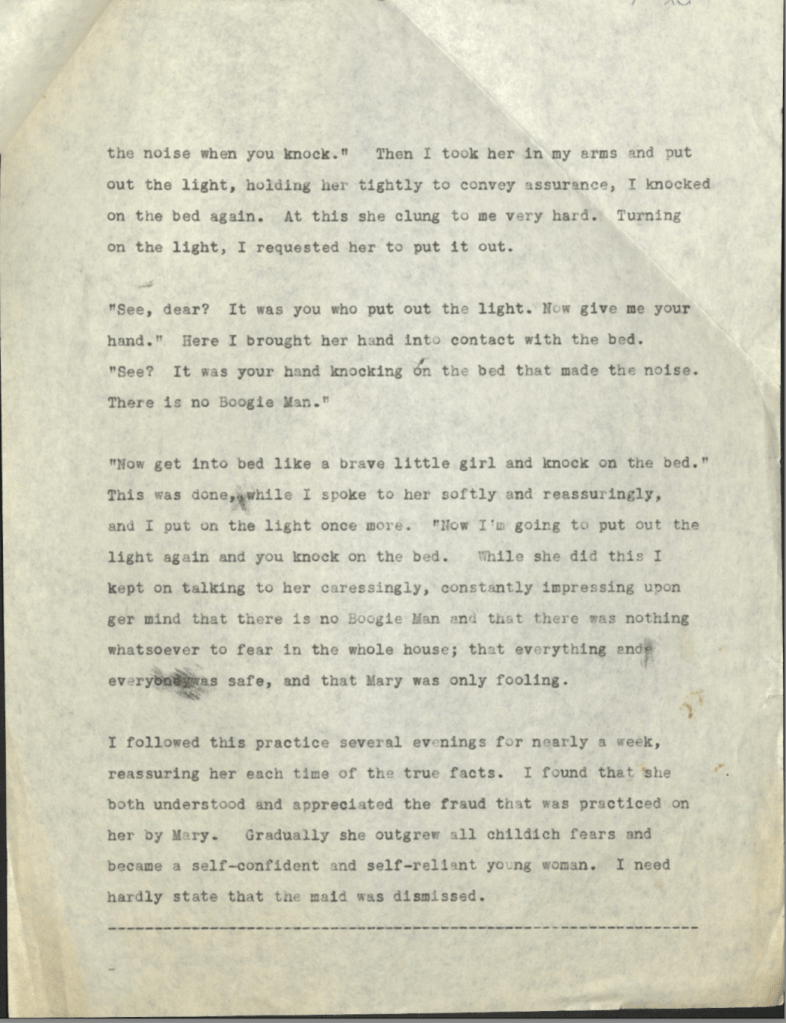
Transcript:
HOW I OVERCAME CHILD’S FEAR OF THE BOOGIE MAN
A detailed description how a diffficulty [sic] was met and dissipated, might be helpful to some mothers in vanquishing a young child’s bedtime fear.
At three and a half years of age my little girl suffered from fright caused by the maid, who, in seeking to get away from her quickly after putting her to bed, told her that if she didn’t go to sleep at once, the Boogie Man would get her.
On the maid’s night out, I put the child to bed and as soon as I was about to leave the room and put out the light she started to whimper, and then to cry. Upon asking the reason, she told me she was afraid of the Boogi [sic] Man; that Mary said the Boogie Man would get her if she didn’t go to sleep right away.
I realized at once what the child was suffering and forthwith tried to conquor [sic] the fear.
“What does the Boogie Man do, darling?” I asked her.
“When Mary puts out the light he knocks on the bed. I’m afraid of the dark.”
While the light was still on, I rapped on the bed with my knuckles.
“Is this the noise he makes?” “Yes.” Then I shaped her hand into a fist and had her knock on the bed.
“See, darling?” This is no Boogie Man. Its your own hand making the noise when you knock.” Then I took her in my arms and put out the light, holding her tightly to convey assurance, I knocked on the bed again. At this she clung to me very hard. Turning on the light, I requested her to put it out.
“See, dear? It was you who put out the light. Now give me your hand.” Here I brought her hand into contact with the bed.
“See? It was your hand knocking on the bed that made the noise.
There is no Boogie Man.”
“Now get into bed like a brave little girl and knock on the bed.”
This was done, while I spoke to her softly and reassuringly, and I put on the light once more. “Now I’m going to put out the light again and you knock on the bed. While she did this I kept on talking to her caressingly, constantly impressing upon ger mind that there is no Boogie Man and that there was nothing whatsoever to fear in the whole house; that everything and everybody was safe, and that Mary was only fooling.
I followed this practice several evenings for nearly a week, reassuring her each time of the true facts. I found that she both understood and appreciated the fraud that was practiced on her by Mary. Gradually she outgrew all childich [sic] fears and became a self-confident and self-reliant young woman. I need hardly state that the maid was dismissed.
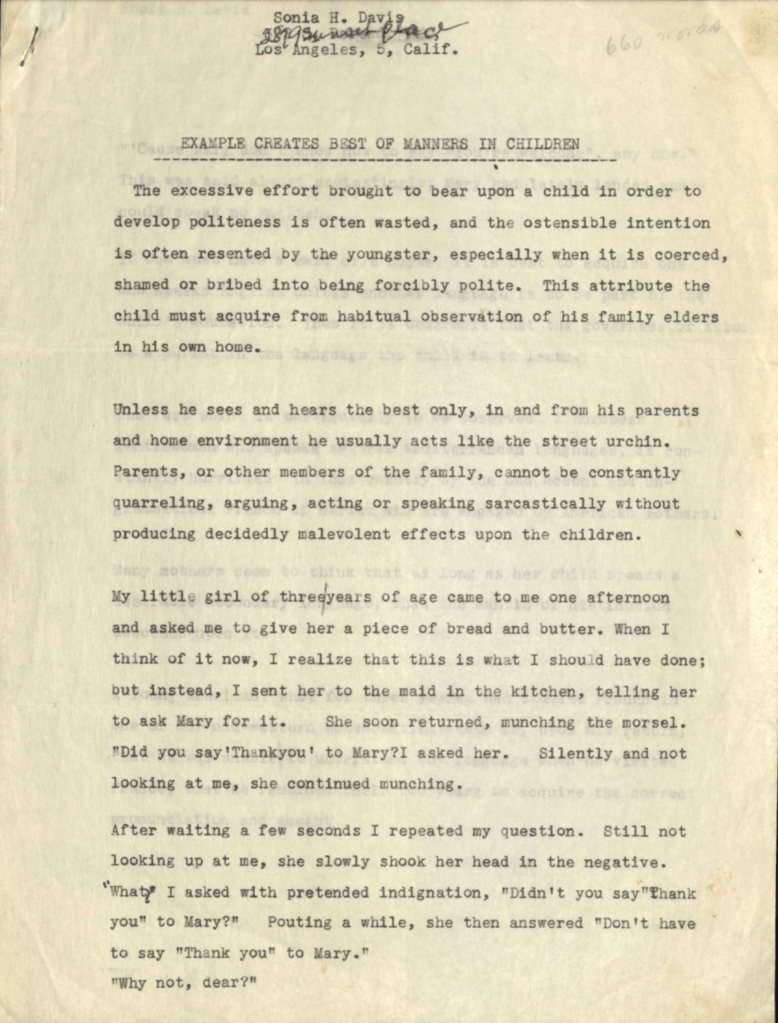

Transcript:
EXAMPLE CREATES BEST OF MANNERS IN CHILDREN
The excessive effort brought to bear upon a child in order to develop politeness is often wasted, and the ostensible intention is often resented by the youngster, especially when it is coerced, shamed or bribed into being forcibly polite. This attribute the child must acquire from habitual observation of his family elders in his own home.
Unless he sees and hears the best only, in and from his parents and home environment he usually acts like the street urchin. Parents, or other members of the family, cannot be constantly quarreling, arguing, acting or speaking sarcastically without producing decidedly malevolent effects upon the children.
My little girl of three years of age came to me one afternoon and asked me to give her a piece of bread and butter. When I think of it now, I realize that this is what I should have done; but instead, I sent her to the maid in the kitchen, telling her to ask Mary for it. She soon returned, munching the morsel. “Did you say ‘Thank you’ to Mary? I asked her. Silently and not looking at me, she continued munching.
After waiting a few seconds I repeated my question. Still not looking up at me, she slowly shook her head in the negative. “What?” I asked with pretended indignation, “Didn’t you say “Thank you” to Mary?” Pouting a while, she then answered “Don’t have to say “Thank you” to Mary.”
“Why not, dear?”
“‘Cause Mary don’t know how to say “You’re welcome”, any how.”
This was said almost protestingly; Mary had lately landed and could speak no English.
If one must have a maid or a nurse, it is best to acquire one who speaks English unless another language is to be part of the child’s education. Then it is desirable that the governess or tutor be a purist in the language the child is to learn.
The last point is particularly to be observed. A European gentlewoman who speaks several Mediterranean languages, is constantly horrified in this country by the bad accent and ungrammatical French of nurses who are engaged by American mothers.
Many mothers seem to think that as long as her child speaks a desirable secondary language, that the mantle of distinction descends upon it.
A Young American, who, for three years, had studied French in one of our mid-western universities, told me, upon his return, that he was unable to understand the language when he visited France, that he remained their two years to acquire the correct pronunciation and accent.
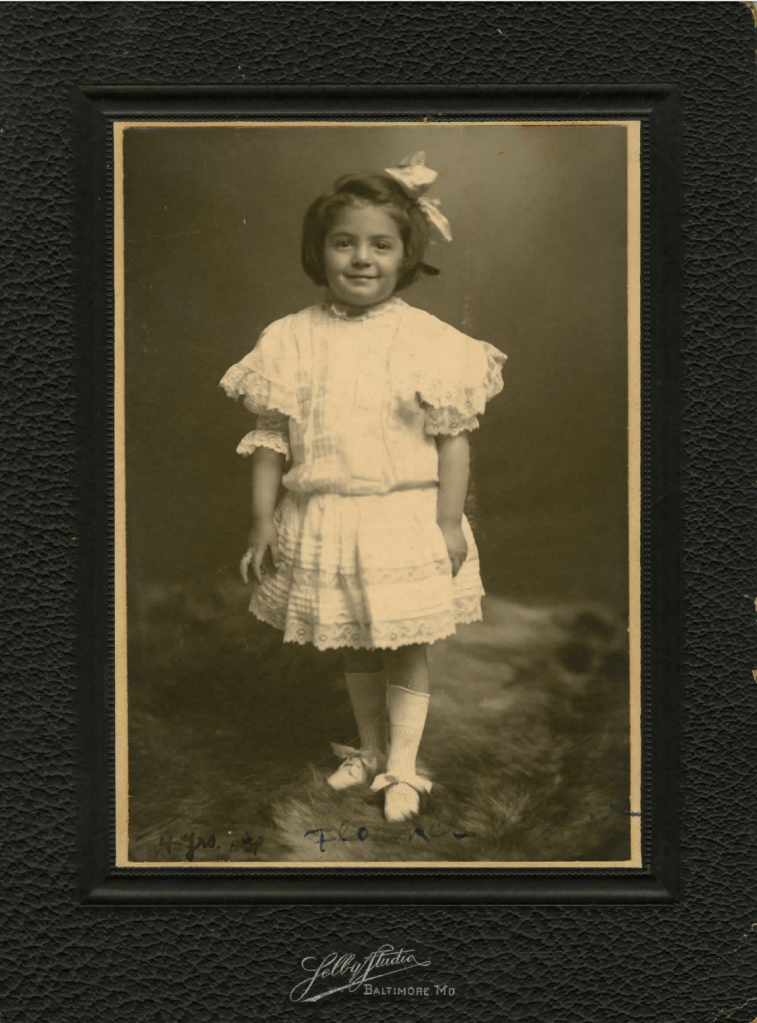
Another great source of information about Florence was Sonia’s letter to the Special Collections Librarian, Christine D. Hathaway. Sonia openly shared anecdotes about Florence, from her cutest moment to her ultimate rebellion. The following is only an extract from the several-page letter.
When “Carol Weld” whose real name is “Florence Carol Greene,” was a child of about ten, I was engaged to an extremely handsome young Italian of excellent family, education and breeding, but I, being of Jewish heritage, and he, of Catholic, our mothers, his and mine objected to our marriage. We were both obliged to renounce the thought and action.
I’ve always sought a man of education, culture, and inquiring mind, good family and other virtues. I was 24—he was 22. I studied the Italian language and learned to read, write and speak a little. He often ate at my mother’s table and I, at his mother’s who liked and admired me very much, but she did not quite guess whether her son and I intended to marry. When both mothers found out there were the usual objections on both sides. Neither of us would do the usual—elope. We at last gave up the thought.
One day Florence met him on the street; he grabbed her up, folded her to himself and ‘boo-hood’ like a hurt animal. When she came home and told me what happened, I felt sorry for both of them. She asked me, aren’t you going to marry F.B?
I said “No, his mother and grama have great objections.” I’m getting over my part, but evidently, he is still badly hurt.
The child was very young but had sense enough to say—for she was very fond of him—Well! if he’ll wait for me I’ll marry him!” As she grew up I obtained a good music-teacher for her, but she wouldn’t practice. Her lower teeth were crooked, but she missed many sessions with her orthdontist [sic].
In both cases I scolded and we became more and more apart. I wanted her to go to college, but she didn’t want a local college. She had a girl-friend who urged her to join her at a girls’ college in Rochchester [sic]N.Y. where they were taught games and rode horses. I told her we had Columbia U, here in N.Y. and I can’t afford to pay for her pleasures. We quarrelled again over that girl. At last she left me and I hadn’t heard from her in years. She learned stenography + typewriting and made her own living.
I looked for Florence everywhere. I heard she went to Chicago. I took a job so I might find her, but I didn’t.
I had a friend who worked in the Hall of Records in N.Y.C. I asked her whether she could obtain some important information for me so I told her I was looking for my daughter; giving her the name and age. She found the name in the Hall of Records. She went to Paris where she became a newspaper writer for the Hearst newspaper, lived there for seven years. On the Boat, going there, she met a young American newspaper-man and they married; but it seems that her temper was unable to hold on to the man, so they were divorced in Paris, but she stayed on. He came back to America, married and now has a newspaper of his own, and interests in a moving picture project.
My daughter still carries his name. She no longer writes, but has formed a Woman’s Club of some sort, and lives in Florida. I’ve obtained her address and have written to her several times. The first two letters were returned to me unopened and unanswered. But I wrote several others, which she accepted but has not answered. She is now 67 years old, never married again. That’s all there is.
Sonia H. Davis to Christine D. Hathaway, October, 8, 1968, Autobiographical Writings (Box 9, Folder 1).
It is only through this letter and the personal essays that we get a real glimpse into Sonia’s relationship with Florence. It would seem their mother-daughter relationship had once been solid, but as years progressed and with that inner rage (or sheer stubbornness) of youth within Florence, their relationship began to come apart. While no one openly claimed it, except by Sonia, Florence seemed to have a temper.
Yet, how much of her temper was a result of years of unresolved trauma? As a child, Florence had not only lived under the roof of Samuel Greene, but had also been sent to live with her grandmother, Racille, aka Rachel Moseson, while Sonia tried to separate from Samuel. We can only imagine what she had witnessed living under the roof of two abusive men: first with her father, Samuel, and later with her grandfather, Solomon Moseson. The former abused her mother, and the latter, her grandmother.
Eventually, Sonia collected Florence and they lived together once again. In spite of the turbulence between Sonia and Florence through the latter’s adolescent years, Sonia wrote and dedicated a poem to her daughter in the first volume of her journal, The Rainbow:
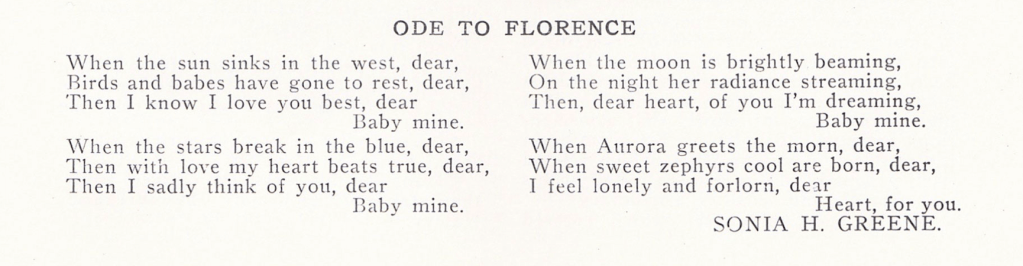
Transcript:
ODE TO FLORENCE
When the sun sinks in the west, dear,
Birds and babes have gone to rest, dear,
Then I know I love you best, dear
Baby mine.
When the stars break in the blue, dear,
Then with love my heart beats true, dear,
Then I sadly think of you, dear
Baby mine.
When the moon is brightly beaming,
On the night her radiance streaming,
Then, dear heart, of you I’m dreaming,
Baby mine.
When Aurora greets the morn, dear,
When sweet zephyrs cool are born, dear,
I feel lonely and forlorn, dear
Heart, for you.
There’s no denying the unspoken heartache of Sonia’s words. The poem was printed in October 1921, but one can only wonder just how long Sonia had been constructing these poetic lines to help ease the strain between her relationship with Florence. 1921 was a pivotal year for Sonia, from joining amateur journalism in January, to meeting H.P. Lovecraft in July, then publishing her own amateur journal in October. Lovecraft certainly harbored some impressions about Florence:
At dinner—about one-thirty—were Loveman, Theobald, Long, Mme. Greene, and the latter’s flapper offspring, yclept Florence—a pert, spoiled, and ultra-independent infant rather more hard-boiled of visage than her benignant mater.
H.P. Lovecraft to Maurice W. Moe, Lord of a Visible World, May 18, 1922, p. 115.
But one thing Mme. Greeneva says quite desolates me—she avers that her fair & frivolous offspring is not to be captivated by the charms of any highbrow, not even the otherwise irresistible Bolingbroke!
H.P. Lovecraft to Rheinhart Kleiner, Letters to Rheinhart Kleiner and Others, p. 187.
Whether intentional or not, once Sonia’s relationship with Lovecraft deepened, Florence had dropped out of the picture. It’s unclear when Florence moved out of her mother’s house, but once Lovecraft moved in with Sonia in March 1924, she was gone. Thereafter, Florence went by her middle name, Carol. On September 3, 1927, Carol Greene had returned to New York from Havre, France. (FamilySearch) It’s hard to say how long her stay was at Havre, but this trip would only be the beginning of her extensive travels to Europe. Only ten days after her return, on September 13, 1927, Carol married John Weld. (FamilySearch)
So, what really happened? What caused the ultimate division between Sonia and Florence? The truth is no one really knows. There’s only Sonia’s truth and speculation.
In 1983, the one and only publication that has ever fully focused on Florence was Lovecraft’s Daughter by R. Alain Everts. “Lovecraft’s Daughter” comprises of three, extremely thin, stapled pamphlets. Legally, Florence was Lovecraft’s stepdaughter when he married Sonia. However, it was an empty title, a role that Lovecraft never truly stepped into, nor one that Florence fully accepted. The journal, in my opinion, does well to inform the reader of who Florence really was, and her achievements in life. While it’s the most anyone has done for her, it still isn’t enough, but that’s no fault of the publication given that Florence worked hard to distance herself from her past and live privately.
I have only the first and second volume in my possession since these were the only two that emerged for sale on eBay.


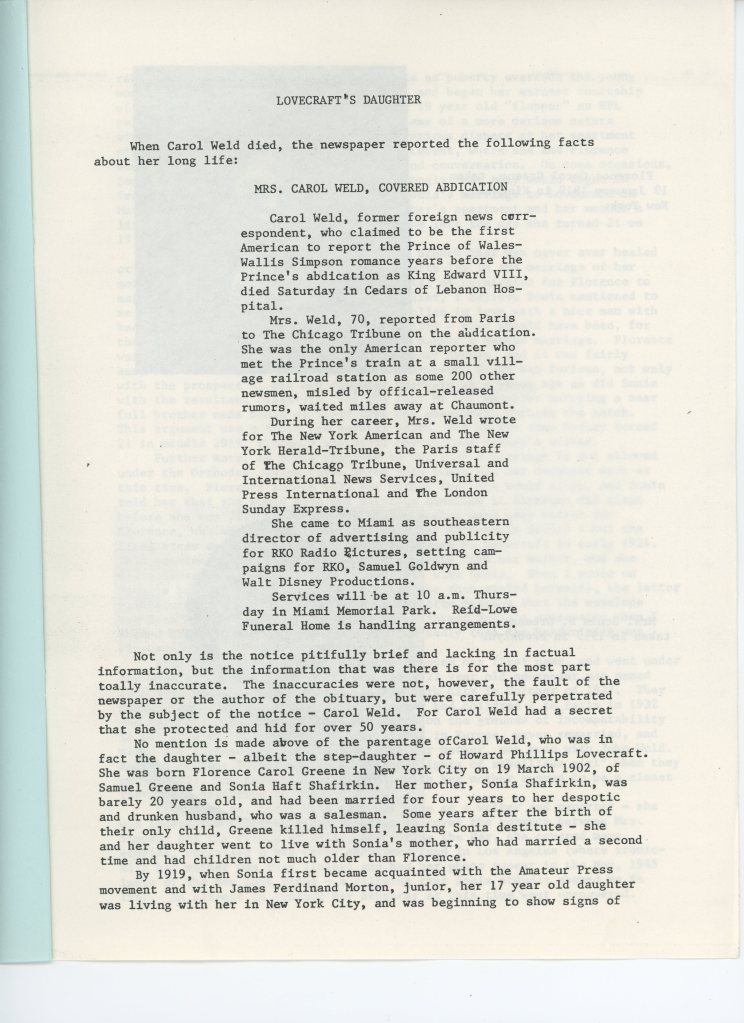
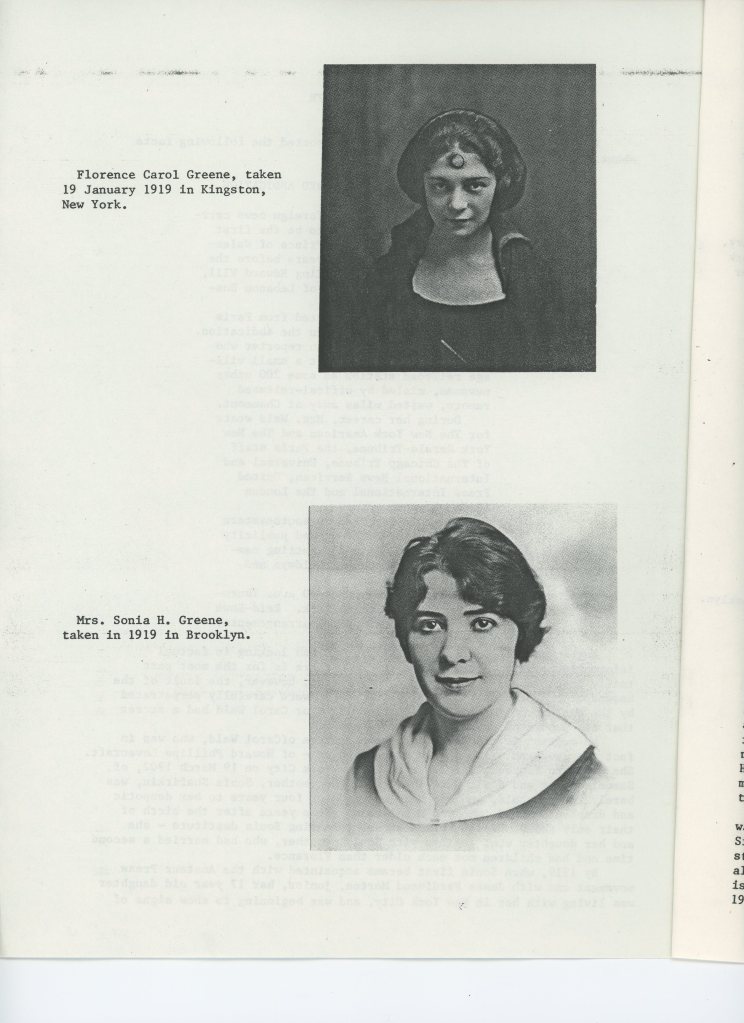
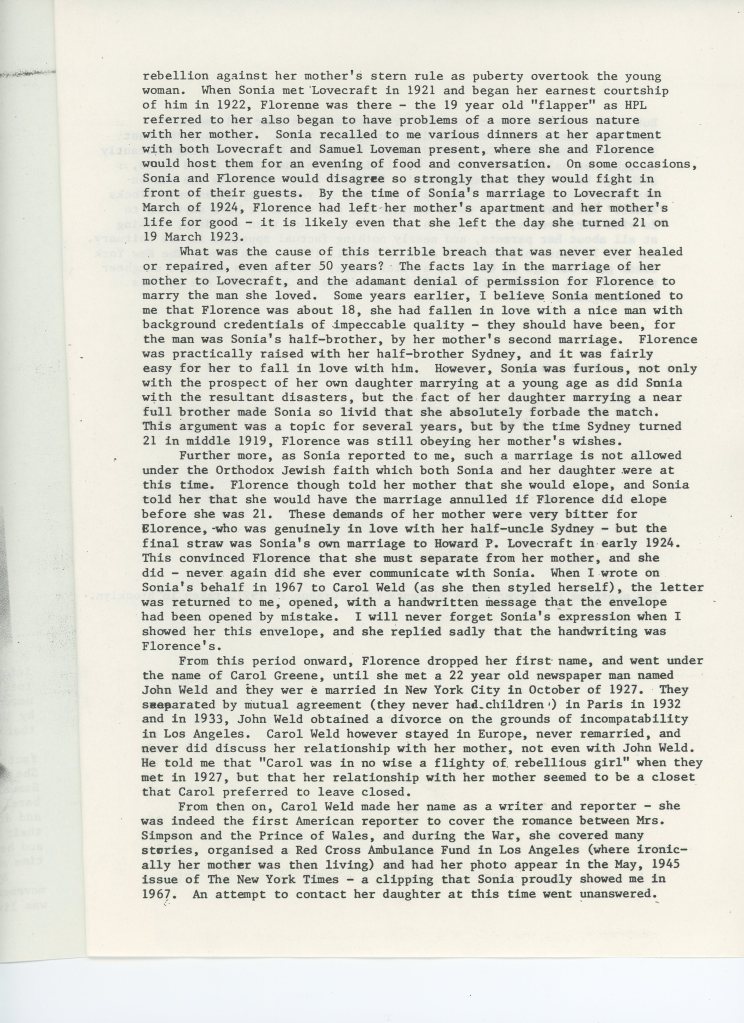

Transcript:
LOVECRAFT’S DAUGHTER
When Carol Weld died, the newspaper reported the following facts about her long life:
MRS. CAROL WELD, COVERED ABDICATION
Carol Weld, former foreign news correspondent, who claimed to be the first American to report the Prince of Wales-Wallis Simpson romance years before the Prince’s abdication as King Edward VIII, died Saturday in Cedars of Lebanon Hospital.
Mrs. Weld, 70, reported from Paris to The Chicago Tribune on the abdication. She was the only American reporter who met the Prince’s train at a small village railroad station as some 200 other newsmen, misled by offical-released [sic] rumors, waited miles away at Chaumont.
During her career, Mrs. Weld wrote for The New York American and The New York Herald-Tribune, the Paris staff of The Chicago Tribune, Universal and International News Services, United Press International and The London Sunday Express.
She came to Miami as southeastern director of advertising and publicity for RKO Radio Pictures, setting campaigns for RKO, Samuel Goldwyn and Walt Disney Productions.
Services will be at 10 a.m. Thursday in Miami Memorial Park. Reid-Lowe Funeral Home is handling arrangements.
Not only is the notice pitifully brief and lacking in factual information, but the information that was there is for the most part toally [sic] inaccurate. The inaccuracies were not, however, the fault of the newspaper or the author of the obituary, but were carefully perpetrated by the subject of the notice—Carol Weld. For Carol Weld had a secret that she protected and hid for over 50 years.
No mention is made above the parentage ofCarol [sic] Weld, who was in fact the daughter—albeit the step-daughter—of Howard Phillips Lovecraft. She was born Florence Carol Greene in New York City on 19 March 1902, of Samuel Greene and Sonia Haft Shafirkin. Her mother, Sonia Shafirkin, was barely 20 years old, and had been married for four years to her despotic and drunken husband, who was a salesman. Some years after the birth of their only child, Greene killed himself, leaving Sonia destitute—she and her daughter went to live with Sonia’s mother, who had married a second time and had children not much older than Florence.
By 1919, when Sonia first became acquainted with the Amateur Press movement and with James Ferdinand Morton, junior, her 17 year old daughter was living with her in New York City, and was beginning to show signs of rebellion against her mother’s stern rule as puberty overtook the young woman. When Sonia met Lovecraft in 1921 and began her earnest courtship of him in 1922, Florenne [sic] was there—the 19 year old “flapper” as HPL referred to her also began to have problems of a more serious nature with her mother. Sonia recalled to me various dinners at her apartment with both Lovecraft and Samuel Loveman present, where she and Florence would host them for an evening of food and conversation. On some occasions, Sonia and Florence would disagree so strongly that they would fight in front of their guests. By the time of Sonia’s marriage to Lovecraft in March of 1924, Florence had left her mother’s apartment and her mother’s life for good—it is likely even that she left the day she turned 21 on 19 March 1923.
What was the cause of this terrible breach that was never ever healed or repaired, even after 50 years? The facts lay in the marriage of her mother to Lovecraft, and the adamant denial of permission for Florence to marry the man she loved. Some years earlier, I believe Sonia mentioned to me that Florence was about 18, she had fallen in love with a nice man with background credentials of impeccable quality—they should have been, for the man was Sonia’s half-brother, by her mother’s second marriage. Florence was practically raised with her half-brother Sydney, [sic] and it was fairly easy for her to fall in love with him. However, Sonia was furious, not only with the prospect of her own daughter marrying at a young age as did Sonia with the resultant disasters, but the fact of her daughter marrying a near full brother made Sonia so livid that she absolutely forbade the match. This argument was a topic for several years, but by the time Sydney turned 21 in middle 1919, Florence was still obeying her mother’s wishes.
Further more, [sic] as Sonia reported to me, such a marriage is not allowed under the Orthodox Jewish faith which both Sonia and her daughter were at this time. Florence though told her mother that she would elope, and Sonia told her that she would have the marriage annulled if Florence did elope before she was 21. These demands of her mother were very bitter for Florence, who was genuinely in love with her half-uncle Sydney—but the final straw was Sonia’s own marriage to Howard P. Lovecraft in early 1924. This convinced Florence that she must separate from her mother, and she did—never again did she ever communicate with Sonia. When I wrote on Sonia’s behalf in 1967 to Carol Weld (as she then styled herself), the letter was returned to me, opened, with a handwritten message that the envelope had been opened by mistake. I will never forget Sonia’s expression when I showed her this envelope, and she replied sadly that the handwriting was Florence’s.
From this period onward, Florence dropped her first name, and went under the name of Carol Greene, until she met a 22 year old newspaper man named John Weld and they wer e [sic] married in New York City in October of 1927. They separated by mutual agreement (they never had children) in Paris in 1932 and in 1933, John Weld obtained a divorce on the grounds of incompatability [sic] in Los Angeles. Carol Weld however stayed in Europe, never remarried, and never discuss her relationship with her mother, not even with John Weld. He told me that “Carol was in no wise a flighty of rebellious girl” when they met in 1927, but that her relationship with her mother seemed to be a closet that Carol preferred to leave closed.
From then on, Carol Weld made her name as a writer and reporter—she was indeed the first American reporter to cover the romance between Mrs. Simpson and the Prince of Wales, and during the War, she covered many stories, organised a Red Cross Ambulance Fund in Los Angeles (where ironically her mother was then living) and had her photo appear in the May, 1945 issue of The New York Times—a clipping that Sonia proudly showed me in 1967. An attempt to contact her daughter at this time went unanswered.
But Sonia followed the career of her daughter from afar and seemed to have some idea of what she had done during the years. For about the last 30 years of her life, Carol Weld worked for RKO in Miami—and significantly enough, her half-brother Sydney was living there when Carol moved there, although he had married and raised a family. Surely this was the reason that Carol Weld moved to Florida—for over 30 years they lived only blocks apart. But, Carol never would contact her own mother or have anything to do with her, even after nearly a half-century. And when she died, nothing at all about her parents, and nearly nothing factual appeared in the obituary.
She was 77 years old when she died on 1 April 1979—even though The New York Times gave her age as 65. For a brief while, she had been nearly a daughter to Lovecraft, and from 1924 until her marriage to John Weld, she was his step-daughter.

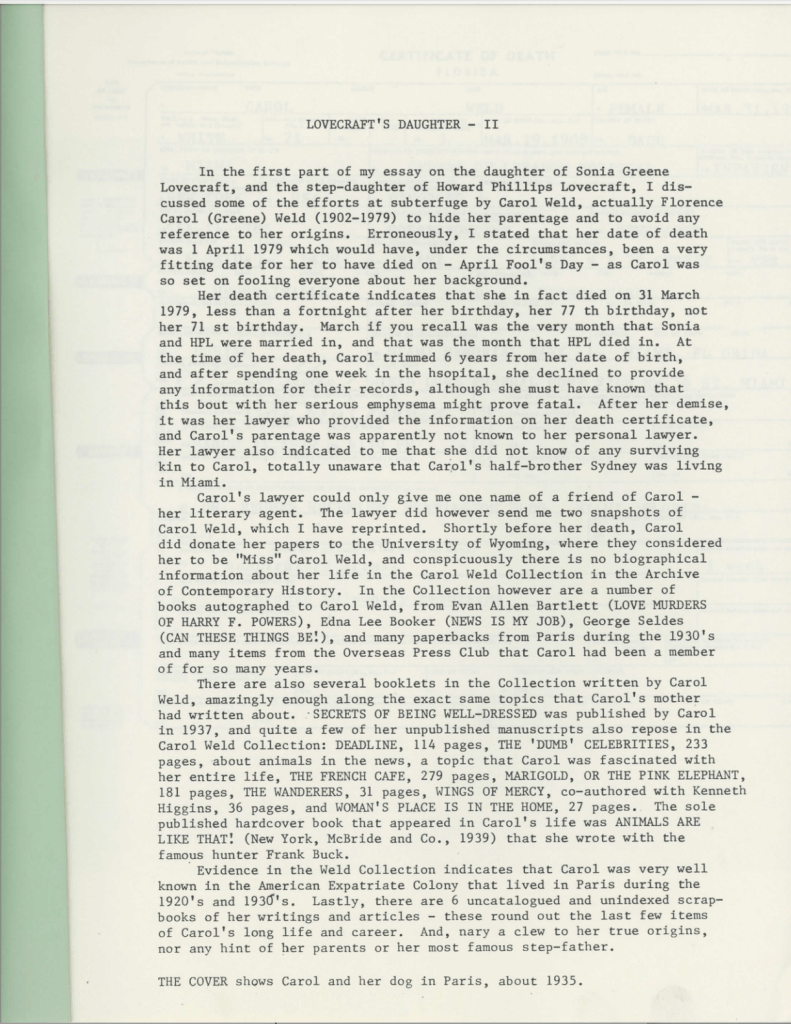
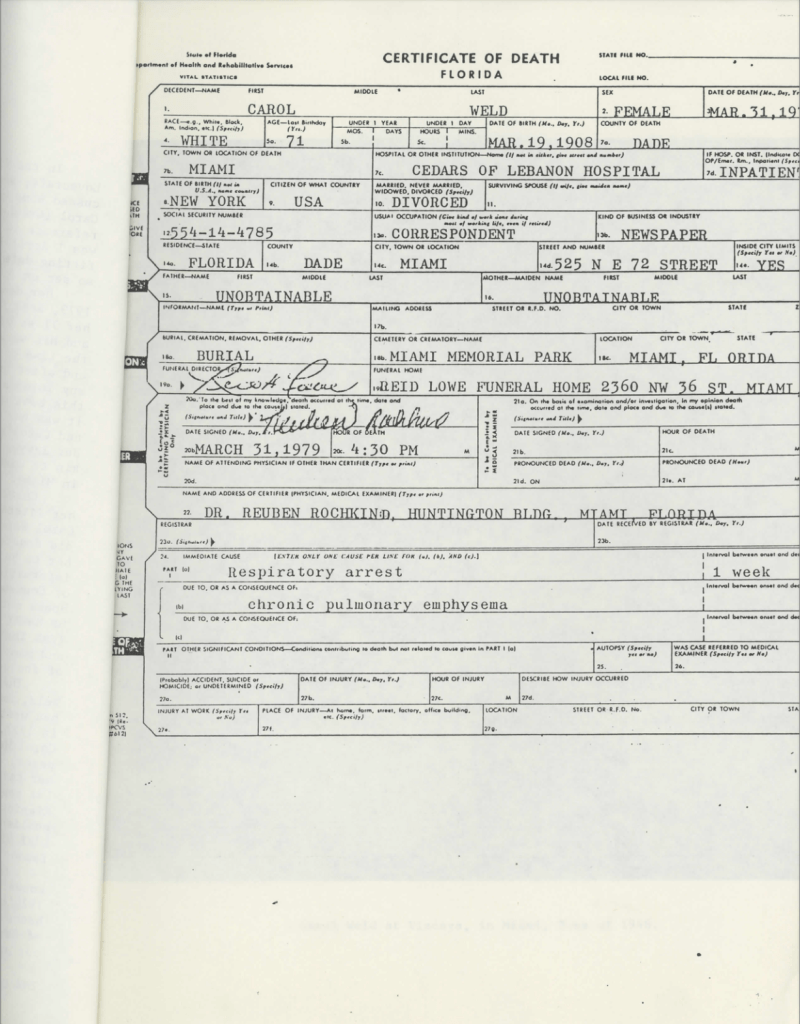
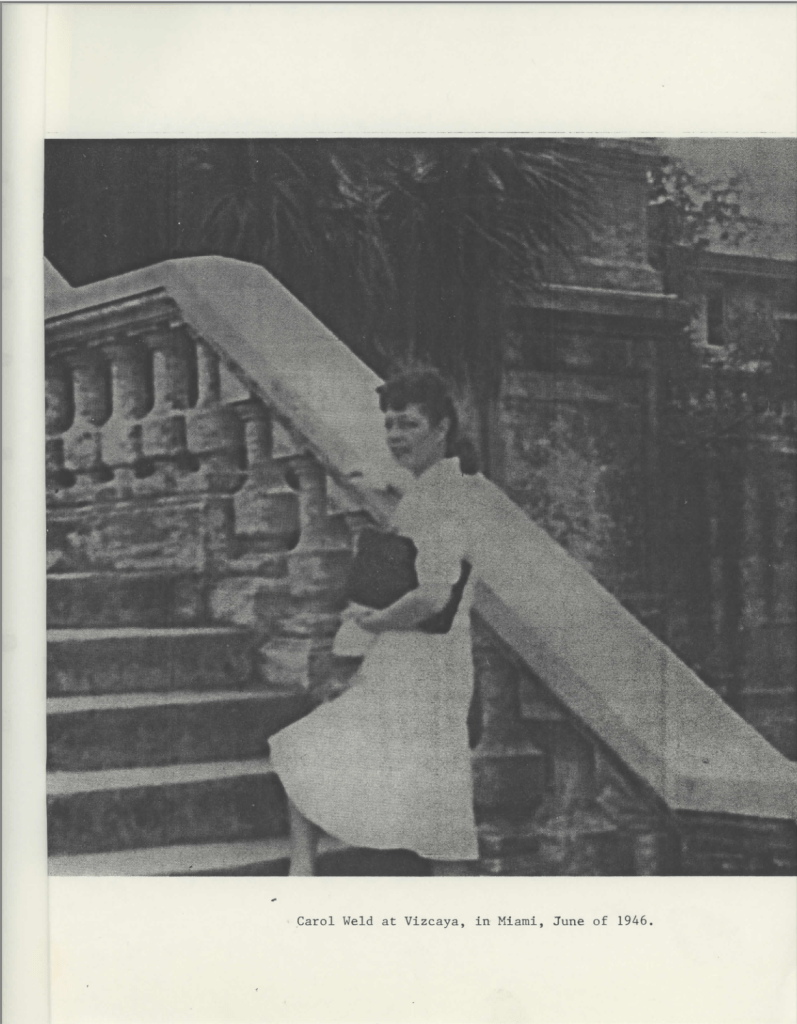
Transcript:
LOVECRAFT’S DAUGHTER – II
In the first part of my essay on the daughter of Sonia Greene Lovecraft, and the step-daughter of Howard Phillips Lovecraft, I discussed some of the efforts at subterfuge by Carol Weld, actually Florence Carol (Greene) Weld (1902 – 1979) to hide her parentage and to avoid any reference to her origins. Erroneously, I stated that her date of death was 1 April 1979 which would have, under the circumstances, been a very fitting date for her to have died on—April Fool’s Day— as Carol was so set on fooling everyone about her background.
Her death certificate indicates that she in fact died on 31 March 1979, less than a fortnight after her birthday, her 77 th [sic] birthday, not her 71 st [sic] birthday. March if you recall was the very month that Sonia and HPL were married in, and that was the month that HPL died in. At the time of her death, Carol trimmed 6 years from her date of birth, and after spending one week in the hsopital, [sic] she declined to provide any information for their records, although she must have known that this bout with her serious emphysema might prove fatal. After her demise, it was her lawyer who provided the information on her death certificate, and Carol’s parentage was apparently not known to her personal lawyer.
Her lawyer also indicated to me that she did not know of any surviving kin to Carol, totally unaware that Carol’s half-brother Sydney was living in Miami.
Carol’s lawyer could only give me one name of a friend of Carol—her literary agent. The lawyer did however send me two snapshots of Carol Weld, which I have reprinted. Shortly before her death, Carol did donate her papers to the University of Wyoming, where they considered her to be “Miss” Carol Weld, and conspicuously there is no biographical information about her life in the Carol Weld Collection in the Archive of Contemporary History. In the Collection however are a number of books autographed to Carol Weld, from Evan Allen Bartlett (LOVE MURDERS OF HARRY F. POWERS), Edna Lee Booker (NEWS IS MY JOB), George Seldes (CAN THESE THINGS BE!), and many paperbacks from Paris during the 1930’s and many items from the Overseas Press Club that Carol had been a member of for so many years.
There are also several booklets in the Collection written by Carol Weld, amazingly enough along the exact same topics that Carol’s mother had written about. SECRETS OF BEING WELL-DRESSED was published by Carol in 1937, and quite a few of her unpublished manuscripts also repose in the Carol Weld Collection: DEADLINE, 114 pages, THE ‘DUMB’ CELEBRITIES, 233 pages, about animals in the news, a topic that Carol was fascinated with her entire life, THE FRENCH CAFE, 279 pages, MARIGOLD, OR THE PINK ELEPHANT, 181 pages, THE WANDERERS, 31 pages, WINGS OF MERCY, co-authored with Kenneth Higgins, 36 pages, and WOMAN’S PLACE IS IN THE HOME, 27 pages. The sole published hardcover book that appeared in Carol’s life was ANIMALS ARE LIKE THAT! (New York, McBride and Co., 1939) that she wrote with the famous hunter Frank Buck.
Evidence in the Weld Collection indicates that Carol was very well known in the American Expatriate Colony that lived in Paris during the 1920’s and 1930’s. Lastly, there are 6 uncatalogued and unindexed scrapbooks of her writings and articles—these round out the last few items of Carol’s long life and career. And, nary a clew [sic] to her true origins, nor any hint of her parents or her most famous step-father.
This is the first source, and perhaps the only source, in which we get this theory of Florence being in love with her uncle, Sidney Moseson—Sonia’s half-brother. I can’t neither accept nor deny this notion to be true, only because Sonia never claimed it to be the reason why they had their fallout. However, Sonia had been interviewed by Everts, and she had spent enough time with him that just maybe this theory was a hard truth she revealed in confidence. There’s also the likelihood of a slight confusion since Sidney had fallen in love and married a young woman named Florence Stone on March 25, 1923. (FamilySearch) Could Everts have easily confused one Florence for another? Probably or probably not. One thing is true: Carol had moved down to Miami, which was not far from Sidney and his family. However, this doesn’t mean she was in love with him but could easily mean she valued him as her closest family. They were practically raised together.
Another interesting anecdote is the argument between Sonia and Florence while Lovecraft and Samuel Loveman were visiting. The only time this incident could’ve occurred with both Samuel Loveman and H.P. Lovecraft around was in April 1922. Sonia had initially invited Loveman to visit New York, and when he did, but did not find it enticing enough to stay, she invited Lovecraft to keep him company. Sonia had turned over her place to them, while she stayed over at her neighbor’s home. This could mean that Florence had also joined Sonia in staying with their neighbor or somewhere else at a friend’s house, or Florence had already moved out, but was still visiting Sonia. Sadly, we’ll never knew what drove these two women to disagree with one another to the point of argument in front of others.
After marrying, John and Carol Weld moved to Paris. In a set of three letters to R. Alain Everts, John Weld gives insight to his relationship with Carol:

Transcript:
Dear Mr. Kirsch:
You might be able to locate Carol Weld through the Overseas Press Club, 54 West 40th st., New York I8, N.Y. I believe she was a founding member and I would presume she still belongs to the organization.
I never did know Carol’s mother, though I believe she lived in Brooklyn while Carol and I were living in Manhattan. There seemed to have been some estrangement between them. I’m afraid I do not have any photograph of Carol, mainly because, when we separated in Paris, in 1932 I left all of my possessions with her. I have not seen her since.
We were married in New York in October, 1927, as I recall, though the exact date I do not remember. My birthdate is February 24, 1905, and you may find some biographical material in Who’s Who in the West. Carol and I had no children. Our separation was by mutual agreement and I was granted a divorce on the grounds of incompatibility in Los Angeles in 1933. So far as I know Carol has not remarried, but then I would not have known of it if she had probably.
It interests me that you are writing the biography of Carol’s mother. Was (is) she someone of note?
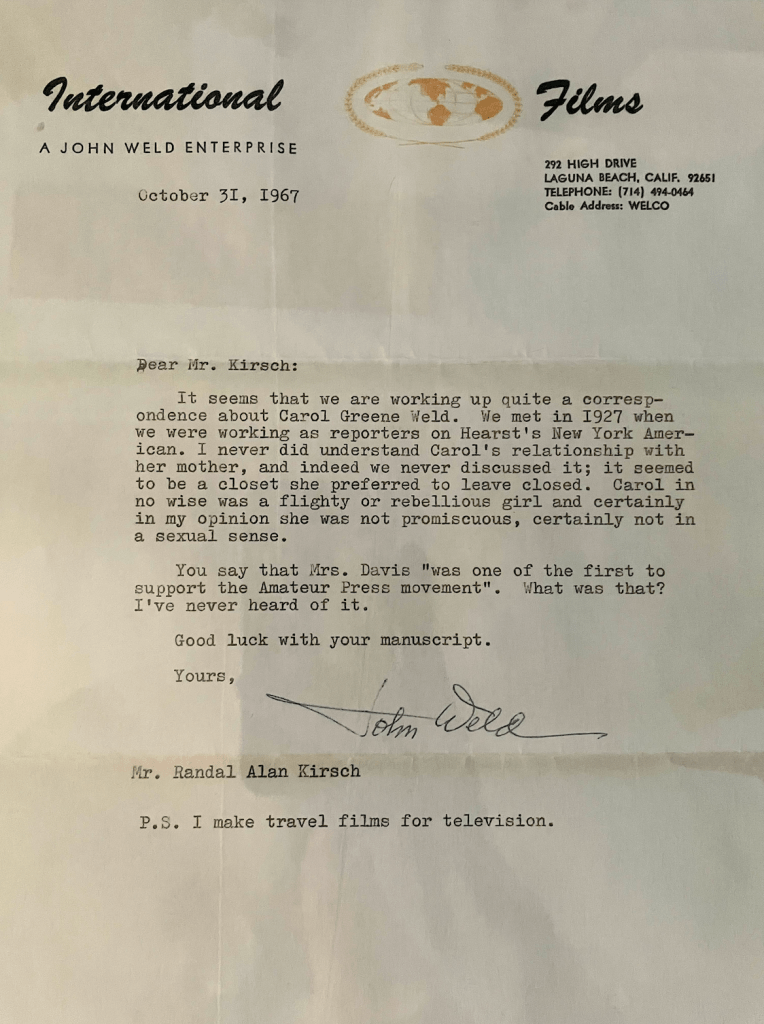
Transcript:
Dear Mr. Kirsch:
It seems that we are working up quite a correspondence about Carol Greene Weld. We met in 1927 when we were working as reporters on Hearst’s New York American. I never did understand Carol’s relationship with her mother, and indeed we never discussed it; it seemed to be a closet she preferred to leave closed. Carol in no wise was a flighty or rebellious girl and certainly in my opinion she was not promiscuous, certainly not in a sexual sense.
You say that Mrs. Davis “was one of the first to support the Amateur Press movement”. What was that? I’ve never heard of it.
Good luck with your manuscript.

Transcript:
Dear Mr. Kirsch:
Do drop in when you’re down this way. Better call me though before you come.
Knowing Carol’s attitude toward her mother, I am not surprised that she refuses to cooperate with you. No, I do not have any photographs of Carol—as I told you, when I left Paris in 1932 I left all of my personal effects with her. However, my sister may have a snapshot or so. I’ll ask her.
Carol does appear to have remained in Europe until 1936, after which she went back and forth from the U.S. to Europe throughout 1936 and into 1937. (FamilySearch, 1936, 1937) Perhaps their failed marriage was a result of incompatibility, but Sonia believed it was her bad attitude that ruined the marriage. As mentioned before, it’s quite possible Carol had a temper, and when you have snippets such as the following newspaper clipping, it’s easy to see her strong will and force at play.
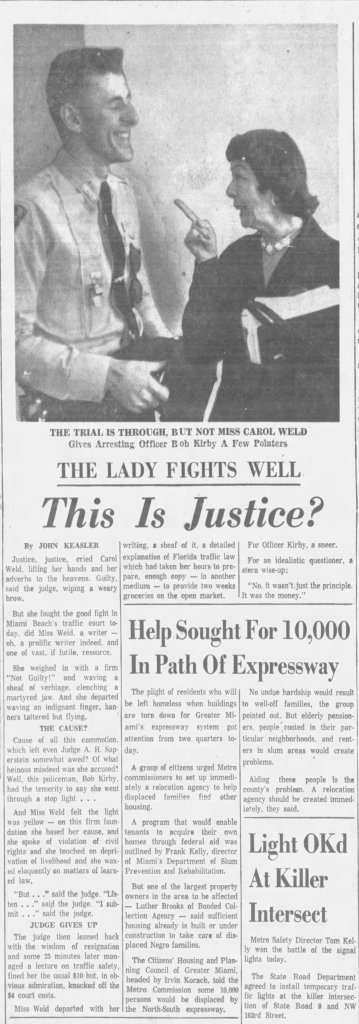
Transcript:
(Photo Caption: “The trial is through, but not Miss Carol Weld. Gives arresting officer Bob Kirby a few pointers.”)
The Lady Fights Well
This is Justice?
Justice, justice, cried Carol Weld, lifting her hands and her adverbs to the heavens. Guilty, said the judge, wiping a weary brow.
But she fought the good fight in Miami Beach’s traffic court today, did Miss Weld, a writer—oh, a prolific writer indeed, and one of vast, if futile, resource.
She weighed in with a firm “Not Guilty!” and waving a sheaf of verbiage, clenching a martyred jaw. And she departed waving an indignant finger, banners tattered but flying.
The Cause?
Cause of all this commotion, which left even Judge A.H. Saperstein somewhat awed? Of what heinous misdeed was she accused? Well, this policeman, Bob Kirby, had the temerity to say she went through a stop light…
And Miss Weld felt the light was yellow—on this firm foundation she based her cause, and she spoke of violation of civil rights and she touched on deprivation of livelihood and she waxed eloquently on matters of learned law.
“But…” said the judge. “Listen…” said the judge. “I submit…” said the judge.
Judge Gives Up
The judge then leaned back with the wisdom of resignation and some 25 minutes later managed a lecture on traffic safety, fined her the usual $10 but, in obvious admiration, knocked off the $4 court costs.
Miss Weld departed with her writing, a sheaf of it, a detailed explanation of Florida traffic law which had taken her hours to prepare, enough copy—in another medium—to provide two weeks groceries on the open market.
For Officer Kirby, a sneer.
For an idealistic questioner, a stern wise-up:
“No, it wasn’t just the principle. It was the money.”
Throughout the years, Sonia never gave up searching for Carol. In the summer or fall of 1926, Sonia got a job in Chicago. While she claimed the job paid better, Sonia also believed getting the job would help her find Carol, since she thought her daughter was living there at the time. Sadly, Sonia was not aware of the whole truth regarding that bit of information: Carol was working for the Chicago Tribune, but in Paris—not in Chicago. Apparently, though, Sonia’s nephew, Martin K. Kopp mentioned something about a possible meeting in San Francisco between the two women:
I also heard that Sonia located Florence, who, as I remember it, was living in the San Francisco area. This was after World War II. They finally met. It was a disaster, and Sonia returned to the Los Angeles area, and never discussed the matter again.
Martin H. Kopp, “Memories of Sonia H. Greene Davis”, The Lovecraft Annual, p. 30.
Sonia never mentioned or wrote about meeting Florence in San Francisco after World War II. She did, however, elaborate on a job she got in San Francisco where she stayed there from 1935 to 1936. Perhaps Sonia mixed the years, or she actually made a second trek to San Francisco to meet Florence.
The truth of the matter is we will never know.

Transcript:
Carol Weld, Writer, Is Avisiting
By Dot Tellitall
There is a lass in our town and she’s had wondrous fun… She’s avisiting with Jane Dixon Wells, and she has had the kind of experiences that make our mouth water. Her name is Carol Weld, and she is on leave from being a foreign newspaper correspondent.
Most of Carol’s experiences were picked up somewhere in France, where she worked for the Chicago Tribune and the United Press during all those exciting months before the war. When she was quizzed about her keen nose for news, she modestly gave all the credit to her dog, “Ric,” a smooth-haired fox terrier, now deceased, who covered all her assignments with her.
“He was really a news hound,” said Carol, “and usually beat me to most of my stories.” One of the chief methods of getting news in Paris is to make the rounds of all the swank bars where the continental American hangs out and which are hodge-podges for news. “Ric” knew the bars as well as his mistress and knew the sequence in which she took them in, so he often used to precede her to each bar. When people saw the dog they would know that Carol was coming along and she turned up usually about a half-hour behind him. “Ric,” said Carol, “interviewed all the famous people in Paris.” It is a very delicate subject, that of poor little “Rickie’s” death by an automobile.
She’s Also An Author
Carol Weld is the co-author with Frank Buck of a popular book called “Animals Are Like That.” She also is one of the twenty famous newspaper people, like H.V. Kaltenborn, who each contributed a chapter to the best seller, “The Inside Story.” Carol’s chapter is called “King Bites Dog.” She expects to be in Louisville about a week. She’s young and pretty and particularly is enjoying Kentucky food.
Don’t look now, Palmer Van Arsdale, ’cause here’s a picture of the little woman, Carolyn, having lunch with a friend in Los Angeles. She certainly looks well.
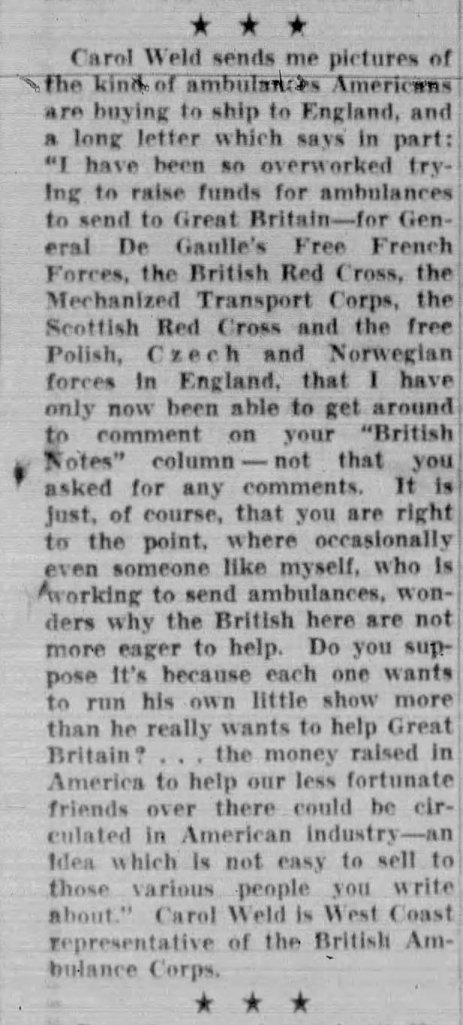
Transcript:
Carol Weld sends me pictures of the kinds of ambulances Americans are buying to ship to England, and a long letter which says in part: “I have been so overworked trying to raise funds for ambulances to send to Great Britain—for General De Gaulle’s Free French Forces, the British Red Cross, the Mechanized Transport Corps, the Scottish Red Cross and the free Polish, Czech and Norwegian forces in England, that I have only now been able to get around to comment on your “British Notes” column—not that you asked for any comments. It is just, of course, that you are right to the point, where occasionally even someone like myself, who is working to send ambulances, wonders why the British here are not more eager to help. Do you suppose it’s because each one wants to run his own little show more than he really wants to help Great Britain?… the money raised in America to help our less fortunate friends over there could be circulated in American industry—an idea which is not easy to sell to those various people you write about.” Carol Weld is West Coast representative of the British Ambulance Corps.
We will never know what truly broke the bond between Sonia and Florence. There was undealt trauma between them, beyond them, and maybe that’s just what caused the division. Maybe Sonia wanted humble beginnings and opportunities, while Carol wanted the whole world on a platter, and that in itself is reason for clashing. At the end of the day, though, Florence wanted to distance herself from her parents, from her past, choosing a new identity, a new self, where she could be whoever she wished. As a result of that decision, we are left with such a scarcity of biographical means that makes it impossible to get to knew her fully like we know her mother, and even her stepfather.
If you wish to learn more about Carol Weld, her papers are located in the University of Wyoming. The collection contains the correspondence and writings of Carol, but half of it is in French. You may read the overview of the collection by clicking on the link below:
Carol Weld Papers, 1904 – 1979
I would like to thank Bobby Derie for the scans of Lovecraft’s Daughter. I greatly appreciate it!
 The Papers of Sonia H. Davis
2 responses to “Florence Carol Greene”
[…] has been blogging extensively over the summer, and now on into the autumn with a long new post on Lovecraft’s daughter by marriage. Especially note the long research-heavy posts “Dear Mrs. Greene” Part I […]
LikeLike
[…] sketches which magnified certain phases of Sonia’s life, such as her relationship with Florence Carol Greene, her correspondence with both Samuel Loveman and Alfred Galpin, her time as a historical […]
LikeLike