Soundtrack: Oppenheimer (Original Motion Picture Soundtrack) by Ludwig Göransson.

Please do convey my love and aloha to Mother Davis—I always have and will have my warm regards for her.
Kilsoo K. Haan to Nathaniel A. Davis, October 4, 1942, John Hay Library, Providence, R.I.
One would think spy espionage had little (or even nothing) to do with Sonia’s life. After all, what proper and furtive means would a milliner have to fight terrorism? (Although it does sound like a great novel idea!) Believe it or not, espionage did, indeed, cross over into Sonia’s life, if only by the degrees of a friendship. Because, you know, a true friend holds bomb strike charts without asking any questions!
In Two Hearts That Beat as One, Sonia elaborated on one very unique meeting:
During the latter part of 1939, Nathaniel and Sonia attended a public lecture given by a Korean. Nathaniel was very interested that he invited the Korean to dinner one day and told him that he had an organization that was ready to help all oppressed peoples. He told him about “Planetaryan”. The Korean became a member without any cost to him!
Sonia H. Davis, Two Hearts That Beat as One, p. 178.
The Korean was Kilsoo Kenneth Haan.
In the original autobiographical manuscripts, Kilsoo Haan was simply rendered as “K.H.”. Sonia was known for changing people’s name. In this case, it was warranted why she would’ve kept his identity a mystery, given he was a literal spy and also her friend. In one passage however, she slipped and wrote his first name, making it a little easier for me to ultimately identify him.
Upon further study of Kilsoo’s papers in Santa Cruz, California (physically), and Nathaniel’s papers in Providence (virtually), I’ve learned Kilsoo was a genuine friend to Nathaniel and Sonia. While his papers do not contain any letters from Nathaniel or Sonia, in the Sonia H. Davis and Nathaniel A. Davis Papers does contain a wealth of correspondence between Kilsoo and Nathaniel, and even letters between Kilsoo and political figures.
We know who he was to Nathaniel and Sonia, but who was Kilsoo Haan really?
Kilsoo Kenneth Haan was born in Chang Dan, Korea, on May 31, 1900. He arrived in Honolulu, Hawaii, at age 5, and soon was working as a sugar cane laborer for the Oahu Sugar Company. After completing the 8th grade, he contracted to raise sugar cane for the Company, while training in the Hawaiian National Guard. After an honorable discharge, Haan moved to San Francisco. There he attended the Salvation Army Training College. Between 1922 and 1926 he served in the Salvation Army as an officer, reaching the rank of Captain, and was stationed back on the Hawaiian Islands. In 1926 he married Stella Yoon in Honolulu, with whom he had a son and a daughter. In 1932 he joined the Sino-Korean Peoples’ League, acting as its representative in Hawaii and America, and began working to assist U.S. intelligence concerning Japan. Between 1938 and 1947 he resided in Washington, D.C., as the Washington representative of the League. He is famous for having attempted to warn various American officals [sic] shortly before the Japanese bombing of Pearl Harbor of the impending attack. Haan became a naturalized United States citizen in 1956. He worked for the Chun King Corporation in San Jose, California, from the mid- 1950’s until 1969. Upon his retirement he moved to Capitola, a seaside village near Santa Cruz, where he died in July, 1976.
“Background”, Guide to the Kilsoo Haan Papers, 1933 – 1973, Online Archive of California.
Although Sonia claimed it was the “latter part of 1939” when they attended Kilsoo’s public lecture, the earliest letter between Kilsoo and Nathaniel was March 28, 1939.
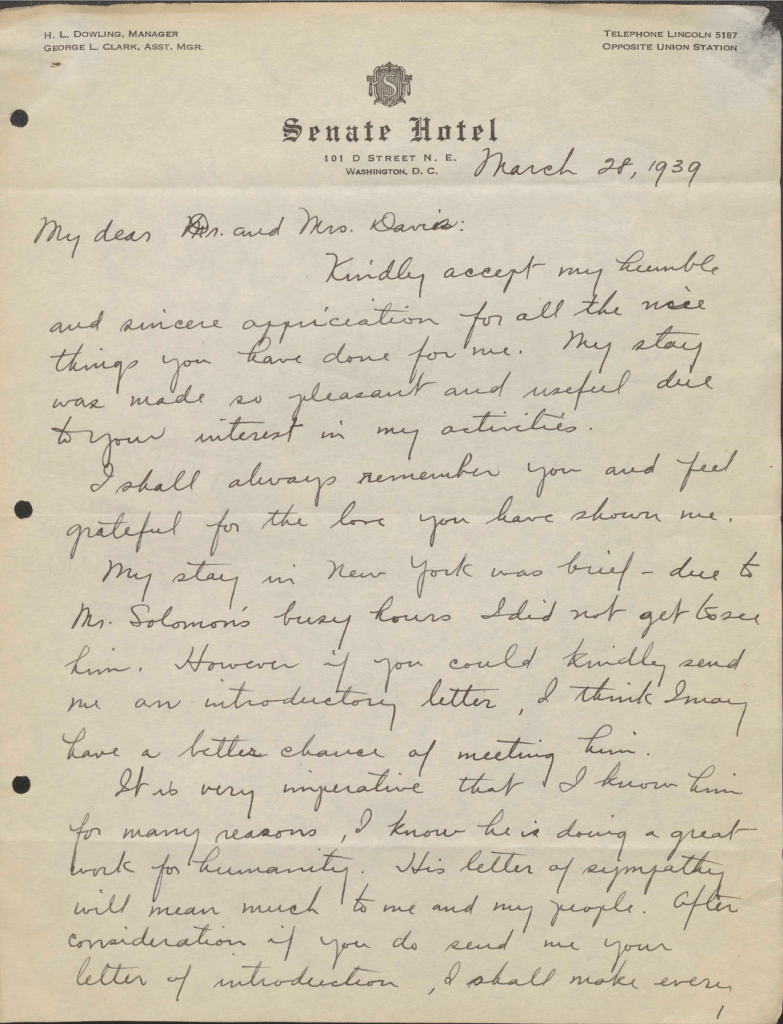

Letter Source: Sonia H. and Nathaniel A. Davis papers (MS.2021.003), Series 2. Nathaniel A. Davis, 1918 – 1964, Series 2. Subseries. Correspondence, 1931 – 1948, Box 1, Folder 38 1930 – 1939, John Hay Library, Providence, R.I.
Transcript:
March 28, 1939
My dear Mr./Dr. and Mrs. Davis:
Kindly accept my humble and sincere appreciation for all the nice things you have done for me. My stay was made so pleasant and useful due to your interest in my activities.
I shall always remember you and feel grateful for the love you have shown me.
My stay in New York was brief—due to Mr. Solomon’s busy hours I did not get to see him. However if you could kindly send me an introductory letter, I think I may have a better chance of meeting him.
It is very imperative that I know him for many reasons, I know he is doing a great work for humanity. His letter of sympathy will mean much to me and my people. After consideration if you do send me your letter of introduction, I shall make every effort to see him and get acquainted with him.
If you can possibly write him and pave the way for me, it would be much easier for me.
I know I am asking much of you and yet I feel I can call upon you for an understanding and cooperation.
I have been so drawn unto you and Mrs. Davis—I don’t know what is the chief attraction, yet it is so—which make me to have faith in your judgment and call on you when in need of such advise [sic] and favor.
Thus far I am laying a good foundation in Washington D.C. and soon hope to carry on my work effectively.
God is with us and so long I am on His side I know I will win.
Enclosed please find a photograph and a photostat. It is self-explanatory.
God bless you and Mrs. Davis.
Sincerely Yours
Kilsoo K. Haan
(Letter was sent at once S.H.D)
There aren’t any letters prior to this date between Kilsoo and Nathaniel, although it’s apparent we’re missing Nathaniel’s initial letter to Kilsoo. It’s very likely Nathaniel and Sonia attended the “public lecture given by a Korean” early 1939, or late 1938. Either way, the lecture forged a bond between the spy and the milliner and her husband. Sonia was by this point very involved in philanthropy, exceptionally outspoken about equality between ethnicities. This was an attribute that was sprung forth by Nathaniel, who was the founder of American Defense Society [Planetaryan] of the United States—a humanitarian organization.
Nathaniel and Sonia had mutual ground with Kilsoo: they sought to improve the welfare of others. When they heard Kilsoo’s message, they believed in the cause and without a second thought, did anything and everything within their power to bring awareness. As a result of his organization, Nathaniel had some pull in political circles, and so he wrote letters of recommendation to his contacts regarding Kilsoo, bringing additional awareness to Kilsoo’s cause:
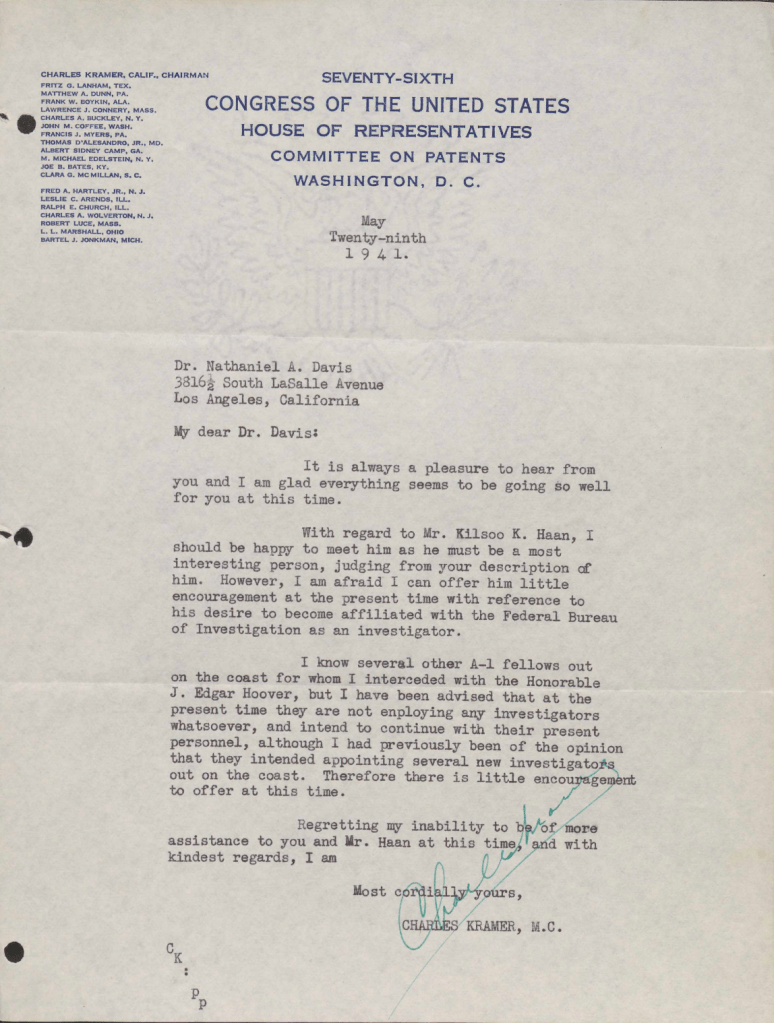
Letter Source: Sonia H. and Nathaniel A. Davis papers (MS.2021.003), Series 2. Nathaniel A. Davis, 1918 – 1964, Series 2. Subseries. Correspondence, 1931 – 1948, Box 1, Folder 39 1940 – 1941, John Hay Library, Providence, R.I.
Transcript:
May
Twenty-ninth
1941.
Dr. Nathaniel A. Davis
3816 1/2 South LaSalle [sic] Avenue
Los Angeles, California
My dear Dr. Davis:
It is always a pleasure to hear from you and I am glad everything seems to be going so well for you at this time.
With regard to Mr. Kilsoo K. Haan, I should be happy to meet him as he must be a most interesting person, judging from your description of him. However, I am afraid I can offer him little encouragement at the present time with reference to his desire to become affiliated with the Federal Bureau of Investigation as an investigator.
I know several other A-1 fellows out on the coast for whom I interceded with the Honorable J. Edgar Hoover, but I have been advised that at the present time they are not enploying [sic] any investigators whatsoever, and intend to continue with their present personnel, although I had previously been of the opinion that they intended appointing several new investigators out on the coast. Therefore there is little encouragement to offer at this time.
Regretting my inability to be of more assistance to you and Mr. Haan at this time, and with kindest regards, I am
Most cordially yours,
Charles Kramer, M.C.
Years 1939 – 1940

Letter Source: Sonia H. and Nathaniel A. Davis papers (MS.2021.003), Series 2. Nathaniel A. Davis, 1918 – 1964, Series 2. Subseries. Correspondence, 1931 – 1948, Box 1, Folder 38 1930 – 1939, John Hay Library, Providence, R.I.
Transcript:
My dear Dr. Davis:
I thank you so much for your prompt answer and also for the letter of introduction to Dr. Solomon. It was very nice of you to favor me with these requests.
Please convey my best wishes to Mrs. Davis.
I shall do my best to do what I can to carry out the work as previously stated.
God bless you.
Yours truly,
Kilsoo K. Haan
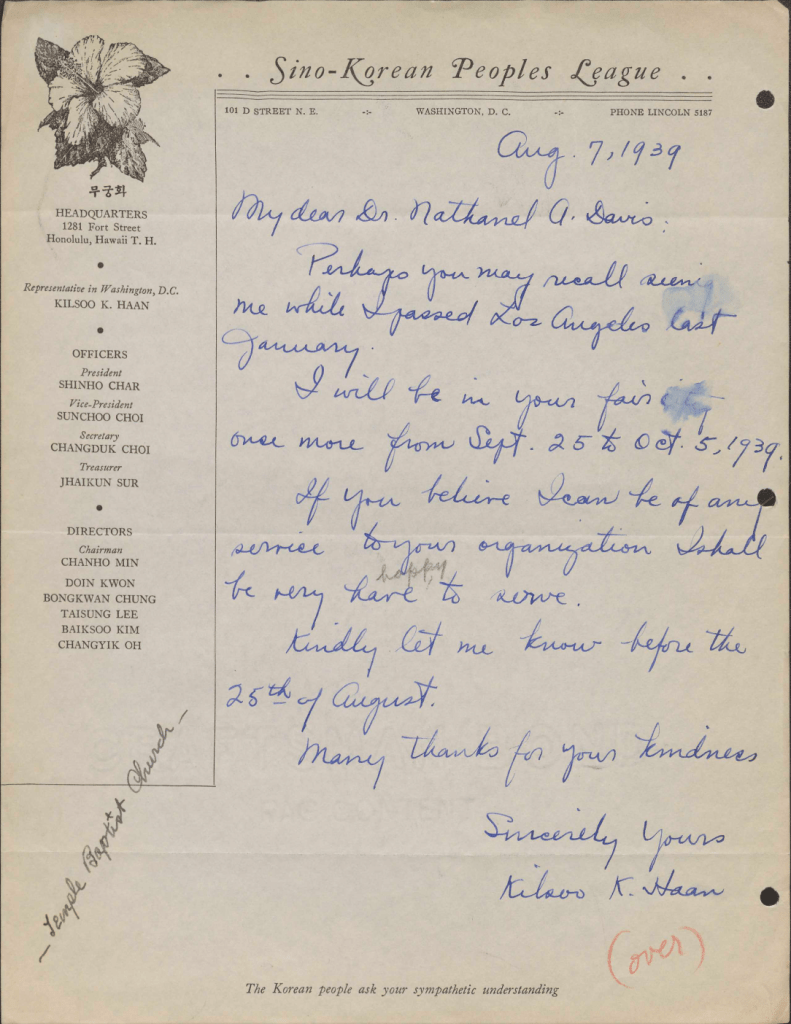
Letter Source: Sonia H. and Nathaniel A. Davis papers (MS.2021.003), Series 2. Nathaniel A. Davis, 1918 – 1964, Series 2. Subseries. Correspondence, 1931 – 1948, Box 1, Folder 38 1930 – 1939, John Hay Library, Providence, R.I.
Transcript:
Aug. 7, 1939
My dear Dr. Nathaniel A. Davis:
Perhaps you may recall seeing me while I passed Los Angeles last January.
I will be in your fair city once more from Sept. 25 to Oct. 5, 1939.
If you believe I can be of any service to your organization I shall be very have [sic] (^happy) to serve.
Kindly let me know before the 25th of August.
Many thanks for your kindness
Sincerely yours
Kilsoo K. Haan

Letter Source: Sonia H. and Nathaniel A. Davis papers (MS.2021.003), Series 2. Nathaniel A. Davis, 1918 – 1964, Series 2. Subseries. Correspondence, 1931 – 1948, Box 1, Folder 38 1930 – 1939, John Hay Library, Providence, R.I.
Transcript:
August 14, 1939
Mr. Kilsoo K. Haan
101 D.St., [sic] N.E.
Washington D.C.
Dear friend Haan: —
We were more than pleased to hear again from you, and especially to note that you are likely soon to be again in Los Angeles.
Since you went East, we have, as you will see by the reply address, moved to more convenient quarters, and much nearer to the offices of the Sino-Korean league.
If in any small way, we have been of any service to you or helped you to attain your objectives in Washington, to have done that is reward enough; my only regret is that we could have not done more.
Before you leave Washington, I would very much like to have you see Mr. John Dockweiler, at the Shoreham Hotel. He was formerly one of our Los Angeles Congressmen and now has an official position in the Capital. His family ranks high in the Democratic Party. His father is one of our ranking men in the party. His brother the Hon. George Dockweiler is a Judge on the Superior Court bench. It may be well worth your while to confer with him. Make an appointment over the telephone saying that I asked to to [sic] do this.
Waiting with pleasant anticipation to see you,
Cordially yours,
Dr. Nathaniel A. Davis

Letter Source: Sonia H. and Nathaniel A. Davis papers (MS.2021.003), Series 2. Nathaniel A. Davis, 1918 – 1964, Series 2. Subseries. Correspondence, 1931 – 1948, Box 1, Folder 34 1938 – 1940, John Hay Library, Providence, R.I.
Transcript:
Aug. 9, 1940
My dear Dr. Davis:
Please forgive my neglectfulness. How are you and Mrs. Davis? I trust both of you are healthy and happy in your good work.
I will be in Los Angeles from the first of Sept. to Oct. 10—
Would it be possible for you to arrange an opportunity of meeting some National Defence minded organization during my stay there?
I shall be only too happy to do what I can to make it a happy and enlightening meeting.
My topics will be—
- New Order in Asia?
- National Defence and You
- Young People’s Problem

Letter Source: Sonia H. and Nathaniel A. Davis papers (MS.2021.003), Series 2. Nathaniel A. Davis, 1918 – 1964, Series 2. Subseries. Correspondence, 1931 – 1948, Box 1, Folder 34 1938 – 1940, John Hay Library, Providence, R.I.
Transcript:
August 19, 1940
Mr. Kilsoo Haan
Senate Hotel
Washington, D.C.
My dear friend Haan,
Both Mrs [sic] Davis and I were glad to receive you [sic] note indicating that after so long a stay in Washington you are about to return to this city for awhile.
I immediately began to make enquiries as to the probability that we might be able to make use of your services in the presentation of your message backed up by your special experience during your stay here.
I am convinced that it is practicable to do this in an adequate way; but inorder [sic] to satisfy those with whom we must co-operate it has been suggested that you give us for publicity purposes and their satisfaction, a resume of your background, accomplishments, attitude to ward [sic] vital American ideals in absolute opposition to Communism, Fascism, Nazism, Atheism, and all subversive movements, and especially your experiences in Washington as you have pressed the cause of justice for suffering Korea and tortured China.
For my own part, this is not needed. I know your standing on these matters. But to do aqequately [sic] that which is in your heart, it will help mightily to go on record. So do not delay in sending to me as much material as you can, sending your reply by air mail. Then we can act. All the rest can be done I am sure.
As ever, looking forward to seeing you,
Very cordially yours
DR. NATHANIEL A. DAVIS
Kilsoo, being a representative of the Sino-Koreans’ People League, strove hard to bring rights to Koreans in America and also in Hawaii. The following letters show a brief example of what he sought to accomplish, and managed to do so:

Letter Source: Sonia H. and Nathaniel A. Davis papers (MS.2021.003), Series 2. Nathaniel A. Davis, 1918 – 1964, Series 2. Subseries. Correspondence, 1931 – 1948, Box 1, Folder 42 1931 – 1942, John Hay Library, Providence, R.I.
Transcript:
March 16, 1939
Mr. Kilsoo K. Haan
1281 Fort Street
Honolulu, Hawaii
Dear Mr. Haan:
I am very happy to send this message to the Sino-Korean People’s League. I have learned of the excellent work you have been doing, and feel that a group such as yours can do a great deal toward the awakening of democracies to the struggle for Korean Independence and the development of an interest in the Korean people.
I congratulate you and wish you continued success.
Very sincerely yours,
Newbold Morris
Acting Mayor
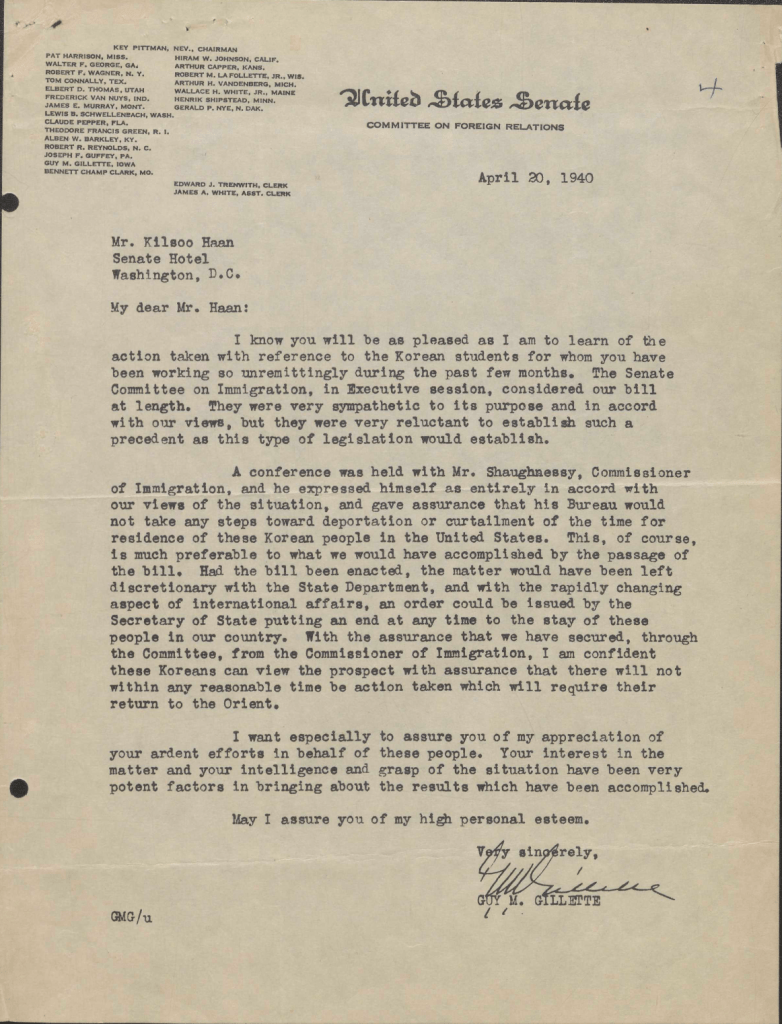
Letter Source: Sonia H. and Nathaniel A. Davis papers (MS.2021.003), Series 2. Nathaniel A. Davis, 1918 – 1964, Series 2. Subseries. Correspondence, 1931 – 1948, Box 1, Folder 42 1931 – 1942, John Hay Library, Providence, R.I.
Transcript:
April 20, 1940
Mr. Kilsoo Haan
Senate Hotel
Washington, D.C.
My dear Mr. Haan:
I know you will be as pleased as I am to learn of the action taken with reference to the Korean students for whom you have been working so unremittingly during the past few months. The Senate Committee on Immigration, in Executive session, considered our bill at length. They were very sympathetic to its purpose and in accord with our views, but they were very reluctant to establish such a precedent as this type of legislation would establish.
A conference was held with Mr. Shaughnessy, Commissioner of Immigration, and he expressed himself as entirely in accord with our views of the situation, and gave assurance that his Bureau would not take any steps toward deportation or curtailment of the time for residence of these Korean people in the United States. This, of course, is much preferable to what we would have accomplished by the passage of the bill. Had the bill been enacted, the matter would have been left discretionary with the State Department, and with the rapidly changing aspect of international affairs, an order could be issued by the Secretary of State putting an end at any time to the stay of these people in our country. With the assurance that we have secured, through the Committee, from the Commissioner of Immigration, I am confident these Koreans can view the prospect with assurance that there will not within any reasonable time be action taken which will require their return to the Orient.
I want especially to assure you of my appreciation of your ardent efforts in behalf of these people. Your interest in the matter and your intelligence and grasp of the situation have been very potent factors in bringing about the results which have been accomplished.
May I assure you of my high personal esteem,
Very sincerely,
Guy M. Gillette
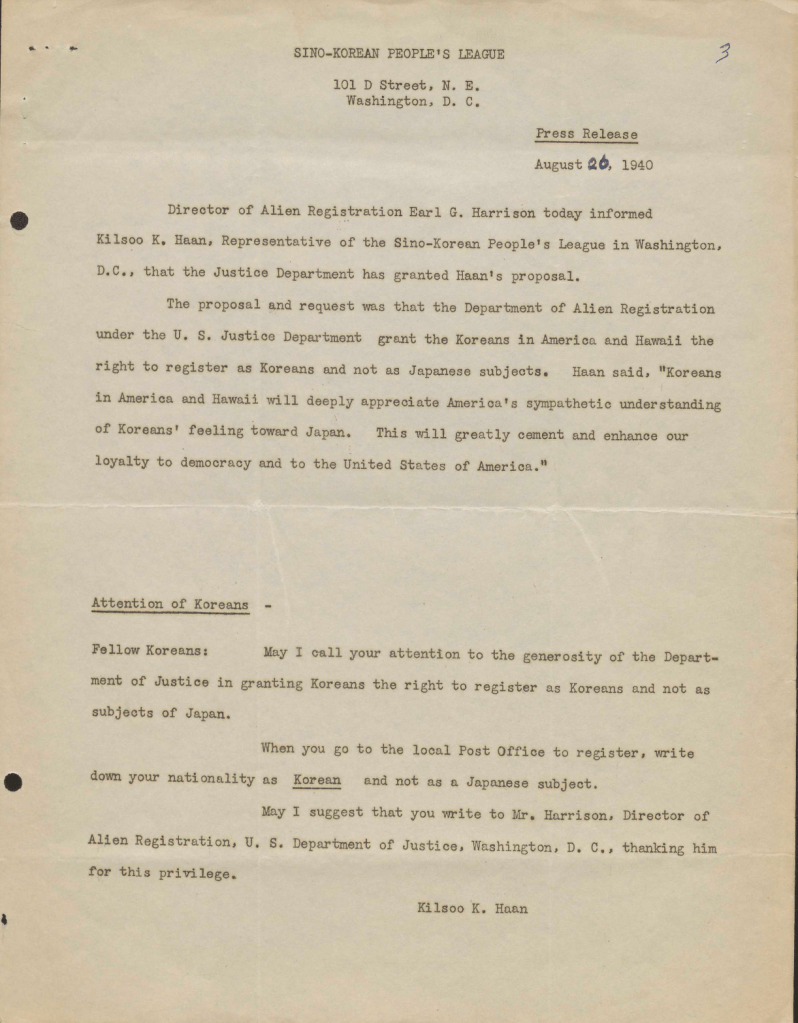
Letter Source: Sonia H. and Nathaniel A. Davis papers (MS.2021.003), Series 2. Nathaniel A. Davis, 1918 – 1964, Series 2. Subseries. Correspondence, 1931 – 1948, Box 1, Folder 34 1938 – 1940, John Hay Library, Providence, R.I.
Transcript:
SINO-KOREAN PEOPLE’S LEAGUE
101 D Street, N.E.
Washington, D.C.
Press Release
August 20 (or 26), 1940
Director of Alien Registration Earl G. Harrison today informed Kilsoo K. Haan, Representative of the Sino-Korean People’s League in Washington, D.C., that the Justice Department has granted Haan’s proposal.
The proposal and request was that the Department of Alien Registration under the U.S. Justice Department grant the Koreans in America and Hawaii the right to register as Koreans and not as Japanese subject. Haan said, “Koreans in America and Hawaii will deeply appreciate America’s sympathetic understanding of Koreans’ feeling toward Japan. This will greatly cement and enhance our loyalty to democracy and to the United States of America.”
Attention of Koreans –
Fellow Koreans: May I call your attention to the generosity of the Department of Justice in granting Koreans the right to register as Koreans and not as subjects of Japan.
When you go to the local Post Office to register, write down your nationality as Korean and not as a Japanese subject.
May I suggest that you write to Mr. Harrison, Director of Alien Registration, U.S. Department of Justice, Washington, D.C., thanking him for this privilege.
Kilsoo K. Haan

Letter Source: Sonia H. and Nathaniel A. Davis papers (MS.2021.003), Series 2. Nathaniel A. Davis, 1918 – 1964, Series 2. Subseries. Correspondence, 1931 – 1948, Box 1, Folder 42 1931 – 1942, John Hay Library, Providence, R.I.
Transcript:
August 19, 1941
55988/630
Mr. Kilsoo K. Haan
Sino-Korean Peoples’ League
101 D Street, N.E.
Washington, D.C.
My dear Mr. Haan:
A copy of your letter of July 30, 1941, which was addressed to J. Edgar Hoover, Director of the Federal Bureau of Investigation, has been referred to this office for reply.
In your letter you request to be advised if there is any reason why your organization should not issue identification cards to each Korean alien in the United States so that he may be distinguished from Japanese.
In reply thereto, you are advised that this office sees no objection to your proposal. It is presumed that the proposed identification card will merely attempt to identify the holder as a Korean and not as a Japanese. Inasmuch as there will be no attempt to imitate or duplicate Federal documents there is, as stated, no reason in our opinion why you should not issue such documents.
Sincerely yours,
Lemuel B. Schofield
Special Assistant to the Attorney General
By (signed) Edw. J. Shaughnessy
Deputy Commissioner
…
August 20, 1941
Attention, Fellow Koreans:
This and other letters have been forwarded to Chairman Kim Ho of the United Korean Committee in Los Angeles, also letter enclosed for Chairman Won Soon Lee in Hawaii and other leaders in Hawaii and Los Angeles.
As soon as the leaders undertake to agree on this necessary program—either the United Korean Committee in Hawaii and Los Angeles or myself will issue a statement of facts and suggestions for your benefit.
Kilsoo K. Haan
Washington Representative
UNITED AMERICAN DEFENSE COMMITTEE
of L.A. Calif.
As remarkable as this achievement may be, Kilsoo’s main fame lies in his work against the Japanese and what he had acquired while undercover in a Japanese base in Hawaii.
While living in Honolulu, he dressed like a Japanese beggar, hair rumpled, face not too clean, and bare-footed. He walked into the Japanese consulate and in peasant Japanese asked for help. He said nobody wanted to give him any kind of job. He was hungry and had no place to live and he simply had to have work, any kind of work.
The two officials looked at each other, then at Kilsoo K. Haan. One asked him whether he could read or write, he said no. Could he do janitor work? He thought he could and would try. While cleaning the offices, he spied their literature, copied it, including the charts where Pearl Harbor was to be struck. When he had all the information he needed, he came to Los Angeles hired the large Embassy Auditorium, put an ad in the local papers, inviting all the Koreans and other citizens to come to the lecture.
Sonia H. Davis, Two Hearts That Beat as One, pp. 178 – 179.
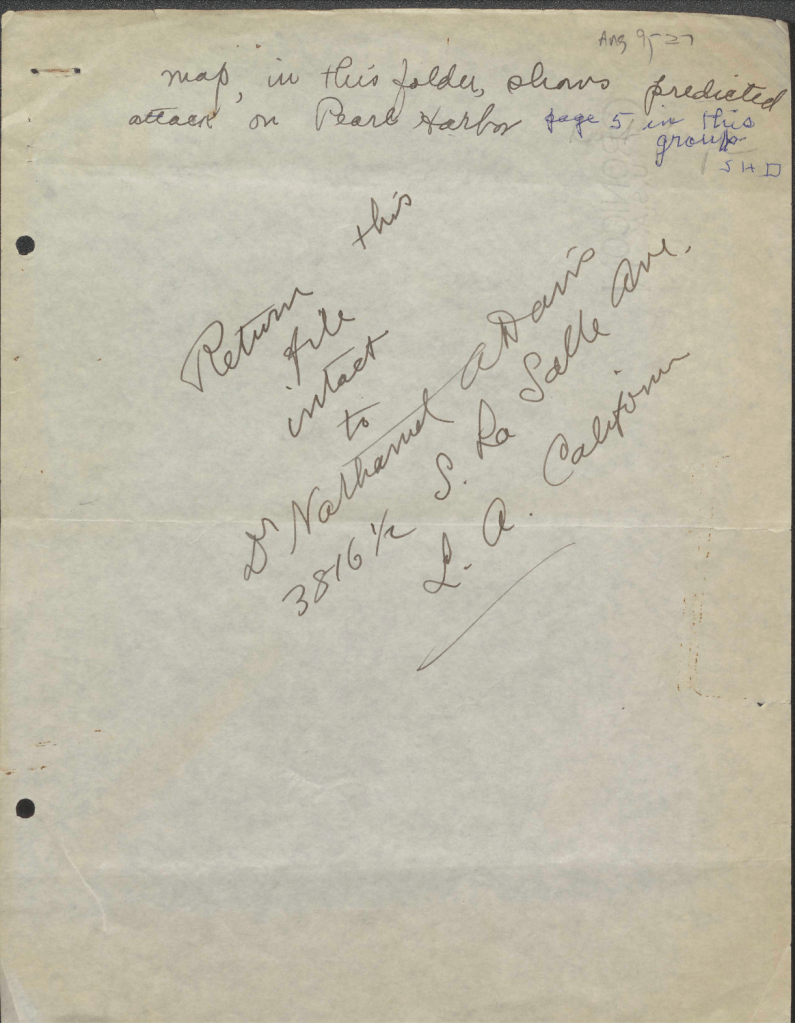
At first, this passage reads a little like one great spy novel. However, this was real, and this was Kilsoo’s real mission in life. These charts were once in the possession of Nathaniel and Sonia:

Letter Source: Sonia H. and Nathaniel A. Davis papers (MS.2021.003), Series 1. Sonia H. Davis, 1922 – 1971, Series 1. Subseries. Correspondence, 1938 – 1971, Box 1, Folder 1 1944 – 1970, John Hay Library, Providence, R.I.
Transcript:
(November 2, 1952)
P.S. I have Charts showing where Pearl Harbor would be struck, and about when. These, my late husband obtained from one Kilsoo Haan, who before the war went to Washington to show these charts and tell what he knew about the then impending disaster, but Washington wouldn’t listen to him. I’ll be happy to show them to you, and also some of the literature, as well as my late husband’s pleadings to F.D. Roosevelt regarding the lack of safety and security of the United States.
S.H.D.
Letter Source: Sonia H. and Nathaniel A. Davis papers (MS.2021.003), Series 2. Nathaniel A. Davis, 1918 – 1964, Series 2. Subseries. Correspondence, 1931 – 1948, Box 1, Folder 34 1938 – 1940, John Hay Library, Providence, R.I.
Moreover, aside from these charts, Kilsoo had “acquired” How Japan Plans to Win by Kinoaki Matsuo. This, too, was something that Nathaniel and Sonia had received:
When World War II was over, Kilsoo Haan wrote the book “How Japan Plans to Win”. When ten thousand copies were sold, Franklin D. Roosevelt forbade the sale of the book. Nathaniel and Sonia had a copy inscribed to them, but it was later lifted or otherwise appropriated from them.
Sonia H. Davis, Two Hearts That Beat as One, p. 180.
Kilsoo did not write How Japan Plan to Win; he translated it and published it in 1942. There appears to be some sort of controversy surrounding how Kilsoo acquired this book. The Japanese believed he stole it from two Japanese officers’ hotel room, while Kilsoo revealed it was given to him. The following transcripts are taken from the first few pages of How Japan Plans to Win:

This page is not numbered but is the first page with actual text.
Transcript:
- The translator is the Washington representative of the Sino-Korean People’s [sic] League, an anti-Japanese secret society of Korean patriots, with a highly organized intelligence service. Valuable information has frequently been passed on by Mr [sic] Haan to U.S. Government Departments.
- A copy of the original Japanese book was ‘acquired’ by the translator from a Los Angeles hotel room of two Japanese Army officers (of whom he had advance information), who had come to the West Coast for propaganda among the Japanese-Americans.
- The book sets out in detail the Japanese strategic plan. December 1941 is laid down as a zero month. The attacks on Pearl Harbour, Guam, Wake, and Midway Islands, and the Philippines have followed according to schedule. Action between the two fleets is discussed: the Nipponese expect to defeat the U.S. Fleet utterly.

Transcript:
TRANSLATOR’S NOTE
How Japan Plans to Win was first published in Tokyo in October of 1940 under the title of The Three-Power Alliance and a United States-Japanese War. The author is an intelligence officer in liaison between the Japanese Foreign Office and the Admiralty; he is also, and more significantly, a high official of the Black Dragon Society, a religious-political organization of militarists which has had a behind-the-scenes influence of growing importance in the development of recent Japanese policy. The purpose of the book was twofold: to stiffen mass support for a Japanese show-down with the United States; and to bring mass pressure to bear upon those members of the Admiralty who still considered a war with the United States suicidal. The present book is an unabridged translation of that work.
The book came into my hands as Washington representative of the Sino-Korean Peoples’ League, an anti-Japanese secret society with agents all over Japan, the mandated islands, Formosa, and our own West Coast. From one of my agents in Japan I receive word some time ago that two Japanese officers, both members of the Black Dragon Society, were on their way to California to do propaganda work among the Japanese-Americans of the West Coast. I was further informed that they were bringing with them a kind of Japanese Mein Kampf, which had been used to stimulate morale at home with some effect. I went at once to the Coast, and was able to secure a copy of the book, which I thereupon undertook to translate, and which is herewith published in English for the first time.
Grateful acknowledgement is hereby made to Mr [sic] Sang Ryup Park and other friends for their help in the translation. If, in spite of the patient efforts of these friends, I have failed to do justice to the author, Kinoaki Matsuo, I hope he will forgive me.
I owe grateful thanks, also, to Senator Guy M. Gillette, who has been very sympathetic and understanding, and who has advised me on the problem of presenting this book to the American public in the interests of National Defence.
Kilsoo K. Haan
You may read the full book here: How Japan Plans to Win.
In the midst of the increasing hysteria of impending war, Nathaniel did his best to inform political figures of a possible invasion through Crescent City, California.


Letter Source: Sonia H. and Nathaniel A. Davis papers (MS.2021.003), Series 2. Nathaniel A. Davis, 1918 – 1964, Series 2. Subseries. Correspondence, 1931 – 1948, Box 1, Folder 34 1938 – 1940, John Hay Library, Providence, R.I.
Transcript:
April 20, 1939
To the Hon. Franklin D. Roosevelt
President of the United States
The White House
Washington, D.C.
My dear Mr. President: —
Refering [sic] back to a recent letter from me expressing the views of this organization relative to a proposition we have for some years contended should be considered as a matter of National Policy, you undoubtedly remember that your attention was called to certain facts in connection with the defences of the Panama canal, the liberation of the naval forces of England, France, and Holland from American waters, the great value to us of the Central American, South American, West Indian, and some other islands as essential to the full protection of our coasts, commerce, and trade, and further of the resources in those teritories [sic] as producers of tropical products which we must have, and to the fact that European debts to us are constant causes of friction; and that we suggested the appointment of a special Congressional Committee to enquire as to the accuracy of our allegations and the practicability of bringing all of these places now held insecurely and quite seriously possible of occupation by enemy European or Asiatic powers definitely under our flag.
Since that time we are glad to note that a naval station has been acquired in Trinidad. This is fine; but we think it is not enough, and we sincerely hope that the complete program may be studied certain that the facts justify our views.
As part of this protection of our shores, there are other matters scarcely less important which we have more than once stressed. All of the ground covered in our correspondence with yourself we have been over. I know all of them from personal surveys of the facts on the spot.
There is another section now in our minds which is perhaps quite as important from the viewpoint of military defense. I refer to specifically to Crescent City, its harbor, Lakes Earle [sic] and Killaw [sic] immediately north of that harbor, and the hinterland in Del Norte and adjacent counties.
A vast stretch of practically unsettled arable, forest, and mineral lands of the greatest potential value, because of engineering difficulties and lack of roads and transportation facilities makes this area almost if not quite our last great West.
The harbor at Crescent City needs to be further developed as a military project as well as for commercial purposes. It is almost exactly mid way [sic] between Portland Oregon and San Francisco, California. It is the only practical point at which a harbor of refuge for ships of any size could be made available between these two ports. The coast line between Portland and San Francisco is at present the longest stretch on this earth on any shore between two major cities without such a port.
At the St. Georges Bank not far at sea from Crescent City is one of the greatest deep sea fishing areas in the world. In the farm and orchard lands of this territory there are possibilities of producing food for a mighty population.
Any alien such as Japan, seeking a landing spot not at present adequately protected, could and we think would finding all they might want, in the area referred to, seize it and settle military colonists there whom we could never expel.
The lakes before named are close to Crescent City. They are seperated [sic] from the sea by sand banks easily dredged through. An aeroplane landing fields and as naval stations, they are ideal.
There is an abundance of stone for building materials and harbor works at hand. A considerable amount of Federal work had been done already in Crescent Bay. But the naval plans should be rushed to completion and fortification make this territory safe for us and from the assaults of aggressor nations.
This Crescent City situation has been before Congress before. But at those times, the urgency of fast moving events did not enter into the argument and perhaps the tinge of racketeering real estate speculators clouded the issue. All of that has passed.
We know by all your record and your recent public statements that these problems lie close to your heart. For this we are grateful.
Trusting that our suggestions may have value and lead to action,
I have the honor to be,
most respectfully yours
National President of the AMERICAN DEFENSE SOCIETY OF THE UNITED STATES.

Letter Source: Sonia H. and Nathaniel A. Davis papers (MS.2021.003), Series 2. Nathaniel A. Davis, 1918 – 1964, Series 2. Subseries. Correspondence, 1931 – 1948, Box 1, Folder 34 1938 – 1940, John Hay Library, Providence, R.I.
Transcript:
September 23, 1939
Hon. Franklin D. Roosevelt
President of the United States
The White House
WASHINGTON, D.C.
My dear Mr. President: —
It is once more my privilege to convey to you both for this organization and on my own account our sincere satisfaction and our congratulations in connection with your recent word over radion [sic] to the American people giving them the reasons for you [sic] stand on the problems of Neutrality. That was finely done. It should place the people of America as well as their representative in the Congress substantially on your side and ready to support you in every way in these trying days.
We note with natural approval the acceptance by various Departments of the suggestions we have made notably with regard to the protection of our aeroplane and munition plants from untrustworthy employees and sabotage; the attention being given to the menace of foreign submarines in the CaribeanSea [sic] and the Gulf of Mexico; the danger spots in Alaska and in Central America; the very real danger involved in the activities of notorious subversive movements; and the need for a new and more definite Americanism among our citizenry. We are in no little measure disturbed by the continued lack of adequate protection of the Del Norte County and Crescent City area in this State and the importance there of a fully developed harbor of refuge as a military measure. Nor are we less concerned with regard to the armed preparedness of certain revolutionary groups to incite domestic trouble and spread racial and credal disruption of American solidarity. The Panama conference relative to Pan American relations is we think, a masterly move which must be stimulated to constant enthusiasm throughout the Americas.
May I add to this that if there is any place I can fill, or

Letter Source: Sonia H. and Nathaniel A. Davis papers (MS.2021.003), Series 2. Nathaniel A. Davis, 1918 – 1964, Series 2. Subseries. Correspondence, 1931 – 1948, Box 1, Folder 38 1930 – 1939, John Hay Library, Providence, R.I.
Transcript:
October 19, 1939
Dr. Nathaniel A. Davis
3816 1/2 South La Salle Avenue
Los Angeles, California
Dear Dr. Davis:
By reference from the President, I have your letter of September 23, 1939.
I want you to know how deeply I appreciate your offer of cooperation in connection with the emergency now confronting this Nation. It is suggested that you refer any information indicating a possible violation of the neutrality laws to Mr. R.B Hood, Special Agent in Charge of this Bureau’s Los Angeles Field Division located at 810 South Spring, Room 603, Los Angeles, California.
It was thoughtful of you to forward the clipping from The Los Angeles Pan American News.
With best wishes and kind regard,
Sincerely yours,

Letter Source: Sonia H. and Nathaniel A. Davis papers (MS.2021.003), Series 2. Nathaniel A. Davis, 1918 – 1964, Series 2. Subseries. Correspondence, 1931 – 1948, Box 1, Folder 39 1940 – 1941, John Hay Library, Providence, R.I.
Transcript:
December 17, 1940.
Dr. Nathaniel A. Davis,
3816 1/2 S. La Salle Avenue,
Los Angeles, California.
Dear Sir:
I am directed by the Secretary of War to acknowledge receipt of your letter of November 14, 1940, addressed to the President, together with data relative to the facilities of Crescent City, Del Norte County, California, in connection with the national defense program.
It is not possible at this time to indicate the extent to which it may be practicable to utilize the facilities at the locality in question for defense expansion activities; however, the information furnished has been made of record for such reference as requirements may warrant.
In the War Department studies for the selection of locations for such additional establishments as may be authorized incident to the defense program, the merits of all suitable areas are carefully evaluated. You may be assured that the merits of the Crescent City, California area will receive full consideration.
With appreciation of your interest in matters relating to the National Defense, I am
Very truly yours,
Major General,
The Adjutant General.

Letter Source: Sonia H. and Nathaniel A. Davis papers (MS.2021.003), Series 2. Nathaniel A. Davis, 1918 – 1964, Series 2. Subseries. Correspondence, 1931 – 1948, Box 1, Folder 34 1938 – 1940, John Hay Library, Providence, R.I.
Transcript:
December 27,1940
REPLY TO Dr. Nathaniel A. Davis, 3816 1/2 S.La [sic] Salle Ave.Los [sic] Angeles. Calif.
Major General E.S. Adams
The Adjutant General’s Office
War Department
Washington, D.C.
Dear Sir: —
By way of calling attention to the urgency of the Crescent City conditions in connection with the present emergency, and the probable advisability of some sort of preliminary investigation being made throughout Del Norte County in California and as additional material to be placed among your records along the material already supplied by us to you, I may say that the emmisaries [sic] of Japan have over a number of years been collecting data undoubtedly for their use later.
One of our own members who is also a member of our World Affairs committee, Mr. Kilsoo Haan, a Korean by birth and for many years a resident of Hawaii who is well known to the authorities in Washington where he has appeared before various Congressional groups as the representative of the Sino-Korean League, informed me that Japan is still using that district as a sort of fairly well concealed clearing house and thinking of it in terms of military action in days to come.
I have suggested to him that he should get into touch with you on his return to Washington. Senator Gillette will bear me out in saying that you will find him decidedly useful in consideration of matters affecting the Pacific area.
Cordially yours,
Dr. Nathaniel A. Davis; President American Defense Society
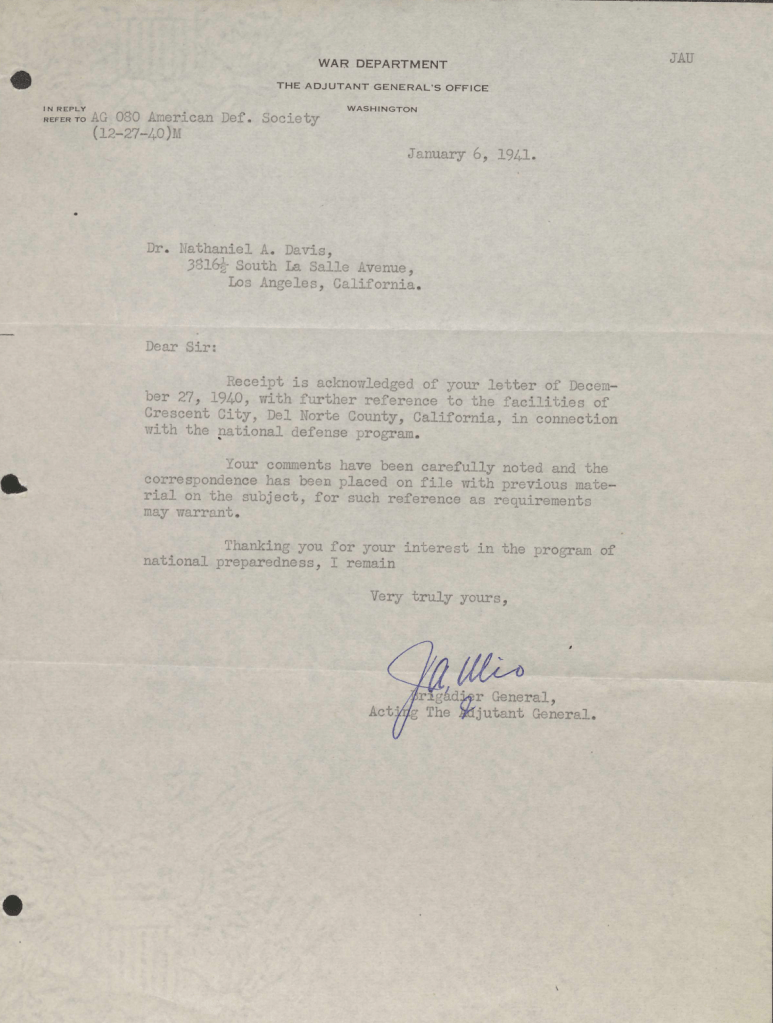
Letter Source: Sonia H. and Nathaniel A. Davis papers (MS.2021.003), Series 2. Nathaniel A. Davis, 1918 – 1964, Series 2. Subseries. Correspondence, 1931 – 1948, Box 1, Folder 39 1940 – 1941, John Hay Library, Providence, R.I.
Transcript:
January 6, 1941.
Dr. Nathaniel A. Davis,
3816 1/2 South La Salle Avenue,
Los Angeles, California.
Dear Sir:
Receipt is acknowledged of your letter of December 27, 1940, with further reference to the facilities of Crescent City, Del Norte County, California, in connection with the national defense program.
Your comments have been carefully noted and the correspondence has been placed on file with previous material on the subject, for such reference as requirements may warrant.
Thanking you for your interest in the program of national preparedness, I remain
Very truly yours,
Brigadier General,
Acting The Adjutant General.
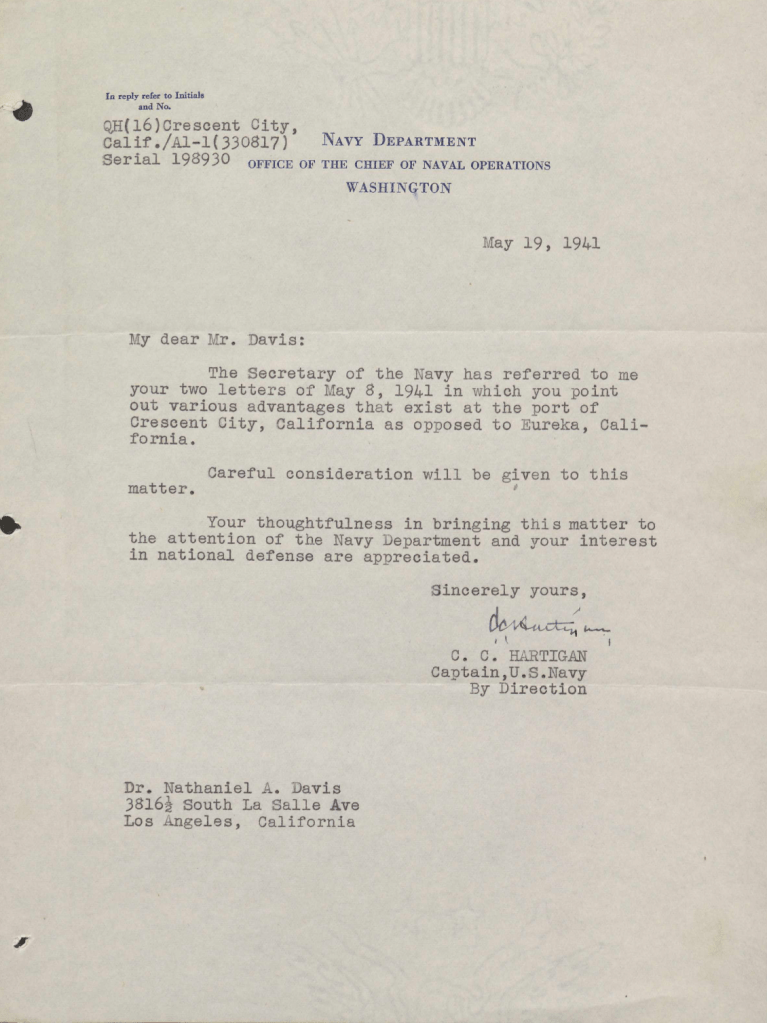
Letter Source: Sonia H. and Nathaniel A. Davis papers (MS.2021.003), Series 2. Nathaniel A. Davis, 1918 – 1964, Series 2. Subseries. Correspondence, 1931 – 1948, Box 1, Folder 39 1940 – 1941, John Hay Library, Providence, R.I.
Transcript:
May 19, 1941
My dear Mr. Davis:
The Secretary of the Navy has referred to me your two letters of May 8, 1941 in which you point out various advantages that exist at the port of Crescent City, California as opposed to Eureka, California.
Careful consideration will be given to this matter.
Your thoughtfulness in bringing this matter to the attention of the Navy Department and your interest in national defense are appreciated.
Sincerely yours,
C.C. Hartigan
Captain,U.S.Navy [sic]
By Direction
I was unable to find proof that supported this theory regarding Crescent City. With that being said, due to California’s long coast, and the state’s sprawling northern region of redwood forests, it’s easy to understand the fear of a possible invasion going unnoticed. Any coastal city that was without a military presence was an Achilles heel. Then with the attack on Pearl Harbor, an attack on California was a real possibility, given how close Japanese submarines were already prowling the state’s coast. On February 23, 1942, a Japanese submarine had in fact shelled a Santa Barbara oil refinery, further perpetuating mass hysteria on the likelihood of an invasion. Santa Barbara History Japanese Attack describes the assault in great detail.
Concerts
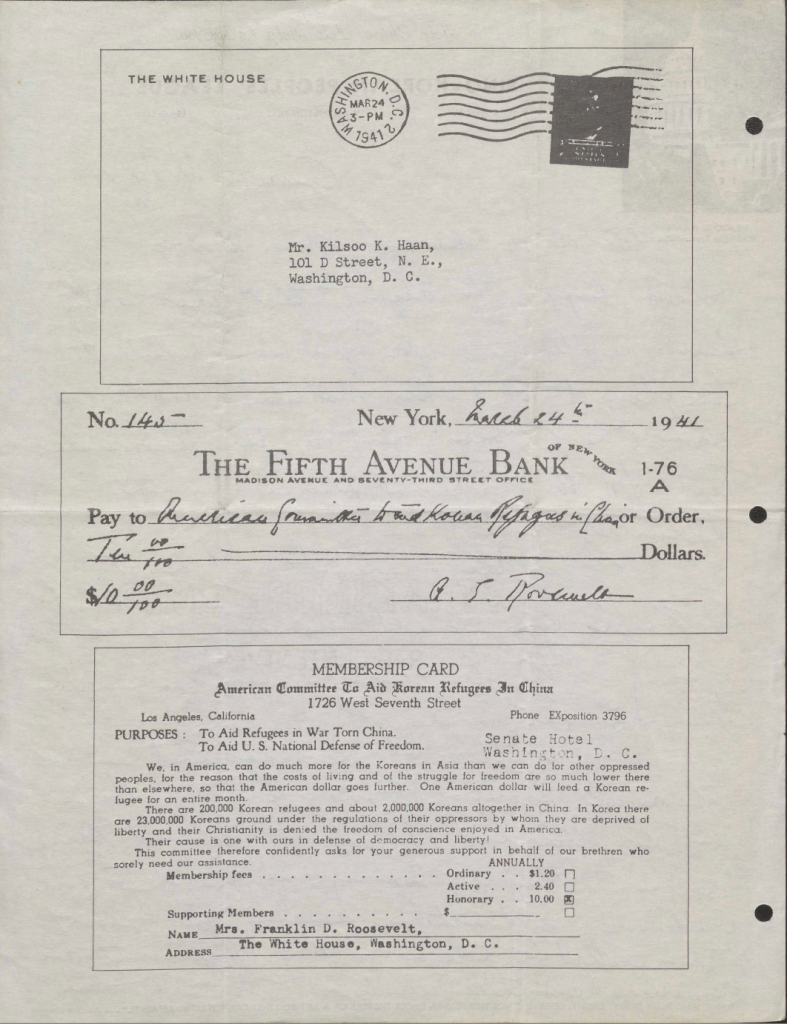
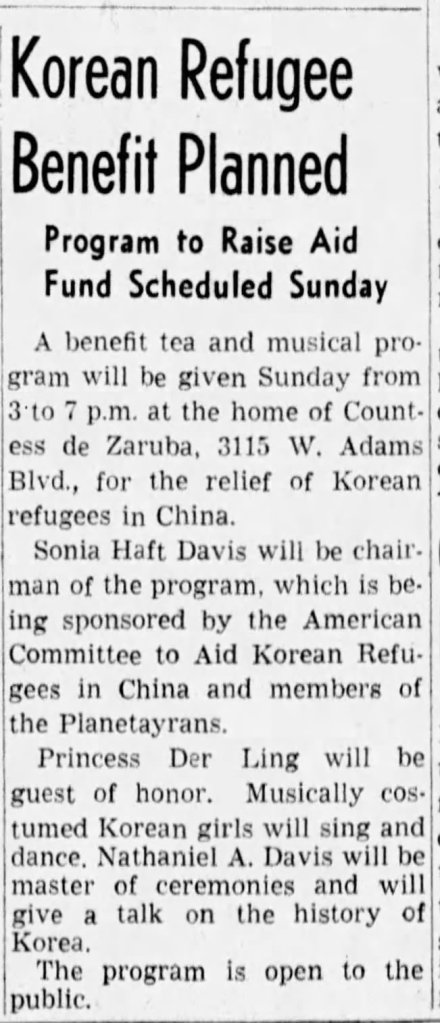
In 1941, still dedicated to Kilsoo’s cause, Nathaniel and Sonia hosted two concerts for Korean refugees in China. The first was scheduled on April 20, 1941:

Letter Source: Sonia H. and Nathaniel A. Davis papers (MS.2021.003), Series 2. Nathaniel A. Davis, 1918 – 1964, Series 2. Subseries. Correspondence, 1931 – 1948, Box 1, Folder 39 1940 – 1941, John Hay Library, Providence, R.I.
Transcript:
You are cordially invited to be with us
At the home of our Hostess
THE COUNTESS de ZARUBA
3115 West Adams Blvd.,
Los Angeles
Sunday afternoon, April 20, 1941, from 3 to 7 o’clock where a Korean Refugee Relief Tea and musical program will be given by the American Committee to Aid Korean Refugees in China, under the auspices of PLANETARYAN.
Princess DER LING will be our guest of honor.
Beautifully costumed Korean girls will sing, dance and play for your pleasure.
Korean dainties, unlike any other Oriental delicacies, will be served, and will be appreciated by the American palate.
Sonia Haft Davis……………Program Chairman
Janet S. Whang……………Assist. Chairman
Dr. Nathaniel A. Davis….. Master of Ceremonies
Madam Alma Wieteck….Violin Soloist…accompanied by
Mrs. Grace Bush………………..Pianiste
Korean Program assisted by Mrs. Marie Lee, Winifred Lee, Lucille Kim, Rose Lee, Gloria Kim, Lila Lee, Marian Kim, Anna Lee, Mrs. Haykyeng Chung, (^Evelyn Kim) Mr. Frank Lee and P.K. Kim.
Story of the wonderful Country, Korea, and its interesting people…………….by Dr. N.A. Davis.
“Stars and Stripes For Me”……Words by Dr. N.A. Davis
Music by Mr. Elliot Carpenter
Sung by
Phil Gatch
Admission….50 cents.
Letter Source: Sonia H. and Nathaniel A. Davis papers (MS.2021.003), Series 2. Nathaniel A. Davis, 1918 – 1964, Series 2. Subseries. Correspondence, 1931 – 1948, Box 1, Folder 39 1940 – 1941, John Hay Library, Providence, R.I.
Transcript:
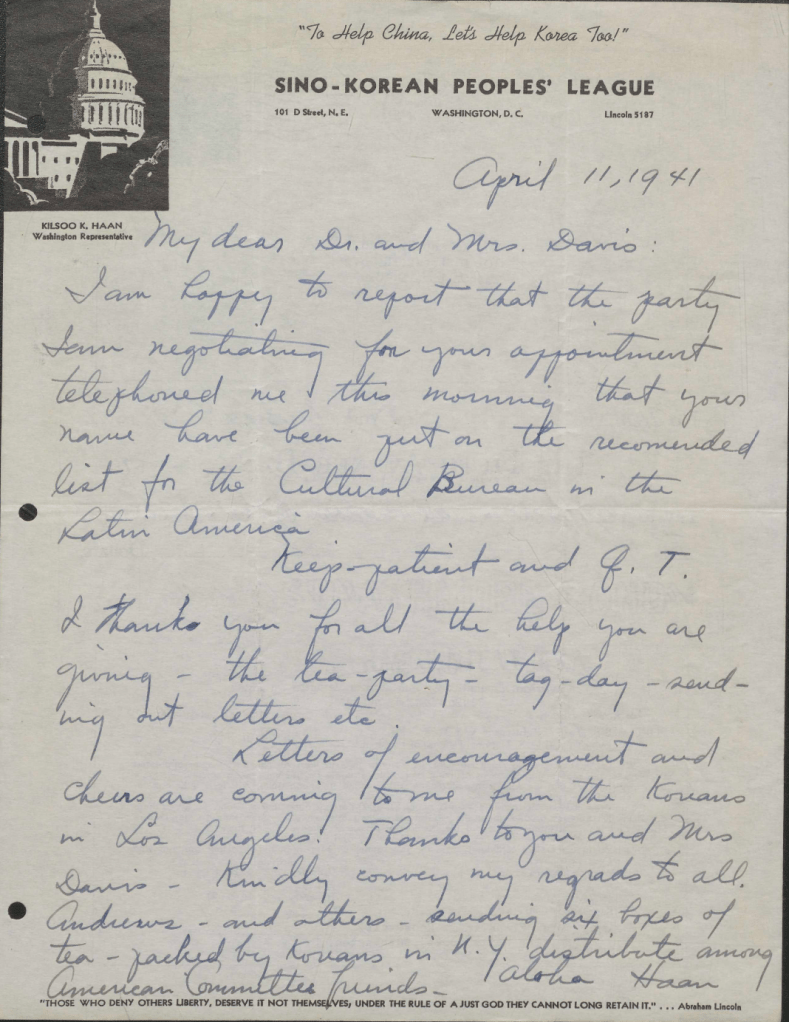
April 11, 1941
My dear Dr. and Mrs. Davis:
I am happy to report that the party I am negotiating for your appointment telephoned me this morning that your name [sic] have been put on the recommended list for the Cultural Bureau in the Latin America.
Keep patient and F.T.
I thanks [sic] you for all the help you are giving—the tea-party—tag-day—sending out letters etc.
Letters of encouragement and cheers are coming to me from the Koreans in Los Angeles. Thanks to you and Mrs. Davis—Kindly convey my regards to all.
Andrews—and others—sending six boxes of tea—packed by Koreans in N.Y. distribute among American Committee friends—Aloha Haan

Letter Source: Sonia H. and Nathaniel A. Davis papers (MS.2021.003), Series 2. Nathaniel A. Davis, 1918 – 1964, Series 2. Subseries. Correspondence, 1931 – 1948, Box 1, Folder 39 1940 – 1941, John Hay Library, Providence, R.I.
Transcript:
1941 APR 19
DR NATHANIEL A DAVIS=
3816 1/2 SOUTH LASALLE ST. LOSA=
THO THOUSANDS OF MILES SEPARATE US MY HEART IS WITH YOU ALL KIND FRIENDS OF CHINA AND KOREA WHO MADE THIS TEAPARTY [sic] POSSIBLE [.] MAY I HUMBLY WISH YOU PLEASANT AND HAPPY EVENING [.] ENJOY THE LEA [sic] AND DANCING TO HELP CHINA [.] LETS HELP KOREA TOO. GOMAPSO=
KILSOO HAAN.
This initial benefit was no doubt significant, and a great success. The second benefit, however, was exceedingly greater, so much so that Sonia had reached out to a fellow friend from the UAPA for help.
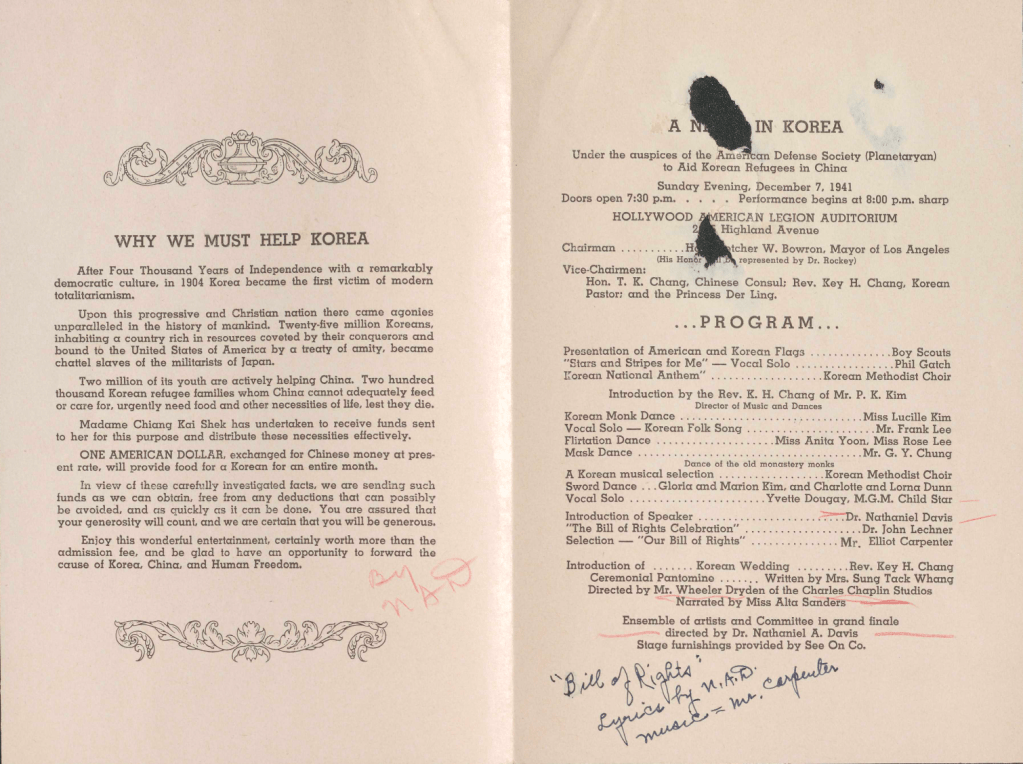
One of the Korean women wrote a short story describing the life of the Koreans, and also a Korean wedding. Sonia was to read that story from the platform, but she decided she could not do justice to it, so she telephoned a fellow-member who was affiliated with the United Amateur Press Association of which she had been a member as well. Sonia asked Mr. Wheeler Dryden to help out in any way he could. He complied at once.
Sonia H. Davis, Two Hearts That Beat as One, p. 179.
Since the stadium did not have a curtain, Wheeler brought his electrician with him. The stage was divided into three segments to present the three acts. The spotlight was to play on each section as needed.
Sonia H. Davis, Two Hearts That Beat as One, p. 179
The stadium in question was the Hollywood American Legion Post 43, which is now simply known as Hollywood Legion Theater. The theater appears to have been and still owned by the American Legion, a wartime veterans’ organization. You can read more about it here: Hollywood Legion Theater.
With Dryden’s help, and with those contributing and participating, the show was set for December 7, 1941.


Source: Sonia H. and Nathaniel A. Davis papers (MS.2021.003), Series 2. Nathaniel A. Davis, 1918 – 1964, Series 2. Subseries. Correspondence, 1931 – 1948, Box 1, Folder 39 1940 – 1941, John Hay Library, Providence, R.I.
Nathaniel had high hopes for this benefit, and it showed in the people who were invited to this event.
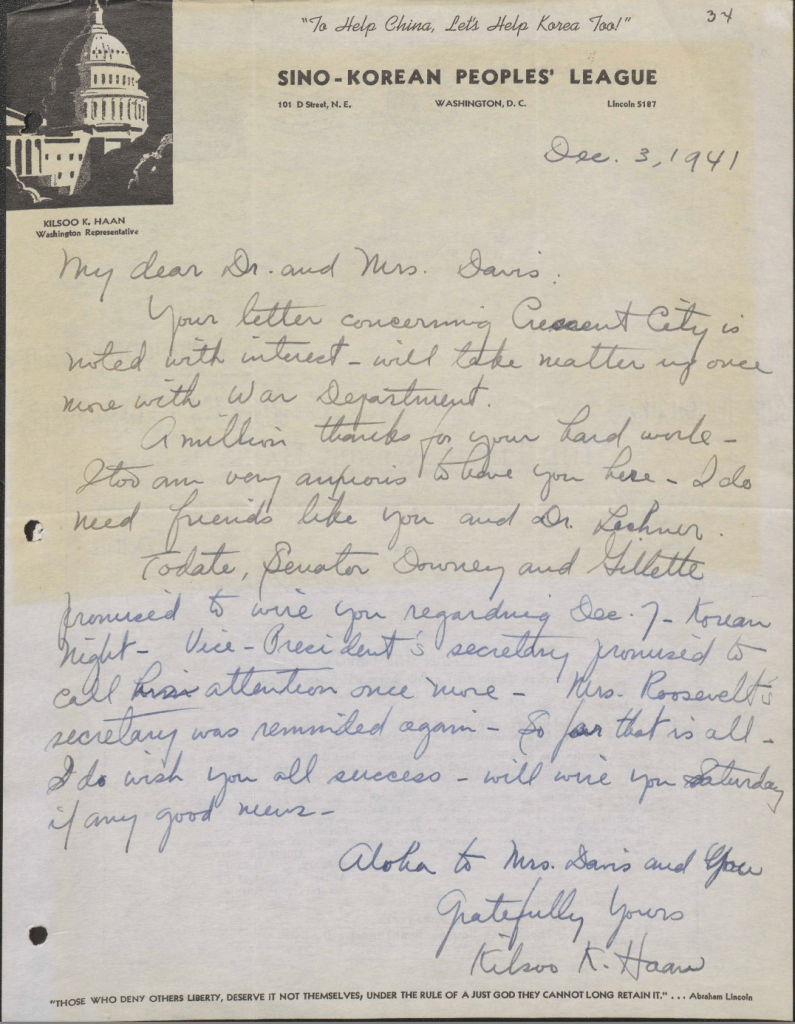
Letter Source: Sonia H. and Nathaniel A. Davis papers (MS.2021.003), Series 2. Nathaniel A. Davis, 1918 – 1964, Series 2. Subseries. Correspondence, 1931 – 1948, Box 1, Folder 39 1940 – 1941, John Hay Library, Providence, R.I.
Transcript:
Dec. 3, 1941
My dear Dr. and Mrs. Davis:
Your letter concerning Crescent City is noted with interest—will take matter up once more with War Department.
A million thanks to your hard work—I too am very anxious to have you here—I do need friends like you and Dr. Lechner.
Todate, [sic] Senator Downey and Gillette promised to wire you regarding Dec. 7—Korean night—Vice President’s secretary promised to call his attention once more—Mrs. Roosevelt’s secretary was reminded again—so far that is all—I do wish you all success—will wire you Saturday if any good news—
Aloha to Mrs. Davis and you
Gratefully yours
Kilsoo K. Haan
Senator Gillette did in fact wire Nathaniel, a day before Kilsoo’s letter:
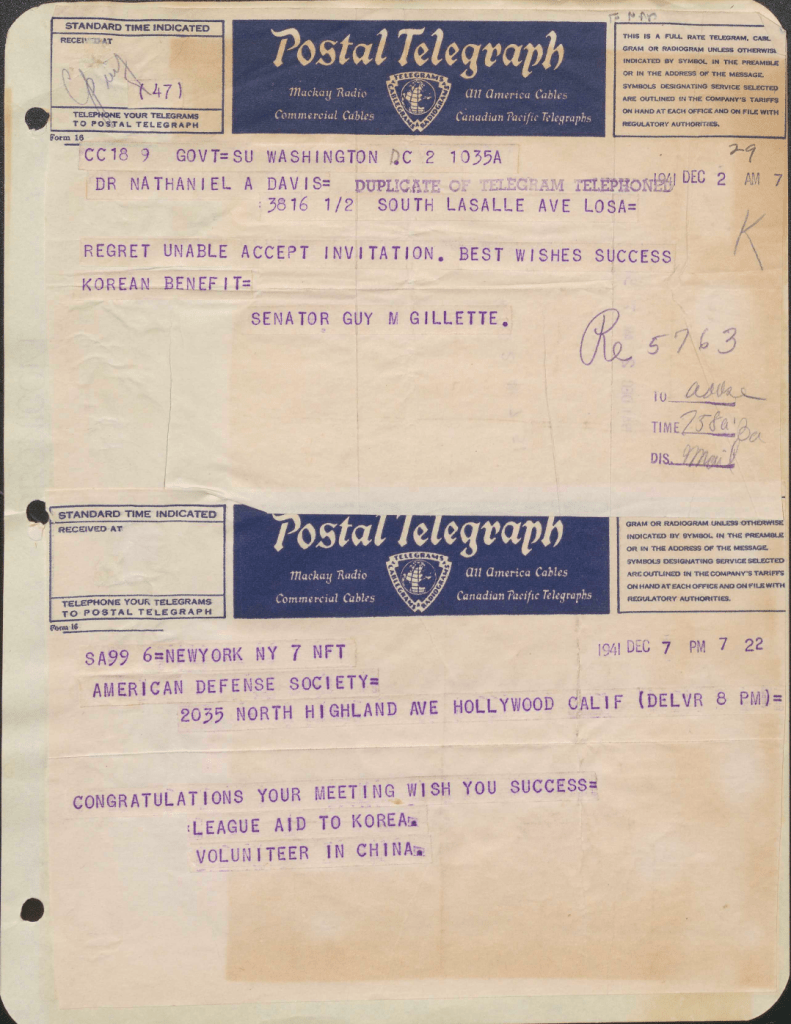
Letter Source: Sonia H. and Nathaniel A. Davis papers (MS.2021.003), Series 2. Nathaniel A. Davis, 1918 – 1964, Series 2. Subseries. Correspondence, 1931 – 1948, Box 1, Folder 39 1940 – 1941, John Hay Library, Providence, R.I.
Transcript:
1941 DEC 2
REGRET UNABLE ACCEPT INVITATION. BEST WISHES SUCCESS
KOREAN BENEFIT=
SENATOR GUY M GILLETTE.
…
1941 DEC 7
CONGRATULATIONS YOUR MEETING WISH YOU SUCCESS=
LEAGUE AID TO KOREA.
VOLUNITEER [sic] IN CHINA.
Another noteworthy invitation for the benefit was denied:

Letter Source: Sonia H. and Nathaniel A. Davis papers (MS.2021.003), Series 2. Nathaniel A. Davis, 1918 – 1964, Series 2. Subseries. Correspondence, 1931 – 1948, Box 1, Folder 39 1940 – 1941, John Hay Library, Providence, R.I.
Transcript:
DEC 6 1941
FOLLOWING MESSAGE RECEIVED FROM MRS [sic] ROOSEVELT TO BE READ SUNDAY NIGHT. WHITE HOUSE/FOR TRANSMITTAL DEAR HAAN/ I AM SENDING GREETINGS TO ALL THOSE ATTENDING THE BENEFIT AND MY GOOD WISHES TO THE SOCIETY FOR THE SUCCESS OF THEIR EFFORTS ON BEHALF OF THE KOREAN REFUGEES IN CHINA[.] I HOPE THAT THE RESULTS OF THE EVENING N [sic] KOREA WILL BE MOST GRATIFYING[.] VERY SINCERELY YOURS SIGNED ELEANOR ROOSEVELT=
KILSOV [sic] HAAN.
Even with the bomb strike charts of Pearl Harbor in their possession, Nathaniel and Sonia could never have predicted the tragedy which had transpired on December 7, 1941.
That last concert was given on December 7, 1941. The chief of police warned the population to stay home that evening, but Nathaniel telephoned and informed him that the tickets had already been sold for this benefit and that many persons would leave their homes that evening. It was very dark and difficult to get about.
Sonia H. Davis, Two Hearts That Beat as One, p. 179.
Southern California’s civil defense authorities had imposed severe dimout restrictions on the region, ordering residents to turn off all lights that could be seen from the sea at night. […] Residents pulled their shades, neon signs flickered off, and motorists learned to drive in the dark.
Nathan Masters, “When L.A. Drove in the Dark: SoCal During World War II”, PBS SoCal.
In another instance, the day after the bombing of the Santa Barbara oil refinery, Los Angeles had a battle of its own:
It began on the evening of February 24, 1942, when naval intelligence instructed units on the California coast to steel themselves for a potential Japanese attack.
All remained calm for the next few hours, but shortly after 2 a.m. on February 25, military radar picked up what appeared to be an enemy contact some 120 miles west of Los Angeles. Air raid sirens sounded and a citywide blackout was put into effect. Within minutes, troops had manned anti-aircraft guns and begun sweeping the skies with searchlights.
It was just after 3 a.m. when the shooting started. Following reports of an unidentified object in the skies, troops in Santa Monica unleashed a barrage of anti-aircraft and .50 caliber machine gun fire. Before long, many of the city’s other coastal defense weapons had joined in. “Powerful searchlights from countless stations stabbed the sky with brilliant probing fingers,” the Los Angeles Times wrote, “while anti-aircraft batteries dotted the heavens with beautiful, if sinister, orange bursts of shrapnel.
Evan Andrews, “World War II’s Bizarre ‘Battle of Los Angeles’”, History.
These were the times Nathaniel and Sonia sought to do good with their aid for Korean refugees. Even in the midst of this chaos, there was another form of chaos creeping into the production of the benefit. A political strain that Nathaniel took care to inform Kilsoo:
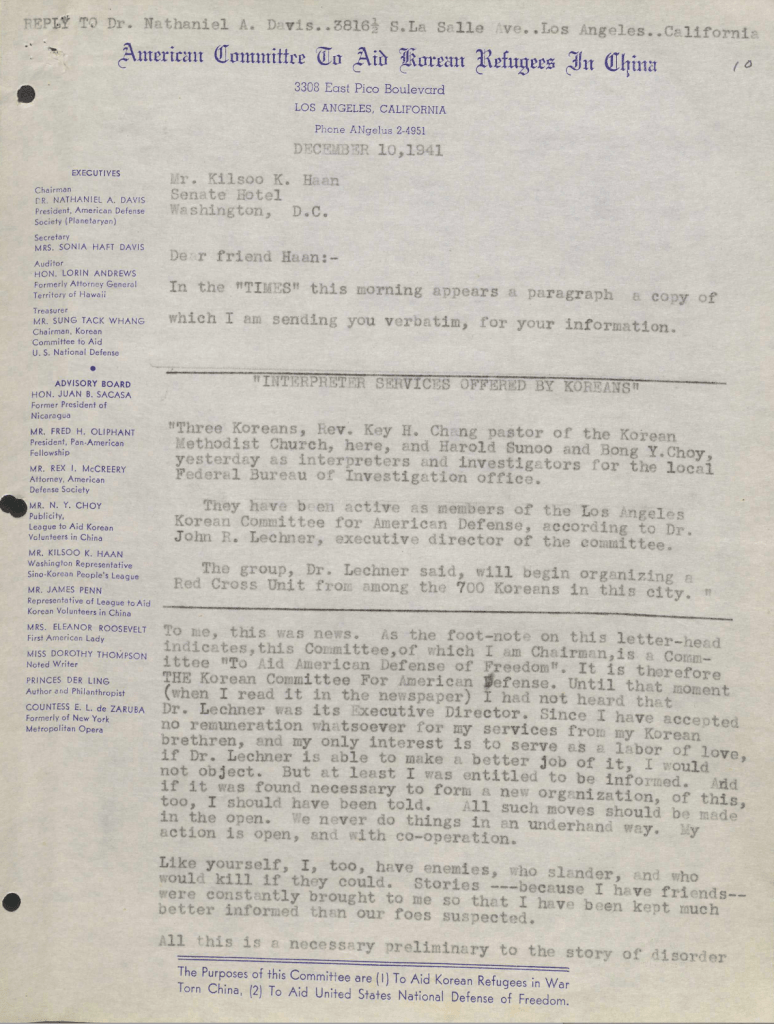

Letter Source: Sonia H. and Nathaniel A. Davis papers (MS.2021.003), Series 2. Nathaniel A. Davis, 1918 – 1964, Series 2. Subseries. Correspondence, 1931 – 1948, Box 1, Folder 35 1941 – 1942, John Hay Library, Providence, R.I.
Transcript:
December 10,1941
Mr. Kilsoo K. Haan
Senate Hotel
Washington, D.C.
Dear friend Haan: —
In the “TIMES” this morning appears a paragraph a copy of which I am sending you verbatim, for your information.
…
“INTERPRETER SERVICES OFFERED BY KOREANS”
“Three Koreans, Rev. Key H. Chang pastor of the Korean Methodist Church, here, and Harold Sunoo and Bong Y. Choy, yesterday as interpreters and investigators for the local Federal Bureau of Investigation office.
They have been active as members of the Los Angeles Korean Committee for American Defense, according to Dr. John R. Lechner, executive director of the committee.
The group, Dr. Lechner said, will begin organizing a Red Cross Unit from among the 700 Koreans in this city. ” [sic]
…
To me, this was news. As the foot-note on this letter-head indicates,this Committee,of [sic] which I am Chairman,is [sic] a Committee to “To Aid American Defense of Freedom”. It is therefore THE Korean Committee For American Defense. Until that moment (when I read it in the newspaper) I had not heard that Dr. Lechner was its Executive Director. Since I have accepted no remuneration whatsoever for my services from my Korean brethren, and my only interest is to serve as a labor of love, if Dr. Lechner is able to make a better job of it, I would not object. But at least I was entitled to be informed. And if it was found necessary to form a new organization, of this, too, I should have been told. All such moves should be made in the open. We never do things in an underhanded way. My action is open, and with co-operation.
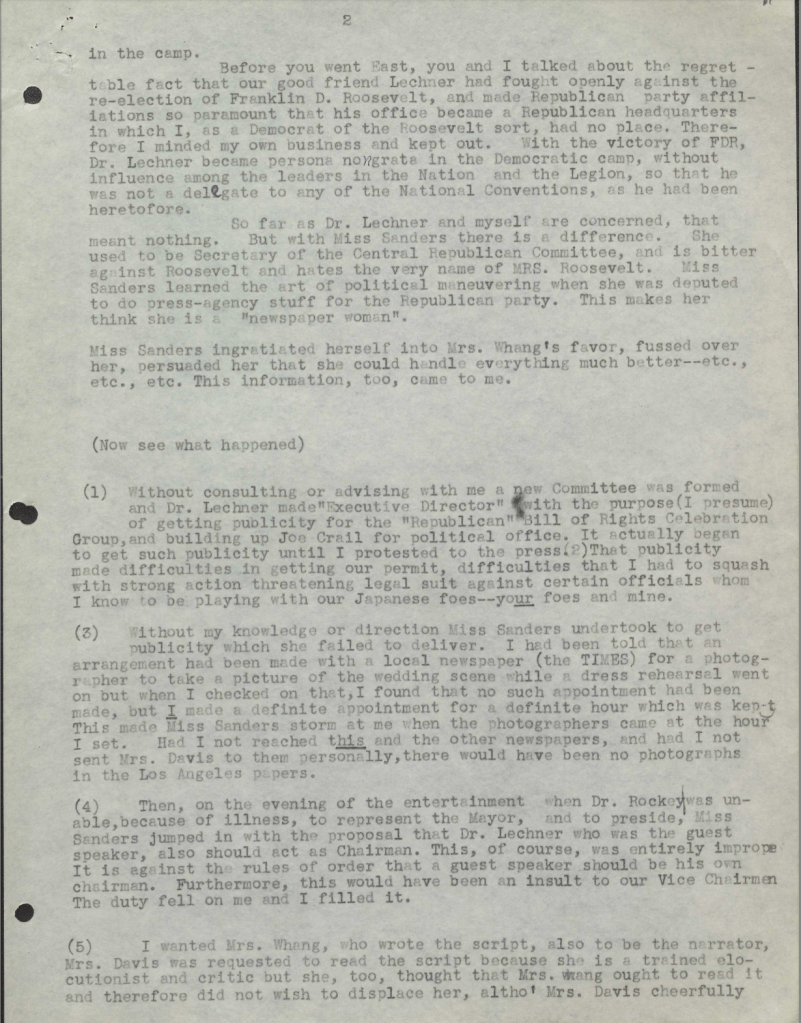
Like yourself, I, too, have enemies, who slander, and who would kill if they could. Stories —because [sic] I have friends—were constantly brought to me so that I have been kept much better informed than our foes suspected.
All this is a necessary preliminary to the story of disorder in the camp.
Before you went East, you and I talked about the regrettable fact that our good friend Lechner had fought openly against the re-election of Franklin D. Roosevelt, and made Republican party affiliations so paramount that his office became a Republican headquarters in which I, as a Democrat of the Roosevelt sort, had no place. Therefore I minded my own business and kept out. With the victory of FDR, Dr. Lechner became persona non grata in the Democratic camp, without influence among the leaders in the Nation and the Legion, so that he was not a delegate to any of the National Conventions, as he had been heretofore.
So far as Dr. Lechner and myself are concerned, that meant nothing. But with Miss Sanders there is a difference. She used to be Secretary of the Central Republican Committee, and is bitter against Roosevelt and hates the very name of MRS. Roosevelt. Miss Sanders learned the art of political maneuvering when she was deputed to do press-agency stuff for the Republican party. This makes her think she is a “newspaper woman”.
Miss Sanders ingratiated herself into Mrs. Whang’s favor, fussed over her, persuaded her that she could handle everything much better—etc., etc., etc. This information, too, came to me.
(Now see what happened)
(1) Without consulting or advising with me a new Committee was formed and Dr. Lechner made“Executive Director” [sic] with the purpose(I presume) of getting publicity for the “Republican” Bill of Rights Celebration Group,and [sic] building up Joe Crail for political office. It actually began to get such publicity until I protested to the press.(2)That [sic] publicity made difficulties in getting our permit, difficulties that I had to squash with strong action threatening legal suit against certain officials whom I know to be playing with our Japanese foes—your foes and mine.
(3) Without my knowledge or direction Miss Sanders undertook to get publicity which she failed to deliver. I had been told that an arrangement had been made with a local newspaper (the TIMES) for a photographer to take a picture of the wedding scene while a dress rehearsal went on but when I checked on that,I [sic] found that no such appointment had been made, but I made a definite appointment for a definite hour which was kept. This made Miss Sanders storm at me when the photographers came at the hour I set. Had I not reached this and the other newspapers, and had I not sent Mrs. Davis to them personally,there [sic] would have been no photographs in the Los Angeles papers.
(4) Then, on the evening of the entertainment when Dr. Rockeywas [sic] unable,because [sic] of illness, to represent the Mayor, and to preside, Miss Sanders jumped in with the proposal that Dr. Lechner who was the guest speaker, also should act as Chairman. This, of course, was entirely improper [sic] It is against the rules of order that a guest speaker should be his own chairman. Furthermore, this would have been an insult to our Vice Chairmen [sic] The duty fell on me and I filled it.
(5) I wanted Mrs. Whang, who wrote the script, also to be the narrator, Mrs. Davis was requested to read the script because she is a trained elocutionist and critic but she, too, thought that Mrs. Whang ought to read it and therefore did not wish to displace her, altho’ Mrs. Davis cheerfully wanted to read it and would have read it but Miss Sanders knowing all this, without consulting me, displaced both Mrs. Whang and Mrs. Davis. Miss Sander’s undue officiousness has caused a great deal of trouble.
Now, let us turn from these unpleasant things for a moment.
We rejoiced to have been able to get our personal friend, Mr. Wheeler Dryden of the Charles Chaplin Studios to work with us. Because Mrs. Davis asked him to do so, he took a crude idea of a beautiful story, cleverly thought out by Mrs. Whang,and [sic] out of that created a great story and a great show, at infinite pains on his part and without any thought of remuneration or any other reward than to be considered a great PLANETARYAN.
The beauty of the thing he did encouraged us to secure the publicity and supply also at no cost to the program, patriotic songs, singers and musicians to stamp the performance as being genuinely American. This seemed entirely providential when yesterday, when no one else could do it because all the men to whom I had to turn, were my personal friends of many years standing, I was able to get the assistance of the U.S. Attorney and others. They all asked for evidence of the Koreans’ attachment to Americanism. That program, given December 7, 1941, was the proof.
I am so thankful for friends, and that I have no enemies except among bigots, Nazi, Fascist and Red groups, and those who, like your foes, have been corrupted by Axis money, or threats.
Now what is to be done about this“storm [sic] in a tea cup”? My good wife and Rev. Chang, too, thought I should call our Committee together and“fight” [sic] it out. I do not think so. This is no time for a row, and I will not make one, besides, I am only blaming human weakness and not any real wickedness. Of course it has to be thrashed out, for if that is not done, The American Defense Society would have to repeal the resolution under which we are operating. We cannot afford to work under cross purposes.
I hope that the Rev. Chang, you, and I are the“Three [sic] Wise Men of the East”. [sic] to straighten it out pleasantly. Here is my idea. This irregular Committee which I have accidentally discovered must be dissolved for the sake of peace. That Dr. Lechner be asked in doing anything this connection, to consult with me as the Chairman of the American Committee to aid Korean Refugees in China and the Executive Director ex Officio to Aid United States National Defence of Freedom as indicated at the bottom of the Letterhead, so that people will not ask me how does it come about that Dr. Lechner is also Executive Director of the same committee. A circumstance that is not good for either of us. It should then be clearly stated, as you have urged before, that nothing be done without consulting me. Otherwise I cannot accept responsibility as I do not know what it will lead up to. When you, Rev. Chang and I have agreed as to what course to pursue it will be my job to do it in a kindly way, and I believe I can.
Here, I must tell you that I feel like John Wesley in saying “God helping me I must do this, I can do no other.” And—so—until the next letter
ALOHA.
Letter Source: Sonia H. and Nathaniel A. Davis papers (MS.2021.003), Series 2. Nathaniel A. Davis, 1918 – 1964, Series 2. Subseries. Correspondence, 1931 – 1948, Box 1, Folder 35 1941 – 1942, John Hay Library, Providence, R.I.
Transcript:
December 11,1941
Mr. S.T. Whang
3308 East Pico Blvd.
Los Angeles
Sir: —
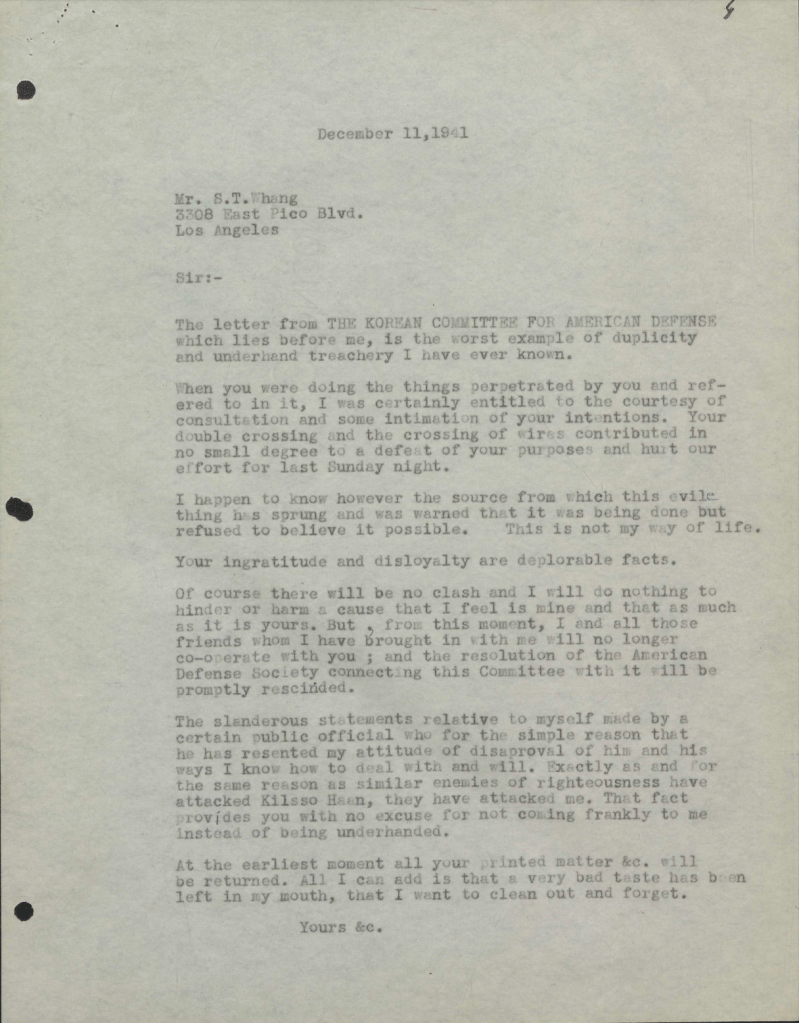
The letter from THE KOREAN COMMITTEE FOR AMERICAN DEFENSE which lies before me, is the worst example of duplicity and underhand treachery I have ever known.
When you were doing the things perpetrated by you and refered [sic] to in it, I was certainly entitled to the courtesy of consultation and some intimation of your intentions. Your double crossing and the crossing of wires contributed in no small degree to a defeat of your purposes and hurt our effort for last Sunday night.
I happen to know however the source from which this vile thing has sprung and was warned that it was being done but refused to believe it possible. This is not my way of life.
Your ingratitude and disloyalty are deplorable facts.
Of course there will be no clash and I will do nothing to hinder or harm a cause that I feel is mine and that as much as it is yours. But , [sic] from this moment, I and all those friends whom I have brought in with me will no longer co-operate with you ; [sic] and the resolution of the American Defense Society connecting this Committee with it will be promptly rescinded.
The slanderous statements relative to myself made by a certain public official who for the simple reason that he has resented my attitude of disapproval of him and his ways I know how to deal with and will. Exactly as and for the same reason as similar enemies of righteousness have attacked Kilsoo Haan, they have attacked me. That fact provides you with no excuse for not coming frankly to me instead of being underhanded.
At the earliest moment all your printed matter &c. will be returned. All I can add is that a very bad taste has been left in my mouth, that I want to clean out and forget.
Yours &c.
Mr. Sung Tack Whang was the chairman of Korean Committee to Aid U.S. National Defense, and it appears that he was considered an executive and treasurer of Nathaniel’s American Committee to Aid Korean Refugees in China. It would seem that during the “A Night in Korea” benefit, Whang had done some espionage, or at least a few of the members of his organization had gone undercover. If Nathaniel felt “entitled to be informed”, it was only because it would appear that his Committee, American Defense Society was associated with Whang’s Korean Committee for American Defense, therefore creating a Committee to aid both Koreans in China and in America. However, it appears that Whang was only concerned about Koreans within the U.S.
Despite the hardships that Nathaniel and Sonia and their Committee faced during the production of this benefit, it is clear that those they were seeking to uplift, and aid were deeply moved by their efforts. To Nathaniel, the appreciation of the Koreans outweighed anything the naysayers sought to do against his pursuit in doing good for others.

Letter Source: Sonia H. and Nathaniel A. Davis papers (MS.2021.003), Series 2. Nathaniel A. Davis, 1918 – 1964, Series 2. Subseries. Correspondence, 1931 – 1948, Box 1, Folder 39 1940 – 1941, John Hay Library, Providence, R.I.
Transcript:
December 10, 1941
Dr. Nathaniel Davis
3916 1/2 So. La Salle
Los Angeles, California
Dear Sir: —
I want to thank you for your spiritual cooperation you have given us Sunday December 7th at the Hollywood American Legion Auditorium, on behalf of the Koreans and American friends. The program was a success indeed.
With just a few words I am sending you my appreciation for your cooperation. Yes indeed! we need all the help from American friends and officially from your government now and in the future.
As you know our Korean people are one hundred percent loyal to your government.
I do hope I can be fit of service to your government and be of assistant [sic] to him anytime. Also every Korean shall be glad to serve him now and in the future to come.
Thanking you again I am,
Respectfully yours,
S.C. Ahn
Prejudices continued to surround Koreans. Specifically, the notion that Koreans were still to be considered Japan’s subjects, or to be one in the same in terms of ethnicity. Sadly, after the attack on Pearl Harbor, discrimination sprung against Asian ethnicities, regardless if they were Japanese or not. When finances and businesses were confiscated from Japanese citizens, thousands of which were interned in military-style camps, Koreans were also very likely thrown into this surge of confusion. (National Park Service) Nathaniel and Sonia continued to fight alongside Kilsoo to make distinctions clear:
Just before World War II was brewing, all the Japanese were treated as aliens and had to give up their markets and shops and were sent to concentration camps. The Koreans, too, began to be treated like an enemy. Their money and industries were impounded, but Nathaniel had written to Henry Morgenthau Jr. and assured him that the Koreans were not Japanese, and they were willing to fight on the side of the United States. Their money and property were restored to the Koreans.
Sonia H. Davis, Two Hearts That Beat as One, p. 180.
Nathaniel, indeed, wrote to Henry Morgenthau:

Letter Source: Sonia H. and Nathaniel A. Davis papers (MS.2021.003), Series 2. Nathaniel A. Davis, 1918 – 1964, Series 2. Subseries. Correspondence, 1931 – 1948, Box 1, Folder 35 1941 – 1942, John Hay Library, Providence, R.I.
Transcript:
December 9, 1941
Hon. Henry F. Morgenthau
United States Treasurer
Washington, D.C.
My dear Mr. Morgenthau:
I have just come from a conference with Hon. Wm. Fleet Palmer, U.S. Attorney, in this city, with regard to a certain matter which he thinks should be referred to you.
The Koreans are by no means to be considered either as Japanese or friendly to Japan. Their status is defined in an Act of Congress recently adopted which classifies them as Koreans and not Japanese so that they carry identification cards as Koreans. They are most decidedly loyal to America beyond all question. It is, therefore, deplorable that an order of the President freezing Japanese assets has been applied in this city to Koreans whose businesses have been closed and whose bank accounts have been seized.
We hope that your good offices with the President may lead to a modification of the order so that this great hardship shall not be imposed unjustly upon our good Korean friends. I am sure that you will see at once the importance of this matter and give it your heartiest and best attention.
Yours sincerely,
Kilsoo had previously written to Henry Morgenthau on this very subject as well:

Letter Source: Kilsoo Haan Papers (MS.151), 1933 – 1973, Correspondence, 1933 – 1975, Box – Folder 2:2 1941, McHenry Library, Santa Cruz, CA.
Transcript:
MAR 10 1941
Dear Sir:
Reference is made to your letter of February 27, 1941.
I regret to advise you that this Department is not in a position to answer your inquiry since it is not felt to be appropriate to anticipate courses of action to be followed in hypothetical situations.
Very truly yours,
J.W. Pehle,
Assistant to the Secretary.
Mr. Kilsoo K. Haan,
Washington Representative,
Sino-Korean Peoples’ League,
101 D Street, N.E.,
Washington, D.C.
Hon. Henry Morgenthau Jr.
Secretary, U.S. Treasury
Washington, D.C.
Honorable Sir:
In view of the precarious situation which exists in the Pacific area, and in view of the strained relations between the Imperial Government of Japan and the United States, the Sino-Korean Peoples’ League requests that your Department help us to clarify some of the apprehensions which exist among the Korean people in the Hawaiian Islands and in America. We understand if and when America freezes all the Japanese financial holdings or confiscates the Japanese financial holdings in the event of war, all such properties and financial holdings belonging to the Koreans too may be frozen or confiscated [sic]
May we humbly request that the Department of Treasury take the attitude of sympathetic understanding and refrain from freezing or confiscating the financial holdings of the Koreans in America even though internationally speaking, we are subject race to Japan?
Last August 19th, the Justice Department Director of Registration, Hon. Earl G. Harrison, ruled Koreans can register as Koreans and not as Japanese subjects when registering under the Alien Registration Act.
We humbly plead that your Department give us the same consideration and rule that the Koreans are Koreans and not to be considered as Japanese, hence the Korean properties and holdings to be exempted from freezing or confiscation.
Years 1941 – 1942


Letter Source: Sonia H. and Nathaniel A. Davis papers (MS.2021.003), Series 2. Nathaniel A. Davis, 1918 – 1964, Series 2. Subseries. Correspondence, 1931 – 1948, Box 1, Folder 39 1940 – 1941, John Hay Library, Providence, R.I.
Transcript:
May 7, 1941
My dear Dr. Davis:
Today the State Department told me to come over:
The Control Dept. in charge of all matters relating to alien-registration of raising money—propaganda and etc. After going over the papers you and Attorney sent—I was told that any money raised here in America for China or refugees in China need not need permit from the State-Department. [sic] He believe [sic] if the American Committee meet such regulation of the City of L.A. or the State law it is sufficient.
Another reason is that U.S.A—do not consider China as a “belligerent—hence this Committee need no permit nor register.
Kindly I am told that since The Defense Society has become the principle and that the American Committee is not a Foreign [sic] principle—he thinks such method of raising fund is not contrary to the law—June 1938—as amended.
He asked me to tell you to write the Social Service Dept. of L.A. that the American Committee under the situation need no permit or register in the State Department.
He further told me to have the Social Service Dept of L.A. to write to the State Dept. Control Bureau and have it verified.
Gratefully yours
Kilsoo K. Haan

Letter Source: Sonia H. and Nathaniel A. Davis papers (MS.2021.003), Series 2. Nathaniel A. Davis, 1918 – 1964, Series 2. Subseries. Correspondence, 1931 – 1948, Box 1, Folder 39 1940 – 1941, John Hay Library, Providence, R.I.
Transcript:
May 12, 1941
My dear Dr. Davis:
I am enclosing clipping of Senate Joint Resolution, No. 15
Regarding Crescent City.
Your letter to Secretary Knox also have been received.
There have been close study of all appointment, I believe you have a good chance—so don’t rush them—I shall do my best—please be assured I will do so.
Kindly convey my best regards to all my friends there.
Very Sincerely Yours
Kilsoo Haan

Letter Source: Sonia H. and Nathaniel A. Davis papers (MS.2021.003), Series 2. Nathaniel A. Davis, 1918 – 1964, Series 2. Subseries. Correspondence, 1931 – 1948, Box 1, Folder 35 1941 – 1942, John Hay Library, Providence, R.I.
Transcript:
Dear friend Haan: —
This morning I received the cutting you sent me from the Washington News of December 11. Not only is the story interesting, but it is most gratifying to see that you are getting press recognition in D.C. for the superb work you have done. More power to you.
I have an uncanny feeling of relief today as I have shaken myself free from the political schemings that have caused us so much annoyance here. I knew it was going on all the time, but could do nothing to stop it. To Mrs. Davis and myself it meant nothing because we have ready means for personal defense and many friends who have known us both for half a century and we can afford to laugh at slanderers for that reason. But these disturbances within Korean ranks are bad. They are dynamitic in their menace to our hopes for right world adjustment. It is too bad that there are so many “purse” patriots, and self seeking [sic] parasites who care for nothing but self and would not dare do the things you have done. It was fear lest the cause of Korea might be hurt that made me stand for it and keep still until the thing came to a head. I have been very fortunate in that so little of that sort has ever plagued me. And when I think of all you have gone through and the black libels that have been hurled at you, libels that made some of your friends in L.A. come to me to ask if these stories were true, my annoyances seem as chaff.
Incidentally, I am personally acquainted with the real men in control of all the Los Angeles papers, including the Republican press. That which you want to get through that way I can handle. But when that is your wish, always send me your instructions or a “release”, so that I have authority and also to prevent the crossing of wires. This also goes for officialdom in general. In regard to Korean matters you, to me, are CHIEF. Give your orders.
We will follow instructions.
As ever,
Letter Source: Sonia H. and Nathaniel A. Davis papers (MS.2021.003), Series 2. Nathaniel A. Davis, 1918 – 1964, Series 2. Subseries. Correspondence, 1931 – 1948, Box 1, Folder 35 1941 – 1942, John Hay Library, Providence, R.I.
Transcript:
Dear friend Haan: —
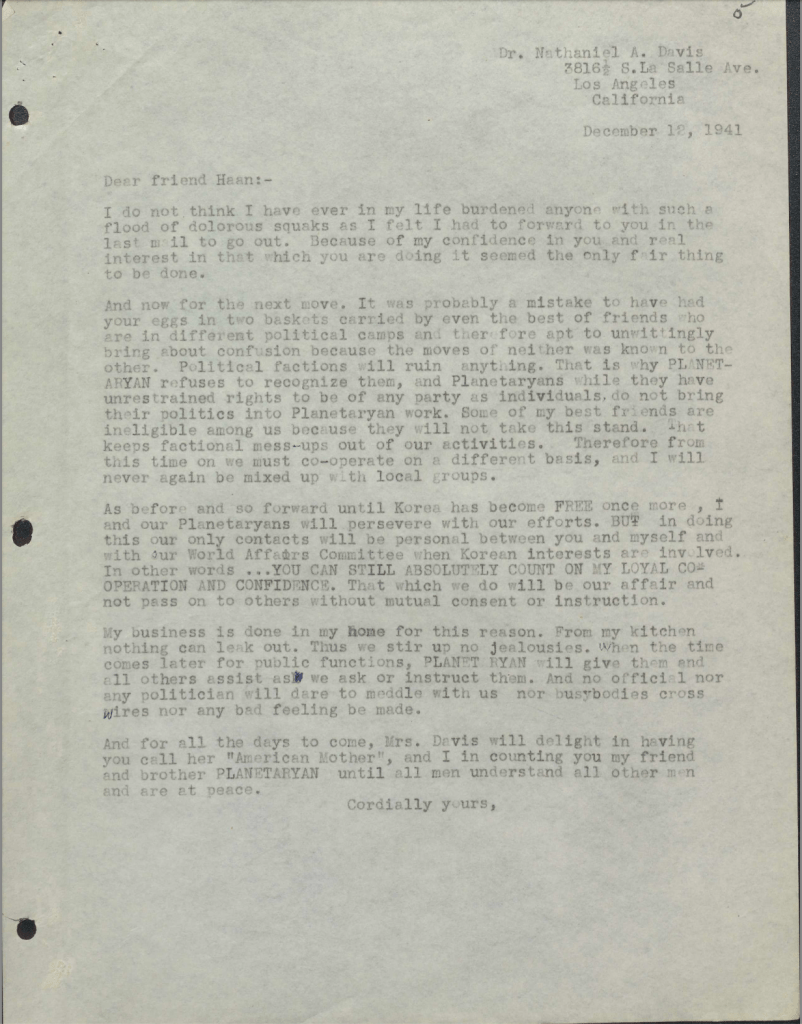
I do not think I have ever in my life burdened anyone with such a flood of dolorous squaks [sic] as I felt I had to forward to you in the last mail to go out. Because of my confidence in you and real interest in that which you are doing it seemed the only fair thing to be done.
And now for the next move. It was probably a mistake to have had your eggs in two baskets carried by even the best of friends who are in different political camps and therefore apt to unwittingly bring about confusion because the moves of neither was known to the other. Political factions will ruin anything. That is why PLANETARYAN refuses to recognize them, and Planetaryans while they have unrestrained rights to be of any party as individuals, do not bring their politics into Planetaryan work. Some of my best friends are ineligible among us because they will not take this stand. That keeps factional mess-ups out of our activities. Therefore from this time on we must co-operate on a different basis, and I will never again be mixed up with local groups.
As before and so forward until Korea has become FREE once more , [sic] I and our Planetaryans will persevere with our efforts. BUT in doing this our only contacts will be personal between you and myself and with our World Affairs Committee when Korean interests are involved. In other words …YOU [sic] CAN STILL ABSOLUTELY COUNT ON MY LOYAL CO-OPERATION AND CONFIDENCE. That which we do will be our affair and not pass on to others without mutual consent or instruction.
My business is done in my home for this reason. From my kitchen nothing can leak out. Thus we stir up no jealousies. When the time comes later for public functions, PLANETARYAN will give them and all others assist as we ask or instruct them. And no official nor any politician will dare to meddle with us nor busybodies cross wires nor any bad feeling be made.
And for all the days to come, Mrs. Davis will delight in having you call her “American Mother”, and I in counting you my friend and brother PLANETARYAN until all men understand all other men and are at peace.
Cordially yours,

Letter Source: Sonia H. and Nathaniel A. Davis papers (MS.2021.003), Series 2. Nathaniel A. Davis, 1918 – 1964, Series 2. Subseries. Correspondence, 1931 – 1948, Box 1, Folder 39 1940 – 1941, John Hay Library, Providence, R.I.
Transcript:
DR NATHANIEL A DAVIS=
3816 1/2 SOUTH LASALLE=
RUSH AIR MAIL YOUR LATEST CORRESPONDENCE REPLIES WITH GAR DEPT AND GILLETTE REGARD CRESCENTCITY [sic] HAVE APPEALED FOR ACTION ALOHA=
KILSOO HAAN.
Letter Source: Sonia H. and Nathaniel A. Davis papers (MS.2021.003), Series 2. Nathaniel A. Davis, 1918 – 1964, Series 2. Subseries. Correspondence, 1931 – 1948, Box 1, Folder 35 1941 – 1942, John Hay Library, Providence, R.I.
Transcript:
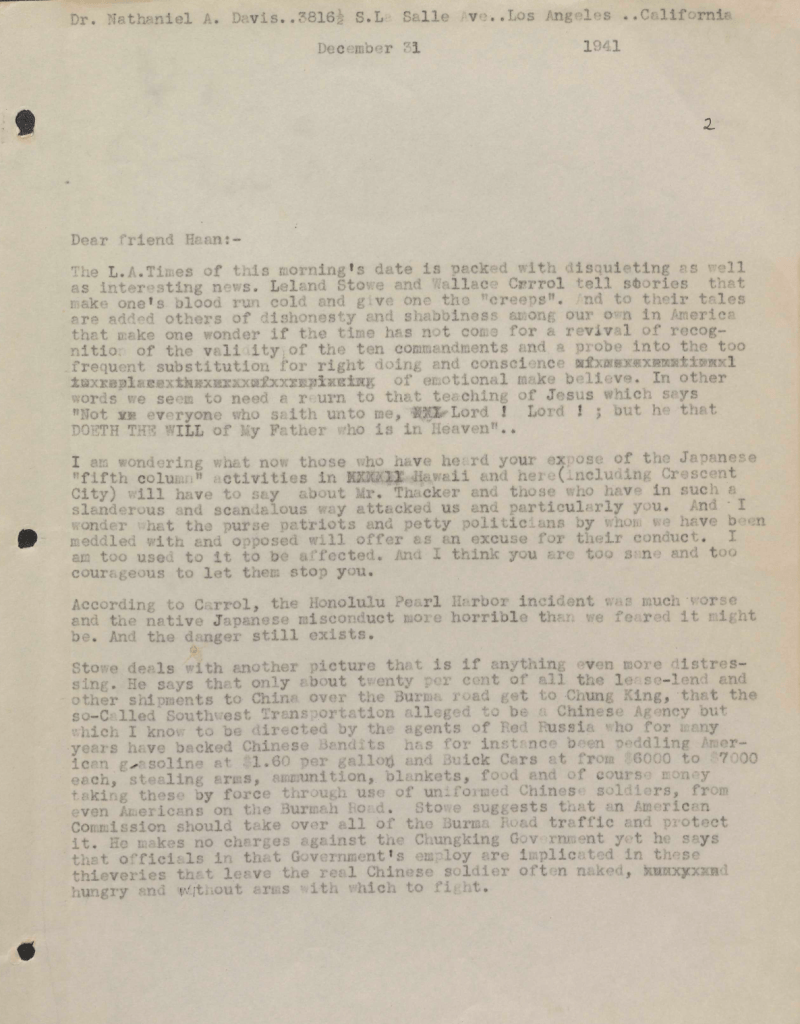
December 31, 1941
Dear friend Haan: —
The L.A.Times of this morning’s date is packed with disquieting as well as interesting news. Leland Stowe and Wallace Carrol tell stories that make one’s blood run cold and give one the “creeps”. And to their tales are added others of dishonesty and shabbiness among our own in America that make one wonder if the time has not come for a revival of recognition of the validity of the ten commandments and a probe into the too frequent substitution for right doing and conscience of emotional make believe. In other words we seem to need a reurn [sic] to that teaching of Jesus which says “Not everyone who saith unto me, Lord! Lord! ; [sic] but he that DOETH THE WILL of My Father who is in Heaven”.. [sic]
I am wondering what now those who have heard your expose of the Japanese “fifth column” activities in Hawaii and here(including [sic] Crescent City) will have to say about Mr. Thacker and those who have in such a slanderous and scandalous way attacked us and particularly you. And I wonder what the purse patriots and petty politicians by whom we have been meddled with and opposed will offer as an excuse for their conduct. I am too used to it to be affected. And I think you are too sane and too courageous to let them stop you.
According to Carrol, the Honolulu Pearl Harbor incident was much worse and the native Japanese misconduct more horrible than we feared it might be. And the danger still exists.
Stowe deals with another picture that is if anything even more distressing. He says that only about twenty per cent of all the lease-lend and other shipments to China over the Burma road get to Chung King, that the so-Called Southwest Transportation alleged to be a Chinese Agency but which I know to be directed by the agents of Red Russia who for many years have backed Chinese Bandits has for instance been peddling American gasoline at $1.60 per gallon and Buick Cars at from $6000 to $7000 each, stealing arms, ammunition, blankets, food and of course money taking these by force through use of uniformed Chinese soldiers, from even Americans on the Burmah Road. Stowe suggests that an American Commission should take over all of the Burma Road traffic and protect it. He makes no charges against the Chungking Government [sic] yet he says that officials in that Government’s employ are implicated in these thieveries that leave the real Chinese soldiers often naked, hungry and without arms with which to fight.
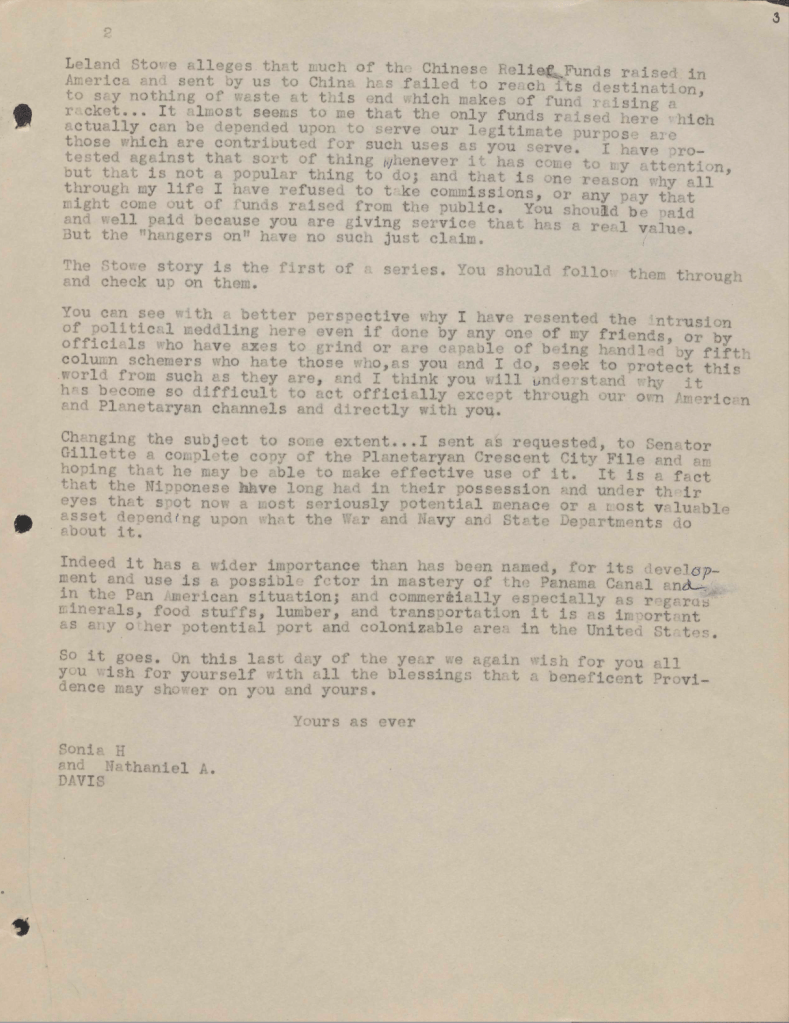
Leland Stowe alleges that much of the Chinese Relief Funds raised in America and sent by us to China has failed to reach its destination, to say nothing of waste at this end which makes of fund raising a racket… It almost seems to me that the only funds raised here which actually can be depended upon to serve our legitimate purpose are those which are contributed for such uses as you serve. I have protested against that sort of thing whenever it has come to my attention, but that is not a popular thing to do; and that is one reason why all through my life I have refused to take commissions, or any pay that might come out of funds raised from the public. You should be paid and well paid because you are giving service that has a real value. But the “hangers on” have no such just claim.
The Stowe story is the first of a series. You should follow them through and check up on them.
You can see with a better perspective why I have resented the instruction of political meddling here even if done by any one of my friends, or by officials who have axes to grind or are capable of being handled by fifth column schemers who hate those who,as [sic] you and I do, seek to protect this world from such as they are, and I think you will understand why it has become so difficult to act officially except through our own American and Planetaryan channels and directly with you.
Changing the subject to some extent…I sent as requested, to Senator Gillette a complete copy of the Planetaryan Crescent City File and am hoping that he may be able to make effective use of it. It is a fact that the Nipponese have long had in their possession and under their eyes that spot now a most seriously potential menace or a most valuable asset depending upon what the War and Navy and State Department do about it.
Indeed it has a wider importance than has been named, for its development and use is a possible fctor [sic] in mastery of the Panama Canal and in the Pan American situation; and commercially especially as regard minerals, food stuffs, lumber, and transportation it is as important as any other potential port and colonizable area in the United States.
So it goes. On this last day of the year we again wish for you all you wish for yourself with all the blessings that a beneficent Providence may shower on you and yours.
Yours as ever
Sonia H
and Nathaniel A.
DAVIS

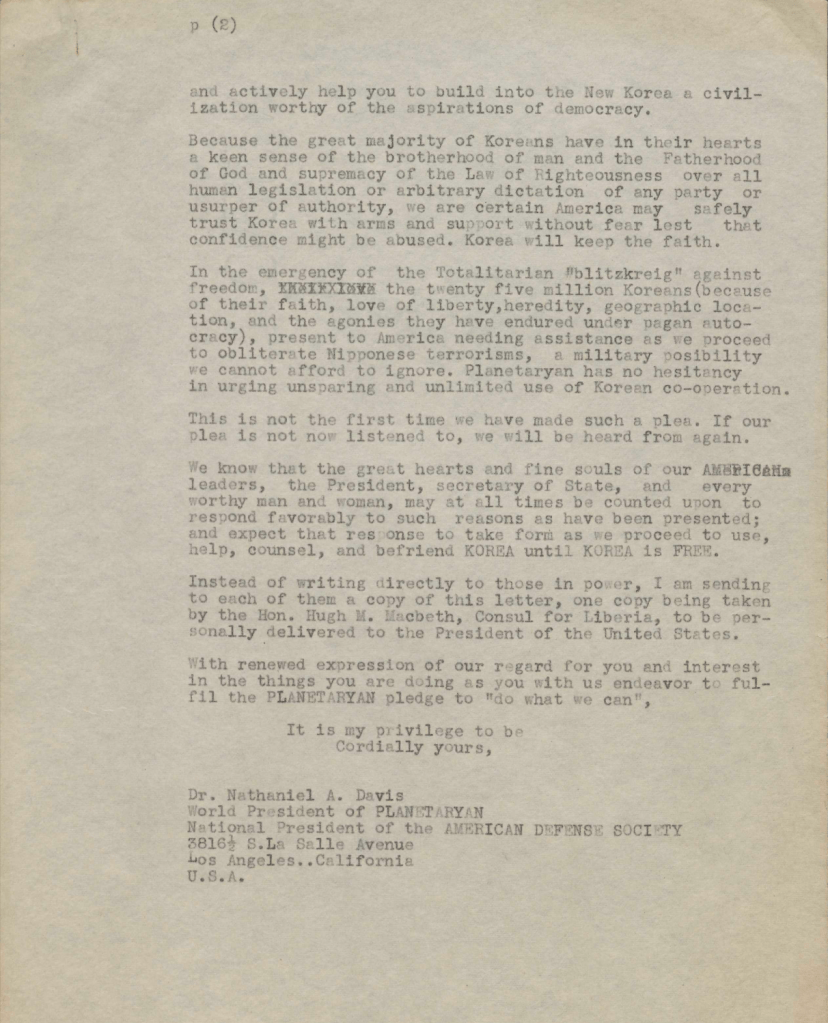
Letter Source: Sonia H. and Nathaniel A. Davis papers (MS.2021.003), Series 2. Nathaniel A. Davis, 1918 – 1964, Series 2. Subseries. Correspondence, 1931 – 1948, Box 1, Folder 35 1941 – 1942, John Hay Library, Providence, R.I.
Transcript:
May 11…..1942
Mr. Kilsoo K. Haan
Representative of the
Sino-Korean League
Washington.. D.C. [sic]
My dear Mr. Haan: —
I have before me a copy of your official letter to the Hon. Cordell Hull, Secretary of State, bearing date May 5. 1942, and have studied that communication, its wording, implications, and plea,carefully [sic] because as you well know,PLANETARYAN [sic] has formally made the Korean cause its own. As World President of this great organization,it [sic] is my privilege to renew to you and your compatriots our pledge not to cease co-operation with you until Korea has been freed from the pagan blight of Japanese oppression.
You, as a member of our World Affairs Committee, know that we have used all the influence at our disposal on behalf of Korea. We have written many letters to the President of the United States, members of the Presidential Cabinet,members [sic] of Congress, the Prime Minister of Great Britain, and others and have given time and effort to serve your distressed and worthy people. To aid them,we, [sic] who are Americans, are bound by treaty obligations,national [sic] and political interest, in world peace and imperilled [sic] democracy. We have not lessened our participation nor will we until Korea has regained its ancient dignity as an integral member of the fraternity of free peoples.
We understand ( and [sic] because of my good fortune in having visited your fatherland and through many years studied its conditions, I think I understand) your problems and the spirit in which you are endeavoring to deal with them.
We also understand that the dangers Korea faces from subversive and selfish elements seeking to disrupt your phalanx and prevent Korea from ridding itself from feudalism on one hand and radicalism on the other, are identical with similar dangers menacing America today. These facts do not lessen but do increase the strength of your argument that our own mighty democracy must stand with and for Korean liberation, and actively help you build into the New Korea a civilization worthy of the aspirations of democracy.
Because the great majority of Koreans have in their hearts a keen sense of the brotherhood of man and the Fatherhood of God and supremacy of the Law of Righteousness over all human legislations or arbitrary dictation of any party or usurper of authority, we are certain America may safely trust Korea with arms and support without fear lest that confidence might be abused. Korea will keep the faith.
In the emergency of the Totalitarian “Blitzkreig” against freedom, the twenty five million Koreans (because of their faith, love of liberty,heredity, [sic] geographic location, and the agonies they have endured under pagan autocracy), present to America needing assistance as we proceed to obliterate Nipponese terrorisms, a military posibility [sic] we cannot afford to ignore. Planetaryan has no hesitancy in urging unsparing and unlimited use of Korean co-operation.
This is not the first time we have made such a plea. If our plea is not now listened to, we will be heard from again.
We know that the great hearts and fine souls of our AMERICAN leaders, the President, secretary [sic] of State, and every worthy man and woman, may at all times be counted upon to respond favorably to such reasons as have been presented; and expect that response to take form as we proceed to use, help, counsel, and befriend KOREA until KOREA is FREE.
Instead of writing directly to those in power, I am sending to each of them a copy of this letter, one copy being taken by the Hon. Hugh M. Macbeth, Consul for Liberia, to be personally delivered to the President of the United States.
With renewed expression of our regard for you and interest in the things you are doing as you with us endeavor to fulfill the PLANETARYAN pledge to “do what we can”,
It is my privilege to be
Cordially yours,
Dr. Nathaniel A. Davis
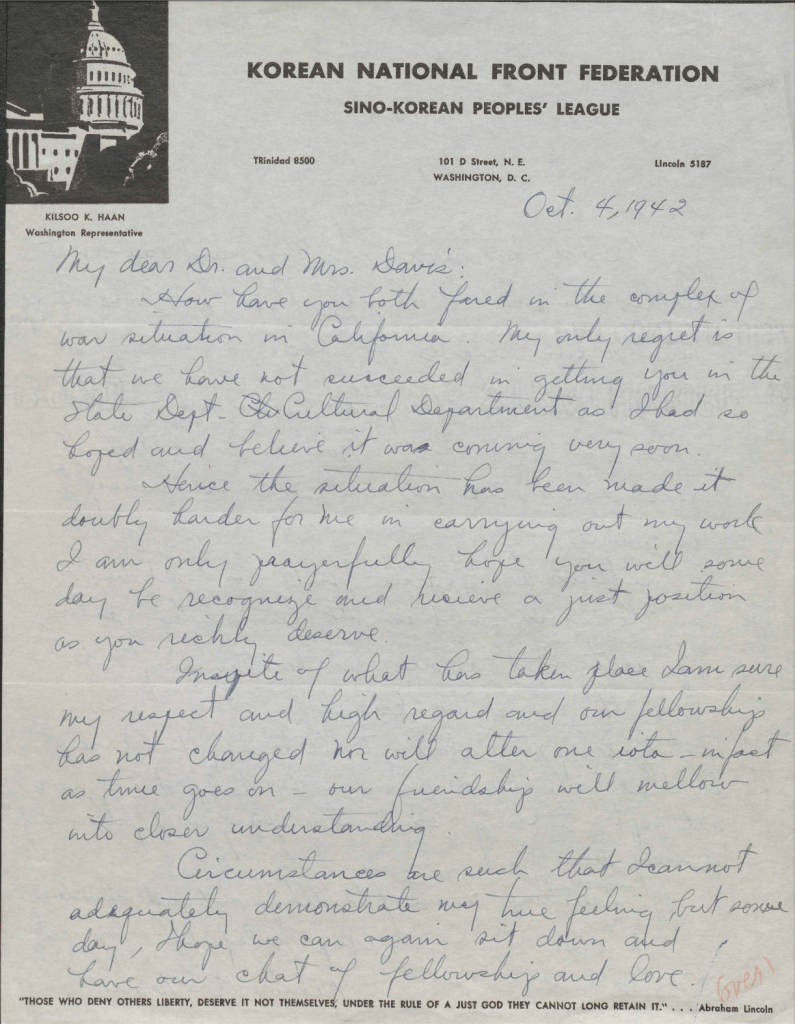

Letter Source: Sonia H. and Nathaniel A. Davis papers (MS.2021.003), Series 2. Nathaniel A. Davis, 1918 – 1964, Series 2. Subseries. Correspondence, 1931 – 1948, Box 1, Folder 40 1942 – 1948, John Hay Library, Providence, R.I.
Transcript:
Oct. 4, 1942
My dear Dr. and Mrs. Davis:
How have you both fared in the complex of war situation in California. My only regret is that we have not succeeded in getting you in the State Dept. Cultural Department as I had so hoped and believe it was coming very soon.
Hence the situation has been made it doubly harder for me in carrying out my work I am only prayerfully hope you will some day be recognize and receive a just position as you richly deserve.
In spite of what has taken place I am sure my respect and high regard and our fellowship has not changed nor will alter one iota—in fact as time goes on—our friendship will mellow into closer understanding.
Circumstances are such that I cannot adequately demonstrate my true feeling, but some day, I hope we can again sit down and have our chat of fellowship and love.
Please do convey my love and aloha to Mother Davis—I always have and will have my warm regards for her.
Whatever be the fate of our war in the Pacific I am sure God in His high place shall reward all men according to its merits.
Let us have greater faith in God and in the inner goodness of humanity. Justice, equality and human understanding will rule this world eventually.
Convey my aloha to Attorney Andrews, and to all the kind friends who helped us in our attempt to bring understanding and fellowship among men.
Trusting to our friendship and understanding
Very gratefully yours
Kilsoo K. Haan
It’s unclear if the letter of October 4, 1942 was the last of their correspondence. It would have been about this time that Nathaniel would’ve began his long battle with squamous cell carcinoma on his left leg and would pass away on April 6, 1945. What is also unclear is if Sonia ever informed Kilsoo of Nathaniel’s passing. It is quite possible that a correspondence solely between Kilsoo and Sonia never sprung up, especially given, that after Nathaniel’s death, she would revisit her life as the former Mrs. Lovecraft.
Even so, Sonia never stopped sharing her testimony of her friendship with Kilsoo, and his feats:
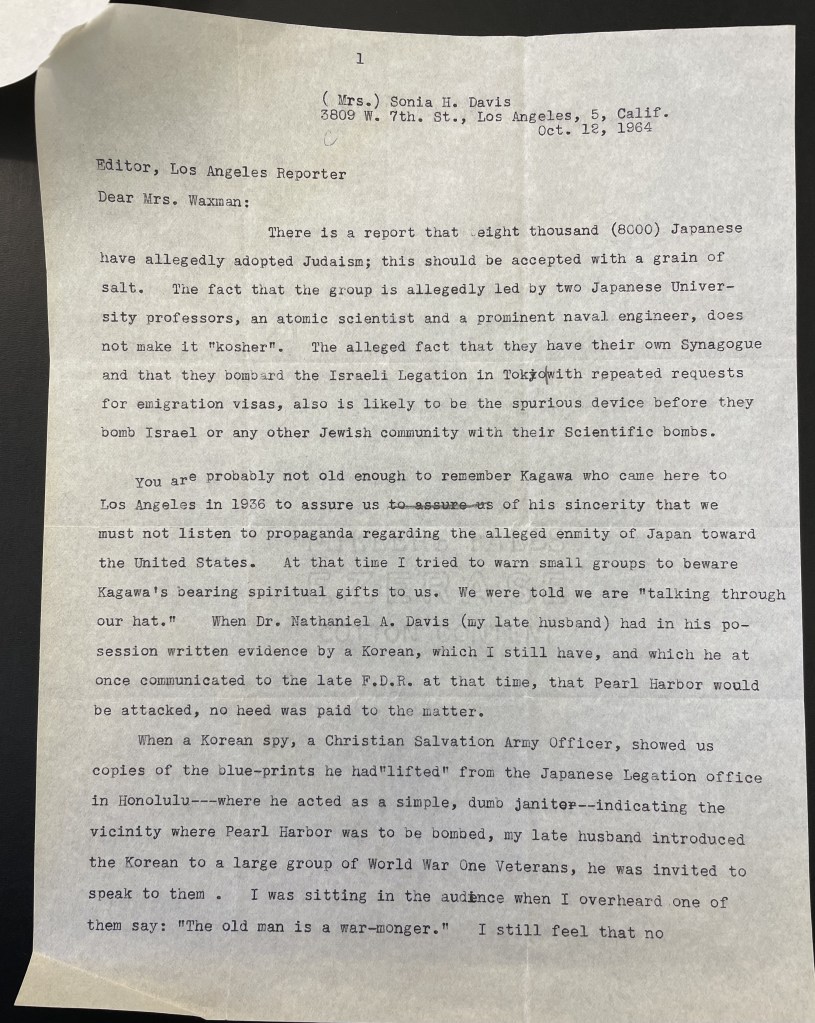

Letter Source: Sonia H. and Nathaniel A. Davis papers (MS.2021.003), Series 1. Sonia H. Davis, 1922 – 1971, Series 1. Subseries. Correspondence, 1938 – 1971, Box 1, Folder 1 1944 – 1970, John Hay Library, Providence, R.I.
Transcript:
Oct. 12, 1964
Editor, Los Angeles Reporter
Dear Mrs. Waxman:
There is a report that eight thousand (8000) Japanese have allegedly adopted Judaism; this should be accepted with a grain of salt. The fact that the group is allegedly led by two Japanese University professors, an atomic scientist and a prominent naval engineer, does not make it “kosher”. The alleged fact that they have their own Synagogue and that they bombard the Israeli Legation in Tokyo with repeated requests for emigration visas, also is likely to be the spurious device before they bomb Israel or any other Jewish community with their Scientific bombs.
You are probably not old enough to remember Kagawa who came here to Los Angeles in 1936 to assure us to assure us of his sincerity that we must not listen to propaganda regarding the alleged enmity of Japan toward the United States. At that time I tried to warn small groups to beware Kagawa’s bearing spiritual gifts to us. We were told we are “talking through our hat.” When Dr. Nathaniel A. Davis (my late husband) had in his possession written evidence by a Korean, which I still have, and which he at once communicated to the late F.D.R. at that time, that Pearl Harbor would be attacked, no heed was paid to the matter.
When a Korean spy, a Christian Salvation Army Officer, showed us copies of the blue-prints he had“lifted” [sic] from the Japanese Legation office in Honolulu—where he acted as a simple, dumb janitor—indicating the vicinity where Pearl Harbor was to be bombed, my late husband introduced the Korean to a large group of World War One Veterans, he was invited to speak to them . [sic] I was sitting in the audience when I overheard one of them say: “The old man is a war-monger.” I still feel that no Oriental can be trusted.
Do you remember the Gibeonites who came to Joshua in rags, carrying stale bread in their sacks, their sandles [sic] dusty, unkempt; when he asked their spokesman who they were and where they came from, he replied: “We are come [sic] from a far country; now therefore make ye a covenant with us. From a far country thy servants ARE come because of the name of thyLord [sic] thy God; for we have heard the fame of HIM, etc, How analogous of the Japanese desire to join the Jewish faith! Joshua, chapter 9, 3 –12.
At that time another group lent itself to a similar purpose; Stalin sent emmisaries [sic] for a similar purpose. Thousands of small groups were inveigled into starting up Peace Clubs by the American communists; all in the name of Peace, while both Japanese and Communists were arming to the teeth.
Also, you will remember—if you were old enough—that Admiral K. Nomuro, [sic] who was visiting the United States, called on the late F.D.R. a few days before the Pearl Harbor incident and pledged the sincerest friendship of his government for that of ours. No sooner had he mounted his plane than Pearl Harbor was struck. Need more be said?
S.H.
At the end of all, Kilsoo Kenneth Haan was a person who sought equality for his people and safety for those he was most loyal. It’s a real shame not much, in terms of scholarship material about Kilsoo, has been published. He had a devastating truth that no one cared to listen to, in which lives paid the price for it, and even to this day, much of his life is left to obscurity. I can only hope that through this post, a light has been shed on the incredible friendship of the milliner and the spy.
God is with us and so long I am on His side I know I will win.
Kilsoo Haan to Nathaniel and Sonia Davis, March 28, 1939, John Hay Library, R.I.
Additional Sources:
A televised interview with Mistuo Fuchida that Sonia might’ve likely watched: Architect of Pearl Harbor Attack
Biographical Overview of Kilsoo Haan: Kilsoo Haan | Densho Encyclopedia
 The Papers of Sonia H. Davis
One response to “The Milliner and the Spy”
[…] and Alfred Galpin, her time as a historical researcher, and her friendship with a Korean spy, Kilsoo Kenneth Haan. The posts of 2024 were a remarkable bunch that covered an array of points that normally get […]
LikeLike